Retro Television Review: St. Elsewhere 2.7 “Entrapment”


Welcome to Retro Television Reviews, a feature where we review some of our favorite and least favorite shows of the past! On Fridays, I will be reviewing St. Elsewhere, a medical show which ran on NBC from 1982 to 1988.  The show can be found on Hulu and, for purchase, on Prime!
This week, Peter’s in trouble …. again!

Episode 2.7 “Entrapment”

(Dir by Mark Tinker, originally aired on December 7th, 1983)

Oh, that Peter White!  Always in trouble for something!

This week, a woman comes into the Emergency Room with her baby and begs for some Seconal, just to help her get some sleep.  Peter says that Seconal might be too powerful a drug but he’s moved by the woman’s pleas.  Finally, he gives her the drugs.  The next morning, Dr. Craig and Dr. Westphall get a call.  The woman was an undercover cop and now, Dr. White — a recovering drug addict himself — is under investigation.

Both Dr. Craig and Dr. Auschlander think that the solution is to just kick Peter out of the hospital.  Westphall disagrees, saying that Peter has come a long way since he completed rehab.  Westphall promises Peter that he and Auschlander will support him when his hearing comes up.

As for Dr. Craig, he finally found out that his secret admirer was Kathy Martin.  This led to Ellen Craig (played by Bonnie Bartlett, William Daniels’s real-life wife) heading down to the morgue and politely telling Kathy to stay away from her man before then mentioning that, if politeness hadn’t worked, she was prepared to beat Kathy up.  I love Ellen.  She’s one of the best characters on the show.

Meanwhile, Irish kid Eddie Carson (Eric Stoltz), who was admitted to the hospital last week, is upset because he’s going to have a big ugly scar on his face.  He’ll probably be even more upset when he discovers that a rival Irish teenager (a protestant, naturally) planted a bomb in his family’s restaurant and blew up his parents.

This was an okay episode.  The highlight was definitely Ellen confronting Kathy Martin.  As for the other storylines, Eddie Carson’s story felt a bit contrived while Peter White’s story was just getting started.  I assume the hearing will be next week.  It’s interesting to see Peter as the victim for once.  Usually, it’s his own stupidity that screws things up for him.  This week, he really was unfairly targeted.

We’ll see what happens next week.
Horror Film Review: Angel Heart (dir by Alan Parker)


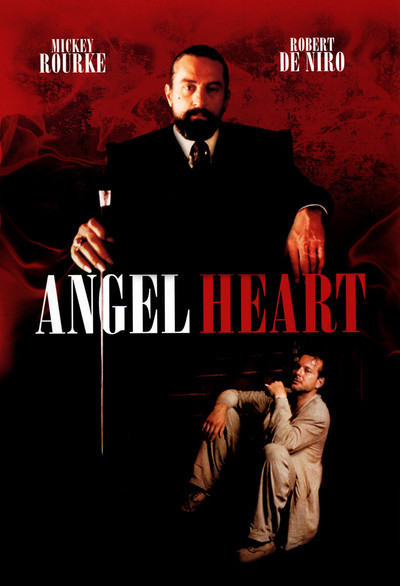
First released in 1987 and set in 1955, Angel Heart tells the story of Harry Angel (Mickey Rourke).

With a name like Harry Angel, it’s perhaps not surprising that Harry is a private investigator.  Harry operates out of New York.  He’s got a shabby apartment.  He wears wrinkled clothes.  He rarely shaves.  He smokes almost constantly.  (In a rare moment of comedy, the camera catches Harry blithely emptying a full ashtray in the middle of the street.)  Harry looks like he reeks of tobacco, beer, sweat, and lost dreams.  And yet, it’s difficult not to like Harry.  He’s got a charming smile, even if his face is often bruised from his latest beating.  He speaks in a low whisper and it’s hard not to get the feeling that Harry is actually kind of shy.  He’s incredibly sleazy but there’s something about him that just makes the viewer want to take care of him.

Harry is hired by a mysterious man named Louis Cyphere (Robert De Niro, cheerfully overacting).  Louis wants Harry to track down a singer named Johnny Favor.  As Cyphere explains it, he did a favor for Johnny and Johnny has yet to pay Cyphere what he owes.  Johnny has been suffering from PTSD ever since he served in World War II.  When last seen, Johnny was receiving electroshock treatment in an upstate hospital.

Harry’s search for Johnny leads him into an increasingly complex and disturbing conspiracy.  He meets a doctor who is addicted to morphine and, when the doctor turns up dead, Harry coolly uses the dead man’s shoe to light his match.  Eventually, Harry’s investigation leads him to New Orleans, where he meets both Johnny’s wife (Charlotte Rampling) and Johnny’s unacknowledged daughter, Epiphany (Lisa Bonet).  As Harry searches for Johnny, he deals with strange visions of his own mysterious past.  He sees himself wandering around Times Square shortly after the attack on Pearl Harbor.  Harry also finds himself having to deal with the fact that almost everyone that he talks to ends up being brutally murdered.  Every time that Harry tries to quit the case, Cyphere offers him more money.  (Cyphere tends to show up whenever Harry finds himself on the verge of abandoning his search.)

Angel Heart moves at its own deliberate pace.  In fact, the first hour can feel a bit slow but that first hour definitely pays off during the second half of the film.  By the time that Harry starts to truly uncover what has happened to Johnny, the audience actually cares about Harry and is actually worried about what’s going to happen to him when he reaches the end of the case.  Mickey Rourke was (and is) an eccentric actor but he’s at his most effective in Angel Heart.  A lesser actor would have just played Harry as being a typical hardboiled detective.  Rourke plays Harry as being a lost soul, a vulnerable man who is often as confused and scared as the people that he’s looking for.  By the end of the film, Harry realizes that the answer to the mystery was right in front of them and his look of despair is surprisingly powerful.  If De Niro gives a good performance that is almost totally on the surface, Rourke gives the type of performance that allows the audience to explore what’s going on beneath the surface of a character who many would initially view as being a cliché.  Mickey Rourke’s Harry Angel is right up there with Bogart’s Sam Spade and Jack Nicholson’s Jake Gittes.  He’s a familiar character who also seems to be a human being.

Full of sex, violence, and increasingly disturbing imagery, Angel Heart is not for everyone.  Alan Parker’s direction emphasizes the darkness of Harry’s world and the bleakness of his situation.  The film ends with a twist that may not be totally unexpected but which is still undeniably disturbing.  The more you think about it, the most disturbing it gets.  Angel Heart is an atmospheric and intelligent chiller.  It’s existential horror at its most nightmarish.

Dead Connection (1994, directed by Nigel Dick)


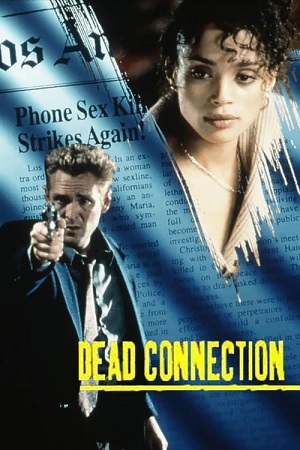
A former boxer and phone sex addict (played by real-life boxer Gary Stretch) is picking up women in Los Angeles, taking them to cheap motels, and beating them to death. Detective Matt Dickson (Michael Madsen, with blonde hair) is a burned out homicide cop who finds himself investigating the murders. It doesn’t take Dickson long to figure out that the killer is using the names of former boxing champs when he checks into the motels. He also figures out that the boxer has phone sex before and after the killing. That’s a lot but it’s not enough to solve the case. To do that, he’ll have to team up with a journalist (played by Lisa Bonet) who has personal reasons for wanting to take down the killer.

Back in the 90s, the main reason that I watched Dead Connection was because I had a hopeless crush on Parker Posey and she was listed as being one of the stars of the film. Parker does appear early on in the film and is just as funny and appealing in her small role as she was in bigger parts in other movies. Unfortunately, Parker gets killed pretty early on in the movie. That traumatized me the first time I saw the movie.

After Parker dies, the main reason to watch the movie is to see what Michael Madsen can do with his clichéd role. It turns out that Madsen can do a lot, even though there’s nothing unusual about the character on paper. Madsen just had the right look and the right style of acting for neo-noirs like this one. Even in a movie like this one, Madsen makes the whispering and the arched eyebrow seem cool and natural. Judging from her performance here, Lisa Bonet should have been a bigger star too. Just as with Madsen, there’s nothing unusual about her role but she still plays it with a lot of conviction.

The main problem with Dead Connection is that it reveals the identity of the killer in the first few minutes and it’s hard to believe that it would take the police a particularly long time to track him down. The minute it was learned that he was using the names of boxers to check into motels, that should have been the end of it for him. Instead, the movie dithers around for a good 90 minutes before finally ending on a predictable note. Despite the script’s flaws, Dead Connection is competently directed by Nigel Dick, who was also responsible for several music videos in the 80s and the 90s. Perhaps that explains why Tears for Fears’s Curt Smith has a tiny role as a desk clerk.

In the U.S., the film was released under the title Dead Connection, playing up the phone sex angle. In Europe, the focus was instead put on the killer’s boxing career and the film was called Final Combination, which made it sound like it was a movie about safecrackers. Neither title is really great but I prefer Dead Connection.