Retro Television Review: St. Elsewhere 2.15 “Attack”


Welcome to Retro Television Reviews, a feature where we review some of our favorite and least favorite shows of the past! On Fridays, I will be reviewing St. Elsewhere, a medical show which ran on NBC from 1982 to 1988.  The show can be found on Hulu and, for purchase, on Prime!
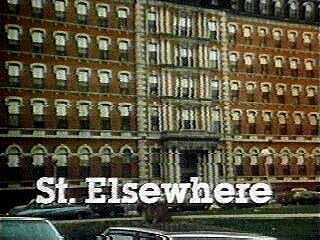
This week, the identity of the Ski Mask Rapist is revealed.

Episode 2.15 “Attack”

(Dir by Kevin Hooks, originally aired on February 22nd, 1984)

The Ski Mask Rapist is continuing to attack.  Off-screen, a pharmacist is assaulted while trying to catch her train.  In the hospital, a candy striper gets lost in the cavernous building and is attacked in a storage room.  When Shirley Daniels enters the storage room, she’s startled by a man wearing a pest control outfit.  She sprays him with her mace but is later told that the police do not believe that he was the rapist.  Instead, he was just a man trying to steal drugs.  When Fiscus tries to put together a list of men who will walk the women to their cars, Dr. Cavanero tells him that one of the men on his list could very well be the rapist.

Amongst themselves, the women who work at St. Eligius debate what they would do if they are attacked.  Shirley carries her mace.  Wendy says that she would use her keys as a weapon.  Jacqueline Wade says that women who don’t struggle and just submit have a better chance of surviving.  Dr. Cavanero dumps her insensitive boyfriend after he offers up a half-hearted, insincere apology for trying to force himself on her during the previous episode.  The head of the hospital’s security gives a lecture and makes the women feel like the attacks are somehow their fault.  “There’s no need to get hysterical,” he says.

(Myself, I carry mace.  I’m always scared that I’ll accidentally spray myself in the face with it but still, I carry it.)

Kathy Martin turns down the offer of a rape whistle, saying that carrying it would give her the aura of a victim.  As the episode ends, she’s attacked in the morgue.  She manages to push up the ski mask, revealing the face of …. Peter White.

It’s not really a surprise that Peter turned out to be the rapist.  I suspected it was him last week.  Rape may be classified as a sex crime but ultimately, it’s about power.  The weakest men are rapists and there’s no man on this show who is weaker than Peter White.  Before Peter attacks Kathy, we see him with a prostitute who tells him that it’s okay that he couldn’t get it up.  Peter mentions that it’s his anniversary.  Peter is weak and, looking back at the the moment he first appeared during the first season (begging Dr. Morrison to cover for him), it’s obvious that the series has been building up to the moment that he loses control.

There were other things that happened during this episode.  Geraldine Fitzgerald played a patient who Auschlander dated in his younger days.  (Now, she’s a drug addict.)  Victor and Roberta returned from their honeymoon, Victor with a painful sunburn and Roberta with a host of problems that she accidentally broadcast to the entire hospital while talking to her friend in the front office.  (You have to make sure the PA is turned off before talking about your sex life, folks.)  There was a humorous scene in which Dr. Ridley got into an argument with Roberta’s psychiatrist (Philip Sterling).  Dr. Morrison tried to figure out why his latest patient (Dan Hedaya) was suffering from sudden bouts of blindness.

In the end, though, this was a grim episode and not always an easy one for me to watch.  Honestly, if I had been a nurse or a doctor at that hospital, I would have walked as soon as it became apparent that the Ski Mask Rapist was someone inside the building.  I would have gone home and refused to come back until they caught the guy.

Kathy saw Peter’s face as he attacked her.  I fear what’s waiting for me on next week’s episode.
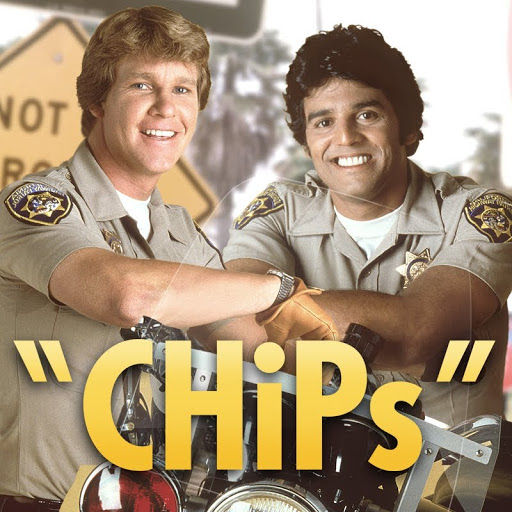
Late Night Retro Television Review: CHiPs 4.9 “Crash Course”


Welcome to Late Night Retro Television Reviews, a feature where we review some of our favorite and least favorite shows of the past!  On Mondays, I will be reviewing CHiPs, which ran on NBC from 1977 to 1983.  The entire show is currently streaming on Prime!

A recently released thief and a bank error are no match for the smiley charisma of Erik Estrada!

Episode 4.9 “Crash Course”

(Dir by Phil Bondelli, originally aired on January 4th, 1981)

Former getaway driver Sonny Matson (Don Stroud) has just been released from prison and he’s fallen back into his old habits.  Everyday, he steals a different car and then robs a different business.  His crimes are getting progressively more bold and Baker is determined to catch him.

Meanwhile, Ponch notices that he has an extra $4,000 in his bank account.  Trying to do the right thing, Ponch reports the discrepancy.  The bank accidentally drains all the money from his account.  With his checks bouncing all over town, Ponch tries to get the bank fix their error.  Good luck with that, Ponch!  Luckily, when one of Sonny’s associates tries to rob the bank, it gives Ponch a chance to play the hero….

It’s The Ponch Show!  Baker may be the one with a personal stake in capturing Sonny but Ponch is the one with big grin and the majority of this episode’s screentime.  Whether he’s thwarting a bank robbery or recruiting all of his co-workers to help him find proof of the bank’s error, Ponch dominates.  Poor Baker.

The best thing about this episode was Don Stroud’s performance as Sonny Matson.  Stroud played a lot of low-level criminals over the course of his career.  With his quick but unfriendly smile, his paranoid eyes, and his cocky attitude, Stroud is actually rather intimidating as Sonny.  Whenever Stroud is onscreen, CHiPs actually feels a little bit dangerous!  That this episode was memorable was largely due to Don Stroud and the hideous 70s decor of Ponch’s bank.  Tacky and dangerous, that’s our CHiPs!

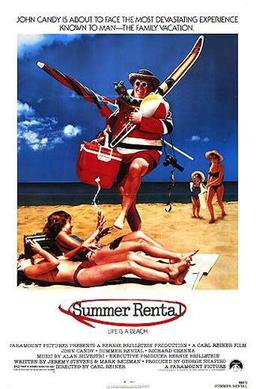
Summer Rental (1985, directed by Carl Reiner)


After a blow-up at work, air traffic controller John Chester (John Candy) is given five weeks of paid leave.  He takes his family to Florida, where they rent a beach house and discover that their summer town is controlled by snobbish sailing champion Al Pellett (Richard Crenna).  It’s the snobs vs slobs as Pellett tries to kick John and his family out of their summer rental and John tries to prove himself to his son and daughter (Joey Lawrence and Kerri Green) by winning the local sailing championship.  Luckily, John has Sully (Rip Torn), a modern-day pirate captain, on his side.

John Candy was a remarkable talent.  It’s just a shame that he didn’t appear in more good films.  He will always be remembered for films like Splash, Uncle Buck, Planes, Train, and Automobiles, and Only The Lonely but unfortunately, most of his starring roles were in lightweight, forgettable far like Summer Rental.  Candy is likable as John Chester and sympathetic even when he’s losing his temper over every minor inconvenience.  But the film itself never really does much to distinguish itself from all of the other 80s comedies about middle class outsiders taking on the richest man in town.  Candy is stuck playing a role that really could have been played by any comedic actor in 1985.  It’s just as easy to imagine Dan Aykroyd or even Henry Winkler in the role.  It feels like a waste of Candy.

The best thing about the film is Rip Torn’s performance as Sully.  Torn’s performance here feels like a dry run for his award-winning work as Artie on The Larry Sanders Show.  I would have watched an entire movie about Sully.  As it is, Summer Rental is inoffensive and forgettable.

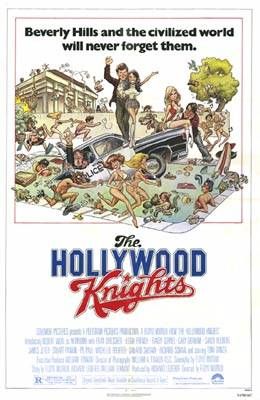
The Hollywood Knights (1980, directed by Floyd Mutrux)


Halloween Night, 1965.  While the high school holds a pep rally and the Beverly Hills Homeowners Association debate the best way to tackle the problem of juvenile delinquency, the Hollywood Knights hang out at Tubby’s Drive-In, their favorite burger joint.  The Hollywood Knights are a car club and a group of fun-loving rebels, determined to have a good time and to always humiliate Officers Clark (Sandy Helberg) and Bimbeau (Gailard Sartain).  In practice, this amounts to a lot of jokes about flatulence and Newcomb Turk (Robert Wuhl) mooning the cops every chance the he gets.  I’m hoping a stunt butt was used for the mooning shots.  If I had known watching Hollywood Knights would mean seeing Robert Wuhl’s bare ass a dozen times over 91 minutes, I wouldn’t have started the movie.

The humor is crude but the movie has a serious side, one that was cribbed from American Graffiti.  Duke (Tony Danza), a senior member of the club, is upset that his girlfriend (Michelle Pfeiffer, in her film debut) is working as a car hop.  He’s also sad that his buddy, Jimmy Shine (Gary Graham), is leaving in the morning for the Army.  Jimmy’s not worried about being sent to Vietnam because Americans are only being sent over there as advisors.  Hollywood Knights doesn’t end with a Graffiti-style epilogue but if it did, Jimmy would be the one who never came home.  The serious scenes work better than the comedy, due to the performances of Gary Graham, Michelle Pfeiffer, and Tony Danza.  I can’t believe I just said that either.  Danza, though he’s way too old to be playing a high school student, is actually really good in this movie.  Pfeiffer doesn’t get to do much but, from her first scene, it’s easy to see why she became a star.  The camera loves her and she brings her character to life, despite not having much screen time.

Unfortunately, the drama takes a back seat to a lot of repetitive humor.  The problem isn’t that the humor is crude.  One thing that has always been true is that, regardless of the year, teenage boy humor is the crudest humor imaginable.  Even back in prehistorical times, teenage boys were probably drawing dirty pictures on the walls of their caves.  The problem is that the humor is boring and Robert Wuhl is even more miscast as a high school student as Tony Danza was.  Fran Drescher plays a high school student with whom Turk tries to hook up.  Drescher, like Pfeiffer, comes across as being a future star in the making.  Robert Wuhl comes across as being the future creator of Arli$$.

The Hollywood Knights has a bittersweet ending, the type that says, “It’ll never be 1965 again.”  This movie made me happy that it will never be 1965 again.  1965 should have sued The Hollywood Knights for slander.  Hollywood Knights tried to mix the nostalgia of American Graffiti with the raunchiness of Animal House but it didn’t have the heart or creativity of either film.  At least some of the member of the cast went onto better things.


Film Review: The Great Smokey Roadblock (dir by John Leone)


First released in 1977, The Great Smokey Roadblock tells the story of Elegant John Howard (Henry Fonda).

Elegant is not really his first name.  It’s a nickname, one to let us know that, in the world of independent truckers, John Howard was one of the good guys.  He never crashed his rig.  He never overcharged for a job.  He always arrived on time and in good shape.  John Howard was a good man but then he turned 60 and he got sick.  He spent months in the hospital, unable to work.  His truck was repossessed.  The movie starts with John sneaking out of his hospital room, stealing back his truck, and hitting the road in search of one final job.  Though John says he just wants to make enough money to get his truck back, the truth is that John is terminally ill.  If he’s going to die, he wants to die doing what he loves.  Of course, dying while driving could lead to some trouble for anyone else who happens to be on the road at the time but still, you have to respect John’s determination.  He’s a true American, independent to his core.

(My Dad occasionally made a living driving a truck so perhaps that’s why I’m partial to films like this one.)

John picks up a hitchhiker, a religious young man named Beebo Crozier (Robert Englund).  John picks Beebo up because Beebo was walking through the desert in a suit.  Beebo claims that he’s walking to Florida but John tells him that he can’t do that.  John will drive Beebo to Florida.  Of course, John also expects Beebo to pay for the gas that his truck uses because it’s not like John has any money.  At first, Beebo accuses John of cheating him.  (Henry Fonda cheating someone!?  Perish the thought!)  Soon, however, John has become Beebo’s mentor.

Everyone respects John but no one wants to hire him.  The only offer that John gets is from sleazy Charlie Le Pere (Gary Sandy), who has an agenda of his own.  Finally, John visits his old friend, Penelope (Eileen Brennan).  Penelope is a madam whose brothel has just been closed down.  John agrees to transport Penelope and her girls (including Susan Sarandon) to a new location on the East Coast.  Penelope offers to help John pay the bills.  Elegant John’s a pimp now!  (I was about to say that this seemed like an odd turn-of-events for Henry Fonda but then I remembered that he starred in The Cheyenne Social Club with Jimmy Stewart.)

There’s not really much of a plot to The Great Smokey Roadblock.  John, Beebo, Penelope, and the girls travel from one location to another.  They get thrown in jail by a notoriously corrupt deputy named Harley Davidson (Dub Taylor).  After they escape, they become minor celebrities.  Two counterculture journalists (played by Austin Pendleton and John Byner) show up and help them broadcast their story and the film comes to a halt while Pendleton and Byner exchange what sounds like improvised dialogue.  The police attempt to set up a roadblock to stop Elegant John and his Six Mystery Women.  I guess that’s the Great Smokey Roadblock of the title.

It’s a weird movie, in that the humor is extremely broad and often crude but Henry Fonda is playing a man who is not only terminally ill but who actually looks like he’s terminally ill.  (Henry Fonda himself was reportedly very ill during the filming of The Great Smokey Roadblock.)  As such, it’s a rather melancholy comedy, one in which every joke seems like it might be the last one that Elegant John will ever hear.  In the 70s, not even a trucker comedy could have a happy ending and, as such, The Great Smokey Roadblock feels like a drive-in film for the existential set.  The film’s plot doesn’t really add up to much and is full of plot holes that serve as evidence of a troubled production.  That said, there’s something rather charming about seeing a pre-Nightmare On Elm Street Robert Englund playing a gentle guy who ends up as Henry Fonda’s protegee.  Fonda and Englund play off each other well and their scenes together are the best thing about The Great Smokey Roadblock.

Norwood (1970, directed by Jack Haley, Jr.)


Norwood Pratt (played by country singer Glenn Campbell) is a just a good old boy who has just returned home from serving in the Marines over in Vietnam.  After saying goodbye to his Marine buddy, Joe William Reese (played by quarterback Joe Namath), Norwood heads to his hometown of Ralph, Texas.  Norwood discovers this his sister (Leigh French) has married an idiot named Bill (Dom DeLuise!)

Norwood gets a job working at the local garage but he’s got his guitar and he’s got his dreams.  All he wants to do is play his music on the Louisiana Hayride radio program.  But with no money and no connections, how is he going to make it there?  When a shady businessman (Pat Hingles) offers to pay him fifty bucks to drive a car and prostitute (Carol Lynley) to New York City, Norwood agrees.  When Norwood discovers the car is stolen, he abandons both the vehicle and the girl but he still heads up to New York City.

Norwood has plenty of adventures and he meets plenty of people, like a hippie (Tisha Stirling) who invites him to open mike night at a coffee house in the Village.  Later, she invites him to join her in a bathtub by asking him if his guitar plays underwater.  “No, ma’m,” Norwood says, “but I do.”  He also meets a pregnant teenager (Kim Darby, Campbell’s co-star from True Grit) and a little person (Billy Curtis) who is traveling with a super intelligent chicken.

There have been a lot of very good films made about the struggle of military veterans to transition back to civilian life after their tour of duty comes to an end.  Unfortunately, Norwood is not one of those films.  Both Norwood and Joe have just returned from Vietnam but neither one of them seems to carry any lingering effects from their time overseas.  Neither of them shares any war stories or any thoughts on war in general.  (Someone does point out that Norwood has a scar.  Norwood says it’s a war wound that he got when he accidentally fell off a water truck.)  There’s no hint that the war itself was not going well for the United States in 1970 or that it wasn’t a popular war and that returning veterans often felt as if they had been rejected by the same country that asked (or forced) them to serve.  Even when Norwood meets the hippies in the Village, there’s no mention of protests.  Instead, Norwood presents 1970 as a time with no real conflicts, which is the perfect era for someone as forgettable as Norwood Pratt to become a star.

Norwood has the same basic and episodic structure as an Elvis movie, except that Elvis could actually act when he wanted to.  No one can deny Glenn Campbell’s talent as a singer but as an actor, he had very little screen presence.  In True Grit and this movie, the best that he could come up with was an amiable dullness.  In True Grit, it didn’t matter because John Wayne was in the movie.  But in Norwood, Campbell had to carry the story and his acting limitations were much more obvious.  Campbell even managed to get outacted by Joe Namath, who, as far as pro football player-turned-actors were concerned, was no Alex Karras.  Wisely, Campbell didn’t further pursue a career as an actor and instead concentrated on singing.  When Campbell died in 2017, he was praised for both his musical legacy and his honesty and courage while facing Alzheimer’s.  He may not have made it as an actor but he still touched a lot of lives.

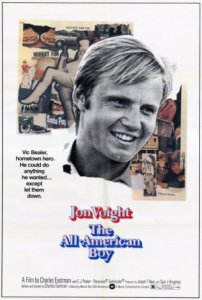
A Movie A Day #149: The All-American Boy (1973, directed by Charles Eastman)


Vic “The Bomber” Bealer is an amateur boxer who appears to be poised to escape from life in his dreary hometown.  He is such a good fighter that he is on the verge of making the U.S. Olympic Team and he is so good-looking that everyone, from his teenage girlfriend (Anne Archer) to his gay manager (Ned Glass) to a woman he meets at a gas station, automatically falls in love with him.  However, after his girlfriend tells him that she is pregnant, Vic abandons both her and boxing.  When she leaves town to have an abortion, Vic starts boxing again but then he learns that she may not have actually had an abortion and Vic leaves for Los Angeles, to see both her and his son.

Sadly, there is something about boxing that has always brought out the pretentious side of some filmmakers and that is the case with The All-American Boy.  This episodic film (which claims to portray “The Manly Art In Six Rounds”) tries to present Vic as being an anti-hero but mostly, he just seems to be vacant loser.  Vic sulks through the entire film, despite not really having much to sulk about.  When one of his conquests asks him what he is thinking, Vic replies, “I ain’t thinkin'” and the movie provides no reason to doubt him on this point.  I was not surprised to learn that The All-American Boy was filmed in 1969 and was deemed unreleasable until the combined success of Midnight Cowboy and Deliverance made Voight into a star.  On the plus side, when he made the film, Jon Voight looked like he could actually step inside the ring and throw a few punches.  On the negative side, the boxing scenes go heavy on the slow motion which, when overused, just looks stupid.  Raging Bull, this film is not.

When it comes to The All-American Boy, Duke has the right idea:

Embracing the Melodrama Part II #36: WUSA (dir by Stuart Rosenberg)


wusaI recently saw the 1970 film WUSA on Movies TV.  After I watched it, I looked Joanne Woodward up on Wikipedia specifically to see where she was born.  I was surprised to discover that she was born and raised in Georgia and that she attended college in Louisiana.

Why was I so shocked?  Because WUSA was set in New Orleans and it featured Joanne Woodward speaking in one of the most worst Southern accents that I had ever heard.  A little over an hour into the film, Woodward’s character says, “What’s all the rhubarb?”  And while “What’s all the rhu…” sounds properly Southern, the “…barb” was pronounced with the type of harshly unpleasant overemphasis on “ar” that has given away many Northern actors trying to sound Southern.  Hence, I was shocked to discover that Joanne Woodward actually was Southern.

That said, her pronunciation of the word rhubarb pretty much summed up every problem that I had with WUSA.  Actually, the real problem was that she said “rhubarb” in the first place.  It came across as being the type of thing that a Northerner who has never actually been down South would think was regularly uttered down here.  And I will admit that WUSA was made 16 years before I was born and so, it’s entirely possible that maybe — way back then — people down South regularly did use the word rhubarb.  But, for some reason, I doubt it.  I know plenty of old Southern people and I’ve never heard a single one of them say anything about rhubarb.

As for WUSA, it’s a long and slow film.  A drifter named Reinhardt (Paul Newman) drifts into New Orleans and, with the help of an old friend who is now pretending to be a priest (Laurence Harvey), Reinhardt gets a job as an announcer at a right-wing radio station.  He reads extremist editorials that he doesn’t agree with and whenever anyone challenges him, he explains that he’s just doing his job and nothing matters anyway.

Reinhardt also gets himself an apartment and spends most of his time smoking weed with long-haired musician types, the exact same people that WUSA regularly denounces as being a threat to the American way.  Living in the same complex is Geraldine (Joanne Woodward), a former prostitute who has a scar on her face and who says stuff like, “What’s all the rhubarb?”  She falls in love with Reinhardt but finds it difficult to ignore what he does for a living.

Meanwhile, Geraldine has another admirer.  Rainey (Anthony Perkins) is an idealistic and neurotic social worker who is regularly frustrated by his efforts to do good in the world.  Reinhardt makes fun of him.  The local crime boss (Moses Gunn) manipulates him.  And WUSA infuriates him.  When Rainey realizes that WUSA is a part of a plot to elect an extremist governor, Rainey dresses up like a priest and starts carrying around a rifle.

Meanwhile, Reinhardt has been assigned to serve as emcee at a huge patriotic rally.  With Geraldine watching from the audience and Rainey wandering around the rafters with his rifle, Reinhardt is finally forced to take a stand about the people that he works for.

Or maybe he isn’t.

To be honest, WUSA is such a mess of a film that, even after the end credits roll, it’s difficult to figure out whether Reinhardt took a stand or not.

Anyway, WUSA is not a lost masterpiece and I really wouldn’t recommend it to anyone.  The film’s too long, there’s too many scenes of characters repeating the same thing over and over again, and neither Newman nor Woodward are particularly memorable.  (You know a movie is boring when even Paul Newman seems like a dullard.)  On the plus side, Anthony Perkins gives such a good performance that I didn’t once think about the Psycho shower scene while watching him.

As boring as WUSA is, I have to admit that I’m a little bit surprised that it hasn’t been rediscovered.  Considering that it’s about a right-wing radio station, I’m surprised that there haven’t been hundreds of pretentious think pieces trying to make the connection between WUSA and Fox News.  But, honestly, even if those think pieces were out there, it probably wouldn’t do much for WUSA‘s repuation.  According to the film’s Wikipedia page, Paul Newman called it, “the most significant film I’ve ever made and the best.”  Paul Newman’s opinion aside, WUSA is pretty dire.