Review: Sneakers (dir. by Phil Alden Robinson)


“The world isn’t run by weapons anymore, or energy, or money. It’s run by little ones and zeroes, little bits of data. It’s all just electrons.” — Cosmo

Sneakers is one of those early-’90s studio thrillers that feels oddly cozy for a movie about global surveillance and information control. It plays like a hangout movie that just happens to revolve around a world-breaking black box, and whether that balance works for you will pretty much decide how much you click with it.

Set in San Francisco, Sneakers follows Martin Bishop (Robert Redford), a one-time radical hacker now leading a boutique team that gets paid to break into banks and corporations to test their security. When a pair of supposed NSA agents lean on him about a skeleton in his past, they strong-arm him into stealing a mysterious “black box” from a mathematician, which turns out to be a codebreaker capable of cracking pretty much any system on Earth. From there, the crew gets pulled into a bigger conspiracy involving shady figures and high stakes, with Martin confronting echoes from his activist days.

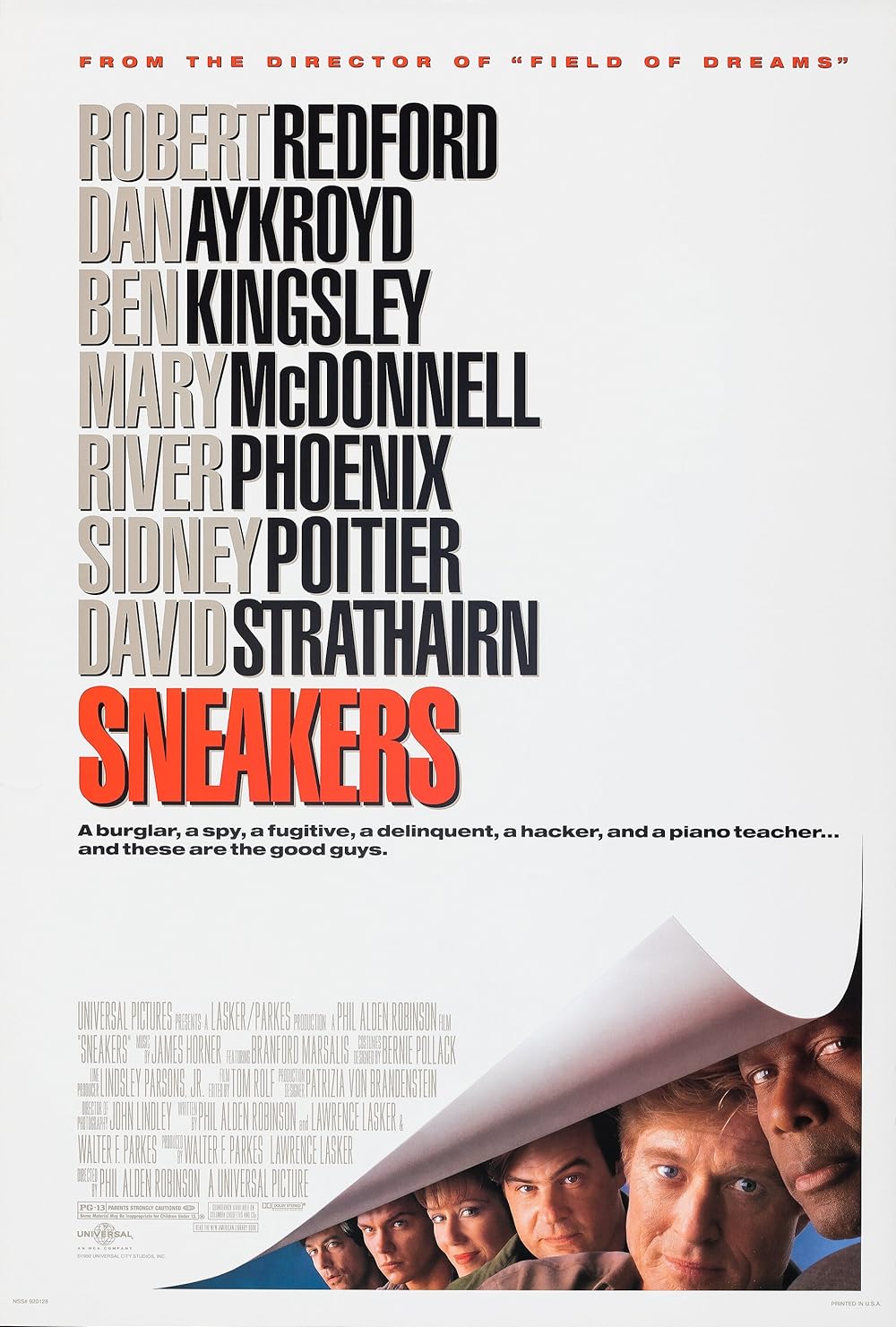
The first thing that jumps out about Sneakers is the cast, which is frankly stacked even by modern standards. Redford brings an easy, weathered charm to Bishop; there’s a low-key joke baked into the movie that this legendary leading man is now playing a guy who looks like he spends more time worrying about his back pain than saving the world, and it works. He’s surrounded by a motley crew: Sidney Poitier’s ex-CIA operative Crease, Dan Aykroyd’s conspiracy-addled tech nut Mother, David Strathairn’s blind audio savant Whistler, and River Phoenix’s eager young hacker Carl. Mary McDonnell rounds things out as Liz, Martin’s ex, who gets roped back into his orbit and ends up doing some of the film’s most memorable social-engineering work.

What makes this lineup click—and really shine—is how effortlessly the ensemble works together, especially with Robert Redford and Sidney Poitier anchoring it as the team’s leaders. Redford’s Bishop is the steady, pragmatic brain, always one step ahead but grounded by his regrets, while Poitier’s Crease brings that sharp-edged authority from his CIA days, barking orders with a mix of gruffness and loyalty that keeps everyone in line. Their dynamic is electric: you get these moments where Bishop’s quiet scheming bounces off Crease’s no-nonsense intensity, like when they’re coordinating a break-in and trading barbs mid-scheme, and it sells the years of trust they’ve built. It elevates the whole group, giving the younger or quirkier members—Mother’s wild theories, Whistler’s uncanny ears, Carl’s fresh energy—a solid foundation to riff off, turning what could be chaos into a tight, believable unit. Phil Alden Robinson directs the film almost like an ensemble comedy interrupted by bursts of espionage, so the banter and the little grace notes between jobs end up being as memorable as the heists themselves. There’s a looseness to the way the team bickers, teases, and riffs on each other that sells the idea they’ve been doing this for years, long before the plot kicked in. You feel that especially in scenes where they’re all huddled around some piece of tech or puzzling out a clue; the script allows them to overlap, crack side jokes, and be fallible instead of treating them like slick super-spies who never misstep.

Tonally, the movie walks an interesting line. On one hand, this is very much a tech thriller about the power of information, with the ominous “Setec Astronomy” anagram (“too many secrets”) tying it all together. On the other, this is a film where an extended sequence revolves around tricking a socially awkward engineer on a date so they can steal his voice patterns and credentials, and the whole thing plays like a romantic caper more than anything. Robinson leans hard into suspense in key stretches—most notably toward the end, where tension builds through clever set pieces involving motion sensors, improvised skills, and closing threats—but even then the movie never loses its sense of mischief.

That playfulness can be both a strength and a limitation. The upside is obvious: Sneakers is fun. It’s easy to watch, easy to rewatch, and it rarely drowns you in jargon for the sake of sounding smart. Instead, it abstracts the tech into clear stakes—this box breaks codes, this system controls money and power—so you always understand the “why” behind every scheme even if you don’t follow every “how.” The downside is that, for a movie nominally about the terrifying implications of a universal decryption key, it doesn’t dig as deeply into the horror of that idea as it could. It gestures at themes of privacy, state overreach, and the weaponization of data, but it’s more interested in using those ideas as a playground than as something to rigorously interrogate.

Viewed from 2026, the tech is obviously dated—landlines, old terminals, magnetic cards—but that almost works in the film’s favor now. There’s a retro-futurist charm to seeing characters talk about “ones and zeroes” and the power of information as if they’re whispering forbidden knowledge, when today that conversation is basically the nightly news. At the time, the film was praised for being ahead of the curve on the idea that whoever controls data controls everything, and you can still feel that prescience. The irony is that what was once cutting-edge has softened into a kind of warm nostalgia, which might be why the movie has quietly settled into cult-favorite status rather than staying in the mainstream conversation.

On a craft level, the movie is sturdy across the board. John Lindley’s cinematography keeps things bright and clean rather than shadow-saturated, which reinforces that lighter tone; San Francisco looks lived-in and slightly mundane, not like a glossy cyber-noir playground. James Horner’s score is a big asset: a jazz-inflected, airy sound that gives scenes a sense of cool rather than danger, which again nudges things toward caper more than hard thriller. It’s the kind of soundtrack that sneaks into your head and quietly sets the mood without demanding too much attention, and a lot of fans single it out as one of his more underappreciated efforts.

If there’s a major weak spot, it’s probably in how the film handles its big ideas and antagonists. The central conflict draws on ideological clashes from the characters’ pasts, but it mostly serves as a charismatic foil rather than a fully fleshed-out debate. The story doesn’t push too hard on challenging cautious pragmatism versus radical change, or probe deeply into who benefits from the status quo. For a tale built on “too many secrets,” the moral landing feels predictable rather than revelatory.

The film also shows its age in how it uses certain characters, especially Liz and Carl. McDonnell gets moments to shine—her date with Werner Brandes is a highlight—but Liz is often pushed to the side once the plot machinery gets going, which is a shame given the sparks between her and Redford. River Phoenix’s Carl is similarly underused; he’s the young blood in a team of older pros, and you can see hints of a more emotionally grounded arc there, but the film keeps him mostly in comic-relief mode. It doesn’t derail the movie, but it does contribute to the sense that Sneakers is more interested in being a breezy ensemble hang than in fully developing everyone it introduces.

Still, it’s hard to deny the movie’s overall charm. The central heist beats are cleanly staged, the reversals are satisfying without being overcomplicated, and the script gives almost every member of the team at least one clutch contribution so it feels like a true group effort. The later stretches cleverly tie together the tech setup and character dynamics, ending on a light coda that underscores the film’s affection for its quirky crew over global intrigue.

As for how it holds up, Sneakers isn’t an untouchable classic, but it’s a very easy film to recommend if you have any affection for ’90s thrillers, ensemble casts, or tech-adjacent stories that don’t drown you in circuitry diagrams. Some of its politics feel glib, some of its gadgets are charmingly antique, and its big questions about Information Age ethics are more backdrop than deep dive. But the film’s mix of laid-back humor, light suspense, and grounded, slightly rumpled characters gives it a distinct flavor that a lot of modern, hyper-slick hacker movies lack.

If you go in wanting a serious, hard-edged exploration of cyber-warfare and state power, Sneakers will probably feel like it’s only skimming the surface. If you’re in the mood for a smart, lightly twisty caper that lets you spend two hours with a killer cast tossing around clever dialogue amid escalating capers, it’s still a very satisfying watch.

Cinemax Friday: The Babysitter (1995, directed by Guy Ferland)


Teenager Jennifer (Alicia Silverstone, shortly before she starred in Clueless) is hired to babysit Jimmy (Ryan Slater), the son of Denise (Lee Garlington) and Harry Tucker (J.T. Walsh) while the Tuckers attend a party over at the the home of Bill and Bernice Holstein (played by George Segal and Lois Chiles).  Harry spends the night drinking and fantasizing about Jennifer while Denise spends the night fantasizing about Bill.  Who does Bernice fantasize about?  The movie doesn’t say.

The adults aren’t the only ones fantasizing.  Bill’s son, Mark (Nicky Katt), is also obsessed with Jennifer and, while his parents are holding their party, he hangs out with his friend Jack (Jeremy London), who also happens to be Jennifer’s bitter ex-boyfriend.  Jack and Mark both start to discuss their own fantasies about Jennifer and they make plans to head over to the Tucker House and surprise Jennifer.  (Mark has even more in mind.)  Meanwhile, even little Jimmy is having fantasies of his own.

Today, it can be easy to forget just what a big deal Alicia Silverstone was in the early to mid-90s.  Even before she landed her star-making turn in Clueless, Silverstone achieved fame as the star of three videos from Aerosmith, all of which featured her playing roles that personified male fantasies.  Her role in The Babysitter fits right in with those Aerosmith videos as the entire film is devoted to men fantasizing about her.  Not much is revealed about who The Babysitter is and her name isn’t even revealed until the end of the movie.  Instead, the movie is about how every male in town, except for George Segal, is obsessed with her.  (What makes George Segal so special?)  Fortunately, Silverstone had the right mix of innocence and sultry beauty to be believable as everyone’s object of lust.  She does a good job playing both the normal teenage girl who just wants to make some extra money babysitting and also the exaggerated caricature who appears in everyone’s fantasies.  (Some of the fantasy scenes are ridiculous but most fantasies are.)

Especially after the release of Clueless, The Babysitter was advertised as being a softcore thriller and it used to show up frequently on late night Cinemax, playing alongside films like Body Chemistry.  Actually, it’s a satire of the suburbs that follows all of the men as they have too much to drink and make fools of themselves.  Thematically, it has more in common with movies like American Beauty, The Ice Storm, and The Virgin Suicides than it does to anything that’s ever been made by Shannon Tweed.  While many viewers were undoubtedly disappointed that Silverstone remained clothed for the majority of the film (and that even the scene where she took a bath was carefully shot to suggest more than it showed), The Babysitter was not a bad movie and it provided the great J.T. Walsh with a rare leading role.  The Babysitter is a better-than-expected mix of Nabokov and Cheever.


The TSL’s Horror Grindhouse: Psycho III (dir by Anthony Perkins)


Norman Bates is back!

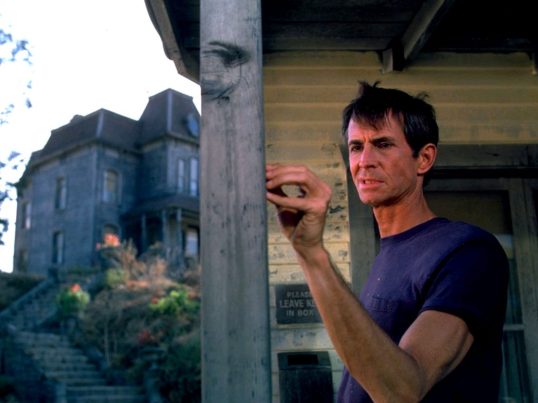
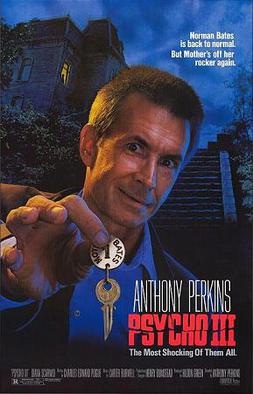
Released in 1986 and directed by Anthony Perkins himself, Psycho III picks up a few months after Psycho II ended.  Norman (Anthony Perkins, of course) is still free.  He’s still got his motel.  He’s still talking to his dead mother.  Of course, at the end of Psycho II, Norman was told that the woman who Norman thought was his mother actually wasn’t his mother.  Instead, Emma Spool told Norman that she was his mother, which led to Norman promptly hitting her with a shovel and then keeping her preserved body hidden away in the motel.  Got all that?  Great, let’s move on….

In Psycho III, business suddenly starts booming at the Bates Motel!  All sorts of people come by to visit.

For instance, there’s the obnoxious tourists who show up at the motel so they can watch a football game and get drunk.  Future director Katt Shea plays one of the unfortunate tourists, who ends up suffering perhaps the most undignified death in the history of the Psycho franchise.  Shea later ends up being stored in the motel’s ice chest.  At one point, the local sheriff grabs a piece of ice and tosses it in his mouth without noticing that it’s covered in blood.

And then there’s Duane Duke (a young Jeff Fahey!), who is superhot but also super sleazy.  For reasons that are never quite clear, Norman hires Duke to be the assistant manager at the motel.  Duke turns out to be thoroughly untrustworthy but he’s Jeff Fahey so he remains strangely appealing even when he shouldn’t be.

Red (Juliette Cummins) shows up at the motel so that she can have sex with Duke and then get stabbed to death while taking off her top in a phone booth.  That, I guess, is Psycho III‘s equivalent of the first film’s shower scene.  Later, Duke comes across Norman mopping up all the blood in the phone booth but he doesn’t say anything about it.  Duke knows better than to ask why there’s blood in the phone booth.

Tracy Venable (Roberta Maxwell) is a journalist whose sole purpose in life is to prove that Norman murdered Emma Spool.  Tracy’s main function in this film is to explain just why exactly so many different women have claimed to be Norman’s mother.  It’s a rather complicated story and you’ll get a migraine if you think about it for too long.

And finally, there’s Maureen (Diana Scarwid), the former nun who has lost her faith and her sanity.  She shows up at the motel and stays in Marion Crane’s old room.  She takes a bath instead of a shower and slits her wrists.  When Norman storms into the room to kill her, the barely lucid Maureen mistakes him for the Virgin Mary and sees his knife as being a crucifix.  Maureen survives and Norman is hailed as a hero for rescuing her.  Later, Norman and Maureen fall in love.  You can guess how that goes.

When compared to the first sequel, Psycho III is much more of a standard slasher film and there’s certainly never any doubt over who is doing the killing.  However, Perkins again does a great job in the role of Norman, making him both sympathetic and creepy.  Fahey, Scarwid, Maxwell, and Hugh Gillin (as the hilariously clueless sheriff) all provide good support.  There’s really not a single character in this film who doesn’t have at least one odd or memorable quirk.  Duane Duke, for instance, is one of the most amazingly sleazy characters in the history of American cinema.  Just when you think that the character can’t get any worse, he proves you wrong.

As mentioned above, Perkins directed this film.  It was one of two movies that Perkins would direct before his death.  As a director, Perkins had a good visual sense, even if he did allow the narrative to meander a bit.  There’s nothing particularly subtle about Perkins’s direction and several of the scenes — like the sex scene between Duke and Red — are so over the top that they become rather fascinating to watch.  That said, there was really no longer any need to be subtle when it came to Norman Bates and his story.

With the exception of the weird Gus Van Sant remake with Vince Vaughn, Psycho III would be the last Psycho film to be released into theaters.  It would also be Perkins’s second-to-last time to play Norman.  (The last time would be in a 1990 made-for-TV sequel, Psycho IV: The Beginning.  Despite it’s title, Psycho IV pretty much ignored everything that happened in the previous two sequels.)  Perkins passed away in 1992, at the age of 60 but the character of Norman Bates would live on, both in his own performances and in the later work of Freddie Highmore in Bates Motel.

Horror Film Review: Psycho II (dir by Richard Franklin)


Norman Bates is back!

No, I don’t mean Freddie Highmore from Bates Motel or Vince Vaughn from the odd Psycho remake that I keep seeing on Showtime.  No, I’m talking about the original Norman Bates, Anthony Perkins!

First released in 1983, Psycho II is a direct sequel to the classic shocker from Alfred Hitchcock.  The film opens with a replay of the original film’s famous shower scene and then immediately jumps forward 22 years.  Having been found not guilty by reason of insanity, Norman Bates has been in a mental institution ever since he was arrested for the murders of Marion Crane and Milton Arborgast.  However, Norman’s psychiatrist, Dr. Raymond (Robert Loggia, who was considered for the role of Sam Loomis in the original film), now feels that Norman has been cured and is no longer a danger to himself or others.  A judge agrees.  Marion Crane’s sister, Lila Loomis (Vera Miles, reprising her role from the original) does not.  She presents the judge with a petition demanding that Norman not be released.  When the judge ignores her, Lila yells that Norman will murder again!

Now free, Norman returns to the Bates Motel and discovers that it’s now being run by the sleazy Warren Toomey (Dennis Franz).  When Norman finds various party favors in the motel rooms and asks Warren what they are, Warren laughs and says, “They’re drugs, Norman.”  Norman’s not too happy about that.  As Dr. Raymond tells him, the world has changed considerably over the past two decades.

However, Norman has other issues to deal with.  For the most part, most of the people in town are not happy that their most famous resident has returned.  Emma Spool (Claudia Bryar) gets Norman a job at a local diner because, in her words, she believes in forgiveness and second chances.  Norman gets to know the new waitress, Mary Samuels (Meg Tilly) and, when Mary tells him that she’s had a fight with her boyfriend, he invites her to stay at the hotel until she can get things together.

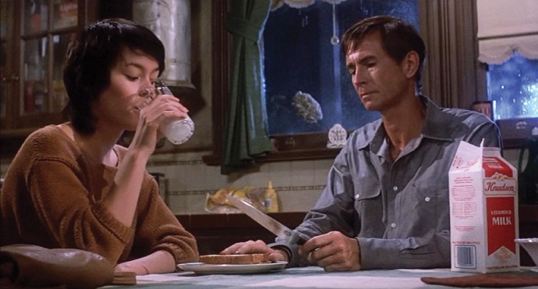
From the minute that he returns home, Norman is struggling to keep it together.  When he first reenters his former house, he hears his mother’s voice but he tells himself that she’s not really there.  But if his mother isn’t there, then who keeps calling him on the phone and yelling at him about the state of the motel?  Who keeps taunting him about his awkward (yet rather sweet) relationship with Mary?  And when two teenagers are attacked after breaking into the house, who else could it possibly be but Norman’s mother?

I was really surprised by Psycho II, which turned out to be a really entertaining little movie, an effective thriller with a healthy dash of dark humor.  It’s a very plot-heavy film, with almost every scene introducing a new twist to the story.  With the exception of the sleazy Warren Toomey, no one in this film turns out to be who you initially expected them to be, including Norman.  Meg Tilly does a good job in the somewhat oddly written role of Mary Samuels and even manages to make an awkward line like “Norman, you’re as mad as a hatter” sound natural.  Not surprisingly, the film is dominated by Perkins’s performance as Norman Bates and what a great performance it is.  The best moments are the ones where Norman awkwardly tries to fit back in with society, nervously laughing at his own jokes and struggling to maintain eye contact with whoever he’s talking to.  You really can’t help but feel sorry for him, especially as the film progresses.

Wisely, Psycho II set out to establish it own identity as a film, as opposed to just trying to duplicate the shocks of Psycho.  (There is a shower scene that’s filmed similarly to the one from the first scene, with a key difference that I won’t spoil.)  It’s what a sequel should be, not a remake but a continuation of the original’s story.  This is definitely a film that’s far better than you may expect.


Back to School #44: Some Kind of Wonderful (dir by Howard Deutch)


some_kind_of_wonderful

For the past two and a half weeks, I’ve been reviewing, in chronological order, some of the best, worst, most memorable, and most forgettable teen films ever made.  We started with two films from 1946 and now, we find ourselves coming to the close of the decade that is often considered to be the Golden Age of teen films, the 1980s.  For our 44th entry in Back to School, we take a quick look at 1987’s Some Kind of Wonderful.

Why a quick look?

Because, quite frankly, there’s not that much to say about it.

Some Kind of Wonderful is a story about an artistic, lower-class misfit who has a crush on one of the popular kids.  The only problem is that the popular kid is being cruelly manipulated by one of the richest students in school.  The misft also has a best friend who is totally in love with the misfit but the misft has somehow failed to notice this.  Eventually, the misfit does get to date the popular kid.  Both the popular kid and the misft are given a hard time by the members of their collective clique but they still manage to go on one truly amazing date.  Finally, the film ends with a big show down at a party and two people kissing outside.

Sound familiar?

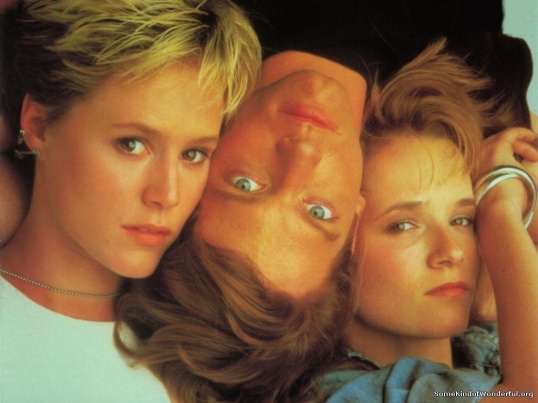
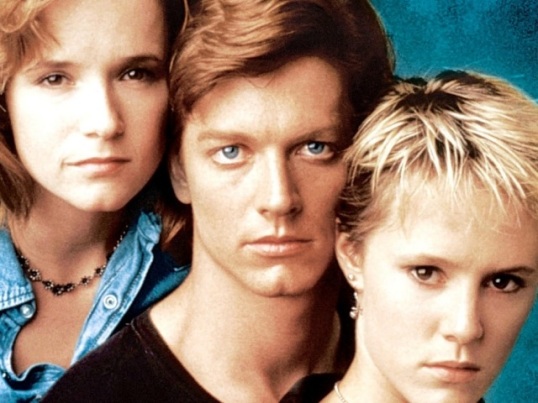
If it does, that probably means that you’ve seen Pretty In Pink.  Some Kind of Wonderful is basically a remake of Pretty In Pink, the only difference being that the genders have been reversed and that the film is a lot more heavy-handed (and predictable) when it comes to examining class differences.   (Not coincidentally, both films were written by John Hughes and directed by Howard Deutch and it must be said that when it comes to Some Kind of Wonderful, it’s easy to feel that both of them were simply going through the motions.)  The misfit is an aspiring painted named Keith (Eric Soltz).  His best friend is a drummer named Watts (Mary Stuart Masterson).  The object of Keith’s affection is Amanda (Lea Thompson).  Unfortunately, even though she lives in the same poor neighborhood as Keith and Watts, Amanda is dating the rich (and therefore, evil) Hardy (Craig Sheffer).

Some-Kind-of-Wonderful-some-kind-of-wonderful-2841626-1024-768

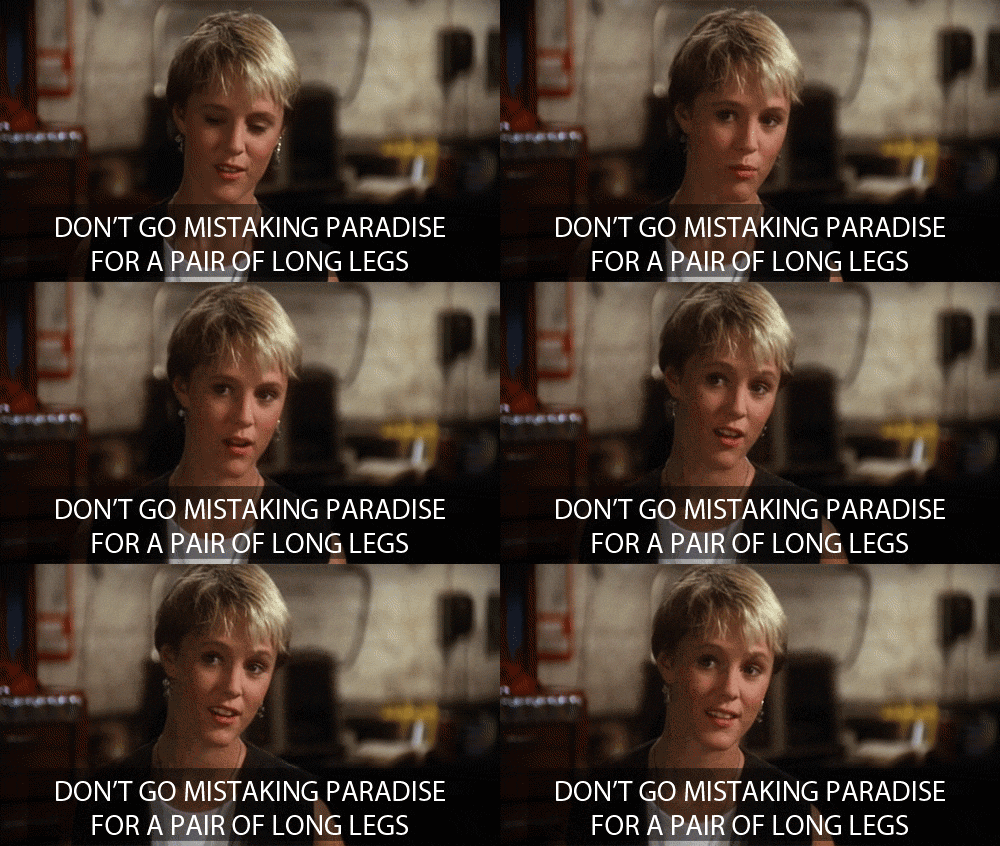
When Keith finally works up the nerve to ask out Amanda, he doesn’t realize that she’s just broken up with Hardy and is on the rebound.  Watts is skeptical, telling Keith, “Don’t go mistaking paradise for a pair of long legs,” and I’m just going to admit that, as the proud owner of a pair of long legs, that line really annoyed me.  I guess it’s because I’ve known people like Watts, who always act like there’s something wrong with wanting to look good.

Shut up, Watts.

Shut up, Watts.

With the help of Watts and Duncan (Elias Koteas), the school bully that Keith managed to befriend in detention, Keith takes Amanda out on an amazing date and shows her a wonderful portrait that he’s painted of her.  At the same time, Hardy — angry because someone from a lower class is now dating his ex-girlfriend — starts to plot his own revenge…

There are some positive things about Some Kind of Wonderful.  There are two really good and memorable scenes that, momentarily, manage to elevate the entire film.  There’s the moment when Keith shows Amanda the painting.  And then there’s the erotically charged scene in which Keith and Watts practice how to kiss.  Koteas, Thompson, and Masterson all gives good performances.  Eric Stoltz is, at times, a bit too intense to sell some of the film’s more comedic moments but overall, he’s well-cast here.  (In fact, the only performance that I really didn’t care for was Craig Sheffer’s.  Sheffer one-dimensional villain only served to remind me of how good James Spader was in Pretty In Pink.)

That's no James Spader

That’s no James Spader

And yet, there’s just something missing from Some Kind of Wonderful, something that keeps this film from being … well, wonderful.  I have to wonder if I had never seen Pretty In Pink, would I have thought more of Some Kind of Wonderful?  Perhaps.  Whereas Pretty In Pink was full of the type of small details and clever moments that make it a joy to watch and rewatch, Some Kind of Wonderful is one of those films that you can watch once and enjoy it without ever necessarily feeling the need to ever watch it again.

Eric Stoltz is going to kill someone