The TSL Grindhouse: Trucker’s Woman (dir by Will Zens)


The 1975 drive-in film, Trucker’s Woman, opens with the tragic (and rather horrifying) death of Jim Kelly, a trucker who meets his demise when the breaks on his truck fail.  We watch as Jim is tossed back and forth inside the cab of his truck and, in fact, the film’s opening credits play out over freeze frames of Jim’s gruesome end.  Jim was a beloved member of the trucking community and his funeral is about as well-attended as a funeral taking place in a low-budget film can be.  Everyone is going to be miss Jim but fortunately, his son Mike (Michael Hawkins) is going to carry on the family business!

As Mike explains to his father’s permanently soused friend, Ben Turner (Doodles Weaver), he’s giving up a lot to take over for his father.  Mike is dropping out of college and sacrificing his dream of becoming a philosophy professor.  Of course, Mike appears to be nearly 50 so, if he still hasn’t gotten that degree, it’s probably for the best that he went ahead of gave up on that dream.  From what little we saw of Jim, he appeared to be 50 as well so you have to kind of wonder if Mike is actually his son.  My theory is that Mike was just a drifter who happened to see a funeral occurring off the side of the road and decided to cash in.

Anyway, Mike is soon driving a truck and discovering that his boss, Fontaine (Jack Canon), is a bit of a jerk who favors certain truckers more than others.  Mike also meets Fontaine’s daughter, Karen (Mary Cannon), at a roadside bar and ends up following her back to her motel, pounding on her door until she gets out of the shower and answers it while wearing a towel, and then announcing that he’s going to be accepting her offer to spend the night with her….

So, you can probably already guess what the main problem with this film is.  At best, Mike is a jerk.  At worst, he’s an alcoholic misogynist who breaks into a woman’s motel room, demands sex, and is then offended when she leaves the next morning without telling him where she’s going.  The film tries to portray Mike as being a strong, independent man who works hard and refuses to be ordered around.  However, he comes across less like Burt Reynolds in Smokey and the Bandit or Kris Kristofferson in Convoy and more like one of those truckers who eventually gets caught with a dead body in the back of his cab.  Everything about Mike just screams homicidal drifter.  Not even the title character from Henry: Portrait of a Serial Killer would have accepted a ride from this guy.

Anyway, Mike and Ben attempt to discover who sabotaged the brakes on old Jim Kelly’s rig and since only a mechanic could have done it, suspicion immediately falls on Diesel Joe (Larry Drake) because he’s the only mechanic in the film!  And who paid Diesel Joe to sabotage the brakes?  Well, there’s only person in the film who has any money so it looks like it’s time for Ben to rally the other truckers and Mike to toss a bunch of people into Fontaine’s pool.

Trucker’s Woman does not work as a thriller or a mystery or a comedy.  It does work as a time capsule of the 70s.  Seriously, look at all of those wood-paneled rooms!  Look at all of those plaid jackets!  Seriously, there’s enough plaid in this film it could have just as easily been called Forever Plaid.  Filmed on the highways of South Carolina, Trucker’s Woman is a film the epitomizes an era but there’s plenty of other films that do the exact same thing and don’t feature an alcoholic misogynist as the lead character.  (Seriously, Rubber Duck would have tossed Mike Kelly out of a moving truck.)

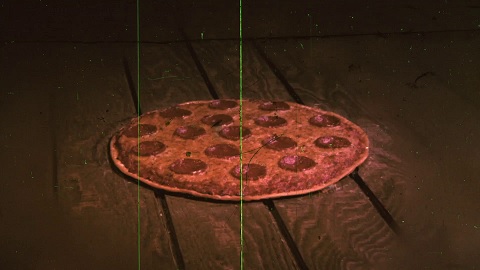
Finally, Trucker’s Woman is infamous in some circles for featuring a random shot of a pepperoni pizza sitting on a wooden deck.  It’s a shot that pops up out of nowhere and has nothing to do with the rest of the film.  It’s thought that the shot was included as an experiment in subliminal advertising and I will admit that my sister and I did order a pizza after this film ended.
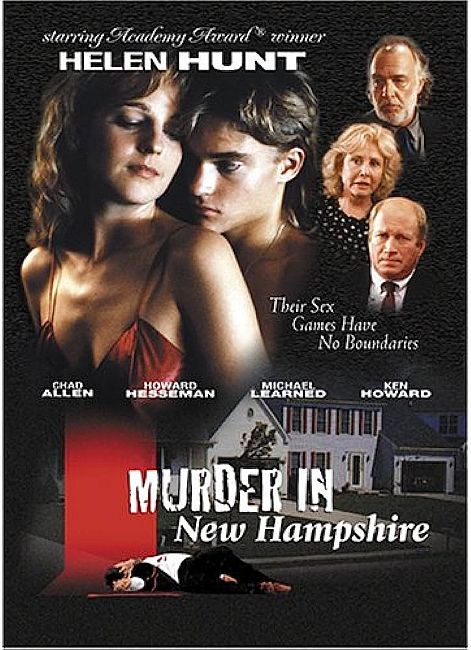
Retro Television Reviews: Murder In New Hampshire: The Pamela Smart Story (dir by Joyce Chopra)


Welcome to Retro Television Reviews, a feature where we review some of our favorite and least favorite shows of the past!  On Sundays, I will be reviewing the made-for-television movies that used to be a primetime mainstay.  Today’s film is 1991’s Murder In New Hampshire: The Pamela Smart Story!  It  can be viewed on YouTube!

When Pamela Wojas (Helen Hunt) first became engaged to Gregg Smart (Hank Stratton), she thought that they would never get older or settle down to a conventional life.  She thought that Gregg would always have long hair and that they would spend the rest of their lives following Van Halen around the country.  But then Gregg got a job with a New Hampshire insurance company and he cut his hair.  And then Pam failed in her attempts to get hired by the local news station and instead, she ended up accepting a job as the part-time media director at a local high school.

Pam spearheaded the school’s anti-drug campaign and ended up working closely with two students in particular, Billy Flynn (Chad Allen) and Cecelia Pierce (Riff Reagan).  Billy and Pam bonded over their shared love of Van Halen and soon, they were having an affair.  Was Pam just trying to relive her youth or was she already setting up Billy to murder her husband?

Based on the true story that also inspired Gus Van Sant’s To Die For, Murder In New Hampshire jumps back and forth through time.  The film opens with Gregg being shot and killed by Billy and one of his friends.  It then cuts to a courtroom, where a prosecutor (Howard Hesseman) tells the jury that Gregg was murdered on the orders of his own wife.  A very conservatively and modestly-dressed Pam sits in the courtroom and provides quite a contrast to the far more wild and hedonistic Pam who we see in the film’s frequent flashbacks.  While Gregg settles comfortably into life as a suburban insurance agent, Pam continually tries to hold onto her past.  While Gregg wins awards for selling the most insurance, Pam tells Billy that Gregg beats her and that he’s dangerous.

It’s difficult to watch Murder In New Hampshire without comparing it To Die For.  They both tell the same story and they even use the same flashback structure.  But if To Die For presented Nicole Kidman as being a soulless killer who was driven by her obsession with being a star, Murder In New Hampshire suggests that Pam’s main motivation was that she just couldn’t handle the idea of settling down and living a conventional, suburban life.  As well, To Die For presented Joaquin Phoenix’s gunman as being someone who was essentially incapable of thinking for himself.  In Murder In New Hampshire, Billy is far more active character.  Though he is undoubtedly manipulated by Pam, Billy is still portrayed as someone who made his own decision to get involved in Pam’s schemes.  If To Die For is a stylized satire of the true crime genre, Murder In New Hampshire is the epitome of what was being satirized.

That said, Murder In New Hampshire is a good example of the true crime genre, largely due to Helen Hunt’s wonderful performance as Pam Smart.  Hunt plays Pam as someone who has never grown up and who is so scared of being required to that she’ll even resort to murder to pull it off.  While Murder In New Hampshire never quite escapes the shadow of To Die For, it’s still an effective film when taken on its own terms.

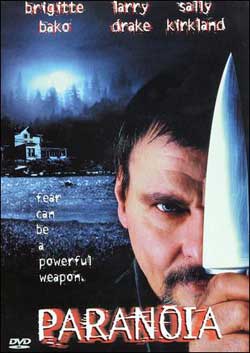
Email of the Damned: Paranoia (1998, directed by Larry Brand)


Interior designer Jana Mercer (Brigitte Bako) is haunted by the night that her entire family was murdered by serial killer, Calvin Hawks (Larry Drake).  Even though Calvin was captured and imprisoned, she still fears that someday he’ll get out.  Calvin, meanwhile, feels that he and Jana have a special bond because he decided to allow her to live.  From his prison cell, he follows her life via the internet.  He even sends her messages, which doesn’t do much for her state of mind.  Finally, a former neighbor of hers invites her to return to her old neighborhood so that she can confront her fears.  However, after serving 20 years in prison, Calvin has been released for good behavior.  As a part of his parole, he is not allowed to go anywhere near Jana or any of the scenes of his crimes.  Soon after getting released, Calvin decides to violate his probation.  A serial killer violating probation?  Who would have guessed?

Paranoia raises a few questions.  What type of prison would allow a serial killer to have a laptop in his cell and access to the internet, let alone send out messages unsupervised?  What type of legal system would sentence a serial killer to only 20 years in prison?  Why wouldn’t the authorities make any effort to let Jana, as the sole survivor of Calvin’s crimes, know that Calvin is about to be released from prison?  Why would Jana, a recluse who says she is incapable of trusting people, be so quick to accept an invitation to go to the country with someone that she barely knows?  It makes no sense but the movie still somehow maintains enough suspense to work.

The best thing about Paranoia are the performances of Brigitte Bako and Larry Drake.  Bako, who was one of the best of the 90s direct-to-video stars, brings some needed sass to the role of Jana while Larry Drake was a B-movie veteran who always made a good villain.  Larry Brand, who also did Overexposed and The Drifter, wrote and directed Paranoia and, just as he did in those two previous films, Brand includes a lot of pop cultural references.  It’s not every day that you see a direct-to-video B-movie that includes an inside joke about The Dick Van Dyke Show.  Brand and his cast bring some unexpected style to the nonsensical story.

Watching Paranoia today, it’s hard not to get nostalgic.  With a plot that hinges on email almost as much as the plot of Sleepless in Seattle, it’s a 90s film, through and through.  They don’t make them like this anymore.

Bubba’s Revenge: Dark Night of the Scarecrow (1981, directed by Frank De Felitta)


Dude, this movie.

Charles Durning plays Otis P. Hazelrigg, a postman in a small town who has an unhealthy interest in a ten year-old girl named Marylee (Tanya Crowe).  When Marylee is mauled and nearly killed by a dog, Otis decides that she was attacked by Bubba Ritter (Larry Drake), a mentally challenged man who has the mind of a child.  With Otis and his redneck friends looking to lynch him, Bubba’s mother disguises him as a scarecrow and tells him to stand out in a field and not move.  When Otis and his friends discover Bubba hiding, they all shoot him until he’s dead.  Otis puts a pitchfork in Bubba’s hands and tells the police that Bubba was attacking them and they didn’t have any choice but to shoot him.

Otis thinks that he’s gotten away with murder but he’s wrong.  After Marylee sings a song in the same field where Bubba was killed, Otis’s friends start dying.  One is suffocated in a grain silo.  Another falls into a thresher.  Before each one dies, they report seeing a scarecrow on their property.  Otis thinks that Bubba’s mother is behind the murders but what if Bubba has actually come back to life?

Dark Night of the Scarecrow will mess up your mind, give you bad dreams, and leave you with a lifelong phobia o scarecrows.  It’s that scary.  I remember that they used to frequently show this movie on TV when I was  growing up and even the commercials were scary.  (The part of the movie that always messed with me were the shots of Bubba’s frightened eyes darting around underneath the scarecrow mask.)  Scarecrows are naturally creepy and the movie’s atmosphere is unsettling but the most frightening thing about Dark Night of the Scarecrow is Otis and the redneck lynch mob that he puts together.  Otis is a thoroughly loathsome character and Charles Durning goes all out playing him.  Otis is a civil servant, which gives him some prestige in the town but he uses that prestige to bully Bubba and harass Marylee.  His concern with Marylee especially feels wrong and the movie does not shy away from the subtext of his interest.  The scarecrow might frighten you but you will absolutely loathe Otis and everyone who follows him.

Dark Night of the Scarecrow was made for television but it’s just as good as any theatrical release.   It is also might be the first movie to feature a killer scarecrow.  Several have been made in the years since but Dark Night of the Scarecrow was the first and it’s still the best.

Bad Medicine: Dr. Giggles (1992, directed by Manny Coto)


In 1957, the citizens of the town of Moorheigh discovered that their local doctor was doing experiments on his patients, removing their hearts and using them to try to bring his dead wife back to life.  The townspeople responded by executing Dr. Rendell and chanting a poem that goes, “This town has a doctor named Rendell/Stay away from his house because he’s the doctor from Hell.”  They would have killed Dr. Rendell’s son too, except that Evan, Jr. escaped by sewing himself up in his mother’s corpse and then later using a scalpel to cut his way out.

Thirty-five years later, Evan, Jr. (Larry Drake) returns to Moorheigh, looking to get revenge on the town.  Because of his evil laugh, he is now known as Dr. Giggles and he has a medical-related one liner for every occasion.  When Dr. Giggles learns that Jennifer (Holly Marie Combs) needs a heart monitor, Dr. Giggles decides to stalk her while killing all of her interchangeable friends.  Dr. Giggles says that he wants to give her a new heart, preferably one that he’s ripped out of someone else’s body.  Jennifer is not very appreciative.

Dr. Giggles was meant to be a franchise started, in the fashion of the Nightmare on Elm Street and Friday the 13th films.  It was a franchise that would never be because there wasn’t much that could be done with Dr. Giggles that wasn’t done during the first film.   Larry Drake was a good actor but, other than the scene where he used a scalpel to cut himself out of a dead body, there was nothing about Dr. Giggles that distinguished from all the other horror movie slasher.  He wasn’t a dream weaver like Freddy or indestructible like Jason.  He was just a dude dressed like a doctor who giggled too much.

For a better film featuring Larry Drake as a villain, do yourself a favor and watch Sam Raimi’s Darkman.

Horror on TV: Tales From the Crypt 1.2 “All Through The House” (dir by Robert Zemeckis)


For tonight’s excursion into the world of televised horror, we have the 2nd ever episode of the HBO anthology series, Tales From The Crypt!

In this one, a woman (Mary Ellen Trainor) kills her husband on Christmas Eve, just to discover that she can’t properly dispose of the body because a psychotic escaped mental patient (Larry Drake), who just happens to be disguised as Santa Claus, is hanging around outside of her house.  It’s a bit of a mess, especially since the woman’s daughter is eagerly awaiting the arrival of Santa herself.

This originally aired on June 10th, 1989 and it’s an enjoyably insane package of holiday cheer and menace.  And, of course, it was directed by none other than Robert Zemeckis!

Enjoy!

Movie Review: Darkman (dir. by Sam Raimi)


As I haven’t been to the movies lately, I’m working on reviews of older films I’ve seen.

A long time ago, just after Tim Burton’s Batman and before Spielberg’s Jurassic Park, Sam Raimi came up with the idea of making his own superhero movie. Supposedly, he had tried to get a hold of both Batman and The Shadow (which eventually went on to Highlander’s Russell Mulcahy), but wasn’t able to. As a result, Darkman was created. I never mind watching it or recommending it, as long as the viewer realizes they’re not shooting for Oscar Winning material here.

Darkman was a strange film. It wasn’t really marketed very well, evidenced in the simple “Who is Darkman?” posters that I remembered seeing on the sides of buses. I don’t recall there being any kind of commercials for the movie. While the movie did alright (and even spawned 2 sequels), I never thought of it as a great success. It still is, despite its flaws, a good film. Well, for someone at 15, it was good.

In Darkman, Peyton Westlake (Liam Neeson) is a gifted scientist that has just about everything. He has a great girlfriend in Julie (Frances McDormand), who’s doing well in her job and he’s on the verge of a major breakthrough in developing a new synthetic skin. If he could only solve the problem where the skin apparently decays in light after 99 minutes. Soon after realizing the flaw in his project, he is attacked a group of criminals (lead by Larry Drake in a great role), burned with his own chemicals and his lab is set ablaze. Left for dead, he’s found and brought to a hospital. They’re able to confirm that he’ll live, but he’s also horribly scarred, has no sensation in his nerves (meaning he feels no pain), and will need skin grafts for the rest of this life. The result of all this trauma is also a bit of mental damage. Westlake breaks free of the hospital, resurrects his lab, and decides to get revenge for what was done to him. The synthetic skin technique now allows him to assume the appearance of anyone he chooses (as long as he has a picture of them, of course). He can wear a disguise for up to 99 minutes in direct sunlight, else his face begins to melt.

One thing I like about some of Sam Raimi’s films is that they’re just strange in some ways. Not Cronenberg strange (that’s just creepy sometimes), but they tend to have some weird elements. He likes to throw things into the camera, whether it’s someone’s face or an object. He’s also into these extreme zoom shots where he’ll have the camera low and bring it racing towards it’s subject. At the time the movie came out, my parents gave me a Camcorder. I did a lot of similar shots, chasing the cats around the house with the camera hovering a few inches off of the floor. I’ll admit it, it was pretty effective here.

Some of the acting was okay in Darkman. I particularly liked Larry Drake at the time because he seemed so different from the character he played on L.A. Law at the time, but everyone else here seemed like they were playing up their roles and in some cases, taking themselves far more seriously than they should have. Some scenes didn’t even make sense to me and felt like filler. I get that Westlake was just a little bonkers, but the whole “See the Dancing Freak” song and dance routine kind of left me with a “What the hell?” expression. Frances McDormand seemed to almost whine on cue (though I guess if I had a love one come back from the dead, I’d be a little shocked too). Colin Friels’ villain caused my family to collectively snicker and groan when at one part, he exclaims “Because I built it!!! I built it all!!” It was just all very strange. M. Night Shyamalan did something similar with The Happening, but for me, this really worked better in Darkman’s favor. Since the acting is so campy, the movie never really tries to make itself out to be Dark Knight / Captain America piece.

If you’re looking at it logically, there’s really no way that Westlake should have been able to pull off half of the disguises he used. You’ve height and weight to consider, and last I checked, Liam Neeson and Larry Drake really had two different body types. Where’d he get all the extra bulk, one has to wonder? Extra clothing, perhaps?

If Darkman has anything going for it, it’s the music. At the time, Danny Elfman was riding the high he had off of movies like Batman, Midnight Run, Dick Tracy and Nightbreed. While Edward Scissorhands remains the strongest score he had that year, Darkman has a number of nice action cues mixed with some somber tones. It helps to carry the film, somewhat.

Overall, Darkman was an interesting look at Sam Raimi’s approach to a superhero. It may have also been one of the key factors in securing the directing duties on the Spider-Man movies in the early 2000’s, which was far superior to this film. If nothing else, it’s worth a laugh or two.