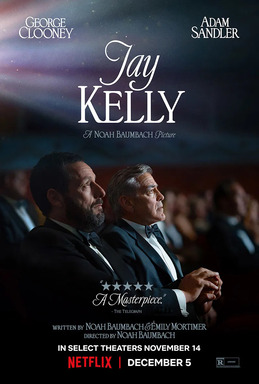
The Films of 2025: Jay Kelly (dir by Noah Baumbach)


Jay Kelly features George Clooney at both his best and his worst.

Clooney plays the film’s title character, an actor who has just hit 60 and who is having an existential crisis as he realizes everything that he’s lost as a result of being rich and famous.  Clooney’s best moments are when he plays Jay as being essentially a prick, a guy who might be well-meaning but who lacks the self-awareness necessary to understand just how condescending and fake he tends to come across to the people who know him.  This is the Jay who insists on having a drink with Tim (Billy Crudup), a former actor who lost a key role to Jay and who has never forgiven him for it.  (It starts out as a friendly drink but it eventually becomes a fight after Tim reveals that he hates Jay and Jay responds by being smug.)  This is the Jay who has alienated both of his daughters (Riley Keough and Grace Edwards) and who doesn’t seem to understand that the rest of the world doesn’t travel with an entourage.

Jay is gloriously unaware in those scenes and they give Clooney a chance to show that he’s still capable of giving a sharp comedic performance.  Watching him in those scenes, I was reminded of the gloriously dumb characters that he played for the Coen Brothers, in both Burn After Reading and Hail, Caesar.  For that matter, I was also reminded of his burned-out hatchet man from Up In the Air, who was not a dumb character but still was someone who, like Jay Kelly, always seemed to be performing.

Unfortunately, as the film progresses, Jay himself starts to wander into flashbacks of himself as a young actor and, even worse, he starts to talk to himself about everything that he’s lost due to his fame and suddenly, he transforms into the insufferably smug Clooney who spent the earlier part of this year in greasepaint, lecturing us all about Edward R. Murrow.  The flashbacks to Jay Kelly’s past often feel like stand-ins for flashbacks to George Clooney’s past (and it’s probably not a coincidence that both Kelly and Clooney are from Kentucky) but they don’t really add up to much.  Jay Kelly is a character who becomes less compelling the more that one learns about him.

The characters around Jay Kelly are far more interesting than Jay himself, though I have my doubts whether that was intentional on the part of director Noah Baumbach.  (An overly long and indulgent sequence on a train would seem to suggest that Jay Kelly was envisioned as being a more fascinating character than he turned out to be.)  Just as he did in Baumbach’s The Meyerowitz Stories, Adam Sandler gives the film its heart, playing the role of Jay’s loyal but unappreciated manager.  Sandler and Laura Dern have a few showy scenes together but Sandler’s best moments come opposite Patrick Wilson as a client who feels that he’s being neglected in favor of Jay Kelly.  (For that matter, Wilson is so good in those scenes that I almost wish he had switched roles with Clooney.)  One might not expect the star of Jack and Jill and That’s My Boy to emerge as one of Hollywood’s best sad-eyed character actors but that’s what has happened in the case of Adam Sandler.

With all that in mind, I have to admit that I enjoyed Jay Kelly more than I thought I would.  Some of that has to do with expectations.  Jay Kelly is currently getting so roasted on social media that I was expecting the film to be a self-indulgent disaster.  While the film is definitely self-indulgent and about 30 minutes too long, it’s not a disaster.  When Clooney’s performance works, it really works.  (Unfortunately, the inverse is also true.)  Adam Sandler, Billy Crudup, Riley Keough, and Stacy Keach all give performances that elevate the occasionally shallow script.  Cinematographer Linus Sandgren captures some beautiful shots, especially towards the end of the film.  Visually, Jay Kelly is a marked improvement on the bland imagery of Marriage Story.  Like its title character, Jay Kelly is imperfect and occasionally annoying but it does hold your attention.

As for the film’s Oscar chances, the reviews are mixed but it’s a film about how tough it is to be an actor and one should not forget that the Actor’s Branch is the biggest branch of the Academy and the majority of the voters are people who are probably going to watch Jay Kelly and say, at the very least, “Hey, I know that guy!”  (Few will admit, “I am that guy,” but that will still definitely be a factor in how they react to the film.)  Regardless of how social media feels about the film, I imagine Jay Kelly will be remembered when the nominations are announced.
Miniseries Review: Death by Lightning (dir by Matt Ross)


Death by Lightning, a four-episode miniseries that recently dropped on Netflix, tells the story of two “forgotten men,” as the show itself puts it.

Michael Shannon plays James A. Garfield, the Ohio farmer and former Congressman who, despite attending the 1880 Republican convention solely to give the nominating speech for Secretary of Treasury John Sherman (Alistair Petrie), found himself nominated for President after the convention found itself deadlocked between supporters of Former President Grant (Wayne Brett) and Senator James Blaine (Bradley Whitford).  Garfield did not want to run for President and he certainly did not want to run with Chester A. Arthur (Nick Offerman), an associate of New York political boss, Roscoe Conkling (Shea Whigham).  However, in November of 1880, James Garfield was narrowly elected the 20th President of the United States.

Matthew MacFayden plays Charles J. Guiteau, a failed lawyer and self-proclaimed newspaper publisher who felt that a stump speech he had given at a small rally was responsible for Garfield’s victory.  Guiteau expected to be appointed to a position in the Garfield administration, perhaps as Consul to France.  In those days of no Secret Service protection and an open White House, Guiteau was one of the many random office seekers who managed to get a face-to-face meeting with Garfield.  What Guiteau did not get was a job.  While Guiteau may have deluded himself into thinking that he was an inside player, everyone else viewed him as being a pesky and disreputable character.  On July 2nd, 1881, Guiteau shot Garfield in the back.  After Garfield died in September, Guiteau was convinced that he would be pardoned by the newly sworn-in President Arthur.  Instead, Guiteau was hanged on June 30th, 1882.

(It’s now generally agreed that Guiteau was such a bad shot that Garfield would have survived his wounds if not for the incompetence of his doctors, who probed his wounds with their bare hands in an effort to extract the bullet.  Garfield died as a result of multiple infections caused by his medical treatment.)

Again, Death by Lightning describes Garfield and Guiteau as both being forgotten men.  That’s not quite true.  I knew who both of them were before I watched the miniseries but then again, I’m also a history nerd.  As much as I don’t want to admit it, it is true that the majority of today’s Americans don’t know either Garfield or Guiteau.  And yet, in 1881, America revolved around them and their fate.  Everyone checked every day for news on Garfield’s health and Guiteau’s trial was heavily covered by the press.  That’s something to remember whenever you hear people talking about how “history will remember” whatever may be happening in the news today.  History may remember but people are quick to forget.

As for Death by Lightning, it does a good job of telling not only the stories of Garfield and Guiteau but also Chester Arthur as well.  The miniseries takes place at a time when political machines dominated American politics and also at a time when the Spoils system and the widespread corruption that it engendered were both accepted as immutable political realities.  Guiteau, having spent his life seeing other people receive jobs for supporting the right candidate, felt that he was naturally entitled to whatever position he requested.  Guiteau’s actions actually did lead to reformation of the Spoils system, with President Arthur emerging an unlikely reformer.  Never again would a random office seeker by allowed through the front doors of the White House and never again would a President casually walk around Washington D.C. without some sort of guard.  With a smart script, good performances, and even a few moments of unexpected cringe humor, Death by Lighting recreates that moment in American history and it pays tribute to James A. Garfield, who was universally described by his contemporaries as being a decent man who was struck down before he could reach his full potential.

How historically accurate is Death by Lightning?  That’s a fair question.  Death by Lightning sticks to the established facts about Garfield and Guiteau but a scene in which Garfield’s daughter argues with him about immigration is undoubtedly meant to be more of a commentary on 2025 than 1880.  I think it can be argued that no film or series can be 100% historically accurate because those who actually witnessed the events in question are no longer with us.  Inevitably, the past is always viewed and recreated through the filter of the present.  And indeed, it is tempting to compares Garfield and Guiteau to our modern-day politicians and activists.  Guiteau, with his constant excuses for his own dumb decisions and his ranting and raving about how he speaks for the people, was a particularly familiar character.  As for the modest and honest Garfield, it’s sadly difficult to think of any modern-day politicians from the same mold.

As a final note, my favorite part of this miniseries occurred during the first episode.  The recreation of the 1880 Republican Convention is wonderfully entertaining.  It’s amazing to think that, in the days before television coverage required political conventions to become carefully choreographed and tightly controlled, there actually was legitimate suspense about who would end up being nominated.  Sadly, those days seem to be over.

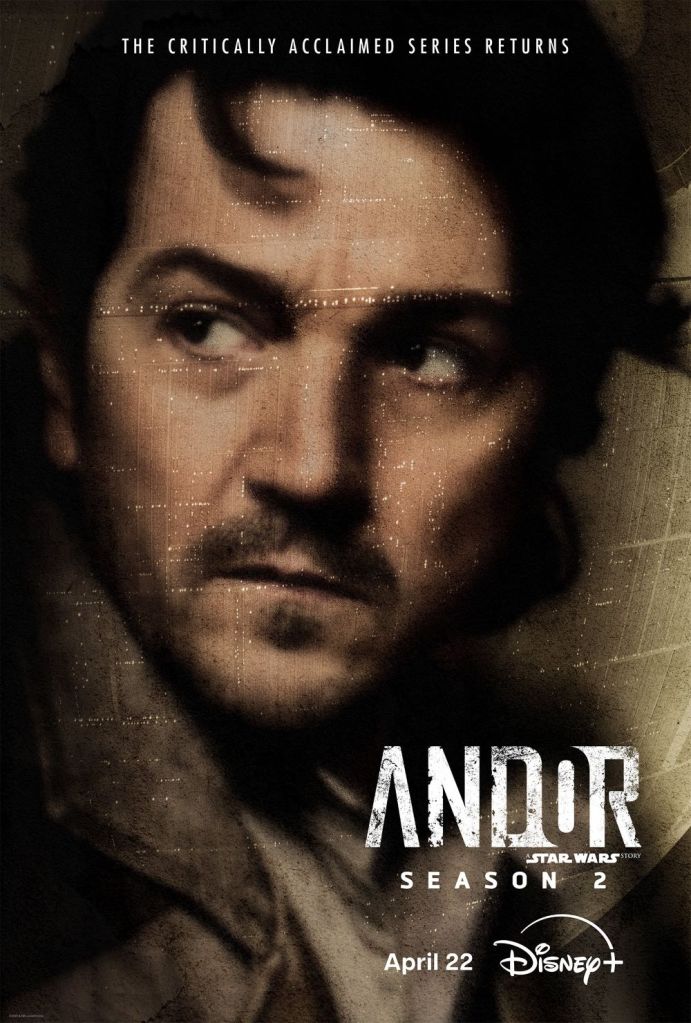
Trailer: Andor Season 2


The revolution starts…now.

Star Wars fans have been very critical of Disney’s stewardship of the franchise since Star Wars: The Last Jedi landed with a monumental thud with the hardcore fanbase. There hasn’t been much to celebrate anything Star Wars under Disney with a few exceptions like Star Wars: Rogue One, The Mandalorian and Skeleton Crew. One Star Wars series that drew critical acclaim from fans and critics alike was Tony Gilroy’s series looking at the origins of one of the main characters from Rogue One and that would be the series Andor.

It was series that no one really wanted since it didn’t involve any of the legacy characters. Yet, under Tony Gilroy’s masterful hands it turned into one of the best shows on Disney+ and, if I daresay, one of the best on tv the year it came out.

It’s going to be almost three years since the first season premiered and, even though the long wait could’ve been a detriment, the second season has been one of the most-anticipated by Star Wars fans. Season 2 of Andor just got it’s first trailer it fetures a very non-Star Wars’y kind of music but very appropriate considering what the season will be about.

I, for one, never thought Steve Earle’s song of rebellion, “The Revolution Starts…” would be the clarion call to start the revolution.

Andor: Season 2 is set for an April 22, 2025 release.