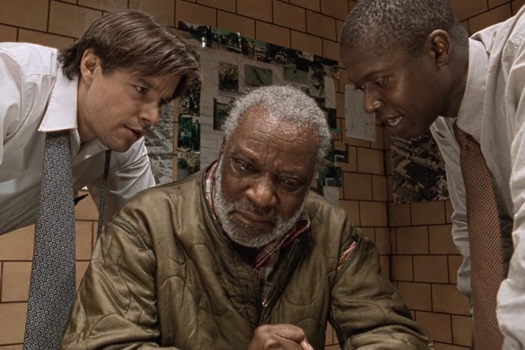
Retro Television Review: Homicide: Life on the Street 1.4 “Son of a Gun”


Welcome to Retro Television Reviews, a feature where we review some of our favorite and least favorite shows of the past!  On Sundays, I will be reviewing Homicide: Life On The Street, which aired from 1993 to 1999, on NBC!  It  can be viewed on Peacock.
This week, things get emotional on Homicide!

Episode 1.4 “Son of a Gun”

(Dir by Nick Gomez, originally aired on February 10th, 1993)

Officer Chris Thormann (Lee Tergesen), a patrol officer who is friendly with the Homicide detectives and who is a bit of protegee to Steve Crosetti, has been shot.  While Thormann lies in surgery with a bullet in his brain, his wife (Edie Falco, in one of her first television appearances) waits for news from the doctors and tries to avoid the members of the callous press.  Crosetti demands to be put in charge of the investigation into Thormann’s shooting and when Giardello points out, quite correctly, that Crosetti is too close to the victim to be objective, Crosetti strips down to his boxers and shows Giardello the scars left behind by every time that he’s been shot.

It’s an odd scene, one that seems to come out of nowhere in an episode that, up until that moment, had been pretty serious.  Kotto does a great job of capturing Giardello’s horror as Crosetti drops his pants.  It’s obvious that this is not the first time that Crosetti has shown off his scars to get assigned to a certain case.  It’s a scene that shouldn’t work but it does work because not only is it well-acted by Yaphet Kotto and Jon Polito but it also captures the insanity of being a homicide detective.  Just four episodes in, Homicide has already shown that it can be a funny show but the humor is rooted in the darkest corners of the human experience.  To survive as a homicide detective, you have to harden yourself to the point of being callous and you have to be able to see the humor in just about everything.  Crosetti, with his constant analysis of the Lincoln assassination and his inventory of bullet scars, may seem crazy but actually, he’s doing what he has to do to survive.

The episode ends with Thormann alive but in a coma and possibly brain-damaged.  And it ends with the shooter still at large.  Crosetti has received an anonymous tip from someone saying that the killer was a man named Alfred Smith.  But who knows if that’s true.

The Adeena Watson case remains open, as well.  Bayliss and Pembleton are still struggling to figure out how to work together.  Bayliss is too obsessed with the case.  Pembleton is too determined to show up the new guy.  A raid on the apartment where it’s believed Adeena was murdered turns up nothing but more evidence of human misery.  That said, a cheerful guy (played by Paul Schulze) who claims to be an agent for hitmen does give up several of his clients, allowing Howard and Felton to close even more cases.  Even Calpurnia Church (Mary Jefferson), the “black widow” from the pilot, is finally arrested due to the agent’s testimony.

Finally, Stanley Bolander goes on his first date with Dr. Blythe.  Before going on his date, he meets his neighbor, Larry Molera (Luis Guzman).  Larry is a carpenter.  He’s built a coffin that is currently sitting in living room.  Bolander’s date goes well but the nervous Bolander turns down Blythe’s offer to go back to her place with her.  Bolander returns to his apartment, where he discovers that Larry is dead and lying in his coffin.  (Much, who was called when Larry’s body was discovered, is shocked to see Bolander.  Bolander is not happy that Much now knows where he lives.)  Larry’s death inspires Boland to return to Dr. Blythe’s apartment.

This was an emotional episode.  Thormann is clinging to his life while his wife and Crosetti wait for him to wake up.  The recently divorced Bolander finally found the courage to go out with Dr. Blythe.  Bayliss appears to be so obsessed with the Adeena Watson case that he’s struggling to think straight.  This episode takes a look at the mental strain that comes from dealing with crime and death on a daily basis.  It’s well-done, even if it’s not quite as memorable as Night of the Dead Living.  (The stuff with Larry and his coffin was a bit too self-consciously quirky to be as emotionally devastating as the show obviously meant for it to be.)  If I took anything away from this episode, it’s that fate is random.  Officer Thormann has been shot in the head but he survived hours of surgery.  Larry seemed to be healthy but he suddenly died while Bolander was on his date.  Adeena’s killer may never be caught while Calpurnia Church was caught because of an initially unrelated investigation.  Some of the detectives are skilled.  Some of them are not.  But, in the end, they’re all at the random mercy of fate.

Retro Television Review: Homicide: Life on Street 1.3 “Night of the Dead Living”


Welcome to Retro Television Reviews, a feature where we review some of our favorite and least favorite shows of the past!  On Sundays, I will be reviewing Homicide: Life On The Street, which aired from 1993 to 1999, on NBC!  It  can be viewed on Peacock.

This week, the Homicide Squad works the night shift on the hottest night of the year.

Episode 1.3 “Night of the Dead Living”

(Dir by Michael Lehmann, originally aired on March 31st, 1993)

On the hottest night of the year, Giardello’s homicide squad works the night shift.  Everyone comes in grumpy.  Munch has just broken up with his girlfriend.  Bolander is trying to work up the courage to call Dr. Blythe.  Bayliss is still obsessing on the Adeena Watson case and he and Pembleton are still trying to figure out how to work together.  Kay’s sister is having trouble at home.  Felton’s wife hates him.  Crosetti worries about his teenage daughter and her boyfriend.  Giardello tries to figure out why the air conditioner is only blowing out hot air on what Lewis claims is the hottest night in history.

Despite the heat and the statistics that show that most homicide occur at night, no calls come in.  Bayliss is convinced he’s cracked the Watson case when he discovers that the fingerprints on Adeena’s library book belongs to someone named James.   He sends Thorson out to arrest James.  James turns out to be a seventh grader who thinks he’s being arrested by not paying a library fine.  (James did check out the book, when he was in the fifth grade.)

A drunk man dressed as Santa Claus is brought in and later falls through the ceiling when he attempts to escape custody.  A baby is found in the station’s basement but it turns out to the cleaning lady’s baby.  She brings him to work with her to protect him from the rats that live in their apartment building.  Eventually, Bolander works up the courage to call Blythe and Bayliss and Pembleton figure out that Adeena’s body was found where it was because her killer brought the body down a fire escape.  At the end of the shift, Giardello assembles his detectives on the roof and joyfully sprays them with the water hose.

It’s an episode that feels like a play, taking place in one location and featuring a lot of monologuing.  Each member of the squad gets a their chance in the spotlight, with the episode revealing that every one of them is a bit more complex than they initially seem.  Even Munch, the misanthrope, is shown to light a candle in memory of “all those who have been killed.”  It’s one of those episodes that makes you understand why Homicide is considered to be classic while also showing you why it struggled in the ratings.  In this episode, Homicide revealed itself to be not a cop show but instead a show about people who happened to be cops.  Most shows about detectives end with an arrest.  This episode ends with Giardello showing his love for the people who work for him.  After spending an hour with everyone sweating and complaining, it’s nice to see them happy on the roof of the station house.  Yaphet Kotto’s joy in the final scene is a wonder to behold.  And yet, it’s easy to imagine how confused audiences, whose expectations had been set by more traditional crime show, would have been.

This episode was meant to be the third episode of the series.  NBC decided that it worked better as the finale of the first season and instead made it the ninth episode.  Peacock has this episode placed where it originally belonged and, with this review, that’s what I’m going with as well.


Retro Television Review: Homicide: Life on the Street 1.2 “Ghost of a Chance”


Welcome to Retro Television Reviews, a feature where we review some of our favorite and least favorite shows of the past!  On Sundays, I will be reviewing Homicide: Life On The Street, which aired from 1993 to 1999, on NBC!  It  can be viewed on Peacock.

This week, the search for Adeena Watson’s murderer begins.

Episode 1.2 “Ghost of a Chance”

(Dir by Martin Campbell, originally aired on February 3rd, 1993)

There’s been a murder in Baltimore.  That, in itself, is not news.  The pilot firmly established that murder is a fact of life in Baltimore.  But, the victim of this crime is an 11 year-old girl named Adeena Watson, who left her home to go to the library and who never returned.  The press is covering every detail.  The police brass want an arrest and they want an arrest quickly.  And the primary detective on the case is rookie Tim Bayliss, who has never even worked a murder case on his own before.  Giardello refuses to replace Bayliss but he also makes it clear that he needs Bayliss to bring him something.

As for Bayliss, he spends most of this episode struggling.  Not only does he not have the respect of his fellow detective but he also, as a rookie, doesn’t even have a desk until Giardello, in a fit of anger, knocks everything off an unoccupied desk and awards it to Bayliss.  (So, was that desk just sitting there the whole time?  I thought they didn’t have any available desks.)  Because this crime is what is known as a “red ball,” (i.e., a murder that has attracted the attention of the media and the public), every detective is looking for Adeena’s murderer.  While Bayliss obsesses on who Adeena was before she was killed, the rest of the squad does the practical things, like talking to neighbors and bringing in all of the city’s sex offenders for interrogation.

My heart broke for Bayliss while watching this episode.  Kyle Secor did a good job of capturing both Bayliss’s outrage over the crime and his fear of failing to solve his first case as a primary.  While Bayliss stared at Adeena’s body in the alley, Munch, Lewis, and Crosetti debated sports.  And while their attitude may have seemed callous, this episode established that disconnecting is the only way to handle working Homicide.  Bayliss, having not learned how to disconnect, grows more and more obsessed with Adeena.  I cheered a little when Bayliss finally stood up for himself and even won the grudging respect of Frank Pembleton.  That said, the change in Bayliss happened almost too quickly to be credible.  Apparently, all it took was for Giardello to give him a desk for Bayliss to go from being meek and overwhelmed to being a confident and take-charge detective.

While Bayliss searched for Adeena’s killer, Much and Bolander dealt with a murder that happened in a wealthy neighborhood.  The killer (Gwen Verdon) was a wife who snapped after 60 years of marriage.  As she explained to Bolander and Munch, she and her husband had earlier promised each other that they wouldn’t get a divorce until the children died.  Bolander has a crush on the coroner, Dr. Blythe (Wendy Hughes), but he’s worried about getting back in the dating game after his own divorce.  When Munch asks Bolander how old he is, Bolander replies, “48.”  Ned Beatty was a great actor and I’ve never seen a bad Ned Beatty performance.  That said, it’s also hard for me to think of any film where he looked a day under 50.

Meanwhile, Kay tries to get a confession from a guy who is about to go on trial for murder.  Felton laughs when Kay says that she was visited by the ghost of the guy’s victim.  However, Felton makes up for being a jerk by helping Kay find the murder weapon.  This whole subplot was odd to me, largely because Kay really doesn’t come across as the type to believe in ghosts.  But whatever works, I guess!  Melissa Leo and Daniel Baldwin did a good job in this episode, selling a storyline that had the potential to be a little bit too cute for its own good.

As the episode ended, the killer of Adeena Watson had yet to be captured.  While the other detective drank at a wharf bar, Bayliss went to Adeena’s memorial service and stared at her coffin, haunted.  It was a powerful moment but one that left the viewer worried about Bayliss’s sanity.  Earlier in this episode, Pembleton said that a murder that goes 72 hours without being solved will never be solved.  Bayliss is running out of time.


Retro Television Review: Homicide: Life on the Street 1.1 “Gone For Goode”


Welcome to Retro Television Reviews, a feature where we review some of our favorite and least favorite shows of the past!  On Sundays, I will be reviewing Homicide: Life On The Street, which aired from 1993 to 1999, on NBC!  It  can be viewed on Peacock.

Today, I take a look at the pilot for a show that has been called one of the best of all time.

Episode 1.1 “Gone For Goode”

(Directed by Barry Levinson, originally aired on January 31st, 1993)

The opening credits for the first episode of Homicide: Life on the Street immediately announce that the show is not going to be a typical network cop show.  The music starts out as moody and low-key before eventually being dominated by a pulsating beat.  The images of dirty streets and crumbling rowhouses and of a dog running around behind a fence are all in black-and-white.  The faces of the cast appear, the majority of them in harsh close-up.  When viewed today, most of the faces are familiar.  Daniel Baldwin, Ned Beatty, Andre Braugher, Clark Johnson, Yaphet Kotto, Melissa Leo, Jon Polito, and Kyle Secor all flash by and the thing that the viewer will immediately notice is that it’s almost as if they’ve been filmed to remove any hint of glamour or attractiveness.  (Out of that impressive cast, only Baldwin, Johnson, Leo, and Secor are still with us.)

Gone for Goode tells several stories, introducing the detectives as they investigate various murders in Baltimore.  Meldrick Lewis (Clark Johnson) and Steve Crosetti (Jon Polito) are first seen searching for a bullet in a dark alleyway and arguing in only the way that two people who have worked with each other for a long time can argue.  Lewis continually refers to Crosetti as a “salami-head,” and Crosetti, who claims that he’s being kept up at night by his doubts about whether or not John Wilkes Booth was actually Lincoln’s assassin, repeatedly says that Lewis will regret that.  Later, Crosetti writes a complaint about the ethnic insults that he’s been forced to listen to but apparently, he never actually sends it.

When not arguing with each other, Crosetti and Lewis investigate “Aunt Calpurnia,” who has buried five husbands and whose niece has nearly been murdered three times.  Aunt Calpurnia has life insurance policies out on everyone.  While digging up Calpurnia’s former husband, Lewis comments that the body in the grave doesn’t look as large as the man in the picture that he’s been given.  The cemetery’s caretaker replies, “Nobody stays fat down there.”  Technically, that’s true but it also turns out that the wrong man was buried in the grave and the caretaker has no idea where anyone is actually buried.

Detective Felton (Daniel Baldwin) and Detective Howard (Melissa Leo) investigate the murder of a man who was found decaying in a basement.  Howard is the primary detective on the case because Felton, being a screw-up, has too many unsolved cases under his name on the dry-erase board that dominates the squad room.  Howard currently has a streak of solved homicides and that continues for her when the murderer just happens to call the crime scene and then agrees to come in for a talk.

Detective Stanley Bolander (Ned Beatty) guilts Detective John Munch (Richard Belzer, who would play the same character years later on Law & Order: SVU) into investigating a hit-and-run that happened months ago.  Munch, who earlier tells a suspect that he is not Montel Williams (“So don’t like to me like I’m Montel Williams”) and leaves both Bolander and the suspect confused as to who Montel Williams is, eventually discovers that the murder was committed by a brain-dread idiot who can only repeat, “I was drinking,” when he’s confronted with his guilt.

Finally, Lt. Al Giardello (Yaphet Kotto) assigns Felton to work with Frank Pembleton (Andre Braugher), a brilliant but arrogant detective who insists on working alone.  Pembleton and Felton’s partnership begins with Pembleton spending an hour in the station’s garage, searching for his squad car because Pembleton forgot to write down the parking space on the back of his keys.  (Of course the garage is full of identical white cars.)  When Felton says suggests just going upstairs and getting a new set of keys, Pembleton shouts that the next car he tries to unlock could be the right car.

Needless to say, the Pembleton/Felton partnership does not last and Pembleton instead ends up working with an eager newcomer to the squad, Tim Bayliss (Kyle Secor).  They two of them work surprisingly well together until Bayliss objects to Pembleton “fooling” a suspect into waving his right to an attorney.

As the episode comes to a close, Bayliss answers his first call in the squad room.  At the crime scene, in the middle of a torrential storm, he discovers the body of a small girl.

I have to say that the idea of trying to review Homicide: Life on The Street is a bit intimidating, just because the show has got an almost legendary reputation.  It’s often described as being the best cop show of the 90s, as well as being held up as a perfect example of a show that was too good to last.  It was never a hit in the ratings and came close to being canceled several times.  Because it was filmed in Baltimore, it was viewed as being an outsider amongst the New York and Hollywood-produced shows that dominated the airwaves.  Executive produced by Barry Levinson (who also directed Gone for Goode) and based on a non-fiction book by David Simon, Homicide is the show that is often cited as the precursor for The Wire, another show that was loved by the critics but not by its network or the Emmy voters.

The pilot is intriguing, largely because it seems determined to scare off its audience.  Unlike other television  detectives, who are inevitably portrayed as being crusaders who are obsessed with justice, the detectives in Homicide are a blue collar bunch who, for the most part, are just doing their job.  Sure, someone like Frank Pembleton might be brilliant.  And Stanley Bolander might truly mean it when he tells Munch that “we speak for the dead.”  And Bayliss does seem to be very enthusiastic about being a “thinking” policeman.  But the show suggests that most detectives are like Felton, Lewis, and Much.  They’re not particularly brilliant and their approach to the job can sometimes seem callous.  But occasionally, they get lucky and a murder is solved.  Indeed, if there is any real message to the pilot, it’s that criminals are stupid.  They get caught not because of brilliant police work but because they do stupid things, like calling the crime scene or failing to ditch the car that they sole.

That said, the pilot also does what a pilot is supposed to do.  It introduces the characters and gives them just enough space to make an impression, along with also leaving enough room for them to grow.  The characters may not all be instantly likeable but, fortunately, the strong cast holds your interest.  The pilot is very much a product of the 90s, with Munch ranting about Montel Williams and Crosetti mentioning Madonna at one point.  But, at the same time, it still feels relevant today.  Pop culture might change but murder remains the same.

Homicide: The Movie (2001, directed by Jean de Segoznac)


Before The Wire, there was Homicide: Life On The Streets.

Based on a non-fiction book by the Baltimore Sun’s David Simon, Homicide: Life on the Streets aired for seven seasons on NBC, from 1993 to 1999. For five of those seasons, Homicide was the best show on television. Produced and occasionally directed by Barry Levinson, Homicide was filmed on location in Baltimore and it followed a group of Homicide detectives as they went about their job. From the start, the show had a strong and diverse ensemble, made up of actors like Andre Braugher, Ned Beatty, Jon Polito, Melissa Leo, Kyle Secor, Clark Johnson, Richard Belzer, Daniel Baldwin, and Yaphet Kotto. When Polito’s character committed suicide at the start of the third season (in a storyline that few other shows would have had the courage to try), he was replaced in the squad by Reed Diamond.

Homicide was a show that was willing to challenge the assumptions of its audiences. The murders were not always solved. The detectives didn’t always get along.  Some of them, like Clark Johnson’s Meldrick Lewis, had such bad luck at their job that it was cause for alarm whenever they picked up the ringing phone. As played by Andre Braugher, Frank Pembleton may have been the most brilliant detective in Baltimore but his brilliance came with a price and his non-stop intensity even led to him having a stroke while interrogating a prisoner. Kyle Secor played Pembleton’s partner, Tim Bayliss.  Bayliss went from being an idealistic rookie to a mentally unstable veteran murder cop in record time, spending seven seasons obsessing on his first unsolved case. Homicide dealt with big issues and, much like its spiritual successor The Wire, it refused to offer up easy solutions.

Despite the critical acclaim and a much hyped second season appearance by Robin Williams (playing a father who was outraged to hear the detectives joking about the murder of his family), Homicide was never a ratings success. After five seasons of perennially being on the verge of cancellation, the producers of Homicide finally caved into NBC’s demands.  The storylines became more soapy and the cases went form being random and tragic to being what the detectives had previously dismissively called “stone cold whodunits.”   New detectives joined the squad and the focus shifted away from the more complex veterans. Not only did this not improve ratings but also those who had been watching the show from the start were not happy to see Pembleton and Bayliss being pushed to the side for new characters like Paul Falsone (Jon Seda) and Laura Ballard (Callie Thorne). Falsone, in particular, was so disliked that there was even an “I Hate Falsone” website. At the end of the sixth season, Andre Braugher left the show and that was the end. The seventh season limped along, with Bayliss growing increasingly unstable.  The show ended with the implication of Bayliss turning into a vigilante and resigning from the Baltimore PD. It was not a satisfying ending. Richard Belzer’s John Munch moved to New York and became a regular on Law & Order: SVU but the rest of the detectives and their fates were left in limbo.

Fortunately, on February 13th, 2000, NBC gave Homicide another chance to have a proper conclusion with Homicide: The Movie.

Homicide: The Movie opens with a montage of Baltimore at its best and its worst, a reminder that Homicide never abandoned the city that had supported it for seven years.  While other shows recreated New York or Chicago on a soundstage, Homicide was always an authentic product of Baltimore. Lt. Al Giardello (Yaphet Kotto) is now running for mayor on a platform calling for drug legalization. When Giardello is shot at a campaign stop, all of the current and former members of the Homicide Unit come together to investigate the case.   While Giardello fights for his life, Pembleton and Bayliss partner up for one final time.

Homicide: The Movie fixes the main mistake that was made by the final two seasons of the show. Though all of the detectives get their moment in the spotlight (and all true Homicide fans will be happy to see Richard Belzer and Ned Beatty acting opposite each other for one final time), the focus is firmly on Pembleton and Bayliss. It doesn’t take long for these two former detectives, both of whom left the unit for their own different reasons, to start picking up on each other’s rhythms. Soon, they’re talking, arguing, and sometimes joking as if absolutely no time has passed since they were last partnered up together. But, one thing has changed. Bayliss now has a secret and if anyone can figure it out, it will be Frank Pembleton. What will Pembleton, the moral crusader, do when he finds out that Bayliss is now a killer himself?

The movie follows the detectives as they search for clues, interview suspects, and complain about the state of the world.  However, in the best Homicide tradition, the investigation is just a launching point to investigate what it means to be right or wrong in a city as troubled as Baltimore.  In the movie’s final half, it becomes more than just a reunion movie of a show that had a small but fervent group of fans. It becomes an extended debate about guilt, morality, and what it means to take responsibility for one’s actions. The final few scenes even take on the supernatural, allowing Jon Polito and Daniel Baldwin a chance to appear in the reunion despite the previous deaths of their characters.

Despite being one the best shows in the history of television, Homicide: Life on the Streets is not currently streaming anywhere, not even on Peacock.   (Considering how many Homicide people later went on to work on both Oz and The Wire, it would seem like it should be a natural fit for HBOMax.) From what I understand, this is because of the show’s signature use of popular music would make it prohibitively expensive to pay for the streaming rights. Fortunately, every season has been released on home video.   Homicide: The Movie is on YouTube, with the music removed.  The movie’s final montage is actually more effective when viewed in complete silence.

In The Line of Duty: Siege at Marion (1992, directed by Charles Haid)


After bombing several Mormon centers in Utah, religious extremist and polygamist Adam Swapp (Kyle Secord) has barricaded himself inside of a farm house with his wives and supporters. The FBI, led by Bob Bryant (Dennis Franz), have the house surrounded and are trying to convince Swapp to peacefully surrender. Swapp, however, has no intention of going down without a fight.

In the 1990s, NBC did a whole series of made-for-TV miniseries about real-life law enforcement operations that inevitably led to the death of at least one of the officers involved. They made so many of them and they churned them out so quickly that NBC even aired a movie about the Branch Davidian stand-off while it was still going on. Siege at Marion, the fourth of the In The Line of Duty films, feels like a precursor to what was eventually happen in Waco. Just as happened in Waco and with the attempts to arrest Randy Weaver at Ruby Ridge, critics claimed that the government came on too strong while the government claimed that they were merely enforcing the law.

Siege at Marion is the least interesting of all of the In The Line of Duty movies, mostly because the Marion siege was neither as mismanaged as what happened in Waco or as egregiously heavy-handed and disturbing as what happened in Ruby Ridge. Though based on a true story, Siege at Marion is a standard stand-off film with the only suspense coming from the film’s distasteful attempts to build up suspense as to whether it’ll be Dennis Franz, William H. Macy, or Ed Begley, Jr. who is killed in the line of duty. Since only one of them is given a backstory and a family, it’s easy to guess which one it will be.

The best thing about Siege of Marion is the cast. Dennis Franz was born to play cops and it’s interesting to see a pre-Fargo William H. Macy playing a non-nervous character. Kyle Secor is convincingly fanatical and unhinged as the messianic Adam Swapp. Secor would go on to star as Tim Bayliss on the much-missed Baltimore-set cop show, Homicide: Life on the Street. Speaking of classic cop shows, Siege at Marion was also directed by Charles Haid, who played Andy Renko on Hill Street Blues. As for the In The Line of Duty films, the last one was made in 1994 but they all live on in syndication.

A Movie A Day #72: Delusion (1991, directed by Carl Colpaert)


George O’Brien (Jim Metzler) is a former executive at a San Diego computer company who is driving across Nevada.  He is heading to Reno, where he plans to set up a company with the embezzled millions that he has hidden in his trunk.  When he spots former Vegas showgirl Patti (Jennifer Rubin) standing on the side of the road, he stops to pick her up.  She explains that her car broke down and she needs a lift.  George is happy to give her a ride.  The only problem is that Patti is traveling with her boyfriend, Chevy (Kyle Secor).  At first, Chevy just seems to be a goofy guy who talks too much.  However, Chevy is actually a hitman, traveling to Vegas to kill a gangster (Jerry Orbach).  After the hit, Chevy abandons George in the desert and steals his car.  Determined to get his money, George pursues Chevy and Patty across the desert.

Starting like a caper film and ending like a spaghetti western, Delusion was one of the best (and most overlooked) of the many low-budget neo-noirs that came out during the first half of the 1990s.  While the underrated Metzler and Secor both give good performances, Delusion is stolen by Jennifer Rubin, who is sexy, funny, and unpredictable as Patti.  The scene where she performs These Boots Are For Walking is one of the best of the 90s.  Whatever happened to her?

And why hasn’t this excellent retro thriller been given a proper release on DVD or Blu-ray?  If any movie is deserves to be rediscovered via a special edition, it’s Delusion.

Horror On TV: Tales From The Crypt 2.6 “The Thing From The Grave”


Welcome to tonight’s excursion into televised horror!

These old episodes of Tales From The Crypt are pretty fun, aren’t they?  Originally, I was planning on only showing Tales From The Crypt on Saturday, Sunday, and Monday but I’ve been enjoying the show so much that I’ve decided to add a Tuesday showing as well.

Tonight’s episode is called The Thing From The Grave and it originally aired on May 8th, 1990.  It stars Teri Hatcher as a model who falls in love with a photographer played by Kyle Secor (yes, the same Kyle Secor who went so brilliant over the top in The Purge: Election Year).  Hatcher’s boyfriend, an abusive asshole played by Miguel Ferrer, gets revenge but, since this is Tales From The Crypt, things don’t go quite the way that Ferrer intended.  Nothing can kill love, which is something that I’ve always believed!

This episode was directed by Fred Dekker, who also directed a brilliant film called Night of the Creeps, which I really should review someday.

Enjoy!

Film Review: The Purge: Election Year (dir by James DeMonaco)


The_Purge_Election_Year

I had really high hopes for The Purge: Election Year.

While the first Purge film was definitely flawed, it still had an interesting and thought-provoking premise behind it.  What would we do, the film forced us to ask, if we could do anything we wanted to for one night out of the year?  Would you hide in your house or would you go out and randomly kill people?  Yes, The Purge had its flaws but it was an interesting film.

And then, in 2014, The Purge: Anarchy was released.  Anarchy was one of the best films of 2014 (a film that saw no shortage of great films).  It was a big, loud, and over-the-top masterpiece of the pulp imagination, one that managed to be as thought-provoking as the first film while also keeping audiences entertained.  It was a political movie, perhaps one of the most overtly political to be released over the past ten years.  And yet, it was also amazingly entertaining.  By further exploring the type of society that would come up with something like an annual Purge, Anarchy forced audiences to think even as it gave them reasons to cheer and hiss.  For many viewers, it also served as an introduction to a tough and grizzled actor named Frank Grillo.  In the role of the enigmatic but ultimately good-hearted Leo Barnes, Frank Grillo gave an outstanding performance.

Well, The Purge: Election Year continues its exploration of the culture behind the Purge.  And Frank Grillo is back as Leo.  It should be said that, just as he did in Anarchy, Grillo supplies Election Year with some of its best moments.  Much like Clint Eastwood, Grillo can communicate an entire backstory just be squinting his eyes.

But overall, Election Year is a disappointment.  As I watched it, I found myself wondering if maybe director James DeMonaco should have quit when he was ahead and ended the series with Anarchy.  Anarchy pushed the idea behind The Purge about as far as it could go and it is perhaps not surprising that Election Year often feels like a rehash that was constructed out of leftovers.

Election Year finds Leo working as head of security for U.S. Sen. Charlie Roan (Elizabeth Mitchell).  Charlie, who saw her family massacred during an earlier purge, is running for President on an anti-Purge platform and it appears that she’s about to overtake the candidate of the New Founding Fathers, the Rev. Edwidge Owens (Kyle Secor).  The New Founding Fathers decide that the best way to take care of Charlie would be to assassinate her on Purge Night.  They announce that, for the first time since the Purge began, government leaders will no longer be granted immunity.

In short, anyone can be killed!

Leo’s idea is for Charlie to stay inside during Purge Night but, if that happened, there wouldn’t be a movie.  Naturally, Leo and Charlie eventually end up on the streets and they get to witness a few surreal and violent moments, none of which have quite the impact of anything we previously saw in Anarchy.  They are given some assistance by a deli owner (Mykleti Williamson) and, naturally, they meet up with rebel leader Dante Bishop (Edwin Hodge).  Just like in the previous film, Leo is eventually forced to decide between purging and showing mercy.

And it’s really never that interesting.  The whole film just falls flat.  The first two Purge film worked because they convinced you that something like The Purge could actually happen.  When, at the end of Anarchy, Leo chose not to murder someone, it felt like a great moment because you truly believed that Leo could have gotten away with murder if he wanted to.  But Election Day is never convinces you that you’re watching anything more than a standard issue sequel.  With the exception of Frank Grillo and Kyle Secor (more about him in a moment), none of the actors are particularly memorable or believable.  In fact, Mykelti Williamson gives a performance that is almost amazingly bad.

I think a huge part of the problem is that the character of Charlie is never credible.  Elizabeth Mitchell is a good actress and has appeared in some of my favorite TV shows (she was Juliet on Lost, for instance) but you never believe that she’s a dynamic senator who is destined to save America from itself.  Every character in the film has at least one moment in which he or she is required to talk about how much they love Charlie.  The film spends so much time worshipping her that it apparently forgot to make her believable.

(It’s hard not to compare Election Year to Anarchy.  Anarchy advocated revolution.  Election Year argues that the system will eventually correct itself, going so far as to present the revolutionaries as almost being villains because they’re not properly deferential to a wealthy white liberal.)

However, I do have to say that Election Year is occasionally elevated by the thoroughly over-the-top performance of an actor named Kyle Secor.  It’s almost as if Secor alone understood that Election Year needed a jolt of pure adrenaline and, at the end of the film, he goes out of his way to provide it.  He bulges his eyes.  He shrieks out his lines.  His entire body shakes and it’s damn near brilliant.  He’s a lot of fun and his performance is probably the most entertaining thing about Election Year.

Undoubtedly, there will eventually be a sequel to Election Year.  Hopefully, it’ll be an improvement.

the-purge-ey-pstr01