Traces to Nowhere is an episode defined by two accidents.
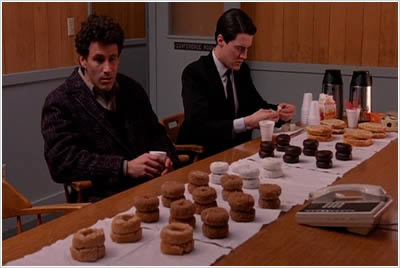
The first is Pete Martell serving Agent Cooper (Kyle MacLachlan) and Sheriff Truman (Michael Ontkean) fish-tainted coffee while Cooper and Truman are asking Josie (Joan Chen) about Laura Palmer (Sheryl Lee) tutoring her in English. Pete runs into the room, saying, “Fellas, don’t drink that coffee! A fish fell into the percolator!” Hours later, sitting at the Double R Diner, Cooper says that he still has “the taste of that fish-flavored coffee in my mouth.”
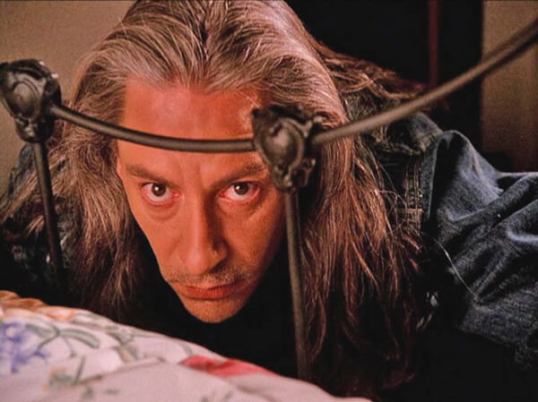
The other accident was Killer Bob, who makes his first appearance when Mrs. Palmer (Grace Zabriskie) has a vision of him in the corner of a room. Bob and his sudden appearances would become one of the best known things about Twin Peaks but, ironically, he wasn’t even a part of the show’s original conception. Bob was played by Frank Silva, a prop master and set decorator who was working on the pilot episode of Twin Peaks when David Lynch accidentally caught his reflection on camera. Lynch was so taken by the accidental image that he created the role of Killer Bob specifically for Silva. Silva made a strong and undeniable impression as the growling Bob but, unfortunately, it would be his only role as an actor. Silva died of AIDS in 1996, four years after appearing in Twin Peaks: Fire Walk With Me.
Frank Silva as Killer Bob
Traces to Nowhere was the first regular episode of the series, following the pilot. Probably in order to reassure nervous television executive and viewers who were on the fence about whether or not Twin Peaks was for them, this episode is more quirky than actively strange. A lot of time is devoted to the show’s more soapy plot threads, like the affairs between Ben Horne (Richard Beymer) and Catherine Martell (Piper Laurie) and Donna Hayward (Lara Flynn Boyle) and James Hurley (James Marshall) and the abusive marriage of Leo (Eric Da Re) and Shelley (Madchen Amick).
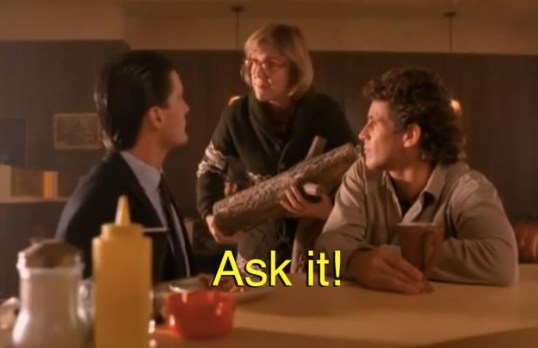
There are a lot of first in Traces to Nowhere. This is the episode where Audrey first talks to Cooper, Cooper first says that the Great Northern serves a “damn fine cup of coffee,” where Cooper first has a slice of cheery pie, and where Cooper first talks about Albert Rosenfield. This episodes also features the first mention of the Bookhouse Boys and, most importantly for fans of the series, the first appearance of Catherine Coulson as everyone’s favorite Log Lady. When the Log Lady first shows up and tells Cooper to ask her log who killed Laura Palmer, the character seems like just a throw away joke. But fans of the show know how important the Log Lady will become.
Catherine Coulson, was passed away in 2015, was the ex-wife of Jack Nance, who played Pete Martell. Coulson and Nance both worked with David Lynch on his first film, Eraserhead. It is said that during the shooting of Eraserhead, Lynch looked over at Coulson and said that he had just suddenly had a vision of her holding a log. (Nance and Coulson were not the only Eraserhead alumni to later appear on Twin Peaks. Charlotte Stewart, who played the weak mother of Bobby Briggs on Twin Peaks, earlier played Mary X, Nance’s strange girlfriend in Erasherhead.)
(In anticipation of the upcoming revival on Showtime, we’re rewatching and reviewing every single episode of the original Twin Peaks all through April! Enjoy!)
“She’s dead, wrapped in plastic.”
— Pete Martell (Jack Nance) in Twin Peaks 1.1 “The Pilot”
When I was thinking about how I was going to open this review of the pilot episode for David Lynch’s iconic (and soon to be revived television series), Twin Peaks, I thought that I would start with this simple statement:
Twin Peaks opens with tears.
Then I rewatched the pilot on Netflix and I discovered that I was actually very incorrect. Though I always think of the tears whenever I think of Twin Peaks, the pilot does not open with them. Instead, it opens in a very David Lynch-like fashion — with signs of normalcy while Angelo Badalmenti’s ominous theme music provides hints that all is not as safe as it seems.
Really, it’s silly to try to talk about the pilot of Twin Peaks without including the opening credits because, in their deceptively simple way, they really do provide a road map of what’s to follow:
The opening credits, with their mix of shrouded atmosphere, man-made machinery and seemingly placid nature, are about as Lynchian as you can get.
Then again, the town of Twin Peaks is about as Lynchian as you can get. Located only a few miles from the Canadian border in Washington State and surrounded by beautiful mountains and glorious wilderness, Twin Peaks is a town that seems strangely out of time. Twin Peaks takes place in 1990s but, at times, the town seems to be stuck in the 50s. Not the real 50s, of course. Instead, it’s the 1950s of television, movies, and the popular imagination. It’s a town where soulful loner James Hurley (James Marshall) wears a leather jacket and drives a motorcycle while teenage vixen Audrey Horne (Sherilyn Fenn) dresses like Natalie Wood in Rebel Without A Cause and waits until she’s safely at her locker to slip on a pair of red high heels. Audrey’s father, ruthless Ben Horne (Richard Beymer), makes plans to sell the town to the Norwegians while, at the local diner, wise Norma Jennings (Peggy Lipton) wearily watches over her customers. It’s a world that could only exist in a dream and what a dream it is.
So no, the pilot of Twin Peaks does not open with tears. Instead, it opens with Pete Martell (played by Jack Nance, the star of Lynch’s Eraserhead) going out to fish. He tries to get a kiss from his wife, Catherine (Piper Laurie), but is coolly — but not cruelly — rebuffed. One gets the feeling that this is a ritual that they go through every morning. It’s only after Pete has stepped outside that he sees the girl on the shore, naked and wrapped in plastic.
That girl, of course, is Laura Palmer (Sheryl Lee). The high school homecoming queen. The girl who did volunteer work. The girlfriend of football player Bobby Briggs (Dana Ashbrook). The daughter of Leland Palmer (Ray Wise), Ben Horne’s lawyer. The best friend of Donna Hayward (Lara Flynn Boyle) and the occasional rival of Audrey Horne. The secret girlfriend of James Hurley.
It’s after Laura is discovered that the tears begin and those tears dominate the first 30 minutes of this 90-minute pilot. Deputy Andy (Harry Goaz) is the first to cry. Laura’s mother (Grace Zabriskie) cries when she gets the news. Leland cries. Donna cries. At the high school, a girl runs by a window, screaming. The school principal announces that Laura has been found dead and breaks down into tears. Only a few people don’t cry. Ben doesn’t cry, knowing that a murder could ruin his business deal. Bobby doesn’t cry, even when he’s arrested under suspicion of having committed murder. (He was the last person known to have been with Laura.) Audrey doesn’t cry and instead, appears to faintly smile at the chaos around her.
And Sheriff Harry S. Truman (Michael Ontkean) doesn’t cry. However, that’s to be expected. Harry is the rock on which Twin Peaks is built, both as a show and town. He’s the least quirky character in the series. He is law and order. He’s got a murder to solve and making things even more urgent is that a classmate of Laura’s, Ronette Pulaski, is also missing.
The first 37 minutes of the pilot do a perfect job of establishing both the town and it’s inhabitants. Everyone has a secret. Everyone has a motive. Along with those that I’ve already mentioned, we also meet waitress Shelly (Madchen Amick), who is married to an abusive trucker named Leo (Eric Da Re) and who is having an affair with Bobby. We meet Bobby’s best friend and fellow football player, a real idiot named Mike (Gary Hershberger). We meet Donna’s father, Doc Hayward (Warren Frost). We meet the police dispatcher, the sweetly off-center Lucy (Kimmy Robertson). We meet Deputy Hawk Hill (Michael Horse) who is as stoic as Andy is emotional. We meet James’s uncle, Ed Hurley (Everett McGill) and Ed’s one-eyed, drapery-obsessed wife, Nadine (Wendy Robie). We meet Josie Packard (Joan Chen), who inherited the mill from her late husband and who is secretly Harry’s lover.
And, after Ronette is discovered wandering, zombie-like on a bridge, we meet FBI Special Agent Dale Cooper (Kyle MacLachlan). More than anything else, Cooper is who people think of whenever they think of Twin Peaks. MacLalchlan plays the quirky FBI agent with just the right combination of earnestness and eccentricity. Speaking into his ever-present tape recorder and praising everything from the trees to the pie to the coffee, Cooper quickly establishes himself as the perfect man to figure out what’s going on in Twin Peaks.
David Lynch once famously described his previous collaboration with MacLachlan, Blue Velvet, as being the “Hardy Boys Go To Hell,” and the same can be said of Twin Peaks. If the first 37 minutes of the pilot were dominated by sadness and secrets, the final 60 are dominated by Dale Cooper’s enthusiasm and cheerful positivity. The town may be strange but Dale loves the trees. Dale may be investigating horrible and brutal crimes but at least he’s found a good slice of pie and damn fine cup of coffee.
“You know why I’m whittling?” Dale asks Harry at one point. “Because that’s what you do in a town where a yellow light means slow down instead of speed up.” Dale smiles after he says it. It doesn’t take him long to fall in love with Twin Peaks.
Throughout the rest of the pilot, we get more hints of a world that’s threatening to spin off of its axis. Dale and Harry run into Dr. Lawrence Jacoby (Russ Tamblyn, who co-starred with Richard Beymer in West Side Story), who was Laura’s psychiatrist and appears to be in need of some therapy himself. When they look at Laura’s body in the morgue, the lights flicker on and off. When Dale finds a scrap of newspaper — featuring the letter “R” — underneath Laura’s fingernail, he grins as if he’s just made it through his first Communion. When Harry and Dale go to the local bank, a moose’s head just happens to be lying on the table in the conference room. It fell, they’re told. Despite all the strangeness, they go about their business. They’ve got a murder to solve.
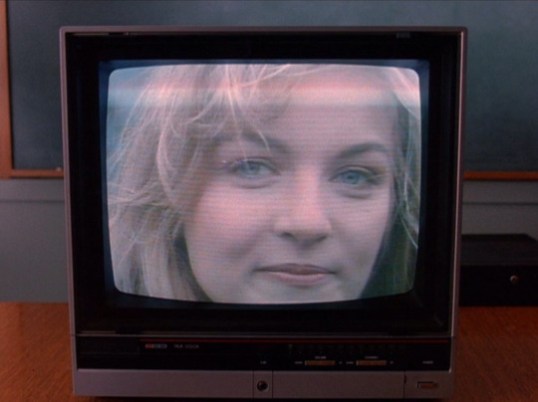
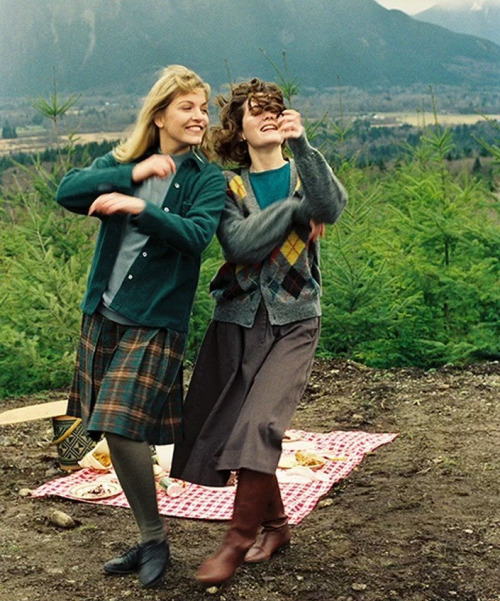
“Mr. Cooper,” Harry says, at one point, “you didn’t know Laura Palmer.” But, as quickly becomes obvious, no one knew Laura Palmer. No one, for instance, knew that she was doing cocaine. And Bobby didn’t know that she was seeing James, or at least he doesn’t until he watches a video that Donna, James, and Laura shot inn the mountains over looking the town. Laura, who we’ve previously just seen as a dead body, is so happily alive in that video that it’s a bit jarring to see her. You half expect her to come out of the TV, like the girl in The Ring. The video ends with her smiling, as if she’s daring both Cooper and the show’s viewers to try to figure out who she actually was. Only later is it revealed that, in a plot twist reminiscent of Dario Argento’s Four Flies on Grey Velvet, James’s motorcycle is reflected in Laura’s eye.
Life goes on in Twin Peaks. Audrey, the character to whom I most relate whenever I watch this show, sits in her father’s hotel and penetrates a styrofoam cup of coffee with a pencil. “What would happen if I pulled this out?” she asks before doing just that. Audrey walks into the hotel’s conference room and tells the Norwegians that she’s feeling sad because her best friend was just brutally murdered, destroying her father’s business deal. (“The Norwegians are leaving! The Norwegians are leaving!” a hotel concierge vainly yells.)
(Perhaps not coincidentally, Norway was also the home of Henrik Ibsen, whose theatrical melodramas often dealt with many of the same themes — greed, infidelity, the corruption that comes with progress — that are present in Twin Peaks. An Enemy of the People could have just just as easily taken place in the American Northwest.)
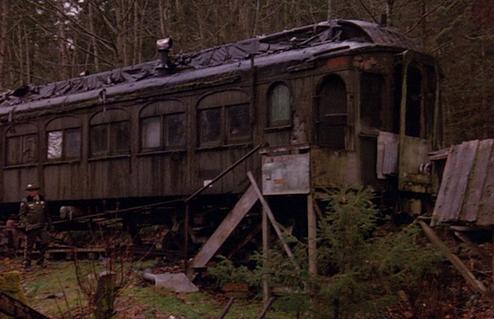
Meanwhile, the local police come across the abandoned railroad car where Laura was murdered and Ronnette raped. Andy calls the sheriff’s office, in tears. “Tell Harry I didn’t cry,” he begs Lucy, “but it’s so horrible!” It’s a moment of very real humanity in the middle of this odd and disturbing mystery. When Andy begs Lucy not to reveal his very human reaction, it’s more than just shame on his part. It’s an indication that perhaps the only way to solve this mystery is to sacrifice one’s emotions.
And, as Andy said, it is horrible. When Dale and Harry walk through that railway car, we are reminded that, as quirky at the show may be, a very disturbing crime is still at heart of it. Among other things, they find a half-heart necklace (the other half is with James) and, written in blood in the debris, a message: “Fire Walk With Me.” As disturbing as this is in the pilot (and this scene really is Lynch at his best), it’s even more disturbing if you know who will ultimately be revealed to have been Laura’s murderer. But that information will have to wait for a later review.
It easy to believe that arrogant Bobby Briggs killed Laura but Cooper only has to talk to him for a few minutes to realize that he didn’t do it. Bobby may be a jerk and a drug dealer. And Cooper is surely correct when he says that Bobby never loved Laura. But Bobby is a bully, not a murderer. When Bobby is released, he and Mike go looking for James. As unlikable as Bobby is, Mike — with his blonde hair and all-American looks — is somehow even worse. At least Bobby is open about being an bad guy. Mike hides his darker instincts behind a carefully cultivated facade of blandness. Looking at Mike in his red letterman jacket, you really do want someone to claw his eyes out.
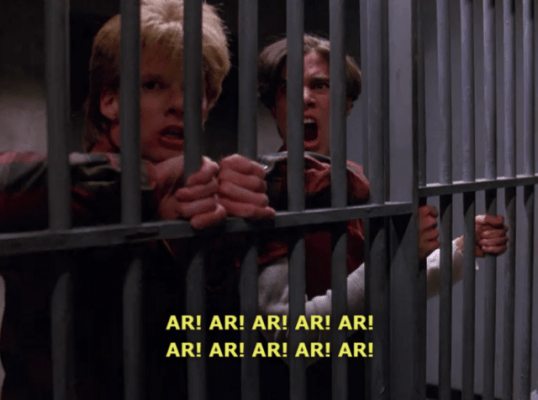
Mike and Bobby look for James at the Roadhouse, one of the most important locations in Twin Peaks. It’s a place where illicit lovers (like Norma and Ed) meet and where Julee Cruise sings haunting songs. Bobby and Mike may not find James but they do find a fight with Ed. This leads to Bobby and Mike spending the night in jail, which, ironically, is where they eventually find James. James has been arrested as a suspect in the death of Laura Palmer. In their cell, Bobby and Mike start to bark like wild dogs.
And so, a pilot that started with the humanity of tears ends with animalistic howls of anger, hate, and jealousy.
And so, Twin Peaks begins.
If I haven’t already made it clear, I am huge fan of the pilot for Twin Peaks. Say what you will about where the series eventually went, the pilot was and remains an absolutely brilliant dream of dark and disturbing things. Having rewatched the pilot, I am definitely looking forward to rewatching the rest of the series for this site and I hope you’ll enjoy the rest of our reviews!
Tonight’s excursion into televised horror is a pretty good one. Carrion Death, which originally aired on June 15th, 1991, was the second episode of the third season of HBO’s Tales From The Crypt.
Kyle MacLachlan plays a serial killer named Earl Raymond Digs. After Earl escapes from custody, he finds himself stuck in the middle of the desert, handcuffed to a corpse. As Earl walks through the desert, dragging a corpse alongside him, he discovers that he’s being watched…
Carrion Death is a gory, little story that has an enjoyably nasty little ending. Kyle MacLachlan does a surprisingly good job as the dangerous but none too bright Earl. And, of course, there’s the bird. That bird does a great job…
Remember how, in the 1990s, every aspiring indie director tried to rip off Quentin Tarantino by making a gangster film that mixed graphic violence with quirky dialogue, dark comedy, and obscure pop cultural references? That led to a lot of terrible movies but not a single one (not even Amongst Friends) was as terrible as Mad Dog Time.
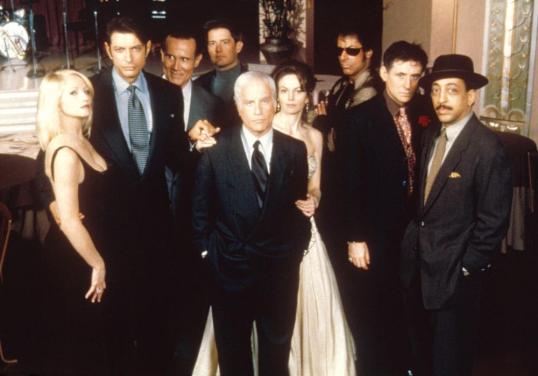
That Mad Dog Time was terrible should come as no surprise. Most directorial debuts are. What made Mad Dog Time unique was the sheer amount of talent that was assembled and wasted in the effort to bring this sorry movie to life. As the son of Joey Bishop, director Larry Bishop was Hollywood royalty and was able to convince several ridiculously overqualified actors to play the thinly drawn gangsters and rouges who populated Mad Dog Time. Much like the Rat Pack movies that his father once starred in, Larry Bishop’s debut film was full of familiar faces. Some of them only appeared for a few seconds while others had larger roles but they were all wasted in the end. Hopefully, everyone was served a good lunch in between filming their scenes because it is hard to see what else anyone could have gotten out of appearing in Mad Dog Time.
Mob boss Vic (Richard Dreyfuss) has just been released from a mental hospital. With the help of his main enforcer, Mick (Jeff Goldblum), and a legendary hitman named Nick (Larry Bishop, giving not only the worst performance in the film but also the worst performance of the 1990s), Vic is going to reassert his control over the rackets. Vic also wants to find his former mistress, Grace Everly (Diane Lane) but he doesn’t know that Grace is now with Mick and that Mick is also having an affair with Grace’s sister, Rita (Ellen Barkin).
(Grace and Rita are the Everly Sisters! Ha ha, between that and all the rhyming names, are you laughing yet?)
Ben London (Gabriel Byrne) has taken over Vic’s nightclub and, while singing My Way with Paul Anka, tells Vic that he should take an early retirement because he’s a paranoid schizophrenic. Before he can deal with Ben, Vic has to kill all of his other rivals, all of whom are played by actors like Michael J. Pollard, Billy Idol, Kyle MacLachlan, Gregory Hines, and Burt Reynolds. The bodies start to pile up but Jimmy the Undertaker (Richard Pryor, looking extremely frail in one of his final roles) is always around to make sure that everyone gets a proper burial.
And there are other cameos as well. Joey Bishop is the owner of a mortuary. Henry Silva is wasted as one the few gangsters to stay loyal to Vic. Christopher Jones, who previously co-starred with Larry Bishop and Richard Pryor in Wild In The Streets before dropping out of a society, plays a hitman who pretends to be Nick Falco. Even Rob Reiner shows up a limo driver who talks too much.
Almost every poorly paced scene in Mad Dog Time plays out the same way. Three or more men confront each other in a room. Hard-boiled dialogue is exchanged for an interminable length of time until someone finally gets shot. You would think, at the very least, it would be watchable because of all the different people in the cast but none of the actors really seem to be into it. Richard Dreyfuss and Jeff Goldblum resort to smirking through their scenes while Gabriel Byrne often appears to be drunk. Whenever he’s in a scene, Burt Reynolds seems to be trying to hide his face and it is hard to blame him. There were many terrible movies released in the 90s but none were as bad as Mad Dog Time.
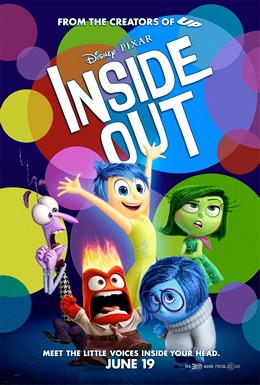
Inside Out is the latest brilliant film from Pixar’s Pete Docter and it will remind you why you fell in love with Pixar in the first place.
There are no talking cars or lovable monsters in Inside Out. Instead, it’s the story of a very normal 12 year-old girl named Riley (voiced by Kaitlyn Dias). Or rather, it’s the story of what goes on in her head. For most of the movie, Riley deals with experiences to which we can all relate: she moves to a new city, she struggles to relate to her well-meaning parents (voiced by Kyle MacLachlan and Diane Lane), and she tries to fit in at a new school. Inside Out is a film about the small moments of life and how they all add up to create a bigger picture.
What sets Inside Out apart is the way that it tells its deceptively simple story. Inside Out takes place almost entirely inside of Riley’s brain. And it turns out that her mind is gigantic wonderland, one that is so big and complex that not even the characters who live there quite understand how it all works. Bing Bong (Richard Kind), a pink half-elephant, half-cat, half-dolphin creature, spends his time wandering through the halls of memory and mournfully thinking back to when he was Riley’s imaginary friend. Whenever Riley goes to sleep, the actors and directors at Dream Productions film a different nightly movie. Meanwhile, Imagination Land is a fun place to visit but not a good place in which to live and past childhood traumass — like a gigantic stalk of broccoli and a terrifying birthday clown — are locked away deep in Riley’s subconscious, where they are guarded by officious policemen. Zigzagging through this mental landscape is the literal Train of Thought.
And then, above it all, there’s Headquarters. This is where five different emotions take turns “steering” Riley through life. Fear (Bill Hader) is always nervous but, at the same time, keeps Riley safe. Disgust (Mindy Kaling) prevents Riley from eating broccoli and hanging out with the wrong crowd. Sadness, meanwhile, hasn’t had much to do over the past 12 years and, as a result, she spends most of her time standing in a corner and feeling … well, sad. Sadness is voiced by Phyllis Smith, best known for playing Meredith on The Office. Smith proves herself here to be a strong and empathetic voice artist.
Their unquestioned leader is Joy (Amy Poehler). As befits her name and job, Joy is always positive, always upbeat, and always optimistic. For 12 years, Joy has been in charge of steering Riley’s life but that all changes when Riley and her family move to San Francisco. Suddenly, Joy finds it more difficult to keep Riley permanently happy. Memories that were formerly color-coded yellow for happy start to turn blue.
When both Joy and Sadness are accidentally expelled from the Headquarters, it’s up to the three remaining emotions to try to keep Riley well-balanced until they can return. However, the journey back up to the Headquarters is a long and dangerous one, full of some of the most imaginative (and metaphorical) imagery in Pixar’s history. Joy and Sadness will have to work together to make it.
And really, that’s what makes Inside Out so special. It’s the rare family film that acknowledges that allowing ourselves to feel sad is often as important as being happy.
Inside Out is a brilliant coming-of-age story and one of the best films of the year. It’s a film that will make you laugh and cry and will remind you of why you fell in love with Pixar in the first place. Kids will love the humor and adults … well, adults will probably be trying to hold back the tears.
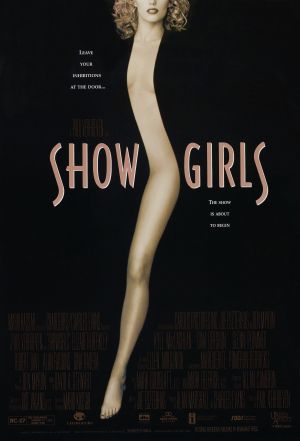
Showgirls in the 1995 film that, 20 years after it was first released, is still held up as the standard by which all subsequent bad films are judged. The story behind the production is legendary. Screenwriter Joe Ezsterhas was paid a then-record sum to write a script that ripped off All About Eve and featured lines like, “Come back when you’ve fucked some of that baby fat off,” and “You’re the only who can get my tits poppin’ right!” (And let’s not forget the heroine’s oft-repeated catch phrase, “It doesn’t suck.”) A major studio specifically hired Paul Verhoeven with the understanding that he was going to give them an NC-17 rated film. And finally, the lead role was given to Elizabeth Berkley, an actress whose previous experience amounted to co-starring on Saved By The Bell.
(And, let’s be honest, the only reason Jessie Spano was a tolerable character was because she wasn’t Screech.)
Berkley plays Nomi Malone, a sociopath who wants to be a star. She hitchhikes her way to Las Vegas where, as is destined to happen to anyone who shows up in Vegas or New York with a clunky suitcase, she is promptly robbed of all of her possessions. “Fuck! Fuck! Fuck! Fuck!” she yells, showing off the very expensive dialogue that was written for her by Joe Ezsterhas. Eventually, Nomi starts to take her frustration out on a random car. The car, it turns out, belongs to sweet-natured Molly (Gina Revara), who is a seamstress for a tacky Vegas show called Goddess.
(Seriously, Goddess makes Satan’s Alley from Staying Alive look like a work of quiet genius.)
Soon, Nomi is living in Molly’s trailer and working as a stripper at the Cheetah Club. The Cheetah Club is owned by Al, who is amazingly sleazy but who is also played by Robert Davi. Robert Davi is one of those actors who knows how to make terrible dialogue interesting and it’s instructive to watch him perform opposite Elizabeth Berkley and the rest of the cast. Whereas the majority of the cast always seems to be desperately trying to convince themselves that their dialogue is somehow better than it actually is, Davi knows exactly what he’s saying. Watching his performance, it’s obvious that Davi understood that he was appearing in a bad film so he figured that he might as well enjoy himself.
The same can be said of Gina Gershon, who plays Cristal Connors, the star of Goddess. Sexually voracious Cristal is basically a male fantasy of what it means to be bisexual. Cristal hires Nomi to give a lapdance to her sleazy boyfriend, Zack (Kyle MacLachlan, giving a good performance despite having to spend the entire film with hair in his eyes) and then arranges for her to be cast in the chorus of Goddess. There’s absolutely nothing subtle about Gershon’s performance and that’s why it’s perfect for Showgirls. It’s been argued that Showgirls is essentially meant to be a huge in-joke and, out of the huge cast, only Gershon, Davi, and occasionally MacLachlan seem to be in on it.
Certainly, it’s apparent that nobody bothered to tell Elizabeth Berkley. Berkley gives a performance of such nonstop (and misdirected) intensity that you end up feeling sorry for her. She’s just trying so hard and she really does seem to think that she can somehow make Nomi into a believable character. And it’s actually a bit unfair that Elizabeth is always going to be associated with this film because I doubt any actress could have given a good performance in a role as inconsistently written as Nomi. One second, Nomi is a wide-eyed innocent who is excited about living in Las Vegas. The next second, she’s screaming, “FUCK OFF!” and threatening strangers with a switch blade. She may be a survivor (and I imagine that’s why we’re supposed to root for her) but she’s also humorless, angry, and apparently clinically insane.
Hilariously, we’re also continually told, by literally everyone else in the movie, that she’s a great dancer, despite the fact that we see absolutely no evidence of this fact. Check out this scene below, where Nomi dances with a lot of enthusiasm and little else.
Once Nomi is cast in Goddess, she promptly sets out to steal both the starring role and Zack from Cristal. Nomi’s cunning plan, incidentally, amounts to fucking Zack in his pool and shoving Cristal down a flight of stairs. Nomi’s finally a star but when a Satanic rock star named Andrew Carver (William Shockley) comes to town, Nomi is confronted with the sordid truth about Las Vegas and, because this long film has to end at some point, Nomi must decide whether to take a stand or…
Well, you can guess the rest.
(Incidentally, I like to assume that Andrew Carver was meant to be a distant cousin of the great short story writer Raymond Carver.)
There seems to be two schools of thought when it comes to Showgirls.
Some critics claim to Showgirls is just crap. They say that it’s a terrible film with bad dialogue, bad acting, and terrible direction. These critics view Joe Eszterhas as being the villain of this tale, a misogynist who conned the studios into paying two million dollars for a terrible script.
And then other critics claim that Showgirls is crappy on purpose. They claim that Verhoeven meant for the film to be a satire of both American culture and Hollywood showbiz dramas. For these critics, Verhoeven used Eszterhas’s terrible script and Elizabeth Berkley’s inexperience to craft a subversive masterpiece.
Myself, I fall somewhere in between. Based on Verhoeven’s other films — Starship Troopers comes immediately to mind — I think his intent with Showgirls probably was meant to be satirical and subversive. But, at the same time, I would argue that Verhoeven’s intent doesn’t change the fact that Showgirls is a surprisingly boring film. For all the sex and the nudity and the opulent costumes and sets and all of the over-the-top dialogue, Showgirls is never really that interesting of a film. It barely even manages to reach the level of being so-bad-that-it’s-good. Instead, it’s slow, it’s draggy, and — satiric or not — the bad performance, the bad dialogue, and the nonstop misogyny get a bit grating after a few minutes.
Of course, that’s why you should never watch Showgirls alone. Showgirls is a film that you have to watch as a part of a group of friends so that you can all laugh together and shout out snarky comments. The first time I ever saw Showgirls was at a party and it was a lot of fun. But, for this review, I rewatched the film on Netflix and I was surprised by how much of a chore it was to sit through the entire running time. This is one of those films — like Birdemic and The Room — that you have to watch with a group. You watch for the experience, not the film.
From David Lynch’s 1986 “mystery” Blue Velvetcomes this scene. Frank Booth (Dennis Hopper) visits Ben (Dean Stockwell), who, we’ve been told previously, is “one suave fucker.” Ben proceeds to prove it by “performing” In Dreams. On just the basis of sheer perversity, this is one of the greatest scenes in film history. Also appearing in this scene — the daughter of Ingrid Bergman (Isabella Rossellini), an actor who would play bad husbands on not only Sex and the City but Desperate Housewives as well (Kyle MacLachlan), an actor who had previously appeared in One Flew Over the Cuckoo’sNest and would later show up in The Two Towers (Brad Dourif), and my very distant cousin, the late, great Jack Nance.
(Jack is the little man with the mustache and the hat. He had the title role in Lynch’s first film, Eraserhead.)



 Remember how, in the 1990s, every aspiring indie director tried to rip off Quentin Tarantino by making a gangster film that mixed graphic violence with quirky dialogue, dark comedy, and obscure pop cultural references? That led to a lot of terrible movies but not a single one (not even Amongst Friends) was as terrible as Mad Dog Time.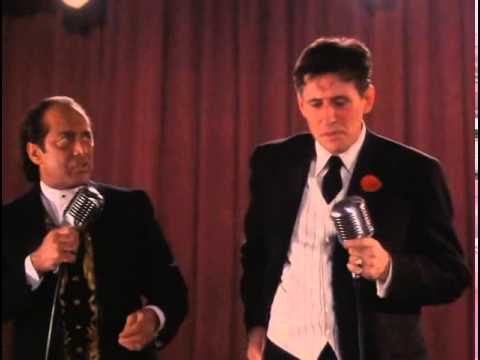
 Through the Shattered Lens