So, guess what I did earlier today? That’s right — I put on a blindfold, a stumbled over to my ever-growing DVD, Blu-ray. and even VHS collection and I randomly selected 12 films!
Why did I do this?
I did it so you, the beloved readers of Through the Shattered Lens, could once again have a chance to tell me what to do. At the end of this post, you’ll find a poll. Hopefully, between now and next Sunday (that’s August 21st), a few of you will take the time to vote for which of these 12 films I should watch and review. I will then watch the winner on Sunday and post my review on Monday night. In short, I’m putting the power to dominate in your hands. Just remember: with great power comes great … well, you know how it goes.
Here are the 12 films that I randomly selected this afternoon:
Abduction — From 1975, this soft-core grindhouse film is based on the real-life abduction of Patty Hearst and was made while Hearst was still missing. Supposedly, the FBI ended up investigating director Joseph Zito to make sure he wasn’t involved in the actual kidnapping.
Aguirre, The Wrath of God — From director Werner Herzog and star Klaus Kinski comes this story about a Spanish conquistador who fights a losing battle against the Amazon.
Black Caesar — In one of the most succesful of the 70s blaxploitation films, Fred Williamson takes over the Harlem drug trade and battles the mafia.
Don’t Look Now — Donald Sutherland and Julie Christie are a married couple who attempt to deal with the death of their daughter by going to Venice, Italy. Christie quickly falls in with two blind psychics while Sutherland pursues a ghostly figure in a red raincoat through Venice. Directed by Nicolas Roeg.
The Lion In Winter — From 1968, this best picture nominee stars Peter O’Toole and Katharine Hepburn as King Henry II and his wife, Eleanor of Aquitaine. Taking place on Christmas Eve, Henry and Eleanor debate which one of their useless sons will take over a king of England. This film is also the feature debut of both Anthony Hopkins and Timothy Dalton.
Logan’s Run— From 1976, this sci-fi film features Michael York and Jenny Agutter as two future hedonists seeking Sanctuary and instead finding Peter Ustinov and a bunch of cats. Filmed in my hometown of Dallas.
Lost Highway — From director David Lynch comes this 1997 film about … well, who knows for sure what it’s about? Bill Pullman may or may not have killed Patricia Arquette and he may or may not end up changing into Balthazar Getty.
Mystic River— From director Clint Eastwood comes this film about murder, guilt, redemption, and suspicion in working-class Boston. Starring Sean Penn, Kevin Bacon, and Tim Robbins.
Naked Massacre — From 1976, this stark film is something a grindhouse art film. It takes the true life story of Chicago mass murderer Richard Speck and transfers the action to Belfast. Also known as Born for Hell.
Night of the Creeps— From 1986, this film features alien slugs that turn an entire college campus into a breeding ground for frat boy zombies. Tom Atkins gets to deliver the classic line: “Well don’t go out there…”
Petulia — Considered by many to be one of the best American films ever made and one of the definitive films of the 60s, Petulia tells the story of a divorced doctor (George C. Scott) who enters into an odd relationship with Julie Christie. Directed by Richard Lester, this film also stars Joseph Cotten, Richard Chamberlain, and the Grateful Dead.
What Have You Done To Solange? — From 1975, What Have You Done To Solange is a classic giallo that features dream-like murders, disturbing subtext, and one of the best musical scores of all time.
So, there’s your 12 films. Vote once, vote often, have fun, and I await your decision.
To me, this first offering actually feels more like a parody trailer (like Machete or Hobo With A Shotgun) than an actual trailer. But no, Sweet Jesus Preacherman appears to be an actual film.
This was directed by James Glickenhaus, who directed The Exterminator. According to the commentary track on one of the 42nd Street Forever DVDs, Glickenhaus felt that The Soldier would help him break into mainstream films and, though I’m not a huge fan of action movies, the trailer does look fairly exciting. Plus, if you watch the whole without blinking, you might catch a split-second appearance from Klaus Kinski. Supposedly, Kinski was offered a role in both this film and Raiders of the Lost Ark. Kinski chose to appear in The Soldier.
Speaking of Klaus Kinski, he’s also featured in our next trailer, The Great Silence. Directed by Sergio Corbucci, The Great Silence has been acclaimed as one of the greatest spaghetti westerns of all time. This film’s title refers to the fact that the nominal hero (played by Jean-Louis Trintignant) is a mute. The trailer also features Ennio Morricone’s excellent score.
There were actually two versions of this film — an explicit one and a slightly less explicit one. I’m guessing this trailer was used to advertise the slightly less explicit version.
In this film, William Shatner, Eddie Albert, Tom Skerritt, and Ida Lupino battle Satanists (and Ernest Borgnine) in New Mexico. Though he’s not mentioned in the trailer, John Travolta made his film debut here. He plays a member of Borgnine’s cult. This trailer — with its promise of the greatest ending of all time — is a drive-in classic.
Let’s end how we began, with a blaxploitation trailer. I do have to say that, as a character, Dolemite looks a bit more interesting that Sweet Jesus Preacherman. Plus, the Dolemite trailer rhymes.
Remember that Monday is Memorial Day so, if nothing else, take a few minutes to remember the men and women who have fought to allow us to live in a country where we can watch movies like Dolemite, Flesh Gordon, and Sweet Jesus Preacherman.
How can I be your dream? Because even though I’m currently all the way in Arlington, celebrating my niece’s 3rd birthday (Happy Birthday, Shannon! — that’s the cool thing about the Internet, this’ll still be here in the future for her to read), I still made the time to put together this weekend’s edition of Lisa Marie’s Favorite Grindhouse and Exploitation Trailers. And I can be your nightmare because … well, that’s my little secret.
Several posts ago, I featured a trailer for a movie called Death Has Blue Eyes. (I love that title, by the way. I’m going to call my autobiography Lisa Marie Has Mismatched Eyes.) Judging from the trailer, this movie could have been called Evil Will Have Wide Lapels. Speaking of eyes, this is yet another movie from 1980 to feature someone shooting beams from her eyes. Apparently, eye beams were a big deal in the early 80s.
For example, The Dark came out in 1979 and what does it feature? That’s right — laser beams being shot from the eyes. Seriously, was this a metaphor for all the cocaine that I’ve heard people were snorting back then?
Films in the 70s and the early 80s were apparently not just obsessed with aliens shooting lasers from their eyes. They were also obsessed with character actor Keenan Wynn. He was featured in The Dark and, that same year, he was also featured in Parts: The Clonus Horror. As for Clonus Horror, I’m guessing that it must be a grindhouse version of one of last year’s best films, Never Let Me Go.
Speaking of clones, here’s the trailer for The Clones. Now, some people have claimed that this might be the most boring trailer ever but I kinda like it just because I think the constant switching from the overly dry voice over to the more surreal scenes of the film creates a kinda neat effect. Believe it or not, I actually have a battered old VHS copy of this film. And it’s not half bad. It ends with this really neat gunfight at an abandoned amusement park that — for some reason — just happens to be sitting out in the middle of Death Valley. Oh, and John Drew Barrymore is in it, acting like John Drew Barrymore. (I also love the fact that apparently, cloning was such a new concept at this point that the trailer had to include a guide to make sure people understood how to properly pronounce the word.)
Actually, I guess the 70s most have been scary all around because apparently, not even Hal Holbrook was safe. I’ve heard good things about this movie though I’ve never actually seen it. I know Code Red announced a DVD release but is Code Red even in business anymore? It’s difficult to keep track. Anyway, this looks like a good movie to have on hand if I ever have to justify why I don’t camp.
6) Venus In Furs (196?)
Well, the 70s are pretty icky, huh? Maybe it’d be better if we took our cinematic time machine back to the 60s, when this adaptation of the Marquis De Sade’s Venus in Furs was apparently made and released. I don’t know much about this film beyond the fact that it is not to be confused with Jess Franco’s Venus in Furs, which starred James Darren and Klaus Kinksi.
Before I talk about this trailer, allow me to share a few facts: my family used to live in Fouke, Arkansas! I’ve been down to Boggy Creek! I never saw the famous Fouke Monster but I went out looking for him a few times! Anyway, this is the trailer for The Legend of Boggy Creek, which is a documentary about an apeman that supposedly lives in the area (though, according to Wikipedia, he hasn’t been spotted since ’98 so maybe he drowned or moved to Missouri). This film is somewhat infamous because it features reenactments of various monster sightings, some of which star people who actually lived in Fouke at the time and who play themselves (and a few of them later sued once the film came out). It was also the first film directed by Charles B. Pierce, who directed a lot of independent films in Arkansas and North Texas, including the classic The Town That Dreaded Sundown. Sadly, Pierce passed away last year at the age of 71.
This is one of those trailers that I discovered while randomly searching Youtube and, I have to be honest, my first thought was that it was a parody trailer. But no, after researching the manner, I can say that Mean Mother is a real movie. It was apparently yet another one of the cinematic offerings of the late Al Adamson.
This Italian film is one of the countless Omen/Exorcist rip-offs that came out in the 70s. Actually, The Night Child is an indirect rip-off of those two films as it’s actually a rip-off of a previous Italian version of the Exorcist, Beyond The Door. What I especially love about this trailer is the “Keeping telling yourself, she’s only a child,” line which is obviously meant to recall the “Keep telling yourself, it’s only a movie…” tagline from Last House On The Left.
“Meet today’s women…beautiful, liberated, and ready for action! They’re the young nurses and they’re growing up fast!” I love the narrator of this trailer. I’ve heard his voice in several exploitation trailers from the early 70s and he just has a way of delivering the sleaziest lines in the most cheerful, harmless way. I’d love to know who he was and if he’s still with us.
Oh. My. God. Okay, I saw this movie a few years ago and I was watching it by myself at 3 in the morning with all the lights off while there was a thunderstorm going on outside and there was this howling wind that kept on making all the windows shake. I got so scared, it’s not even funny. This is a remake of the silent classic. It stars Klaus Kinski, Bruno Ganz, and Isabelle Adjani and was directed by the one and only Werner Herzog.
“Why don’t you come along and see me this week? And bring your girlfriend…” This trailer was specifically designed to promote this film in Australia. Needless to say, that’s not actually Sylvia Kristel providing the voice over.
Sometimes, believe it or not, I feel very insecure when I come on here to talk about movies because, unlike most of my fellow writers and the site’s readers, I’m actually pretty new to the world of pop culture and cult films. Up until 8 years ago, ballet was my only obsession. It was only after I lost that dream that I came to realize that I could feel that same passion for other subjects like history and writing and movies. In those 8 years, I think I’ve done a fairly good job educating myself but there’s still quite a bit that I don’t know and, at times, I’m almost overwhelmed by all the movies that I’ve read so much about but have yet to actually see. And don’t even get me started on anime because, honestly, my ignorance would simply astound you. What I know about anime — beyond Hello Kitty — is pretty much limited to what I’ve read and seen on this site. (I do know what a yandere is, however. Mostly because Arleigh explained it to me on twitter. I still don’t quite understand why my friend Mori kept using that as her own personal nickname for me back during my sophomore year of college but that’s a whole other story…)
The reason I started soul searching here is because I’m about to review a book — The Eurospy Guide by Matt Blake and David Deal — that came out in 2004 and I’m about to review it as if it came out yesterday. For all I know, everyone reading this already has a copy of The Eurospy Guide in their personal collection. You’ve probably already spent 6 years thumbing through this book and reading informative, lively reviews of obscure movies. You may already know what I’ve just discovered. Well, so be it. My education is a work in progress and The Eurospy Guide has become one of my favorite textbooks.
The Eurospy Guide is an overview of a unique genre of films that started in the mid-60s and ended with the decade. These were low-budget rip-offs — the majority of which were made in Italy, Germany, and France — of the Sean Connery-era James Bond films. These were films with titles like Code Name: Jaguar, Secret Agent Super Dragon, More Deadly Than The Male, and Death In a Red Jaguar. For the most part, they starred actors like George Nader, Richard Harrison, and Eddie Constantine who had found the stardom in exploitation cinema that the mainstream had never been willing to give to them. They featured beautiful and underappreciated actresses like Marilu Tolo and Erika Blac and exotic, over-the-top villainy from the likes of Klaus Kinski and Adolfo Celi. Many of these films — especially the Italian ones — were directed by the same men who would later make a name for themselves during the cannibal and zombie boom of the early 80s. Jess Franco did a few (but what genre hasn’t Jess Franco experimented with) and even Lucio Fulci dabbled in the genre. Their stories were frequently incoherent and, just as frequently, that brought them an undeniably surreal charm.
And then again, some of them were just films like Operation Kid Brother, starring Sean Connery’s younger brother, Neil. (Operation Kid Brother was an Italian film, naturally.)
Well, all of the films — from the good to the bad (and no, I’m not going to add the ugly) — are covered and thoroughly reviewed in The Eurospy Guide. Blake and Deal obviously not only love these films but they prove themselves to be grindhouse aficionados after my own heart. Regardless of whether they’re reviewing the sublime or the ludicrous, they approach each film with the same enthusiasm for the potential of pure cinema run amuck. It’s rare to find reviewers who are willing to pay the same respect to a film like The Devil’s Man that they would give to a sanctioned classic like The Deadly Affair.
Along with reviewing a countless number of films, Deal and Blake also include two great appendices in which they detail the review some of the film franchises that came out of the genre and provide biographies of some of the more prominent stars of the eurospy films.
The highest compliment I can pay to The Eurospy Guide is that, even with all the various films guides I own (and I own a lot), I found films reviewed and considered in this book that I haven’t found anywhere else. Everytime I open this book, I learn something that, at least to me, is new. The book was an obvious labor of love for Blake and Deal and I love the results of their labor.
1) Simon, King of the Witches— I’ve never seen this film but I caught this trailer on one of the 42nd Street compilation DVDs. It doesn’t really make me want to see the film but I love the trailer because it is just so totally and utterly shameless. Seriously, could this thing be more early 70s? As well, I’ve always wondered — would witches actually have a king? I mean, seriously, get with the times.
The film, by the way, stars Andrew Prine who apparently had a really promising film career until his girlfriend, Karyn Kupicent, died mysteriously in 1964. A lot of people believed that Prine killed her though he always denied any guilt and there’s really no evidence to connect him to the crime. Interestingly, even more people seem to think that Kupicent was murdered because she knew something about John F. Kennedy’s assassination. Finally, true crime author Steve Hodel has suggested that Kupicent was actually murdered by his father, Dr. George Hodel. (Steve also claims that George was the Black Dahlia killer, the Zodiac killer, Chicago’s lipstick killer, and that George was responsible for just about every unsolved murder in history. Oedipus much?)
2) The Town That Dreaded Sundown — Though I didn’t consider this while selecting this trailer, this is another film that features the unfortunate Robert Prine. I’ve seen this film exactly one time when it showed up on late night television once. Unfortunately, considering that it was 4 in the morning and the movie was obviously heavily edited for television (not to mention that constant commercial interruptions), I didn’t really get to experience the film under ideal circumstances. As a result, I’ve been trying to track this movie down on DVD ever since. It’s not an easy film to find.
One of the reasons this movie fascinates me is because it’s not only based on a true unsolved crime but it actually follows the facts of the case fairly closely. In the late 40s, Texarkana was stalked by a masked gunman known as the Phantom Killer. The case was never solved and its gone on to become a bit of a local legend in the rural Southwest. Part of my interest in this case comes from the fact that I grew up in the rural Southwest. It’s the part of the country I know best and this film was actually filmed in the southwest as opposed to just an arid part of Canada. Interestingly enough, the Phantom Killer had a lot of similarities to the later Zodiac Killer. However, as far as I know, Steve Hodel has yet to accuse his father of haunting Texarkana.
The film itself was made by Charles B. Pierce, a filmmaker who was based in Arkansas and made several independent films in that state. Perhaps this explains why the trailer refers to “Texarkana, Arkansas” even though everyone knows that the only part of Texarkana that matters is the part that’s in Texas.
3) Nightmares in a Damaged Brain — This is one of the infamous “video nasties” (trust the English to not only ban movies but to come up with a stupid and annoying label for those movies). Like many of those films, this is a gory Italian film that seems to bathe in the sordid.
It’s also fairly difficult film to find. The DVD I own is actually a copy of the severely cut version that was eventually released in England, of all places.
(Another thing about the English — why is it that a culture that obsessively uses the word “cunt” in casual conversation seems so driven to distraction by a little fake blood? It’s as if someone told them that banning movies would somehow make up for the attempted genocide of Catholics in Northern Ireland.)
However, even in cut form, this is a disturbingly dark and frequently depressing film. Evil seemed to radiate through my entire apartment the whole time I was watching it and that atmosphere is captured in the movie’s trailer.
As a sidenote, the gore effects in this film are credited to Tom Savini. At the time of the film’s release, Savini announced that he actually had nothing to do with this movie.
4) To the Devil a Daughter— I recently read a biography of Christopher Lee in which he cited this movie, along with the original Whicker Man, as one of his personal favorites. It was also the film debut of Natassia Kinski, the daughter of Klaus Kinski. Considering Klaus’s reputation, the title is ironic.
5) Vampire Circus — This is another movie that I’ve never seen but I’ve heard great things about it. Supposedly, its one of the last great Hammer vampire films. Reportedly, it was controversial at the time of its release because it featured vampires attacking English children. (Which, if nothing else, at least prevented from growing up to kill little Irish children.) Seeing the trailer leaves me even more frustrated that it has yet to be released, in the States, on DVD.
6) Dr. Butcher, M.D.— This is actually a rather odd zombie/cannibal film hybrid from Italy. It was originally titled Zombie Holocaust but the American distributors retitled it Dr. Butcher. I love this trailer for much the same reason I love the Simon, King of the Witches trailer. It is just pure and shameless exploitation. Plus, it features some of the best moments of the great Donal O’Brien’s performance as the “title” character. I recently forced my sister Erin to watch Zombie Holocaust. Ever since, whenever I start to ramble too much, she simply looks at me and says, “Lisa’s annoying me. About to perform removal of vocal chords…” She actually does a fairly good impersonation. Consider this just more proof that the Grindhouse brings families closer together.
How do I explain my fascination with Klaus Kinski, an actor who died long before I even saw my first movie? Certainly, it’s not due to his charming screen presence. Kinski never made any secret of the fact that he loathed most of his films and that loathing is usually painfully apparent on-screen. Nor can my fascination be linked to the quality of the films he made. With the exception of a few Italian spaghetti westerns and a set of films he made with Werner Herzog, the majority of Kinski’s films are of little interest beyond his performance in them. Kinski’s film career was largely made up of playing countless murderers, rapists, and psychopaths. By most (but certainly not all) accounts, he committed even worse behavior offscreen.
Yet somehow, Klaus Kinski has captured not only my imagination but the imagination of film buffs around the world. A very good friend of mine has confessed to me that she finds watching Kinski in a bad film to be an almost erotic experience and I have to admit that I do as well. Kinski had one of those faces that was so ugly that it was almost beautiful and, watching him onscreen, it’s hard not to feel as if the you are literally watching cinematic exorcism. It’s as if the fictional characters that Kinski creates are little more than his real-life demons being captured on-screen. A lot of actors specialize in playing insane but Kinski seemed to actually be insane. Even today, watching his performance in Augirre, The Wrath of God on DVD, it’s hard not to feel as if Kinski is going to jump out of the TV at any minute and proceed to destroy your living room while screaming insults in German. Even nearly 20 years after his death, Klaus Kinski remains mad, bad, and dangerous to know.
I have to admit, I’ve always had a weakness for the whole fantasy of the bad boy with the wounded poet’s soul and, even middle-aged and ugly, Klaus Kinski was the ultimate bad boy. Whether or not Kinski had the soul of a poet is another question and a difficult one to answer. However, if you’re going to solve to riddle of who Klaus Kinski really was, that’s the question that must be answered. And probably the best place to start your investigation is with Werner Herzog’s 1999 documentary/tribute, My Best Fiend.
Herzog directed Kinski in five films, beginning with the classic Aguirre, the Wrath of Godin 1972 and ending with the unfortunate Cobra Verdein 1987. The spirit of their collaboration can be seen in the fact that Herzog was rumored to have directed Kinski at gunpoint in Aguirre (though Herzog denies this) and that Kinski eventually physically assaulted Herzog during the filming of Cobra Verde. In both the contemporary press and his own controversial autobiography (entitled Kinski: All I Need Is Love) Kinski regularly declared Herzog to be “an idiot.” Herzog, for his part, regularly declared that he would never make another movie with Kinski just before signing him to another role. Despite all this however, Kinski’s best performances were given in his movies with Herzog and no other actor has ever proven to be as perfectly suited to translate Herzog’s worldview as Klaus Kinski (though Nicolas Cage came close in last year’s Bad Lieutenant). My Best Fiend is Herzog’s attempt to understand his late muse.
The film opens with a classic Kinski image. We see a young, long-haired Kinski, standing on stage. He’s in the middle of one of his infamous one-man shows and has decided that the audience is not paying proper attention to him. He responds to this by literally attacking the audience.
We soon learn that shortly after this footage was filmed, Kinski agreed to star in Aguirre, the Wrath of God. Over archival footage of Kinski scowling and screaming in the Amazon, Herzog talks about both working with Kinski as an actor and about filming Aguirre in general. (Even if you’re not interested in the twisted life of Klaus Kinski, My Best Fiend is fascinating as a behind-the-scenes look at filmmaking.) Herzog talks about how Kinski regularly threatened to leave the production and how he responded by threatening to murder Kinski if he did. Members of the film crew are interviewed. They create a portrait of a monstrous man who, at one point during filming, shot off a cameraman’s thumb for no discernible reason. And yet, as all of this is presented to us, Herzog also shows us clips of Kinski’s amazing performance in the movie. Much like Herzog, we are forced to wonder how such a loathsome human being could also be such a gifted (and, in his admittedly warped way, sensitive) artist.
Though most of the film is devoted to Aguirre, Herzog does offer up anecdotes about his other collaborations with Kinski. He tells how Kinski would regularly threaten to have him killed and he admits to often fantasizing about killing Klaus Kinski himself. He goes as far as to mention that, during several film shoots, members of the crew would frequently (and seriously) offer to kill Kinski for him. He also tells of the hurt of continually reading the latest Kinski interview in which Kinski would, without fail, refer to his director as being an untalented hack.
And yet, the portrait of Klaus Kinski that emerges here is not exactly negative. Even as Herzog tells us that he often wanted to murder Kinski, he finds the time to visit the apartment where an undiscovered, penniless Kinski once lived. He talks to people who knew Kinski when he was younger and they offer up stories of a young man who, while undeniably arrogant, was also refreshingly honest in his refusal to compromise his own unique vision of the world. Herzog interviews two of Kinski’s costars, Eva Mattes and Claudia Cardinale. Both Mattes and Cardinale describe Kinski as being gentle, calm, and supportive while dealing with them. Mattes is especially touching as the amount of affection she felt for this supposed madman is obvious in every word she says. Kinski, himself, is seen assuring Herzog that all the insults and extreme negativity in All I Need Is Love is simply a ruse to convince people to buy the book. In short, Kinski is simply giving the people what they want.
As much as I loved My Best Friend, there were still some things that I wish the movie had spent more time on. Beyond a few tantalizing hints, we learn little of Kinski’s life before he first met Herzog (though we do learn that Kinski had spent time in a mental hospital where he was diagnosed as being schizophrenic) and even less time is spent on the hundreds of films that Kinski made without Herzog. While this makes sense as the film is about Herzog’s relationship with Kinski, it also creates the impression that Kinski was an unknown before Herzog cast him. This simply is not true as Kinski was already had something of a cult following as the result of appearing in several Italian spaghetti westerns. As well, Herzog doesn’t go into near enough detail about the Cobra Verde shoot that eventually led to the end of his collaboration with Kinski. Perhaps its understandable that Herzog would prefer to concentrate on obvious triumphs like Aguirre and Nosferatu but it’s still hard not to feel that he’s allowing his own ego to get in the way of telling the full story of his relationship with Klaus Kinski.
However, any and all flaws are rendered moot by the film’s final scenes. We first see Kinski, during the shooting of Fitzcarraldo, angrily screaming and shouting at a crew member. This is Kinski at his worst (though Herzog insists this is actually a rather mild example of Kinski’s anger), a raving madman who seems to intent of inspiring his audience to rise up and destroy him.
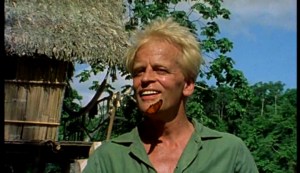
This is followed by a scene in that same Peruvian jungle where Kinski, smiling almost beatifically, gently plays with a butterfly.
After seeing that scene, it leaves me convinced (as it did Herzog) that there truly was the soul of poet lurking underneath the monstrous facade of Klaus Kinski.


 Through the Shattered Lens