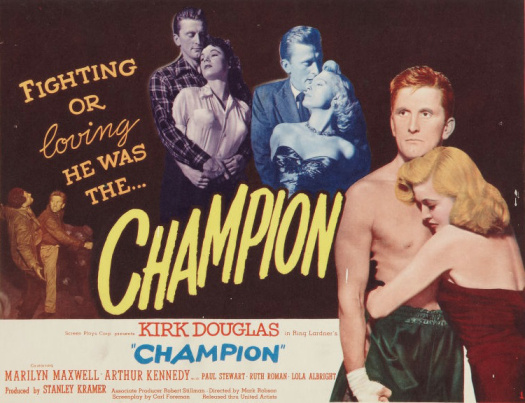
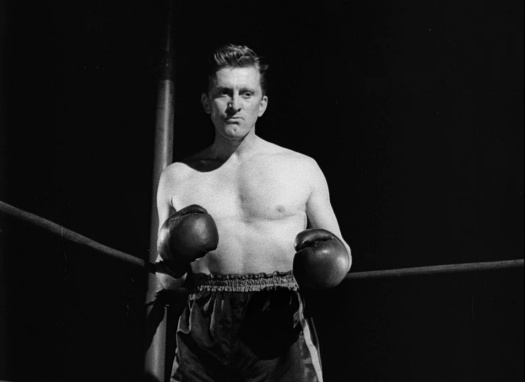
Kirk Douglas slugged his way to superstardom in director Mark Robson’s CHAMPION, one of two boxing noirs made in 1949. The other was THE SET-UP , helmed by Robson’s former RKO/Val Lewton stablemate Robert Wise. While that film told of an aging boxer (Robert Ryan) on the way down, CHAMPION is the story of a hungry young fighter who lets nothing stand in his way to the top of the food chain. The movie not only put Douglas on the map, it was a breakthrough for its young independent producer Stanley Kramer .
Douglas is all muscle and sinew as middleweight Midge Kelly, and a thoroughly rotten heel. He’s a magnetic character, a classic narcissist with sociopathic tendencies drawing the people around him into his web with his charm. Midge has no empathy for others, not even his loyal, game-legged brother Connie (Arthur Kennedy in a solid performance), after…
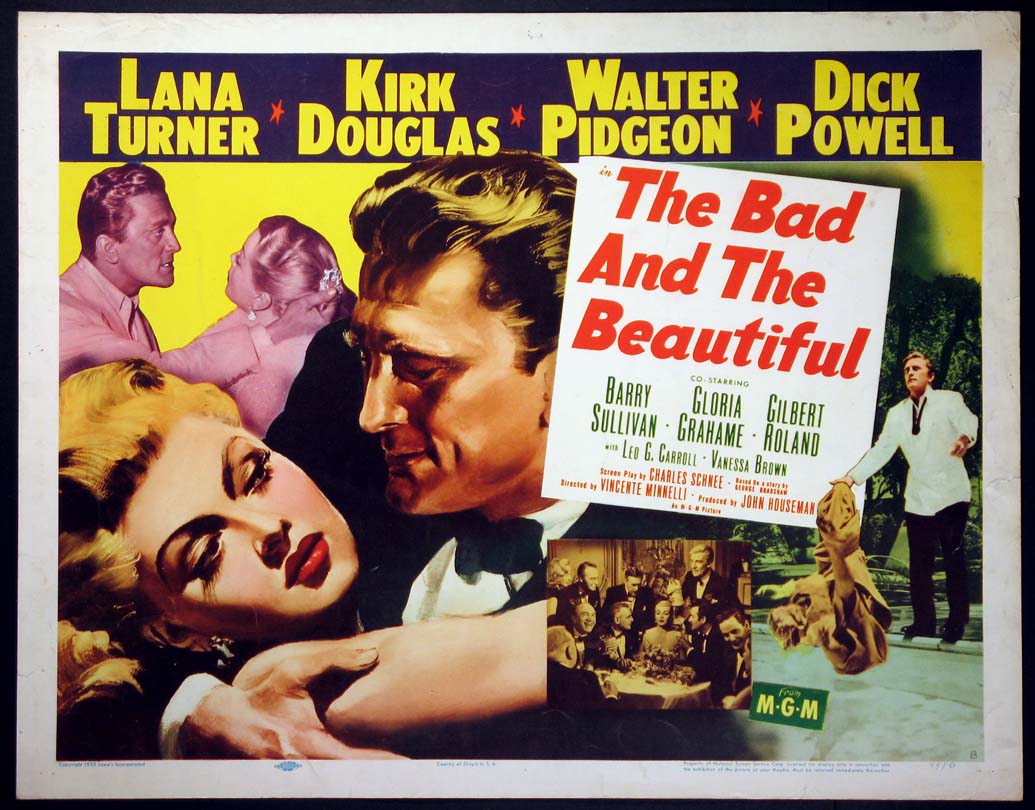
Today is the 100th birthday of movie legend Kirk Douglas! Like Olivia de Havilland earlier this year, Kirk is one of the last living Golden Age greats. Bursting onto the screen in film noir classics like THE STRANGE LOVES OF MARTHA IVERS and OUT OF THE PAST , he first received top billing in the 1949 boxing noir CHAMPION, earning an Oscar nomination for his performance. Later, Kirk starred in some of the best films Hollywood has to offer: ACE IN THE HOLE, 20,000 LEAGUES UNDER THE SEA , LUST FOR LIFE (his second Oscar nom, though he never won the statue), PATHS OF GLORY, SPARTACUS, LONELY ARE THE BRAVE. One of my personal favorites is 1952’s THE BAD AND THE BEAUTIFUL.
One of those Hollywood movies about making Hollywood movies, THE BAD AND THE BEAUTIFUL is expertly directed by insider Vincent Minnelli, who knew this material like the back of his hand. Aided…
The 41st film in Mill Creek’s Fabulous Forties box set was the 1946 film noir, The Strange Love of Martha Ivers. While The Strange Love of Martha Ivers is definitely a superior example of noir and features Barbara Stanwyck in one of her best femme fatale roles, the film is best remembered for being the film debut of a Hollywood icon.
In December of this year, Kirk Douglas will turn 100 years old. He is one of the few stars of the Golden Age of Hollywood left. (Olivia De Havilland is another. She’ll be turning 100 on the 1st of July.) Though he’s had his share of health issues over the past few years, it is somehow not surprising that Kirk Douglas is going to make it to a hundred. In fact, it probably wouldn’t be surprising if he lasted for another hundred after that. Regardless of how old or young he may have been at any point in his career, Kirk Douglas has always epitomized virile masculinity. Whenever you see Kirk Douglas in a film, you know that you might not like or trust his character but you definitely want him around if things start to get tough. That remains true whether you’re watching Kirk in The Bad And The Beautiful or in Holocaust 2000.
That’s why it’s interesting to see Kirk cast very much against type in his very first film. In The Strange Love of Martha Ivers, Kirk Douglas plays Walter O’Neil. Walter is the district attorney of a Pennsylvania mining town called Iverstown. He is married to Martha Ivers (Barbara Stanwyck), the niece of the widow of the man who founded Iverstown. Walter owes almost all of his success to the influence of the Ivers family and he knows it. He’s also in love with Martha but she doesn’t love him. And he knows that as well. Walter deals with his insecurity by drinking.
Walter and Martha have a secret. Seventeen years ago, Walter witnessed Martha murder her abusive aunt. (The aunt is played by Judith Anderson, the creepy housekeeper from Rebecca.) Walter helped Martha to cover up the crime, lying that he saw a burglar beat the aunt to death. As a result of their lies, an innocent man was executed for the murder.
Now, many years later, Sam Masterson (Van Heflin) has returned to Iverstown. Sam was a friend to both Martha and Walter when they were younger. Sam came from the poor section of town and ran away shortly after the death of Martha’s aunt. Walter has always suspected that Martha truly loves Sam. When Sam — now a drifter and a gambler — shows up in town, Walter fears that he knows the truth about the aunt’s death. Walter is scared that Sam is going to blackmail him. Even worse, he’s scared that Sam is going to steal Martha away from him.
Walter has reason to be worried. Having met a troubled young woman named Toni (Lizabeth Scott), Sam believe he is no longer in love with Martha. However, Martha does claim to love Sam and Sam finds himself being drawn back to her. In fact, Martha loves Sam enough to suggest that maybe he should murder Walter…
The Strange Love of Martha Ivers is an entertaining melodrama, one that features great performances from Heflin, Stanwyck, and Scott. However, in the end, it’s mostly interesting because Kirk Douglas is not only making his debut in a totally atypical role but he also does a fantastic job. If The Strange Love of Martha Ivers had been made in the 50s, Kirk probably would have been cast as Sam but he’s unexpectedly perfect in the role of the angry, self-loathing, and ultimately tragic Walter.
You watch The Strange Love of Martha Ivers and, even with Kirk Douglas cast against type, you can’t help but think, “No wonder he made it to a hundred!”
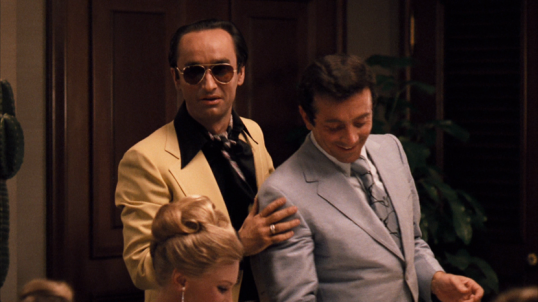
Once upon a time, Paramount Pictures released a movie about an Italian-American organized crime family.
It was a self-styled epic that used the Mafia as a metaphor for both business and politics. The movie mixed scenes of violent death with family and community ceremonies. The main mafioso was played by a famous actor who was a big box office draw in the 1950s and another character, a war hero who was initially reluctant to get involved in the family business, was played by an up-and-coming young actor. The majority of the movie took place in New York but there were several scenes that were set in Sicily.
It may sound like The Godfather but actually, it was The Brotherhood, a film that flopped so badly that Paramount executives nearly passed on the chance to make a movie out of Mario Puzo’s bestselling novel. According to Peter Biskind’s The Godfather Companion, Francis Ford Coppola frequently cited The Brotherhood as being exactly the type of movie that he did not want to make while he was directing The Godfather.
Kirk Douglas, who both produced and starred, plays Frank Ginetta. Frank, an old-fashioned and honorable mobster, is hiding out in Sicily with his wife, Ida (Irene Pappas). Frank knows that a rival gangster, Jim Egan (Murray Hamilton), has put a price on his head. When Frank’s brother, Vinnie (Alex Cord), shows up in Palermo, Frank is overjoyed at first. But Ida reminds him, “They’re going to send someone.”
Most of the film is taken up with flashback to Frank and Vinnie’s old life in New York. When Vinnie returns from serving in the army, he marries Emma Bertolo (Susan Strasberg), the daughter of Don Bertolo (Luther Adler who, as a stage actor and director, served as an early mentor to the future Don Corleone, Marlon Brando). Frank grew up idolizing their Sicilian father and, at first, he is happy when Vinnie announces that he wants to enter the “family business.” But then Vinnie starts to side with non-Sicilian gangsters like Egan and Sol Levin (Alan Hewitt).
The scenes in Sicily work the best, with Frank unsure as to whether or not Vinnie has arrived to visit or to murder him. But the scenes in New York are such a mess that it took me a while to realize that they were even supposed to be flashbacks. It is hard to keep track of how much time has passed from scene to scene and Alex Cord and Kirk Douglas are two of the most unlikely brothers imaginable.
The main problem with The Brotherhood is that it is impossible to watch it without thinking about The Godfather. The Brotherhood has much in common with The Godfather but it has none of its authenticity and does not come close to matching its epic scale. Kirk Douglas tries his best and puts a lot of effort into talking with his hands but he is miscast from the moment he first appears. Robert Evans once said that he chose Coppola to direct The Godfather because he wanted to “smell the pasta.” The Brotherhood was directed by Martin Ritt and you never smell the pasta.
The Brotherhood is an interesting footnote in the history of The Godfather but ultimately, it’s an offer you can refuse.
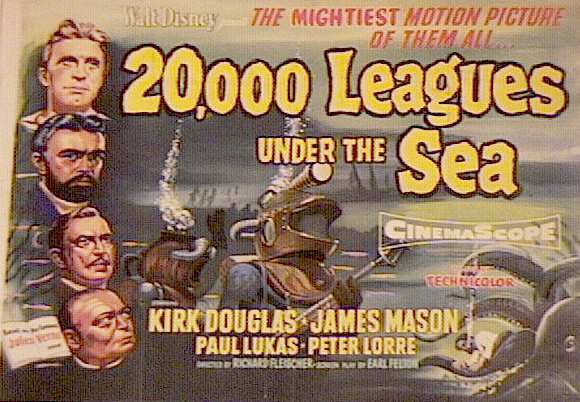
When TCM aired this movie last week, I just had to watch. It was one of my favorites as a kid, and I was curious to see how well it held up with the passage of time. To my delight, 20,000 LEAGUES UNDER THE SEA is even more enjoyable in adulthood, a joyous sci-fi adventure film thanks to the fine cast and the genius of Walt Disney.
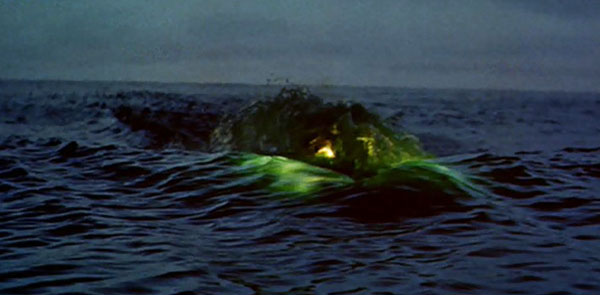
Based on the Jules Verne novel, 20,000 LEAGUES UNDER THE SEA takes us back to 1868, where rumors of a sea monster attacking ships are running rampant. Eminent scientist Professor Aronnax and his protégé’ Counseil are invited to join a voyage to investigate the matter, along with the free-spirited harpoonist Ned Land. They encounter the beast and are shipwrecked, only to discover the monster is actually a fantastic, futuristic submarine, The Nautilus. The sub is commanded by Captain Nemo, who picks up Aronnax, Counseil, and…
I first saw There Was A Crooked Man as a part of TCM’s tribute to the great actor Warren Oates. Warren Oates was rarely cast in the lead but, as a character actor, he appeared in supporting roles in several great films. Unfortunately, There Was A Crooked Man is not one of them.
Directed by Joseph L. Mankiewicz and written by the screenwriting team of Robert Benton and David Newman (best known for writing Bonnie and Clyde), There Was A Crooked Man is meant to be a comedic western. Outlaw Paris Pittman (Kirk Douglas) is arrested while visiting a bordello. Paris is sent to an Arizona prison, where everyone tries to get him to reveal where he has hidden the stash from a $500,000 robbery. Pittman uses everyone’s greed to manipulate them into helping him attempt to escape. Standing in Pittman’s way is the new warden, a liberal reformer played by Henry Fonda.
There Was A Crooked Man is a long movie that features a lot of familiar faces. Burgess Meredith plays The Missouri Kid, who has been in prison for so long that he is now an old man. Hume Cronyn and John Randolph play a bickering gay couple who eventually become a part of Pittman’s scheme to escape. Even Alan Hale, the skipper from Gilligan’s Island, shows up as a guard named Tobaccy! There Was A Crooked Man is a big movie but it’s also not a very good one. It’s not serious enough to be a good drama but it’s not funny enough to be a good comedy either.
At least the movie has Warren Oates going for it. Oates plays Harry Moon, a prisoner who is drafted into Pittman’s escape plot. It is a typical Warren Oates supporting role but he steals every scene that he appears in. Even in the smallest of roles, Warren Oates was worth watching and he’s the best thing about There Was A Crooked Man.
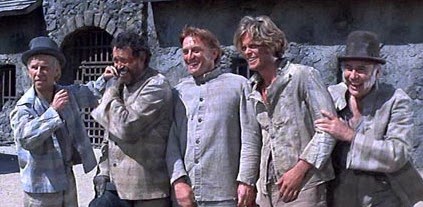
Hume Cronyn, Warren Oates, Kirk Douglas, Michael Blodgett, and John Randolph in There Was A Crooked Man
One of my favorite actors, the laconic, iconic Robert Mitchum was born August 6, 1917 in Bridgeport, Connecticut. Rugged Robert had a wandering spirit, riding the rails in the days of the Depression, and even did time on a Georgia chain gang. Mitchum eventually ended up in California , and was bitten by the acting bug. After small roles in Laurel & Hardy comedies and Hopalong Cassidy oaters, Mitchum got noticed in a series of B-Westerns based on the novels of Zane Grey. His big break came as a tough sergeant in 1945’s THE STORY OF G.I. JOE, which he received an Oscar nomination for Best Supporting Actor. But the role that made him a star was world-weary private eye Jeff Bailey in the film noir classic OUT OF THE PAST.
We meet Bailey running a gas station in the small town of Bridgeport, California (an homage to Mitchum’s hometown, perhaps?) He has a mute…
Last week, I started a little series that I call Embracing The Melodrama, Part II. Over the next three weeks, I will be reviewing, in chronological order, 128 cinematic melodramas. I started this series with the 1927 silent film Sunriseand now, we have reached our 18th film, the 1949 best picture nominee, A Letter To Three Wives!
Now, I’m going to start this review by pointing out something that will probably scare off some of our readers. So, before you read the next paragraph, understand that A Letter To Three Wives is a great film that’s full of great performances and witty dialogue and you really should watch it the next time that it’s on TCM. Got all that? Okay. Good. Moving on…
A Letter To Three Wives feels a lot like a 1949 version of Desperate Housewives. Now, before you freak out, I’m talking about early Desperate Housewives as opposed to later Desperate Housewives. The similarities are actually pretty striking. Both A Letter To Three Wives and Desperate Housewives take place in an upper class suburb. Both of them deal with women who appear to have happy marriages but who are all actually dissatisfied with how their lives have turned out. Both of them are satires disguised as mystery stories. (The mystery in Desperate Housewives involved murder. The one in A Letter To Three Wives involves adultery.) Perhaps most significantly, both Desperate Housewives and A Letter To Three Wives are narrated by a snarky woman who exists largely off screen.
The narrator in A Letter To Three Wives is named Addie Ross and voiced by Celeste Holm. We never actually see Addie but we hear a lot from her and a lot about her. Apparently, every man in town has, at some point, been in love with Addie. Every woman is jealous of her. And Addie, amazingly enough, seems to have the power to know exactly what’s happening in everyone else’s marriage. At the start of A Letter To Three Wives, Addie has sent … well, a letter to three wives. In the letter, Addie explains that she’s run off with one of their husbands but she declines to reveal which husband. Each one of the wives thinks back on her marriage and wonders if her husband is the one.
Deborah (Jeanne Crain), for instance, is a country girl who met and married Bradford “Brad” Bishop (Jeffrey Lynn) during World War II. Deborah is insecure about the fact that Brad comes from an upper class background and that he was apparently engaged to marry Addie before he met Deborah.
(Here’s an interesting piece of trivia for those of you who, like me, are into true crime stories. Along with the movie character, there’s also a real-life murderer named Bradford “Brad” Bishop. Like the character in the movie, he came from an upper class background. Unlike the film character, the real Brad Bishop ended up murdering his wife, his children, and his mother and then fled to Europe. He’s been a fugitive for close to 40 years and is believed to still be alive. He’s currently on the FBI’s most wanted list.)
And then there’s Rita (Ann Sothern), who is an old friend of Brad’s. Rita is married to George. George is a quiet and intellectual English professor who is insecure over the fact that Rita, working as a soap opera writer, makes more money than he does. George is played by Kirk Douglas and, admittedly, it does take a while to get used to the idea of Kirk Douglas playing an introverted intellectual. But, once you get over the initial shock, Kirk Douglas gives a pretty good performance. Kirk may be miscast but that actually works to the film’s advantage. In a world where surface appearances hide the unexpected truth, it only makes sense that a mild college professor would look like Kirk Douglas.
My favorite wife was Lorna Mae (Linda Darnell), who grew up next to the train tracks and who pursues and eventually married a wealthy, older man (Paul Douglas). It was impossible for me not to relate to and even admire Lorna Mae. Much like me, Lorna Mae was determined to get what she wanted. Perhaps my favorite scene with Lorna Mae was when she blatantly did everything possible to get stuffy old Paul Douglas to look at her legs, largely because I’ve done the exact same thing on occasion.
A Letter To Three Wives is an entertaining and witty film that still holds up today. Director Joseph L. Mankiewicz deservedly won the Best Director Oscar for his work here. The film itself was nominated for best picture but lost to All The King’s Men. I actually happen to like All The King’s Men but, if I had been an Academy voter in 1949, my vote would have totally gone to A Letter To Three Wives.
For our latest entry in the 44 Days of Paranoia, let’s take a look at one of the silliest films ever made, Brian DePalma’s 1978 horror/thriller hybrid The Fury.
The Fury opens on a beach in Israel. CIA veteran Peter (Kirk Douglas, who grimaces up a storm) is hanging out with his teenage son Robin (Andrew Stevens) and his friend and colleague Ben Childress (John Cassavetes). Two things quickly become apparent.
First off, Robin has psychic powers. We know this because Peter is obsessed with protecting him from being captured by a shadowy government agency that wants to use his power as a weapon.
And secondly, Ben is evil. We know that Ben’s evil because he’s played by John Cassavetes. As one of the first truly independent filmmakers, Cassavetes would often raise the money to make his fiercely individualistic films by playing villains in bad B-movies, like this one.
Ben, in fact, is so evil that he’s arranged for terrorists to attack the beach. After Peter is apparently killed in a ludicrously violent gunfight, Ben takes off with Robin.
However, Peter is not dead! Somehow, despite the fact that both the beach and the ocean were pretty much blown up with him on it, Peter survived and now, he’s looking for his son. Peter makes his way to Chicago where he calls up his girlfriend, Hester (Carrie Snodgress), and says things like, “I want your body, baby.”
Hester, meanwhile, works at the Paragon Clinic, which is run by Dr. James McKeever (Charles Durning) who, himself, is secretly working for Ben. The Paragon Clinic is a front to try to discover other teenage psychics and to turn them into weapons as well. The newest patient is Gillian (Amy Irving), a teenage girl who might be able to help Peter track down his son.
Of course, what Peter doesn’t take into account is that, in his absence, Robin has turned into a power-mad sociopath who spends his time doing things like killing tourists at amusing parks…
Wow, that’s a lot of plot, isn’t it? And, with all of that, I haven’t even gotten into what happens during the second half of the film!
The Fury is an enjoyably silly film, an awkward attempt to combine DePalma’s previous film, Carrie, with a paranoia-fueled political thriller. There’s a certain charm to a film that takes itself so seriously and yet, at the same time, manages to be totally over-the-top and ludicrous.
For example, just consider the performances of the high-powered cast and the fact that none of the actors appear to be acting in the same film. Playing a character who is a bit of a hero by default (because, seriously, how stupid did he have to be to not realize that Ben was evil to begin with), Kirk Douglas grimaces so manfully that Peter’s stupidity almost starts to feel like a satiric comment on hyper-masculinity. John Cassavetes, on the other hand, is so disdainful of the film that he actually rolls his eyes while delivering some of his more melodramatic lines. Meanwhile, Carrie Snodgress is forced to say things like, “Here comes the Pony Express!” and Charles Durning brings the full weight of his talent to deliver lines like, “If you’re having your monthlies, I don’t want you near the patient.”
And finally, there’s Amy Irving. In DePalma’s Carrie, Irving played Sue Snell, the sole survivor of a psychic rampage. In The Fury, Irving gets to play the psychic and she gives such a dramatic and emotional performance that you almost get the idea that she was trying to challenge Sissy Spacek. “This is how you play a psychic, Sissy!” she seems to be shouting. Of course, the big difference is that Carrie was actually a good film whereas The Fury is a bad film that happens to be watchable.
Finally, no review of The Fury is complete without talking about Brian DePalma’s direction. To put it lightly, Brian DePalma directs the Hell out of The Fury and the effect is something like what an episode of Agents of SHIELD would look like if directed by Martin Scorsese. The entire film is a collection of tracking shots, zoom lenses, and sweeping overhead shots with the camera only stopping long enough to linger over scenes of violence and spilled blood. In perhaps the film’s most ludicrous scene, Amy Irving runs away from the clinic in slow motion while the orchestral score plays out on the soundtrack. We get close-ups of Irving’s face and close-ups of the faces of her pursuers. One character gets shot multiple times but we don’t hear the gunshots. Instead, we only hear the music and watch as the character overacts and dies in slow motion. It’s almost as if DePalma was trying to win a bet by achieving the most counter-productive use of slow motion in film history.
Ultimately, The Fury is so thoroughly silly and over-the-top that it simply has to be seen.



 Once upon a time, Paramount Pictures released a movie about an Italian-American organized crime family.



 Through the Shattered Lens