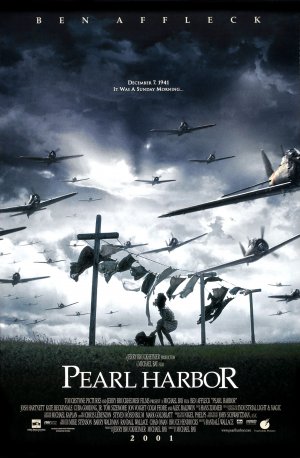
Embracing the Melodrama Part II #100: Pearl Harbor (dir by Michael Bay)


Pearl_harbor_movie_poster

“And then all this happened…”

Nurse Evelyn Johnson (Kate Beckinsale) in Pearl Harbor (2001)

The “this” that Evelyn Johnson is referring to is the Japanese attack on Pearl Harbor.  You know, the date will live in infamy.  The attack that caused the United States to enter World War II and, as a result, eventually led to collapse of the Axis Powers.  The attack that left over 2,000 men died and 1,178 wounded.  That attack.

In the 2001 film Pearl Harbor, that attack is just one of the many complications in the romance between Danny (Ben Affleck), his best friend Rafe (Josh Hartnett), and Evelyn (Kate Beckinsale).  The other complications include Danny briefly being listed as dead, Danny being dyslexic before anyone knew what dyslexia was (and yet, later, he’s still seen reading and writing letters with absolutely no trouble, almost as if the filmmakers forgot they had made such a big deal about him not being able to do so), and the fact that Rafe really, really likes Evelyn.  Of course, the main complication to their romance is that this is a Michael Bay film and he won’t stop moving the camera long enough for anyone to have a genuine emotion.

I imagine that Pearl Harbor was an attempt to duplicate the success of Titanic, by setting an extremely predictable love story against the backdrop of a real-life historical tragedy.  Say what you will about Titanic (and there are certain lines in that film that, when I rehear them today, make me cringe), Leonardo DiCaprio and Kate Winslet had genuine chemistry.  None of that chemistry is present in Pearl Harbor.  You don’t believe, for a second, that Ben Affleck and Josh Hartnett are lifelong friends.  You don’t believe that Kate Beckinsale is torn between the two of them.  Instead, you just feel like you’re watching three actors who are struggling to give a performance when they’re being directed by a director who is more interested in blowing people up than in getting to know them.

Continuing the Titanic comparison, Pearl Harbor‘s script absolutely sucks.  Along with that line about “all this” happening, there’s also a scene where Franklin D. Roosevelt (Jon Voight) reacts to his cabinet’s skepticism by rising to his feet and announcing that if he, a man famously crippled by polio and confined to a wheelchair, can stand up, then America can win a war.

I’ve actually been to Pearl Harbor in Hawaii.  I have gone to the USS Arizona Memorial.  I have stood and stared down at the remains of the ship resting below the surface of the ocean.  It’s an awe-inspiring and humbling site, one that leaves you very aware that over a thousand men lost their lives when the Arizona sank.

I have also seen the wall which lists the name of everyone who was killed during the attack on Pearl Harbor and until you’ve actually been there and you’ve seen it with your own eyes, you really can’t understand just how overwhelming it all is.  The picture below was taken by my sister, Erin.
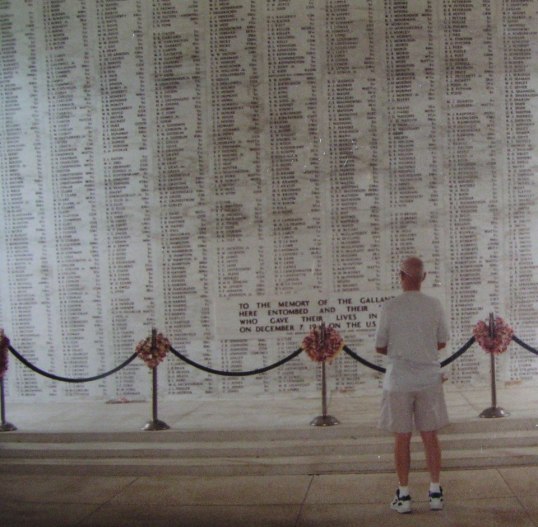
Pearl Harbor 2003If you want to pay tribute to those who lost their lives at Pearl Harbor, going to the Arizona Memorial is a good start.  But avoid Michael Bay’s Pearl Harbor at all costs.
44 Days of Paranoia #35: A Dark Truth (dir by Damian Lee)


For the latest entry in the 44 Days of Paranoia, we take a look at one of the more obscure films of 2013.  A Dark Truth was briefly released last January and it didn’t get much attention.  Having recently watched the film, I can understand why.

A Dark Truth (subtle name, no?) opens with a lengthy and disturbing scene of men, women, and children being chased through the jungle by machine gun-wielding soldiers.  As we eventually learn, the people fleeing are the citizens of a village in Ecuador and the soldiers are there on a mission to kill every single one of them.  It’s such a disturbing and well-shot sequence that I watched it with a sinking feeling because I knew that there was no way the rest of the film would be able to live up to it.

And it turns out I was right.  Director Damian Lee seemed to realize this as well because he revisits the footage every time his film starts to drag.  Unfortunately, the more we see these violent images, the less powerful they become.  By the end of the film, that whole opening sequence has lost whatever power it had simply because we’ve seen it one too many times.

It turns out that the soldiers were working for a — wait for it! — Big Evil Corporation.  It seems that this Canadian water purification company accidentally poisoned the village’s water and this led to several villagers getting sick.  An executive, who is so villainous that he’s played by Kim Coates, ordered that all the villagers be executed.  Among the few that escaped was a veteran political activist (Forest Whitaker) and his wife (Eva Longoria).

Meanwhile, in Canada, corporate executive Deborah Kara Unger finds out what the company did in Ecuador.  Wracked with guilt, she hires former CIA Agent-turned-talk radio host Andy Garcia to go down to Ecuador and rescue Whitaker.

A Dark Truth, which obviously aspires to be something more than just a conventional action thriller, is a film that starts with an exciting bang but then ends with a whimper that, even if you have managed to stay awake while watching it, you’ll barely hear.  This is one of the slowest films ever made (it certainly feels longer than 105 minutes) and the excessively stylized direction can’t make up for the fact that the film’s plot and dialogue are both painfully predictable.  About the only thing that The Dark Truth has going for it is that, while Longoria is painfully miscast, the film does feature good performances from Garcia, Whitaker, and Coates.  Best of all is Kevin Durand, who plays a hired assassin here.  Durand doesn’t get to say much  but he’s such an intimidating physical presence that he doesn’t need to say much.

Seriously, somebody needs to give Kevin Durand his own action franchise.

Other Entries In The 44 Days of Paranoia 

  1. Clonus
  2. Executive Action
  3. Winter Kills
  4. Interview With The Assassin
  5. The Trial of Lee Harvey Oswald
  6. JFK
  7. Beyond The Doors
  8. Three Days of the Condor
  9. They Saved Hitler’s Brain
  10. The Intruder
  11. Police, Adjective
  12. Burn After Reading
  13. Quiz Show
  14. Flying Blind
  15. God Told Me To
  16. Wag the Dog
  17. Cheaters
  18. Scream and Scream Again
  19. Capricorn One
  20. Seven Days In May
  21. Broken City
  22. Suddenly
  23. Pickup on South Street
  24. The Informer
  25. Chinatown
  26. Compliance
  27. The Lives of Others
  28. The Departed
  29. A Face In The Crowd
  30. Nixon
  31. The Hunger Games: Catching Fire
  32. The Purge
  33. The Stepford Wives
  34. Saboteur

A Horror Quickie With Lisa Marie: The Amityville Curse (dir. by Tom Berry)


Before I left for my vacation, I watched several of the free horror movies that are available on Fearnet and, to a large extent, I got what I paid for.  That said, seeing as how it is October and how this Horror Month here at the Shattered Lens, I committed myself to reviewing each film that I watched via Fearnet, regardless of how thoroughly awful any particular film might turn out to be.

And that brings us to The Amityville Curse, a Canadian film from 1990 that was made to capitalize on the whole Amityville Horror scam.

In the Amityville Curse, a group of 6 friends spend the night in a haunted house and things work out as you might expect.  You’d be justified in assuming that the haunted house is the same house from the Amityville Horror but you’d be wrong.  Instead, they’re staying in a different house that just happens to also be in Amityville and which just happens to be haunted as well.  (One lesson to be learned from this mess of a movie: when it comes to haunted house stories, it’s often best to keep things simple.) 

Apparently, decades earlier, a priest was murdered in the house while taking confession and the local community has scorned the house ever since.  However, at the start of the film, a fat, balding guy and his boring wife buy the house and their friends come down to help with the remodel.  Unfortunately, one of those friends is played by Kim Coates and, as everyone knows, the minute Kim Coates shows up in a horror movie, he’s going to end up getting possessed and killing a lot people.

Which is pretty much what happens here.

I have to admit that I feel sorry for Kim Coates whenever I see him in a movie like this.  Kim Coates (who is currently a member of the cast of Sons of Anarchy) is a talented character actor and, when given the chance, he has proven that he can play likable and sympathetic characters.  But, he’s got these slightly off-center eyes and a nervous, jumpy manner about him.  As a result, whenever he shows up in a movie, he always seems to be killing people.  Whenever I see a talented actor like Kim Coates in a movie like The Amityville Curse, I clench my little hand into a fist and I shake it at the unkind Gods of typecasting.

As for The Amityville Curse, well, what can I really say about it?  This is a truly terrible movie, one of the worst that I’ve ever seen.  It’s a horror movie without a single scare.  It’s the type of movie that I would warn everyone to stay away from except that I doubt this already obscure film will ever again see the light of day.

Except maybe on Fearnet.

What Lisa Marie Watched Last Night: A Friend of the Family (dir. by Stuart Gillard)


What did I watch last night?  I watched A Friend of the Family, a 2007 film that shows up on the Lifetime Movie Network every couple of weeks.

Why Was I Watching It?

Ennui.

What Was It About?

Well, it’s yet another Canadian true crime, exploitation film that has found a second life on Lifetime.  Newly weds Allison and Darrin (Laura Harris and Erik Johnson) move to a small town in Canada.  Darrin befriends and goes into business with David (Kim Coates) and David is like so obviously a serial killer but Allison is the only one who notices.  And then, when Allison attempts to let people know that David’s the one who has been killing all the blonde waitresses in town, everyone responds by saying that she’s the one who is being silly and emotional!

What Worked

It all worked!  Well, okay, not all of it but enough of it worked that I had fun curling up on the couch and watching it.  Laura Harris was a sympathetic heroine (and she played her character with just a hint of instability so you wondered sometimes if maybe she was just imagining it all), Kim Coates was creepy in that Kim Coates way, and Erik Johnson — Oh. My. God.  So. Cute.

Add to that, I could relate to this film.  Nobody believed me when I said the janitor in high school was a serial killer and I’m still pretty sure I was right about that.

What Didn’t Work?

You know what?  It all worked, as far as I’m concerned.

“Oh my God!  Just like me!” Moments

There were several, most of them having to do with Alison’s struggle to get people to listen to what she was saying.  Seriously, men need to lean how to shut up and listen when it comes to potential serial killers living next door.

Lessons Learned

The main lesson was the same one that’s taught by most Lifetime movies: If you ever think the guy next door might be obsessed with you and plotting to kill you, take the law in your own hands.  Seriously, all the men in your life are worthless when it comes to these situations. 


Review: Open Range (dir. by Kevin Costner)


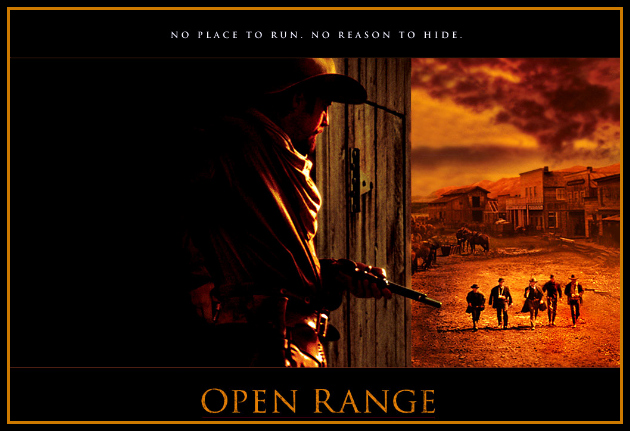
2003 marked a sort of a small comeback for Kevin Costner both as a director and as an actor. The work in question was the very well-done Western, Open Range. Open Range was a moderately budgeted film which has more in common with Costner’s first directorial work, Dances with Wolves than his last big-budget flop, The Postman.

The film was an adaptation of the Lauran Paine novel, The Open Range Men, and it captures much of the themes found in the novel. This was probably due to the fact that screenwriter Craig Storper didn’t deviate from the novel’s basic story. There were no superfluous action sequences and gunfights to ratchet up the action. Everything about Open Range was about the gradual and inevitable final confrontation between the “free-grazers” and the “barbed-wire” men. The free-grazers were played by Kevin Costner and Robert Duvall as Charles Waite and Boss Spearman, respectively. On the other side of the conflict was Michael Gambon playing Denton Baxter, the ruthless land-baron whose attempt to keep the free-grazers from grazing on his land also hides another agenda. Caught in-between these two strong-willed groups were the people in the town Baxter pretty much controls through his “town marshal” (played with fake bravado by James Russo) and the herd helpers under Boss Spearman’s employ.

The theme of freedom to roam the open country versus the rights of a landowner echoes throughout the film. Set in the latter end of the 19th-century, Open Range shows the clash of the more natural ways of the Old West slowly eroding to be replaced by the more industrial, monopolistic practices that became prevalent during the 1880’s, also known in US History as the Gilded Age. Even the personalities of the conflicting characters mirror this theme as the free-grazers only want to use the land as it has been used for years upon years and thats sharing between all men of the West. The land-baron has other ideas in mind and everything boils down to him owning everything around him, even if it means using ruthless tactics to gather even more property.

Open Range also has a bit of modernism in its subplot of Charley Waite’s growing attraction to the sister of the town doctor and the same sister’s well-rounded characterization. It’s not often that a traditional Western shows women in a very positive light instead of the usual submissive and stay-at-home characters of Western’s past. This could also be attributed to the wonderful, underrated performance by Annette Bening who plays Sue Barlow, the doctor’s sister and Charley Waite’s love interest. Bening doesn’t play Sue as the traditional Western female. She also doesn’t go overboard and turn Sue into a 20th-century feminist. She instead plays the character as someone who knows her place in the world, but also one who is strong-willed and willing to stand for what is right.

Open Range was a wonderful throwback to what made such modern Westerns like Unforgiven and Tombstone such a success both for traditionalists and new fans. Kevin Costner’s direction was very low-key. Allowing the story to tell itself at its own pace until the final confrontation. The final gunfight in the end gets a lot of well-earned attention from critics and fans. The entire sequence takes at least 10-15 minutes from start to finish. The fight itself was done in a realistic fashion. There was no sharpshooter dead-eyes in this film, but individuals who had skill but still missed. It was a fight where it wasn’t who was the fastest, but who was the calmest under fire. There’s also a suddenness to the brutality in the final gunfight that demystifies the old-style Western shootouts of past. Some complained that the film was very slow and took too long to get to the “good stuff”, but I actually thought the gradual pacing of most of the film’s length gave the final confrontation even more impact. Costner seem to have learned the lesson all good directors know: less means more.

Open Range won’t go down as a great piece of film making. It surely won’t go down as one of the best in history. What Open Range did accomplish was putting the Western back to its epic and majestic roots, but at the same time keeping the intimacy of a character-driven story. In time, Open Range would probably go down as one of the underrated gems of the last decade and find a place next to its closest comparison, Unforgiven, as one of the best Westerns of the new era.