Leading up to this film I was still hesitant to embrace it after the underwhelming Superman Returns. I think the more fun and energetic Marvel Studios fare has spoiled me to the the more dour (though still entertaining) take on the DC main heroes (though the Green Lantern one was neighter serious, fun or enjoyable).
The trailers and teasers already released for Man of Steel has focused a lot on the existential question about who or what Superman is and his role on Earth. Some of the teasers and trailers even try to ape the Terence Malick visual-style with the close-ups of waving wheatfields and background narration asking deep questions. But this latest trailer now switches gear and focuses on the villain of the film and more action.
I’m not hugging this film 100%, but this latest trailer has me closer to embracing it.
Will Man of Steel be too dour a la Christopher Nolan or two much a visual overload by way of Zack Snyder or will the two differing storytelling styles be able to meld into a perfect balance to finally give Superman his day in the sun once again.
Man of Steel is set for a June 14, 2013 release date.
We’re now just two months away from one of this year’s biggest and most-anticipated films. It’s also one of the biggest gamble for Warner Bros. Pictures in light of the success that Marvel/Disney had with their Marvel Cinematic Universe.
Man of Steel looks to reboot that Superman film franchise after the lackluster Superman Returns of a few years back. Gone are Bryan Singer and in comes Zack Snyder in the director’s chair with Christopher Nolan (himself reviving the Batman franchise from the depths) overlording over it all. It’s a recipe that smells success, yet there’s still some nagging doubt about whether it’s going to rule the summer and become the stepping stone to what Warner Brothers hopes will be their return shot at Marvel/Disney: a Justice League film.
The first trailer for Man of Steel had quite the Malickesque look to it. From the subtle music in the background to existential narration about the nature of Superman. Then that was followed up a couple months later by a more action-packed trailer that had the hallmarks of Snyder as a visual artist of onscreen mayhem. Now we have a third trailer (hopefully a final one) that seems to be an amalgam of the first two that tries to explore the nature of Superman in regards to his adopted planet and then some action that shows Man of Steel won’t be a two and half hours of Zack Snyder channeling his inner Terence Malick.
Man of Steel is set for a June 14, 2013 release date.
The very first Man of Steel trailer was underwhelming and played out more like a Terence Malick production. A lot seem to have happened between the release of that first official to the latest one which Warner Brothers premiered earlier today. Where the first trailer was all about serene images of Kal-El in his Clark Kent persona going through his Jack London phase this second trailer delves more into the persona of an emergent Superman who fears that the world he intends to protect from General Zod may not and will not be ready to accept his as their savior.
We get to see more glimpses of the action Man of Steel seem to have more of than the underwhelming reboot done by Bryan Singer just a couple years ago. There’s scenes of entire high-rises collapsing and what looks like Superman battling either Zod or, at the very least, Zod’s minions. We also get to see some of the other cast members from Costner’s Pa Kent to Diane Lane as Ma Kent. We already get to see Michael Shannon as General Zod and Richard Schiff as S.T.A.R. Labs director Dr. Emil Hamilton. The film doesn’t give it out but whether Emil Hamilton is an ally of Superman or a potential enemy the film will have to answer.
The story has a lot of the gritty, realistic DNA that Christopher Nolan’s Dark Knight trilogy had but the impressive visuals that Zack Snyder has become well-known for. It’s going to be interesting to see if the Nolan narrative aesthetic will be able to co-exist with the Snyder flair for imagery.
We’ll find out in June 14, 2013 if all the questions being asked about this second reboot of the Superman franchise will be positive ones or more of the case of opportunity and potential wasted.
“The one constant through all the years, Ray, has been baseball. America has rolled by like an army of steamrollers. It has been erased like a blackboard, rebuilt and erased again. But baseball has marked the time.” — Terence Mann
I have always been a fan of baseball. I would say that baseball has been the one thing which has always remained constant for me throughout the years. Other sports may be flashier, faster and more violent, but baseball I’ve always equated as part of America’s national identity. This is why 1989’s Field Of Dreams by Phil Alden Robinson continues to resonate for me and for legions of baseball fans everywhere.
The film is based off of the W.P. Kinsella’s novel, Shoeless Joe, and tells the story of one Ray Kinsella and his titular field of dreams. It’s a film which sees Ray not just building a baseball field in his field of corn despite financial problems bringing him and his family closer to losing everything, but it also sees him traveling across the country to find a reclusive writer in Terence Mann (J.D. Salinger in the novel). It’s afilm which offers an insight to what makes baseball and the American identity so intertwined as the film finally offers Ray a chance to finally realize that the very baseball field he has built in his cornfield has granted many a second chance to realize their dream. For this film that dream is to be able to play baseball once more and this second chance becomes important to the ghosts of baseball’s past who have fallen from baseball’s grace through a scandal which had them banned from the game they love.
I’ve never been a big Kevin Costner fan, but his work in this film as Ray Kinsella showed me why people saw in him talent as an actor and not just a pretty face up on the screen. His real-life love for baseball shows in his performance as Ray whose own love for baseball becomes a personal journey for redemption and reunion with a father who also shared his love for the sport. The performances by Amy Madigan as Ray’s supportive wife was quite good and allowed the character not to be eclipsed by Costner’s excellent work as Ray. Even James Earl Jones as the writer Terence Mann gives the film a level of gravitas which just added to the film’s intimate yet epic nature. But it’s the breakout performance by Ray Liotta as the ghost of baseball great Shoeless Joe Jackson. Liotta’s screentime was limited to mostly in the latter part of the film, but his presence dominated every moment he was on the screen.
Field of Dreams has been called just a good baseball film by some, but for many people who have seen and loved it see it as more than just a film about baseball. It’s a film that shows Americana at it’s best and most nostalgic. Shows how one sport has become such a positive influence on the relationship between children and their fathers. It’s a film that dares to show genuine affection and love to the idea of letting someone follow their dream despite many outside influences and obstacles trying to get in their way. There’s a reason the film was nominated for an Oscar Best Picture. Even voters who are so used to rewarding films that look at the darker and more depressing side of the human condition could see the inherent quality in a film which looks at the brighter and more hopeful side of the equation.
The Company Men is the first film to be directed by veteran television producer and writer John Wells. Previously, Wells worked on ER, The West Wing, Southland, Third Watch, and a whole host of other shows that I’d rather die than ever have to actually sit through. With The Company Men, Wells attempts to tell the story of the current economic recession and what its like to go from being a high-paid executive to just another unemployed statistic. The end result is a deeply uneven film that comes so very close to succeeding but ultimately fails.
The film opens in 2008 and indeed, most of the film takes place in ’08. It always amuses me how any film that comes out now that deals with either the economy or the wars in the Middle East (the Hurt Locker being an obvious example), the filmmakers always go out of their way to let us know that their movie is taking place during the Bush administration and not the Obama Administration. Some people would call that “ass kissing” but I just find it to be amusing.
Anyway, getting back on track here, the films follows three corporate executives who all work for a fictional company called GTX. There’s a rich, white guy played by Ben Affleck. And then there’s a richer, white guy played by Chris Cooper. And then finally, I guess to add some variety to the mix, there’s a white guy who is really, really rich and he’s played by Tommy Lee Jones. Anyway, Affleck, Cooper, and Jones are all cheerfully doing their thing until one day, the recession hits and boom! Suddenly, Affleck is told that he has become “redundant.” He’s given a severance package and sent off on his merry way. Meanwhile, Cooper worries that he’s about to face the same fate while Jones — who is one of the company’s vice presidents — tries to keep GTX’s satanic CEO from putting anyone else out of work.
It’s Affleck and his story that commands most of the film’s running time and, to his credit, Affleck actually gives a surprisingly good performance here as he starts out as smug and self-centered before eventually becoming desperate and insecure until finally, by the end of the film, he’s reached a state of acceptance. A lot of this has to do with the fact that he finally humbles himself into accepting a job with his blue-collar brother-in-law, a homebuilder played by Kevin Costner.
A word about Kevin Costner in this film: I could have done without him. First off, I understand his character is supposed to be a blue-collar, plain-spoken, salt-of-the-Earth type but honestly, he just comes across like a overlymacho asshole who probably voted for Lyndon LaRouche at some point in the past. I guess he’s supposed to be John Wells’ version of the noble savage or something.
But with that one glaring exception, The Company Men is a remarkably well-acted film. Even though Jones and Cooper are saddled playing predictable characters, they both bring a real unexpected poignancy to their portrayals. Cooper, especially, is strong and always sympathetic even though you know everything that’s going to happen to him from the minute he first shows up on-screen. Rosemarie DeWitt has the rather thankless role of being Affleck’s wife but she brings a lot of strength to a thinly written character and she and Affleck have a real chemistry. When they’re on-screen together, you believe in their marriage which is more than you can say for most screen couples.
The cast of The Company Men is such a strong ensemblethat you really find yourself hoping (and sometimes even believing) that the overall film will succeed as well. But, alas, the film fails and it manages to fail for all the obvious reasons. John Wells is best known for his work in television and The Company Men never really shakes that made-for-TV feeling. For every scene that offers up an unexpected insight or a subtle piece of characterization, there’s a hundred more that feel glib, smug, and ultimately forced. For every honest note, there’s a false one waiting right around the corner to pounce on it and beat it into submission. This is the type of movie where Tommy Lee Jones walks around a deserted shipyard and delivers a monologue about the way things use to be to a character who has absolutely no logical reason for being there beyond the fact that Wells needed to find an excuse for Jones to deliver the whole long speech to begin with. Don’t get me wrong — Jones delivers the words beautifully but so what? The scene still feels safe, predictable, and ultimately false.
And what’s the deal with Maria Bello in this film? She plays Sally Wilcox who is apparently in charge of “downsizing” at GTX. She’s also having an adulterous affair with Tommy Lee Jones despite the fact that all Jones ever does is criticize her for even existing. Never mind the fact, of course, that Jones is a part of the entire corporate culture that’s responsible for the Sally Wilcoxes of the world to begin with. It’s hard not to feel that her character is there to largely let Jones off the hook. It’s not Jones’s fault that everyone who works under him ends up unemployed and, in one really obvious plot development, dead. No, it’s that evil Sally Wilcox with her blonde hair and black lingerie. And what you can’t blame on Sally, put the blame on Jones’s wife and toss Cooper’s wife in there as well since they’re both portrayed as being heartless wenches (as opposed to DeWitt who is a good wife because she supports Affleck no matter what). The Company Men is full of sympathy for depressed, self-pitying white guys but it has next to none for the women who have to live with them.
Wells is obviously trying to say something about the Recession but what? Obviously, he lays a lot of the blame at the doorstep of greedy CEOs like the one played, in this film, by Craig T. Nelson. Unfortunately, you get the feeling that Wells seems to think that he’s the only person in the world who has managed to figure out that excessive corporate greed can be a bad thing. He may think that he’s educating but really all he’s doing is preaching and the only ones listening are the choir.
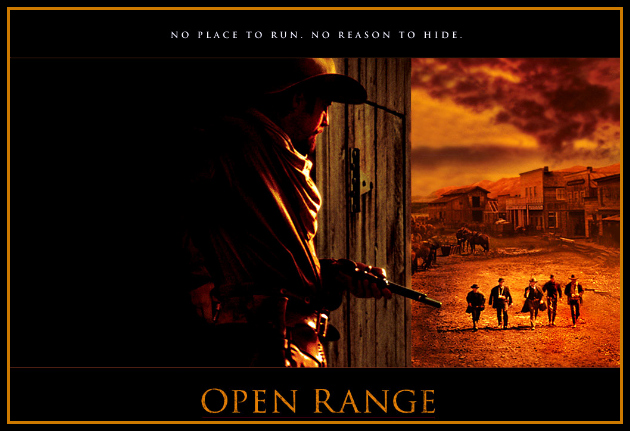
2003 marked a sort of a small comeback for Kevin Costner both as a director and as an actor. The work in question was the very well-done Western, Open Range. Open Range was a moderately budgeted film which has more in common with Costner’s first directorial work, Dances with Wolves than his last big-budget flop, The Postman.
The film was an adaptation of the Lauran Paine novel, The Open Range Men, and it captures much of the themes found in the novel. This was probably due to the fact that screenwriter Craig Storper didn’t deviate from the novel’s basic story. There were no superfluous action sequences and gunfights to ratchet up the action. Everything about Open Range was about the gradual and inevitable final confrontation between the “free-grazers” and the “barbed-wire” men. The free-grazers were played by Kevin Costner and Robert Duvall as Charles Waite and Boss Spearman, respectively. On the other side of the conflict was Michael Gambon playing Denton Baxter, the ruthless land-baron whose attempt to keep the free-grazers from grazing on his land also hides another agenda. Caught in-between these two strong-willed groups were the people in the town Baxter pretty much controls through his “town marshal” (played with fake bravado by James Russo) and the herd helpers under Boss Spearman’s employ.
The theme of freedom to roam the open country versus the rights of a landowner echoes throughout the film. Set in the latter end of the 19th-century, Open Range shows the clash of the more natural ways of the Old West slowly eroding to be replaced by the more industrial, monopolistic practices that became prevalent during the 1880’s, also known in US History as the Gilded Age. Even the personalities of the conflicting characters mirror this theme as the free-grazers only want to use the land as it has been used for years upon years and thats sharing between all men of the West. The land-baron has other ideas in mind and everything boils down to him owning everything around him, even if it means using ruthless tactics to gather even more property.
Open Range also has a bit of modernism in its subplot of Charley Waite’s growing attraction to the sister of the town doctor and the same sister’s well-rounded characterization. It’s not often that a traditional Western shows women in a very positive light instead of the usual submissive and stay-at-home characters of Western’s past. This could also be attributed to the wonderful, underrated performance by Annette Bening who plays Sue Barlow, the doctor’s sister and Charley Waite’s love interest. Bening doesn’t play Sue as the traditional Western female. She also doesn’t go overboard and turn Sue into a 20th-century feminist. She instead plays the character as someone who knows her place in the world, but also one who is strong-willed and willing to stand for what is right.
Open Range was a wonderful throwback to what made such modern Westerns like Unforgiven and Tombstone such a success both for traditionalists and new fans. Kevin Costner’s direction was very low-key. Allowing the story to tell itself at its own pace until the final confrontation. The final gunfight in the end gets a lot of well-earned attention from critics and fans. The entire sequence takes at least 10-15 minutes from start to finish. The fight itself was done in a realistic fashion. There was no sharpshooter dead-eyes in this film, but individuals who had skill but still missed. It was a fight where it wasn’t who was the fastest, but who was the calmest under fire. There’s also a suddenness to the brutality in the final gunfight that demystifies the old-style Western shootouts of past. Some complained that the film was very slow and took too long to get to the “good stuff”, but I actually thought the gradual pacing of most of the film’s length gave the final confrontation even more impact. Costner seem to have learned the lesson all good directors know: less means more.
Open Range won’t go down as a great piece of film making. It surely won’t go down as one of the best in history. What Open Range did accomplish was putting the Western back to its epic and majestic roots, but at the same time keeping the intimacy of a character-driven story. In time, Open Range would probably go down as one of the underrated gems of the last decade and find a place next to its closest comparison, Unforgiven, as one of the best Westerns of the new era.


 Through the Shattered Lens