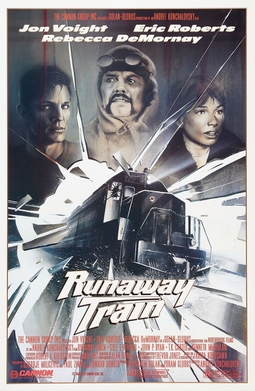
The Eric Roberts Collection: Runaway Train (dir by Andrei Konchalovsky)


In 1985’s Runaway Train, Eric Roberts plays Buck McGeehy, a prisoner at Stonehaven Maximum Security Prison in Alaska.

Like the majority of the prisoners, Buck looks up to Manny (Jon Voight), a bank robber who has just been released from spending three years in solitary confinement.  Manny is a tough guy who refuses to allow the prison system to beat him down.  Warden Ranken (John P. Ryan) views Manny as being a threat to his authority and he’s especially angry that it was the courts that ordered that Manny finally be released from solitary.  When Ranken tries to arrange for Manny to be assassinated at a prison boxing match, it’s Buck who saves Manny’s life.  When Manny later manages to escape from the prison, Buck tags along.

Manny and Buck are a study in contrasts.  Manny is as cold as the Alaskan landscape.  He’s ruthless and doesn’t allow himself to get too close to anyone but, at the same time, he does live by a definite code.  Buck is simple-minded, an earnest guy who talks too much and who probably wouldn’t have survived a day in prison if it wasn’t for his skill as a boxer.  Buck and Manny manage to make their way across the frozen wilderness but, when they hop on a train, they soon find themselves trapped on the out-of-control locomotive, along with a railroad engineer named Sara (Rebecca De Mornay).  The three of them have to find a way to either escape from or stop the train.  At the same time, the obsessed Warden Ranken is determined to recapture Manny and, if that means flying a helicopter over the train so that Ranken can lower himself onto it, so be it.

Runway Train, which was based on a script by Akira Kurosawa, was one of the few Cannon films to find success with not just critics but also audiences and the industry.  The Golden Globes nominated it for Best Film.  The Academy didn’t go quite that far but they did nominate the film for Best Editing, along with also nominating Jon Voight for Best Actor and Eric Roberts for Best Supporting Actor.  While Voight is a multiple-Oscar nominee (and one-time winner for Coming Home), Runaway Train is, so far, the only film for which Eric Roberts has been nominated.  (He should have been nominated for Star 80 but his character in that film was a bit too realistically sleazy for the Academy to honor.)  Roberts has described Runaway Train as being one of his favorite films and he even used the title for his autobiography.  It was on this film that he met Danny Trejo, who not only trained Roberts for the boxing scenes but also helped Roberts kick his addiction to cocaine.

And Roberts has every reason to be proud.  Runaway Train is a fast-moving, visually stunning thrill ride, a masterpiece of the pulp imagination.  Yes, the symbolism of the runaway train is a bit obvious.  Yes, the philosophical edge of the film’s dialogue can sometimes feel a bit out-of-place.  Who cares?  John Voight and Eric Roberts sell their characters with such skill that you don’t care that they’re both criminals who have done terrible things.  From the minute we see that frozen jail and the prisoners tossing burning pieces of paper at the guards, we know why both Manny and Buck have to escape.  John P. Ryan turns the warden into everyone’s worst nightmare of a small, pretty man with power, an authoritarian who uses the system to control the lives of others and who resents anyone who does not bow down before him.  Even though her role is largely limited to reacting to what everyone else does around her, Rebecca de Mornay still turns Sara into a compelling character and never allows her to become merely a damsel in distress.  Runaway Train is a heart-pounding action film and one that still holds up today.

Previous Eric Roberts Films That We Have Reviewed:

  1. Star 80 (1983)
  2. Blood Red (1989)
  3. The Ambulance (1990)
  4. The Lost Capone (1990)
  5. Love, Cheat, & Steal (1993)
  6. Voyage (1993)
  7. Love Is A Gun (1994)
  8. Sensation (1994)
  9. Dark Angel (1996)
  10. Doctor Who (1996)
  11. Most Wanted (1997)
  12. Mercy Streets (2000)
  13. Wolves of Wall Street (2002)
  14. Mr. Brightside (2004)
  15. Six: The Mark Unleased (2004)
  16. Hey You (2006)
  17. Amazing Race (2009)
  18. In The Blink of an Eye (2009)
  19. Enemies Among Us (2010)
  20. The Expendables (2010) 
  21. Sharktopus (2010)
  22. The Dead Want Women (2012)
  23. Deadline (2012)
  24. The Mark (2012)
  25. Miss Atomic Bomb (2012)
  26. Bonnie And Clyde: Justified (2013)
  27. Lovelace (2013)
  28. The Mark: Redemption (2013)
  29. Self-Storage (2013)
  30. A Talking Cat!?! (2013)
  31. This Is Our Time (2013)
  32. Inherent Vice (2014)
  33. Road to the Open (2014)
  34. Rumors of War (2014)
  35. Amityville Death House (2015)
  36. A Fatal Obsession (2015)
  37. Stalked By My Doctor (2015)
  38. Enemy Within (2016)
  39. Joker’s Poltergeist (2016)
  40. Prayer Never Fails (2016)
  41. Stalked By My Doctor: The Return (2016)
  42. The Wrong Roommate (2016)
  43. Dark Image (2017)
  44. Black Wake (2018)
  45. Frank and Ava (2018)
  46. Stalked By My Doctor: Patient’s Revenge (2018)
  47. Clinton Island (2019)
  48. Monster Island (2019)
  49. The Savant (2019)
  50. Seven Deadly Sins (2019)
  51. Stalked By My Doctor: A Sleepwalker’s Nightmare (2019)
  52. The Wrong Mommy (2019)
  53. Exodus of a Prodigal Son (2020)
  54. Free Lunch Express (2020)
  55. Her Deadly Groom (2020)
  56. Top Gunner (2020)
  57. Deadly Nightshade (2021)
  58. The Elevator (2021)
  59. Just What The Doctor Ordered (2021)
  60. Killer Advice (2021)
  61. The Poltergeist Diaries (2021)
  62. The Rebels of PT-218 (2021)
  63. A Town Called Parable (2021)
  64. Bleach (2022)
  65. My Dinner With Eric (2022)
  66. Aftermath (2024)
  67. The Wrong Life Coach (2024)

BORDERLINE (1980) – Charles Bronson battles human smuggler Ed Harris (in his first major film role)!


After a couple of decades of toiling away in TV and supporting roles, Charles Bronson became a huge international film star in 1968 when he starred in the films FAREWELL, FRIEND (with Alain Delon), and Sergio Leone’s ONCE UPON A TIME IN THE WEST (with Henry Fonda). For the next 5 years, Bronson would star in successful international co-productions, before hitting it big in the United States with the influential 1974 blockbuster, DEATH WISH. From 1974 to 1977, Bronson had his pick of any role that he wanted. This was probably the most interesting time in his career as he truly tried to expand his range with films like the depression-era HARD TIMES (1975), the romantic comedy FROM NOON TILL THREE (1976), the Raymond Chandler-esque ST. IVES (1976), and the surreal western THE WHITE BUFFALO (1977). But after 1977’s TELEFON and a series of underwhelming box office returns in the states, Bronson’s star was on the wane. He wouldn’t have his next #1 box office hit until he joined forces with the infamous Cannon studios in 1982 for the sequel to his biggest hit and DEATH WISH II. Cannon Studios would provide Bronson with a guaranteed paycheck and a non-stop presence on cable TV and at the video store for the remainder of the decade. I call the films that Bronson made between 1977 and 1982 the in-betweens. They don’t really fit into his European phase (1968-1973), his post-DEATH WISH phase (1974-1977) or his Cannon phase (1982-1989). To be completely honest, it seemed his career was somewhat in limbo at this point, and the movies he made during these years are some of his least well-known.

One of the movies that Charles Bronson made during the in-between years was 1980’s BORDERLINE. In this film, he plays Jeb Maynard, a border patrolman and expert tracker who will stop at nothing to find the human smuggler responsible for killing his friend and fellow patrolman Scooter, played by Wilford Brimley. I like this lower-key Bronson film. Director Jerrold Freedman has made a more realistic film than a lot of the movies in Bronson’s filmography. Outside of the murder that gets the story going, and the final showdown with the lead smuggler (a young Ed Harris), most of the film is made up of good old-fashioned field work and investigation. Bronson even based much of his performance on the technical advice of legendary border patrolman Albert Taylor. Now that doesn’t mean there aren’t some solid, action-packed scenes during the movie. My favorites include a scene where an undercover Maynard goes into Mexico with the mother of a young Mexican boy who was accidentally killed at the same time as Maynard’s friend Scooter. Maynard poses as a family member of the woman in hopes of being smuggled across the border so he can see how the illegal immigrants are being brought in. When thieves intercept the group, all hell breaks loose, and Maynard and the woman must fight their way out. Another badass moment occurs when Bronson beats needed information out of one of the smugglers in a nasty bathroom. This last scene is especially enjoyable for us Bronson fans.

There are so many good actors in this film. Outside of Bronson, Brimley, and Ed Harris, the cast is filled out by other veterans like Bruno Kirby, Bert Remsen, Michael Lerner, John Ashton, and Charles Cyphers. On a side note, Ed Harris gets the “introducing” credit here, even though he had appeared in several TV shows, as well as the movie COMA with Michael Douglas. This was his first major role in a feature film though. I also want to throw out special mention to Karmin Murcelo. She’s not a household name, but she’s excellent as the mother of the young boy who gets killed with Wilford Brimley’s character, who then helps Bronson in his quest to find the killer. Her career extended over 3 decades, and it’s easy to see why based on this performance.

BORDERLINE may not be an explosive action film like some of Bronson’s other work, but it’s an effective drama with a good performance from the star. I think he embodies the character perfectly. It’s also just as relevant in 2025 as it was in 1980, and I give the film a solid recommendation.

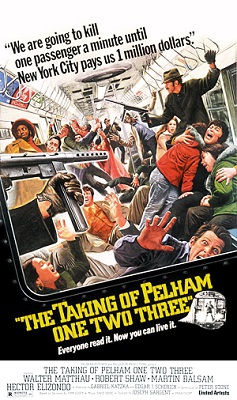
Film Review: The Taking of Pelham One Two Three (dir by Joseph Sargent)


Welcome to New York in the 1970s!  While the intellectuals flock to the latest Woody Allen movie and the wealthy throw radical chic parties in Manhattan and disturbed young men drive taxis at night and pray for a real flood to clear away all the vermin, most of the city’s citizens are just trying to make it through the day.  For many of them, that means spending an hour or two riding the subway.  In some ways, the subway is the great equalizer.  The minute that you sit down on a filthy train car, it doesn’t matter how old you are or how you vote or the color of your skin.  All that matter is finding a way to avoid making eye contact with anyone else.

Four men, all wearing obvious disguised, board the downtown Pelham 1-2-3 train.  They all look suspicious but, this being New York, no one wants to make eye contact.  Everyone just wants to reach their next stop.  The men — who are known as Mr. Blue (Robert Shaw), Mr. Green (Martin Balsam), Mr. Grey (Hector Elizondo), and Mr. Brown (Earl Hindman) — have other plans.  Revealing that they’re armed, they take the 18 passengers of the first car hostage.  Their leader, Mr. Blue, has a simple demand.  He wants a million dollars to be delivered to the car within an hour.  If the money’s late, he will kill one hostage every minute, until he receives what he wants.

While the cold-stricken mayor (Lee Wallace) tries to figure out how to 1) raise a million dollars and 2) handle the situation without losing any potential votes in his reelection campaign, Lt. Zach Garber (Walter Matthau) communicates with Mr. Blue via radio.  With Mr. Blue underground and Zach above ground, the two of them establish a cautious rapport.  Robert Shaw plays Blue as being efficient, polite, but ruthless while Walter Matthau plays Garber with his usual rumpled but intelligent style.  As embodied by Matthau, Garber is New York City in human form while Shaw is perfectly cast as the outsider who, for at least an hour or two, has managed to bring the city to its knees.

Even though the original The Taking of Pelham One Two Three is often described as being a Walter Matthau film or a Robert Shaw film, the film’s main character actually is the city of New York City.  The film portrays the city as being chaotic, angry, and unpredictable but, at the same time, also resilient and strong.  Yes, Garber may spend a lot of time bickering with his co-workers but, in the end, he and Lt. Rico Patrone (Jerry Stiller, another great New York figure) work together to do what has to be done to resolve the situation.  For all the time that’s spent on how Mr. Blue and his compatriots take that train hostage, just as much time is spent focusing on how the police, the politicians, and the Transit Authority react to what’s happened.  Not having any firsthand knowledge of the New York subway system (beyond being told not to use it when I was in NYC a few years ago), I can’t say whether or not the film is realistic but what’s important is that it feels realistic.  Even though the film is full of familiar character actors, it still seems as if you’re just watching a bunch of New Yorkers having a very long day.  Though guns are fired and there is a runway train, The Taking of Pelham One Two Three takes a refreshingly low-key approach to its story.  There’s no huge action set pieces.  The film’s classic final shot hinges not on Garber’s marksmanship but instead on his ability to remember the small details.

The Taking of Pelham One Two Three is one of my favorite heist movies.  It’s well-acted.  It’s got an interesting plot.  It’s got a few moments of unexpected humor.  Robert Shaw is a great (and, at times, almost compelling) villain while Walter Matthau and Jerry Stiller make for a great detective team.  The great Martin Balsam also turns in a wonderful turn and, even though he’s playing a bad guy, it’s hard not to sympathize him.  You need only see his apartment to understand why exactly he felt the city of New York owed him more than it had given him.  Best of all, The Taking of Pelham One Two Tree is a tribute to a great American city.  The Taking of Pelham One Two Three celebrates New York City in all of its rude, messy, and brilliant glory.

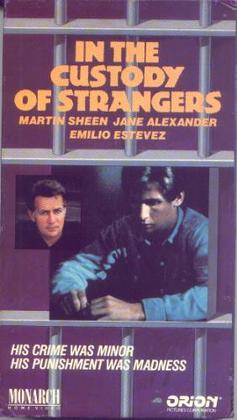
In The Custody of Strangers (1982, directed by Robert Greenwald)


In this television film, Emilio Estevez plays the world’s worst son but his behavior makes sense because he also has the world’s worst father (played by Estevez’s real-life father, Martin Sheen).

When teenager Danny Caldwell (Estevez) gets arrested for crashing into a police car while driving drunk, his mother, Sandy (Jane Alexander), wants to bail him out and bring him home.  However, Frank Caldwell (Sheen) is an old-fashioned disciplinarian and he decides that his son needs to spend a night in jail in order to teach him a lesson.  Even though, as a juvenile, Danny is given a private cell, he still snaps when the older inmate in the cell next door starts coming onto him.  After smashing the man’s head against the cell bars, Danny picks up a battery charge and is sucked into the system.

While Frank and Sandy struggle to get Danny released from jail, Danny falls deeper and deeper into despair and anger.  It’s an overcrowded, busy jail and Danny is often left in isolation for both his safety and the safety of the other prisoners.  Even though the warden (Kenneth McMillan) is sympathetic to Danny and can tell that he’s not really a hardened criminal, there’s only so much that he can do for him.  Meanwhile, on the outside world, Frank stubbornly refuses to admit that he made a mistake by leaving Danny in jail overnight.  When a job opportunity presents itself in another state, the unemployed Frank misses some of Danny’s hearings so that he can interview for it, leaving Danny feeling abandoned all over again.

For obvious reasons, the casting of Martin Sheen and Emilio Estevez as father and son works very well in this film.  Not only is there the obvious family resemblance but both Sheen and Estevez project the same attitude of anger and resentment towards the world.  If Danny has a chip on his shoulder, it’s because he inherited from his father.  In The Custody of Strangers does a good job of showing how being imprisoned can often turn someone who made a mistake into a hardened criminal but, even though it’s mostly critical of the criminal justice system, it doesn’t let Frank off the hook either.  Frank may say that he was just trying to discipline his son but the film makes clear that what he actually wanted was for jail to do his job as a parent.  The results are disastrous and the film ends on a note of ambiguity.  After what Danny has been through, it’s clear that he’ll never be the same person again.

Sheen, Alexander, and Estevez all give good performances in In The Custody of Strangers.  The only ray of hope that the film offers is the kindly warden and he’s also the film’s biggest flaw because it’s hard to believe that, with everything else going on in the jail, he would have had time to take such a benevolent interest in just one inmate.  In real life, Danny Caldwell would have been even more lost than in this movie.

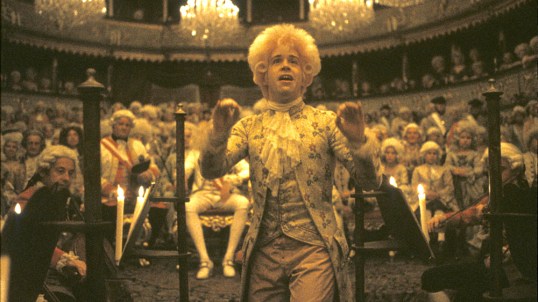
Lisa Reviews An Oscar Winner: Amadeus (dir by Milos Forman)


The 1984 film Amadeus is about a man who learns, after it’s a bit too late to really do anything about it, that he is thoroughly mediocre.

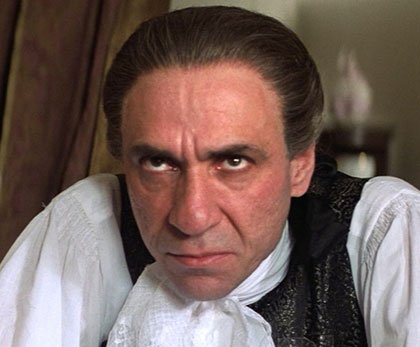
When we first meet Antonio Salieri (played by F. Murray Abraham), he’s an old man who has been confined to a mental asylum because he attempted to slit his own throat.  What should drive Salieri — a respected, if not particularly beloved, composer in 18th Century Vienna — to attempt to take his own life?  As he explains it to Father Vogler (Richard Frank), it’s the guilt of knowing that he’s responsible for death of the greatest composer of all time, Wolfgang Amadeus Mozart.

When Mozart (Tom Hulce) first showed up in Vienna, Salieri was already the court composer to the thoroughly vacuous Emperor Joseph II (Jeffrey Jones).  At the time, Salieri believed himself to be a genius touched by God.  As he recounts to Father Vogler, he prayed to God when he was a boy and he struck what he believed was an ironclad deal.  God would make Salieri a great composer and Salieri would remain a faithful believer.

But then Mozart shows up and, from the minute that he first hears one of Mozart’s compositions, Salieri realizes that Mozart is the one who has been blessed with genius.  Mozart is the one who is writing the music that will be remembered for the rest of time, long after Salieri and all of his other rival composers have been forgotten.  Upon first hearing Mozart, Salieri suddenly realizes that he has been betrayed by God.  He is a mediocre talent and he’s always been a mediocre talent.

The worst part of it is not just that Mozart’s a genius.  It’s also that Mozart knows he’s a genius.  He’s a bit of a brat as well, with a remarkably annoying laugh and vulgar manners that scandalize proper society.  Despite the efforts of his rivals to dismiss his talent, Mozart is beloved by the common people.  He’s an 18th century rock star and it seems as if no amount of scandal and petty jealousy can slow him down.  Even worse, the emperor takes a interest in Mozart and commissions him — and not Salieri — to write an opera.

Rejecting a God that he feels has betrayed him, Salieri plots Mozart’s downfall….

Goddamn, this is a great movie.  Seriously, everything about Amadeus works.

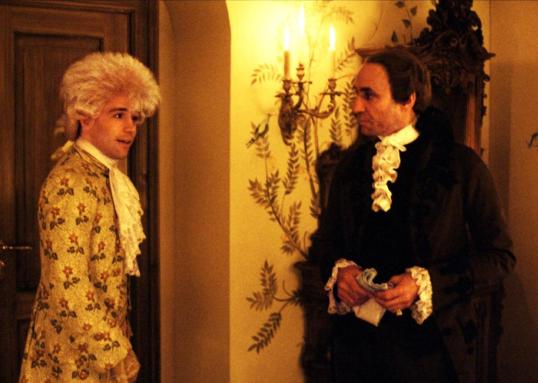
The ornate sets and the costumes not only wonderful to look at but they also actually tell us something about the characters who inhabit them.  One look at the beautiful but cluttered home that Mozart shares with his wife, Constanze (Elisabeth Berridge), tells you almost everything you need to know about not only Mozart’s tastes (which are expensive) but also his talent (which is undisciplined but also limitless).  The empty-headedness of Emperor Joseph is perfectly mirrored by the pretty but uninspired decor of his court while the grubby chaos of the mental asylum seems to have sprung straight from Salieri’s tortured soul.  As visualized in Amadeus, there’s a cold beauty to Vienna, one that is fascinating but, at the same time, menacing.  As for the costumes, Mozart’s powdered wig somehow seems to be brighter than everyone else’s and his colorful wardrobe demands your attention.  Meanwhile, when a costumed and masked Salieri shows up at Mozart’s door, he’s like the Grim Reaper coming to collect a soul.

The witty script is full of sharp lines and director Milos Forman does a wonderful job of balancing comedy and drama.  The scenes involving Joseph II are frequently hilarious and Jeffrey Jones does a great job of portraying Joseph as essentially being a very influential dunce.  The scene where Joseph tells Mozart that he liked his latest composition but that “there are simply too many notes” is a classic and one to which any artist, whether they’re Mozart or not, will be able to relate.  (“Just cut a few and it will be perfect.”)

The film is dominated by the performances of F. Murray Abraham and Tom Hulce.  Hulce is wonderfully flamboyant in the early part of the film and, bravely, he doesn’t shy away from portraying Mozart as occasionally being a bit of a spoiled brat.  It’s not just that Mozart can be annoying.  It’s also that he’s often deliberately annoying.  When we first see Mozart, it’s easy to understand why his very existence so grated on Salieri’s nerves and why Salieri considers him to be an “obscene child.”  But as the film progresses, Hulce lets us in and we come to see that Mozart is actually a very vulnerable young man.  When his disapproving father (Roy Dotrice) comes to visit, we suddenly understand both why Mozart is so driven to succeed but also why he is so instinctively self-destructive.

Meanwhile, F. Murray Abraham — well, what can I say about this performance?  In the role of Salieri, Abraham gives one of the greatest film performances of all time.  In many ways, Abraham has a tougher job than Hulce.  If Hulce has to convince us that Mozart has been touched by genius despite the dumb things that he often does, Abraham has to make petty jealousy compelling.  And somehow, Abraham manages to do just that.  Whereas the role of Mozart allows Hucle to wear his emotions on the surface, Abraham has to play a character who keeps most of his thoughts and impulses hidden and the fact that we end up understanding Salieri (if never actually sympathizing with him) is a testament to F. Murray Abraham’s skill as an actor.  Abraham won the Oscar for Best Actor for his work in Amadeus and it was more than deserved.

At the end of the film, Salieri declares himself to be the patron saint of mediocrities and, to a large extent, that’s what sets Amadeus apart from other biopics.  Most people are mediocre.  Most people are not going to end their life as a Mozart.  They’re going to end their life as a Salieri or worse.  This is one of the few films to be made about a runner-up.  It’s interesting to note that, even though the film is more about Salieri than Mozart, it’s still called Amadeus.  It’s not named Antonio or Salieri.  Even in a film made about Salieri, Mozart is advertised as the main attraction.

(It should also be noted that many historians believe that Salieri and Mozart were actually fairly friendly acquaintances and that, beyond the normal rivalry that any two artists would feel, neither held any significant ill will towards the other.  In other words, enjoy Amadeus as an outstanding piece of cinema but don’t necessarily mistake it for historical fact.)

Along with Abraham’s victory, Amadeus also won Best Picture of the year.  Of the nominees, it certainly deserved it.  (My pick for the best film of 1984 is Once Upon A Time In America with Amadeus as a close second.)  It’s a great film and one that definitely deserves to be watched and rewatched.

Embracing The Melodrama Part III #7: True Confessions (dir by Ulu Grosbard)


The 1981 film True Confessions tells many different stories.

It’s a story about Los Angeles.  It’s not necessarily a story about Los Angeles as it exists.  Instead, it’s a story about Los Angeles as we always imagine it.  It’s the late 40s and, having vanquished the Nazis in Europe, men are returning to California and looking for a new life.  Meanwhile, aspiring starlets from across the country flood into Hollywood, looking for stardom.  It’s a city where glitz and ruin exist right next to each other.  It’s the mean streets that were made famous by Raymond Chandler and, decades later, James Ellroy.

It’s a murder mystery, one that is based on one of the most notorious unsolved homicides of all time.  The bisected body of woman named Lois Fazenda has been found in a vacant lot.  When the newspapers discover that Lois was both a prostitute and a Catholic, she becomes known as “the Virgin Tramp.”  One need not have an encyclopedic knowledge of unsolved crimes to recognize that Lois Fazneda is meant to be a stand-in for Elizabeth Short, the tragic and infamous Black Dahlia.

It’s a story about corruption.  Crooked cops.  Rich perverts.  Greedy politicians.  Sinful clergy.  They’re all present and accounted for in True Confessions.  As quickly becomes apparent, Los Angeles is a city where you can do anything as long as you have the money to pay the right people off.

And finally, it’s a film about two brothers.  Tom and Des Spellacy grew up in a strong Irish Catholic family but, as they got older, their lives went in different directions.  Tom (Robert Duvall) became a detective, the type who is willing to cut corners but who, in the end, takes his job seriously.  Des (Robert De Niro) entered the priesthood and is now a monsignor in the Los Angeles diocese.  Des is ambitious and he has a powerful mentor, Cardinal Danaher (Cyril Cusack).

Though Tom and Des have gone their separate ways, they are still linked by Jack Amsterdam (Charles During).  To the public, Jack is a wealthy and respected businessman.  However, Tom and Des both know the truth.  When Tom first joined the department, he worked as a bagman for Jack and he knows that Jack made most of his money through a prostitution ring.  Des know that Jack donates to the Church as way to cover up his own corruption but Des looks the other way.  The Cardinal, after all, wants Jack’s money.

When Tom starts to investigate Lois’s death, it doesn’t take him long to figure out that Jack is probably the one responsible.  Meanwhile, Jack and his lawyer (Ed Flanders) start to pressure Des to convince his brother to let the case go.  Finding justice for Lois Fazneda could mean the end of both Tom and Des’s career.

Based on a novel by John Gregory Dunne, which was adapted into a screenplay by Dunne and Joan Didion, True Confessions is an imperfect but intriguing film.  This is one of Robert Duvall’s best performances and he brings a manic edge to the role that keeps the audience off-balance.  In the role of Jack Amsterdam, Charles Durning is the epitome of casual corruption and Burgess Meredith does a good job as an aging priest.  On the other hand, Robert De Niro seems strangely uncomfortable in the role of Des and you never quite believe that he and Duvall are actually brothers.  Director Ulu Grosbard does a good job of creating a proper noir atmosphere but, at the same time, he denies the audience the dramatic climax to which the film appears to be building up to.

That said, for whatever flaws True Confessions may have, it’s an always watchable and thought-provoking film.

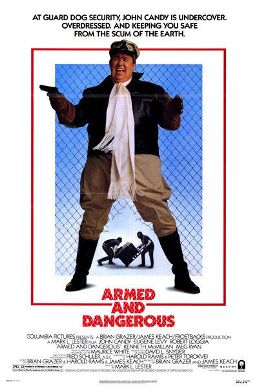
A Movie A Day #224: Armed and Dangerous (1986, directed by Mark L. Lester)


John Candy and Eugene Levy make a great team in the underrated comedy, Armed and Dangerous.

John Candy plays Frank Dooley, a member of the LAPD.  One of the first scenes of the movie is Frank climbing up a tree to save a little boy’s kitten and then getting stuck in the tree himself.  When Frank discovers two corrupt detectives stealing televisions, Frank is framed for the theft and kicked off the force.

Eugene Levy plays Norman Kane, a lawyer whose latest client is a Charles Manson-style cult leader who has a swastika carved into his head.  After being repeatedly threatened with murder, Norman asks for a sidebar and requests that the judge sentence his client to life in prison.  The judge agrees on the condition that Norman, whom he describes as being “the worst attorney to ever appear before me,” find a new line of work.

Frank and Norman end up taking a one day training course to act as security guards and are assigned to work together by their tough by sympathetic supervisor (Meg Ryan!).  Assigned to guard a pharmaceutical warehouse, Frank and Norman stumble across a robbery.  The robbery leads them to corruption inside their own union and, before you can say 80s cop movie, Frank and Norman are ignoring the orders of their supervisors and investigating a crime that nobody wants solved.

Armed and Dangerous was one of the many comedy/cop hybrid films of the 1980s.  Like Beverly Hills Cop, it features Jonathan Banks as a bad guy.  Like the recruits in Police Academy, all of Frank and Norman’s fellow security guards are societal misfits who are distinguished by one or two eccentricities.  There is nothing ground-breaking about Armed and Dangerous but Mark Lester did a good job directing the movie and the team of Candy and Levy (who has previously worked together on SCTV) made me laugh more than a few times.

Armed and Dangerous was originally written to be a vehicle for John Belushi and Dan Aykroyd.  It’s easy to imagine Belushi and Aykroyd in the lead roles but I think the movie actually works better with Candy and Levy, whose comedic style was similar to but far less aggressive than that of Belushi and Aykroyd.  One of the reasons that Armed and Dangerous works is because John Candy and Eugene Levy seem like the two last people to ever find themselves in a shootout or a car chase.  With Belushi and Aykroyd, it would have been expected.  After all, everyone’s seen The Blues Brothers.


A Movie A Day #169: Malone (1987, directed by Harley Cokeliss)


It’s Burt Reynolds vs. Cliff Robertson.  Cliff has got the money but Burt’s got the mustache and the toupee.
Robertson plays Charles Delaney, a wealthy businessman who, with the help of a mercenary army, has bought nearly all the land in a small Oregon town.  Only the owner of a local gas station, Paul Barlow (Scott Wilson), has refused to sell.  Delaney and his men think that they can intimidate Paul into selling but what they do not realize is that Paul has a houseguest.  Richard Malone (Burt Reynolds) was driving through town when his car broke down.  While waiting for it to get fixed, he has been staying with Paul and his teenage daughter, Jo (Cynthia Gibb).  What no one knows is that Malone used to be an assassin for the CIA.

If ever there was a film that demanded the talents of Charles Bronson, it is Malone.  The tough and ruthless title character would have been a perfect Bronson role, especially if Malone had been made twenty years earlier.  Instead, the role went to Burt Reynolds, who was on the downside of his career as an action hero.  Sometimes, Burt tries to play the role as serious and emotionally guarded.  Then, in other scenes, Burt will suddenly smile and wink at the camera as he briefly turns back into the Bandit.  This is not one of Burt’s better performances.  He gets good support from the entire cast, including Lauren Hutton as his CIA handler, but, in most of his scenes, Burt comes across as being tired and his toupee makes him look like The Brady Bunch‘s Robert Reed.  Burt was 51 when he made Malone and he looked like he was at least ten years older, making the scenes where Jo comes onto him even more improbable.

Where Malone succeeds is in the action scenes.  Along with Burt’s final assault on Delaney’s compound, there is also a classic showdown in a barbershop.  Malone had a budget of ten million dollars.  How many blood squibs did that buy?  Pay close attention to the scene where two hitmen attempt to surprise Malone in his room and find out.

Malone is may not feature Burt at his best but it is still a damn sight better than some of the other films that awaited Burt once his starpower started to diminish.  Mad Dog Time, anyone?

A Movie A Day #85: Blue Skies Again (1983, directed by Richard Michaels)


As Lisa said in her review of Night Game, Erin asked for baseball reviews today and there is no way you can turn down Erin.  So, I watched Blue Skies Again on YouTube.

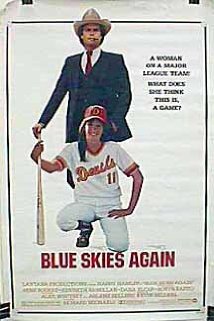
The Denver Devils is a minor league baseball team that is coming off of its worst season ever.  The new owner (Harry Hamlin) is only concerned with making money and does not know anything about baseball.  The veteran coach (Kenneth McMillan) does not have the respect of his players.  Teammates like Ken (Andy Garcia), Calvin (Joseph Gian), and Wall Street (Cylk Cozart) are worried that they could lose their place on the team at any moment.  The only good news is that two sports agents (Mimi Rogers and Dana Elcar) have found the perfect prospect for the Devils.  This player can play second base.  This player can catch a grounder and turn it into a double play.  This player can hit the ball out of the park.  The only problem?  The player’s name is Paula (Robyn Barto) and she’s a girl!

Robyn Barto was asked to audition after a casting director saw her playing softball for her community college.  Blue Skies Again was her first film role.  In the role of a professional baseball player, Barto was a very convincing softball player.  But Barto was likable and had an engaging screen presence so it’s too bad that this movie was not only her first but also her last.  In the publicity leading up to the release of Blue Skies Again, Barto got to throw out the opening pitch at a Dodger game but that was it for her time in the spotlight.  According to one article that I found that was written ten years after the release of Blue Skies Again, Barto never regretted not having a film career and ended up coaching the softball team at her old high school.

Blue Skies Again was not only the debut of Robyn Barto but also the first feature film for both Mimi Rogers and Andy Garcia.  Garcia does not get to do much but Mimi Rogers shows off the sexy and fun screen presence that always makes me wonder why she never really became a big star.

Blue Skies Again is an okay movie but it does not add up to much.  No one wants to play with a girl but then she gets a hit so everyone changes their mind.  It’s the type of movie that, today, would be made for Hallmark or the Family Channel.  It’s a nice baseball movie but it can’t compare to the real thing.