Retro Television Reviews: Miami Vice 1.10 “Glades”


Welcome to Retro Television Reviews, a feature where we review some of our favorite and least favorite shows of the past!  On Mondays, I will be reviewing Miami Vice, which ran on NBC from 1984 to 1989.  The entire show is currently streaming on Tubi!

This week, Crockett and Tubbs leave Miami!

Episode 1.10 “Glades”

(Dir by Stan Lathan, originally aired on November 30th, 1984)

Episode ten opens with the Animals’s “We’ve Got To Get Out Of This Place” playing on the soundtrack and the camera tracking down some of the less glamorous sections of Miami.  This is a far different part of the city than the viewer is used to seeing on Miami Vice.  The sleek art deco architecture has been replaced by vacant lots, run-down apartments, and torn-up streets.  It serves as a reminder that, while some people in Miami are getting very rich, others are still trapped in the cycle of poverty.

Joey Bramlette (Keith Szarabajka) is staying in a  cheap motel room, courtesy of the Vice Squad.  Joey is due to testify in court against his former boss, a Colombian drug lord named Ruiz.  Joey’s testimony is the key to the entire case but, when he receives a mysterious letter, he escapes the safehouse and flees back to his home in the Everglades.  Though it was Zito and Switek who allowed him to escape, Crockett and Tubbs are the ones who head down to the Everglades to find him.

That’s right …. Crockett and Tubbs aren’t in Miami anymore!

As Crockett and Tubbs soon discover, the Everglades is full of rednecks, smugglers, and enforcers.  Safely hidden away from civilization, it’s a place where there is no law.  After a group of rednecks (led by John Pankow) trick Sonny and Tubbs into getting lost in the wilderness (“Moss grows on the north side of a tree!” Crockett announces as he tries to figure out how to return to civilization), the two cops are found by Joey and his wife, Cassie (Margaret Whitton).  Joey reveals that he still wants to testify but that Ruiz’s men have kidnapped his daughter.  Working together with Joey and his family, Crockett and Tubbs have to figure out how to storm Ruiz’s heavily guarded compound and rescue Joey’s daughter.

This episode was a bit of a change of pace but I enjoyed it.  Some of that is because, when I was growing up, I spent a lot of time in the country and I’ve still got a lot of family out there, working on their farms and living in communities much like the one that Crockett and Tubbs visited in this episode.  I may now be a city girl but I’ve still got my country side.  I can still remember what it was like, walking around the tall grass while wearing short shorts and a tank top.  Though I cringed a bit when it first appeared that this episode was going to portray rural Florida as being the equivalent of Deliverance, I was happy to see that it was ultimately a celebration of the resilience of country people.

There was an interesting subtext to this episode as everyone that Sonny and Tubbs met was a smuggler, either working for Ruiz or independently running marijuana into Florida.  Later, one of the older smugglers mentioned that he used to run moonshine, therefore suggesting that there wasn’t much difference between the War on Drugs of the 1980s and the doomed effort at prohibition of the 1920s.  Miami Vice is a cop show that often suggests that it’s sometimes best not to get too hung up on rigidly enforcing the law.  That’s quite a contrast to most other cop shows that I’ve seen.  Even modern cop shows tend to take the attitude that anyone who violates the law has to be punished in some way, whether by incarceration or death.  Miami Vice may have been about law enforcement but its heart belonged to the libertarians.

Next week’s episode of Miami Vice guest stars Burt Young, Michael Madsen, Lenny Von Dohlen, and Terry O’Quinn!
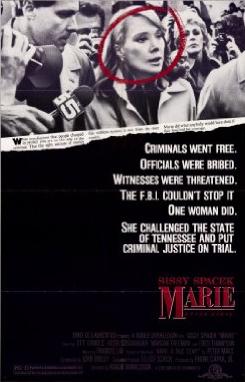
18 Days of Paranoia #15: Marie (dir by Roger Donaldson)


The 1985 film, Marie, tells a true story.

(In fact, the film’s official title is Marie: A True Story, just in case there was any doubt.)

The film opens in Tennessee, in the early 70s.  Marie Ragghianati (Sissy Spacek) has left her alcoholic and abusive husband and is now living with her mother and trying to raise three children, one of whom is chronically ill, on her own.  Though she manages to win a scholarship to Vanderbilt University, she quickly discovers that having a degree does not necessarily translate into getting a job.  However, while Marie was a student, she became acquainted with Eddie Sisk (Jeff Daniels), a seemingly friendly lawyer who now has a job as the counsel for the newly elected governor of Tennessee, Ray Blanton (Don Hood).  Marie goes to see Eddie and she soon finds herself working in the governor’s office.

With Eddie’s support, Marie rises up through the ranks.  Of course, he does get a little bit annoyed whenever Marie asks him why the governor is so eager to offer clemency to certain criminals.  At first, Eddie claims that it’s because the governor is against the death penalty and he doesn’t want to send anyone to die in “Old Sparky.”  Later, Eddie claims that it’s because the state has been ordered to do something about prison overcrowding.  And finally, Eddie admits that, on occasion, it’s done as a political favor.  It appears that some of the children of Tennessee’s wealthiest families have a really bad habit of getting arrested for some very serious crimes.

Eventually, there’s an opening on the state parole board and Eddie recommends that Marie be appointed the board’s new chairperson.  As Eddie explains it, the governor wants to put a Democrat on the board and he wants to appoint a woman.  (Despite the governor’s insistence that he wants to bring more women into state government, the film makes it clear that the Blanton administration was essentially a boys club.)  Marie agrees and soon, she’s making over a hundred dollars a day!  (That was apparently an unusual thing in the 70s.)

No sooner has Marie moved into her new position than she is informed that some of the governor’s aides have been selling pardons.  When Marie goes to Eddie about the situation, his charming facade disappears as he gets angry with her and accuses her of trying to ruin his career.  When rumors get out that she may have gone to the FBI, Marie becomes a pariah.  The governor demands her resignation, which she refuses to give.  She finds herself being followed by strange cars and harassed by the police.  (At one point, she is arrested for drunk driving despite being sober.)  Meanwhile, people start to show up dead.

When Blanton fires Marie on trumped-up corruption charges, she decides to take the governor to court.  Fortunately, Marie is friendly with a lawyer named Fred Thompson.  The future U.S. Senator and presidential candidate plays himself in this film and he gives such an authoritative performance that he went on to have a busy career as a character actor whenever he wasn’t running for or serving in office.

Marie is a strangely disjointed film.  On the one hand, you’ve got Sissy Spacek, Fred Thompson, and Jeff Daniels all giving excellent performances and you’ve also got an inspiring true story.  On the other hand, the film attempts to combine so many different genres that it sometimes feels as if you’re watching multiple films at once.  The film starts out as the story of a single mom trying to restart her life and then it becomes a workplace drama as Marie has to deal with gossip about her relationship with Eddie and hostile co-workers like fellow board member Charles Traughber (Morgan Freeman, in a small role that would probably be forgettable if it was filled by anyone other than Morgan Freeman).  Then it becomes a courtroom drama, with Fred Thompson cross-examining witnesses and giving final arguments.  Meanwhile, at the same time, it’s also a political thriller in which two men are brutally murdered before they can testify against the governor.  And then finally, it’s also a crime drama as detectives try to track down a career criminal who has friends in the governor’s office.  It’s a film of many good parts but those parts don’t always seem to easily fit together and the end result is somewhat awkward whole.

(Interestingly enough, some of the film’s moments that seem as if they’re most likely to be fictionalized are actually based on fact.  For instance, two men who could have brought down Blanton were mysteriously murdered at the same time that Marie was suing the state.)

In the end, Marie doesn’t really come together but it has a good cast and a good lesson: Never trust a politician.

Other Entries In The 18 Days Of Paranoia:

  1. The Flight That Disappeared
  2. The Humanity Bureau
  3. The Private Files of J. Edgar Hoover
  4. The Falcon and the Snowman
  5. New World Order
  6. Scandal Sheet
  7. Cuban Rebel Girls
  8. The French Connection II
  9. Blunt: The Fourth Man 
  10. The Quiller Memorandum
  11. Betrayed
  12. Best Seller
  13. They Call Me Mister Tibbs
  14. The Organization

Cannes Film Review: Missing (dir by Costa-Gavras)


The 1982 film Missing takes place in Chile, shortly after the American-backed military coup that took out that country’s democratically elected President, Salvador Allende.

Of course, the film itself never specifically states this.  Instead, it opens with a narrator informing us that the story we’re about to see is true but that some names have been changed “to protect the innocent and the film.”  The film takes place in an unnamed in South America, where the military has just taken over the government.  Curfew is enforced by soldiers and the sound of gunfire is continually heard in the distance.  Throughout the film, dead bodies pile up in the streets.  Prisoners are held in the National Stadium, where they are tortured and eventually executed.  Women wearing pants are pulled out of crowds and told that, from now on, women will wear skirts.  The sky is full of helicopters and, when an earthquake hits, guests in a posh hotel are fired upon when they try to leave.  About the only people who seem to be happy about the coup is the collection of brash CIA agents and military men who randomly pop up throughout the film.

Again, the location is never specifically identified as Chile.  In fact, except for the picture of Richard Nixon hanging in the American embassy, the film never goes out of its way to point out that the film itself is taking place in the early 70s.  If you know history, of course, it’s obviously meant to be Chile after Allende but the film itself is set up to suggest that the story its telling is not limited to one specific place or time.

Charlie Horman (John Shea) is an American who lives in the country with his wife, Beth (Sissy Spacek).  Charlie is a writer who occasionally publishes articles in a local left-wing newspaper.  In the aftermath of the coup, Charlie is one of the many people who go missing.  All that’s known is that he was apparently arrested and then he vanished into the system.  The authorities and the American ambassador insist that Charlie probably just got lost in the confusion of the coup and that he’ll turn up any day.  Even though thousands have been executed, everyone assumes that Charlie’s status as an American would have kept him safe.  As brutal as the new government may be, they surely wouldn’t execute an American….

Or, at least, that’s what Ed Horman (Jack Lemmon) believes.  Ed is Charlie’s father, a businessman from New York who simply cannot understand what’s going on.  He can’t understand why his son and his daughter-in-law went to South America in the first place.  He can’t understand why his government is not doing more to find his son.  And, when he eventually arrives in South America himself, Ed cannot understand the violence that he sees all around him.

Working with Beth, Ed investigates what happened to his son.  At first, Ed blames Beth for Charlie’s disappearance and Beth can barely hide her annoyance with her conservative father-in-law.  But, as their search progresses, Beth and Ed come to understand each other.  Beth starts to see that, in his way, Ed is just as determined an idealist as Charlie.  And Ed learns that Charlie and Beth had good reason to distrust the American government…

Costa-Gavras is not exactly a subtle director and it would be an understatement to say that Missing is a heavy-handed film.  The Embassy staff is so villainous that you’re shocked they don’t all have mustaches to twirl while considering their evil plans.  When, in a flashback, Charlie meets a shady American, it’s not enough for the man to be a CIA agent.  Instead, he has to be a CIA agent from Texas who heartily laughs after everything he says and who brags on himself in the thickest accent imaginable.  When Charlie talks to an American military officer, it’s not enough that the officer is happy about the coup.  Instead, he has to start talking about how JFK sold everyone out during the Bay of Pigs.

As the same time, the film’s lack of subtlety also leads to its best moments.  When Beth finds herself out after curfew, the city turns into a Hellish landscape of burning books and dead bodies.  As Beth huddles in a corner, she watches as a magnificent white horse runs down a dark street, followed by a group of gun-toting soldiers in a jeep.  When Ed and Beth explore a morgue, they walk through several rooms of the “identified” dead before they find themselves in a room containing the thousands of unidentified dead.  It’s overwhelming and heavy-handed but it’s also crudely effective.  While the film itself is a bit too heavy-handed to really be successful, those scenes do capture the horror of living under an authoritarian regime.

(Interestingly, Missing was a part of a mini-genre of films about Americans trapped in right-wing South American dictatorships.  While you can’t deny the good intentions of these films, it’s hard not to notice the lack of films about life in Chavez’s Venezuela or the political dissidents who were lobotomized in Castro’s Cuba.)

Missing won the Palme d’Or at the 1982 Cannes Film Festival (an award that it shared, that year, with the Turkish film Yol) and it also received an Oscar nomination for best picture of the year.  (It lost to Gandhi.)

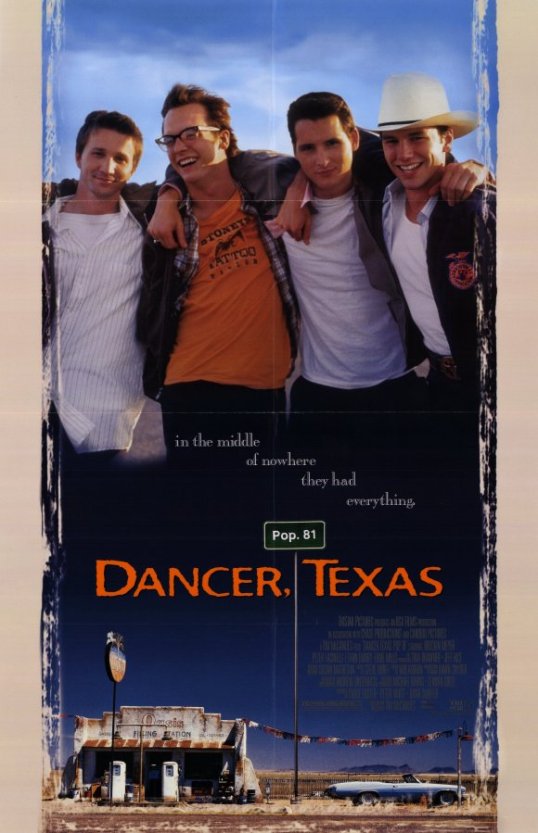
Back to School #53: Dancer, Texas Pop. 81 (dir by Tim McCanlies)


dancer-texas-pop-81-movie-poster-1998-1020196368

Dancer, Texas Pop. 81 is a 1998 film about a small town in West Texas that only has a population of 81 citizens.  Just from my own experience of telling people about how much I happen to like this movie, I get the feeling that only 81 people may have actually seen it.  But no matter!  Regardless of how many people have actually seen it, Dancer, Texas is one of my favorite films about my home state.

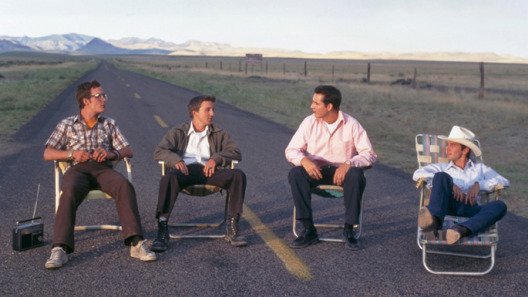
Dancer starts out with a scene that is so quintessentially Texan that it might as well appear next to Texas in the dictionary.  Four teenagers — all of whom are scheduled to soon graduate from high school — sit out in the middle of the highway.  The road seems to stretch on forever.  The land around them is empty.  If you’ve ever been to West Texas, you know what type of land I’m talking about.  It’s the type of land where you feel like you can see forever.  In the far distance, we see a pair of headlights.

“Car’s comin'” one of them drawls, knowing that they’ve got at least another 15 minutes before that car ever gets anywhere near the tiny town of Dancer, Texas.

These four teenage boys make up 80% of the graduating class of Dancer’s high school and all four of them are planning on leaving town and heading for Los Angeles.  Keller (Breckin Meyer) is their leader, the big dreamer who can’t wait to get out of the state.  Terrell Lee (Peter Facinelli) is the son of the only rich man in town and he’s being pressured by his mother to stay in Dancer and to learn the oil business.  John (Eddie Mills) is the simplest of the four and also the most reluctant about leaving.  He simply wants to be a farmer and he can’t understand why his taciturn father refuses to say anything to keep him from leaving town.  And finally, there’s Squirrel (Ethan Embry), who is the weird one.  Every group needs a weird one and Squirrel is weird even by the usual standards of small town oddness.

Not much happens in Dancer, Texas.  That goes for both the film and the town.  Over the course of two days, all four of the boys are forced to decide whether they really want to leave or if they actually want to stay.  Adding an extra poignancy to their decision is the fact that there literally is no chance that life in Dancer is ever going to change.  Dancer is as it has always been and always will be.  Deciding to stay means staying forever.  And, as the film shows, that’s okay for some people and terrible for others.

I really like Dancer, Texas.  Yes, it does move at its own deliberate pace and yes, a few scenes do tend to get a bit too obvious in their sentimentality (just to name two of the complaints that I saw from some commenters over at the imdb).  Meyer, Facinelli, and Mills all give such wonderfully natural performances that it makes you all the more aware that Embry seems a bit out-of-place.  But, ultimately, none of that matters.  Dancer, Texas is one of the most honest and sincere films that I’ve ever seen and it’s a film that does my home state proud.

Lisa’s Rating: 8 out of 10

211