Gene Roddenberry’s post-STAR TREK career had pretty much gone down the tubes. The sci-fi series had been a money loser, and Roddenberry wasn’t getting many offers. Not wanting to be pigeonholed in the science fiction ghetto, he produced and wrote the screenplay for PRETTY MAIDS ALL IN A ROW, a black comedy skewering the sexual revolution, with French New Wave director Roger Vadim making his first American movie. The result was an uneven yet entertaining film that would never get the green light today with its theme of horny teachers having sex with horny high school students!
All-American hunk Rock Hudson was in the middle of a career crisis himself. After spending years as Doris Day’s paramour in a series of fluffy comedies, his box office clout was at an all-time low. Taking the role of Tiger McGrew, the guidance counselor/football coach whose dalliances with the cheerleading squad leads to murder…
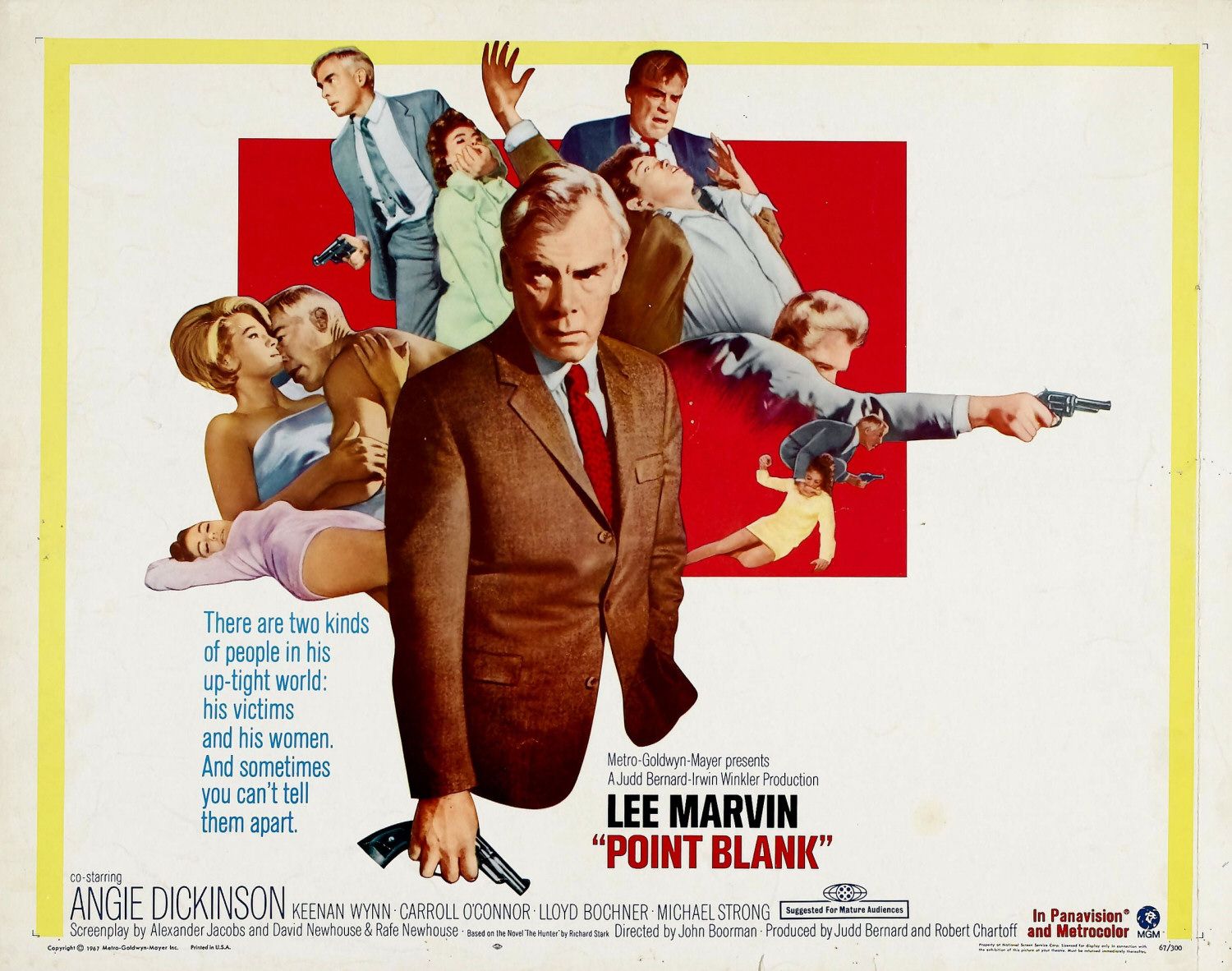
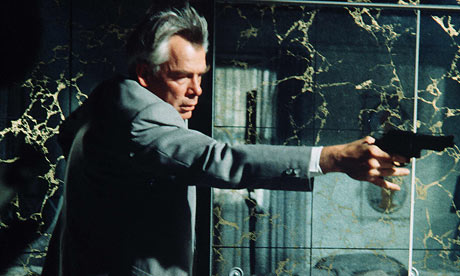
Lee Marvin was one tough son of a bitch both onscreen and off, awarded the Purple Heart after being wounded by a machine gun blast in WWII. The ex-Marine stumbled into acting post-war, and Hollywood beckoned in the 1950’s. His imposing presence typecast him as a villain in films like HANGMAN’S KNOT, THE BIG HEAT , and BAD DAY AT BLACK ROCK. A three season stint in TV’s M SQUAD brought Marvin more acclaim, and he solidified that with his Oscar-winning role in CAT BALLOU, parodying his own tough-guy image. Marvin was now a star that could call his own shots, and used that clout in POINT BLANK, throwing out the script and collaborating with a young director he had faith in, John Boorman.
POINT BLANK is a highly stylized revenge drama centering on Marvin’s character of Walker. The nightmarish opening sequence shows how Walker was left for dead on deserted Alcatraz Island by…
Up until recently, I firmly believed that Love and Other Drugs was the most annoying movie ever made. But then, a few nights ago, I cracked open my Mill Creek 50 Drive In Movie Classic box set and I watched a little film from 1971. I was just looking for a horror film to review for October. Little did I know that I would soon be watching the most annoying movie ever made!
The name of that movie?
The Manipulator.
The star of that movie?
Mickey Freaking Rooney.
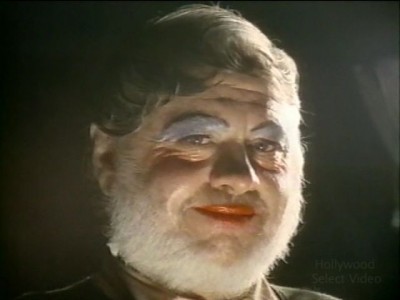
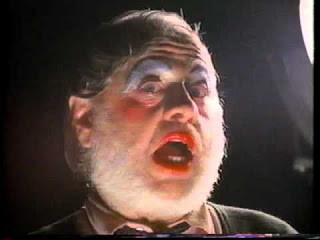
In The Manipulator, Mickey plays B.J. Lang, a former Hollywood makeup artist who has had a mental breakdown. He now lives in a dusty warehouse, surrounded by old movie props and mannequins. B.J. spends a lot of time talking to himself and trying on makeup. Sometimes, he wears a fake nose and pretends that he’s Cyrano de Bergerac. And then, at other times, he imagines all of his mannequins coming to life and taunting him. (It’s kind of like the final scene of Maniac, except nobody’s head gets ripped off.) Occasionally, he has weird flashbacks, which are all about giving the filmmaker an excuse to utilize the fish-eye lens and psychedelic lighting.
Eventually, we learn that BJ (and, as I watched the film, I kept wondering if his name was supposed to make viewers think about oral sex) is not alone in his warehouse. There’s a woman (Luana Anders) who is being held prisoner. He has her tied up in a chair and, whenever she begs to eat, he feeds her baby food. BJ calls her Carlotta, though that’s apparently not actually her name. The woman yells a lot. Her first five minutes of screen time consist of her repeating, “MR. LAAAAAAAAAANG” over and over again.
BJ spends most of his time delivering monologues about how Hollywood used to be and occasionally, he demands that Carlotta help him put on a play. At one point, BJ appears to have a heart attack and this leads to Carlotta going, “DON’T DIIIIIIIIIIIIIIIIIEEEEEE, MR. LAAAAAAAAANG” over and over again.
And then a homeless bum (Keenan Wynn) shows up and wanders about for five minutes before dying.
The problem with writing about a film like The Manipulator is that, just by describing the plot, you make it sound more interesting than it actually is. You’re probably reading this and thinking, “Wow, this sounds really weird! I need to see it at least once…”
No, you don’t. It may sound weird but ultimately, it’s more emptily pretentious than anything else. This was both director Yabo Yablonsky’s first and final film and there is not a single camera trick that he does not employ. We get the weird angles, the random moments of slow motion, the even more random moments when the film is suddenly sped up, the extreme close-ups, the sudden blackouts, the ragged jump cuts, and, of course, lots of rack focus and zoom lens use. Compared to The Manipulator, the direction of Getting Straight appears to be mild and conventional! The film does feature three talented performers but none of them seem to have the slightest idea what the movie is about or who they are supposed to be playing. In particular, both Rooney and Wynn seem to be making up their dialogue as they go along.
And really, that’s why The Manipulator is so annoying. It should have, at the very least, been an insane misfire. Instead, it’s just boring.
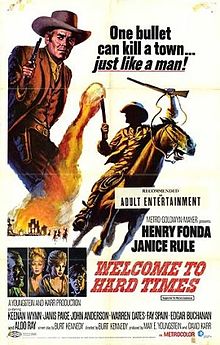
Welcome to Hard Times is a western that used to frequently turn up on TV when I was a kid. I remembered that I had always enjoyed it but otherwise, I had largely forgotten about it when I saw that it was airing on TCM earlier today. I rewatched it to see if I would still enjoy it. Welcome To Hard Times has its flaws but it is still an above average addition to the genre.
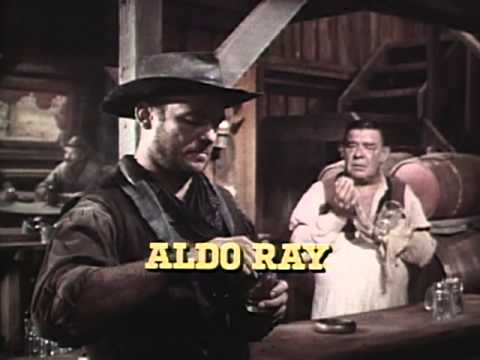
Based on a novel by E.L. Doctorow, Welcome to Hard Times takes place in the small western settlement of Hard Times, Nevada. When the mysterious Man From Bodie (Aldo Ray) shows up, he terrorizes everyone in the town. When the town founder, Mr. Fee (Paul Birch), attempts to stand up to him, the Man from Bodie shoots him dead. When the local undertaker, Mr. Hansen (Elisha Cook, Jr.) tries to stop the Man from stealing one of his horses, the Man silently guns him down. As the town’s mayor, Will Blue (Henry Fonda), stands by and helplessly watches, The Man rapes and murders Fee’s girlfriend and also kills the local saloonkeeper, Avery (Lon Chaney, Jr.). The Man burns down the town and finally leaves.
Thought most of the surviving townspeople abandon Hard Times, Will Blue stays behind and tries to rebuild. He adopts Fee’s son, Jimmy (Michael Shea). Also staying behind is Jimmy’s mother, Molly Riordan (Janice Rule), a former saloon girl who was also raped by the Man and who constantly taunts Will for not being able to stand up to him. New settlers arrive and the town starts to rebuild. Zar (Kennan Wynn) and his four girls reopen the saloon and serve the workers at a nearby mine. Isaac Maple (John Anderson) reopens the general store. Under Will’s leadership, Hard Times starts to thrive.
A drifter named Leo Jenks (the great Warren Oates) also moves in. When Molly discovers that Leo is a crack shot, she gets him to teach Jimmy how to handle a shotgun. Both she and Will know that the Man is going to return in the spring. Molly is obsessed with vengeance and Will fears that Jimmy is going to be consumed by her hatred.
Of course, the Man does eventually return.
Welcome to Hard Times works best at the beginning and the end, when Aldo Ray is on-screen. As the sadistic Man from Bodie, Ray gives a classic western bad guy performance. He’s intimidating, he’s violent, and he guns down the citizens of Hard Times with even more casual arrogance than Lee Marvin, Jack Palance, and Lee Van Cleef combined! The middle section of the film drags and it is hard to ignore Jane Rule’s shaky Irish accent. It is obvious that Welcome to Hard Times is trying to say something about Will Blue’s humanistic approach but it does not seem to know what.
Director Burt Kennedy was best known for directing comedic westerns. Welcome to Hard Times was a rare dramatic film for him. It’s not a great western but, thanks to Aldo Ray’s performance and the excellent work of cinematography Harry Stradling, Jr., it’s still a worthy addition to the genre.
“Oh we must be doin’ somethin right to last 200 years…”
— Haven Hamilton (Henry Gibson) in Nashville (1975)
The 1975 Best Picture nominee Nashville is the epitome of an ensemble film. It follows 24 characters as they spend five days wandering around Nashville, Tennessee. Some of them are country music superstars, some of them are groupies, some of them are singers looking for a first break, and at least one of them is an assassin. The one thing that they all have in common is that they’re lost in America. Released barely a year after the resignation of Richard Nixon and at a time when Americans were still struggling to come to terms with the turmoil of the 60s, Nashville is a film that asks whether or not America’s best days are behind it and seems to be saying that they may very well be. (That’s a question that’s still being asked today in 2015.) It’s appropriate, therefore, that Nashville both takes place in and is named after a city that everyone associates with perhaps the most stereotypically American genre of music that there is.
Nashville follows 24 characters, some of whom are more interesting than others. For five days, these characters wander around town, occasionally noticing each other but far more often failing to make any sort of connection.
Haven Hamilton (Henry Gibson) is a veteran star, a somewhat comical character who sings vapid songs about home and family and who smiles for the public while privately revealing himself to be petty and vain. His son, Bud (Dave Peel), is a Harvard graduate who acts as his father’s business manager. Oddly enough, Haven is an unlikable character until the end of the film when he suddenly reveals himself to be one of the few characters strong enough to keep Nashville for descending into chaos. Meanwhile, Bud seems to be a nice and modest guy until he takes part in humiliating another character.
Haven’s lover is Lady Pearl (Barbara Baxley), who owns a nightclub and spends most of the film drinking. Much like Haven, she starts out as a vaguely comical character until she finally gets a chance to reveal her true self. In Pearl’s case, it comes when she delivers a bitter monologue about volunteering for Bobby Kennedy’s presidential campaign.
Haven’s lawyer is Delbert Reece (Ned Beatty), an obsequies good old boy who is married to gospel singer Linnea (Lily Tomlin). They have two deaf children. Linnea has learned sign language. Delbert has not. Over the course of the film, both Delbert and Linnea will be tempted to cheat. Only one of them actually will.
And then there’s Barbara Jean (Ronee Blakley), a mentally unstable singer who has come to Nashville with her manipulative husband/manager, Barnett (Allen Garfield). Almost every character in the film wants something from Barbara Jean. A mostly silent Vietnam veteran named Kelly (Scott Glenn) claims that his mother knows Barbara Jean. A nerdy guy named Kenny (David Hayward) comes to Nashville just to see her perform.
Both Kelly and Kenny end up getting to know Mr. Green (Keenan Wynn), a rare Nashville resident who doesn’t seem to care about music. However, Mr. Green’s spacey niece, L.A. Joan (Shelly Duvall), is obsessed with having sex with as many musicians as possible.
Among those being targeted by L.A. Joan is Tom Frank (Keith Carradine), one-third of the folk trio Bill, Mary, and Tom. Unknown to Bill (Allan F. Nicholls), Tom is sleeping with Bill’s wife, Mary (Cristina Raines). Unknown to Mary, Tom is sleeping with almost every other woman in Nashville as well. When Tom takes to the stage at Pearl’s nightclub and sings a song called I’m Easy, the audience is full of women who think that he’s specifically singing to them.
Another one of Tom’s songs, the appropriately titled “It Don’t Worry Me,” is frequently sung by Albuquerque (Barbara Harris), who spend the entire film trying to get discovered while hiding out from her much older husband, Star (Bert Remsen).
Another aspiring star is Sulleen Grey (Gwen Welles), who is a tone deaf waitress who suffers the film’s greatest humiliation when she agrees to perform at a political fund raiser without understanding that she’s expected to strip while singing. Trying to look after Sulleen is Wade (Robert DoQui), who has just been released from prison.
And then there’s the loners, the characters who tend to pop up almost randomly. Norman (David Arkin) is a limo driver who, like everyone else in Nashville, wants to be a star. The hilariously bitchy Connie White (Karen Black) and the bland Tommy Brown (Timothy Brown) already are stars. (The character of Tommy Brown is one of Nashville’s oddities. He’s listed, in the credits, as being a major character but he only appears in a few scenes and never really gets a storyline of his own.) There’s the Tricycle Man (Jeff Goldblum), a silent magician who mysteriously appears and disappears throughout the film.
And, finally, there’s Opal (Geraldine Chaplin), an apparently crazed woman who is wandering around Nashville and pretending to be a reporter for the BBC. (It’s never specifically stated that Opal is a fake but it’s fairly obvious that she is.) How you feel about the character of Opal will probably determine how you feel about Nashville as a whole. If you find Opal to be a heavy-handed caricature, you’ll probably feel the same way about the rest of the film. If you find the character of Opal to be genuinely amusing with her increasingly pretentious musings, you’ll probably enjoy Nashville.
There is one more very important character in Nashville. He’s the character who literally holds the film together. He’s also the reason why I’m including Nashville in this series of reviews about political films. That character is named Hal Phillip Walker and, though he’s never actually seen in the film, he’s still the driving force behind most of what happens. Walker is a third-party presidential candidate, a man who seems to be universally admired despite the fact that his campaign appears to just be a collection of vapid platitudes. Walker’s campaign manager, John Triplette (Michael Murphy), comes to Nashville and sets up the Walker For President rally. That’s where Nashville reaches its violent and not-all-together optimistic climax.
Reportedly, Nashville is a favorite film of Paul Thomas Anderson’s and you can see the influence of Nashville in many of Anderson’s films, from the large ensemble to the moments of bizarre humor to the refusal to pass judgement on any of the characters to the inevitable violence that ends the film. Also, much like Anderson’s films, Nashville seems to be a film that was specifically made to divide audiences. You’re either going to think that Nashville is a brilliantly satirical piece of Americana or you’re going to think it’s a self-indulgent and self-important mess.
As for me, I think it’s great and I think that, after you watch it, you should track down and read Jan Stuart’s The Nashville Chronicles: The Making of Robert Altman’s Masterpiece. It’s the perfect companion for a great film.
“Gentlemen! You can’t fight here! This is the war room!” — President Merkin Muffley (Peter Sellers) in Dr. Strangelove: Or How I Learned To Stop Worrying And Love the Bomb (1964)
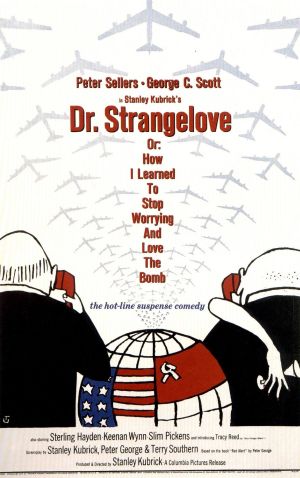
The next time you hear someone bragging about how their favorite politician is an intellectual who always acts calmly and rationally, I would suggest that you remember the example of President Merkin Muffley, one of the many characters who populate the 1964 best picture nominee, Dr. Strangelove or How I Learned To Stop Worrying and Love the Bomb.
As played by Peter Sellers, Merkin Muffley is the epitome of rational political action. Speaking in a steady (if somewhat muffled) midwestern accent and always struggling to remain calm and dignified, Muffley keeps order in the War Room as the world edges closer and closer to apocalypse.
Just consider, for example, this scene where President Muffley calls the Russian leader (the nicely named Dimitri Kissoff) and explains that a little something silly has happened.
As Muffley explains in the above scene, Gen. Jack D. Ripper (Sterling Hayden) has gone crazy. Convinced that the Russians have been sapping his precious bodily fluids, Gen. Ripper has ordered a nuclear strike on Russia. Unfortunately, Russia has built a Doomsday Machine that, should Russia be bombed, will destroy the world.
While Muffley is at fist skeptical about a doomsday machine, his advisor, Dr. Strangelove (also played by Peter Sellers), explains that the doomsday machine not only exists but that it’s actually a pretty good idea. The wheelchair-bound Dr. Strangelove speaks in a German accent and appears to have lost control over the left side of his body. At random moments, his left arm shoots up in a Nazi salute. At other times, his hand tries to strangle him. Making these surreal moments all the more memorable is the fact that nobody in the War Room seems to notice or question them.
And, while it’s always tempting to dismiss a character like Dr. Strangelove as being an over-the-top caricature, the fact of the matter is that, following the end of World War II, several Nazi scientists ended up working for the U.S. government. In many ways, the U.S. space program was the creation of a bunch of real-life Dr. Strangeloves.
Of course, President Muffley and Dr. Strangelove aren’t the only roles played by Peter Sellers in this film. Sellers also plays Lionel Mandrake, a British officer who — as the result of an office exchange program — happens to be at Burpelson Air Force Base at the same time that Gen. Ripper orders the attack on Russia.
As famous as his Sellers’s performances as Dr. Strangelove and President Muffley may be, I actually think Mandrake is his best performance in the film. In many ways, Mandrake is the audience’s surrogate. He’s the one who gets to hear Ripper’s rambling explanation for why he launched an attack on Russia. He’s the one who has to try to convince the hilariously unhelpful Col. Bat Guano (Keenan Wynn) to help him find a quarter so he can call the Pentagon.
(“You’re gonna have to answer to the Coca-Cola company,” Guano says, before shooting open a Coke machine to get change.)
Sellers plays Mandrake as a parody of the traditional, stiff upper lip British army officer. Not only does that allow some great humor as Mandrake keeps a calm demeanor while listening to Ripper’s increasingly crazed monologue but it also allows Mandrake to be the only sane man in the movie.
(Of course, the whole point of Dr. Strangelove is that the world’s become so insane that one sane man can not make a difference. )
Sellers earned a best actor nomination for playing three different roles and he deserved it but, for me, the two best performances in the film come from Slim Pickens and George C. Scott.
Pickens, of course, is the bomber pilot who ends up riding an atomic bomb like a bull in a rodeo. As a character, Maj. Kong may be a bit too much of a spot-on stereotype but Pickens brings such sincerity to the role that it doesn’t matter. Oddly enough, you feel almost happy for him when he rides that bomb to his death. You know that’s exactly how he would have wanted to go out.
And then there’s George C. Scott, playing the role of Gen. Buck Turgidson. From the safety of the War Room, Turgidson looks forward to nuclear war and worries when President Muffley invites the Russian ambassador to join them. (“But he’ll see the big board!” Turgidson exclaims.) Turgidson is both hilariously stupid and hilariously confident. Perhaps my favorite Turgidson moment comes when he trips, falls, and stands back up without once losing his paranoid train of thought.
(Though he doesn’t have a big role, James Earl Jones makes his film debut in Dr. Strangelove. The way he delivers the line “What about Major Kong?” makes me laugh every time.)
50 years after it was first released, Dr. Strangelove remains a comic masterpiece of a nightmare, a film that proves that political points are best made with satire and not sermons.
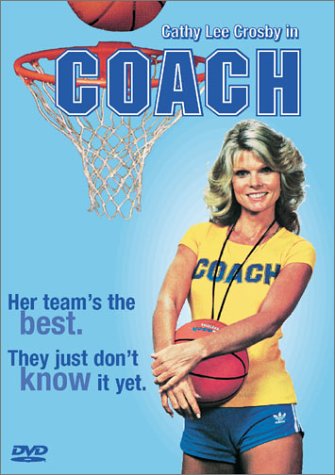
Just from watching the trailer above, you probably think that the 1978 film Coach is just your standard high school sports film. And, in many ways, it is. But, since it was made in the 70s, things still get a little bit weird. Before proceeding, I should probably point out that Coach (like the similar The Teacher) was produced by Crown International Pictures. But you probably already guessed that.
An exclusive California high school has a problem. The boy’s basketball team is having a terrible season. The most powerful man in town, F.R. Granger (Keenan Wynn), demands a change! (You can tell that Granger is powerful because he goes by his initials.) After ordering the hapless basketball coach to resign, Granger and the school board hire Randy Rawlings to replace him. Oddly enough, they don’t actually interview Randy for the job or attempt to meet Randy ahead of time. They just know that Randy is a former Olympian and are overjoyed when Randy accepts the job.
On Randy’s first day on the job, everyone is shocked to discover that Randy Rawlings is — GASP — a woman! Now, I’ll admit that this film is a little bit before my time and the world was probably a lot different back in the 70s but, as an Olympic medalist, wouldn’t Randy be a bit of a celebrity? And would anyone as obsessed with winning as F.R. Granger actually hire a coach sight unseen? Anyway, F.R. is none too happy to discover that Randy (Cathy Lee Crosby) is a woman and tries to fire her on the spot. Sorry, F.R. — can’t be done. As Randy points out, F.R. needs cause to fire her.
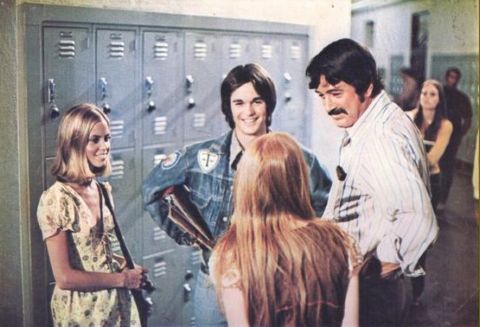
After forcing them to all take a cold shower and then coaching them to a few victories, Randy wins over the team. She also starts sleeping with one of her players (played by a very young and handsome Michael Biehn) and this is where the movie gets weird. I kept expecting this affair to be discovered and used by F.R. as an excuse to fire Randy. Because, after all, why would any film feature a rather creepy subplot about a teacher sleeping with a student unless it was somehow going to pay off in the end? But instead, the affair just sort of happens and never really ties back into the main plot of whether or not Randy will be able to coach the team to having a winning season.
Now, I know you’re probably thinking to yourself, “What would the great Russian writer Anton Chekhov think about this?” Well, here’s an exact quote from Mr. Chekhov:
“Remove everything that has no relevance to the story. If you say in the first chapter that there is a rifle hanging on the wall, in the second or third chapter it absolutely must go off. If it’s not going to be fired, it shouldn’t be hanging there.”
In other words, Coach was definitely not written by Anton Chekhov.
Anton Chekhov ponders the narrative failings of Coach
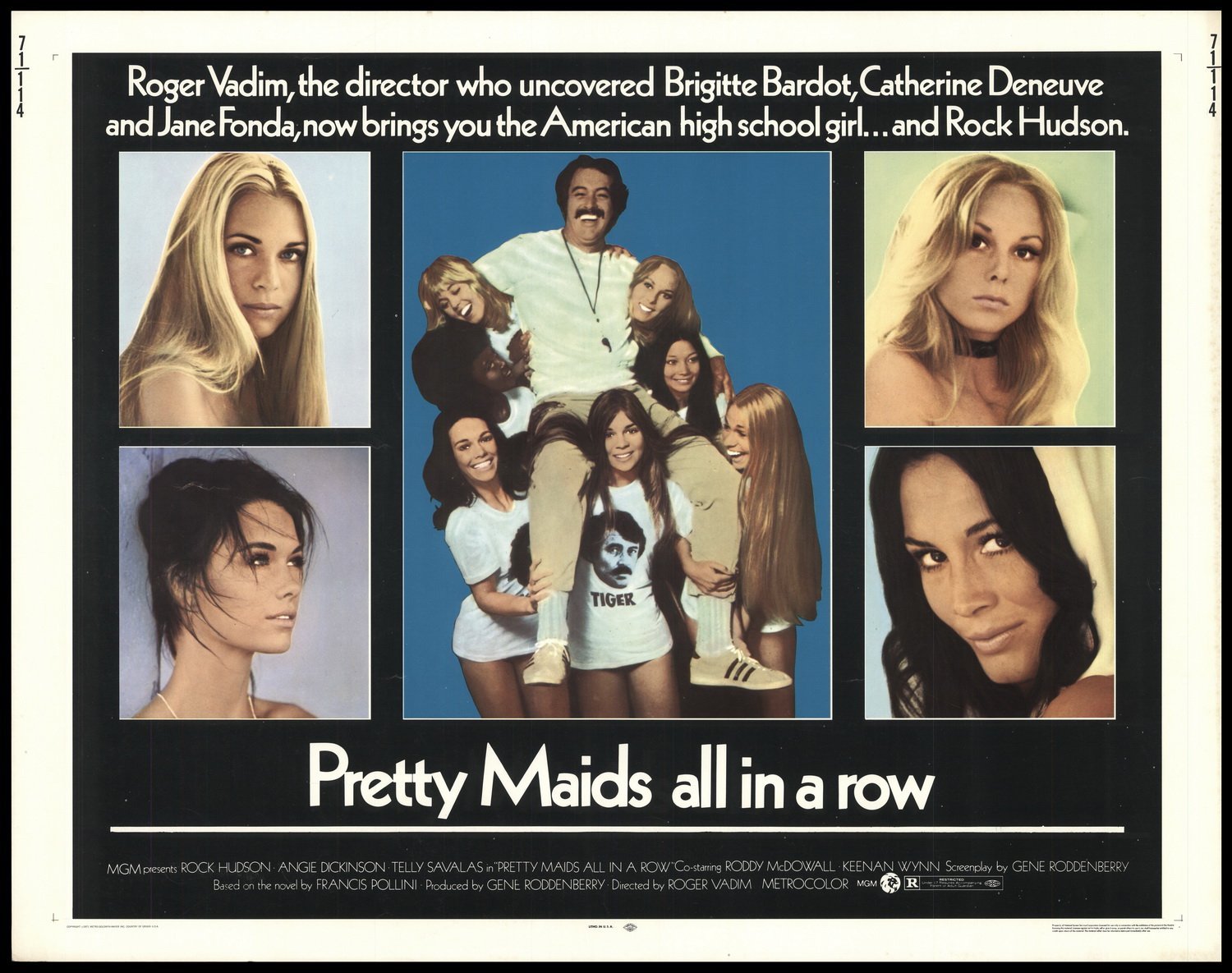
Pretty Maids All In A Row, which — as should be pretty obvious from the trailer above — was originally released in 1971, is a bit of a historic film for me. You see, I love movies. And, as a part of that love, I usually don’t give up. Regardless of how bad a movie may turn out to be, once I start watching, I stick with it. I do not give up. I keep watching because you never know. The film could suddenly get better. It could turn out that what originally seemed like a misfire was actually brilliant satire. If you’re going to talk or write about movies, you have an obligation to watch the entire movie. That was a rule that I had always lived by.
And then, one night, Pretty Maids All In A Row popped up on TCM.
Now, I have to admit that I already knew that Pretty Maids was going to be an extremely 70s film. I knew that it was probably going to be more than a little sexist. I knew all of this because the above trailer was included on one of my 42nd Street Forever DVDs. But I still wanted to see Pretty Maids because the trailer hinted that there might be an interesting hiding underneath all of the cultural baggage. If nothing else, it appeared that it would have some sort of worth as an artifact of its time.
(If you’re a regular reader of this site, you know how much I love my cinematic time capsules.)
So, the film started. I logged onto twitter so that I could live tweet the film, using the hashtag #TCMParty. And from the moment the film started, I knew it wasn’t very good. It wasn’t just that the film’s camerawork and music were all extremely 70s. After all, I like 70s music. I don’t mind the occasional zoom lens. And random psychedelic sequences? WHO DOESN’T LOVE THOSE!? No, my dislike of the film had nothing to do with the film’s style. Instead, it had to do with the fact that there was absolutely nothing going on behind all of that style. It wasn’t even style for the sake of style (which is something that I usually love). Instead, it was style for the sake of being like every other “youth film” that came out in the 70s.
And then there was the film’s plot, which should have been interesting but wasn’t because director Roger Vadim (who specialized in stylish decadence) had no interest in it. The film takes place at Oceanfront High School, where the only rule is that apparently nobody is allowed to wear a bra. We meet one student, Ponce De Leon Harper (played by an amazingly unappealing actor named John David Carson), who is apparently on the verge of having a nervous breakdown because, at the height of the sexual revolution, he’s still a virgin.
(Because, of course, the whole point of the sexual revolution was for losers like Ponce to finally be able to get laid…)
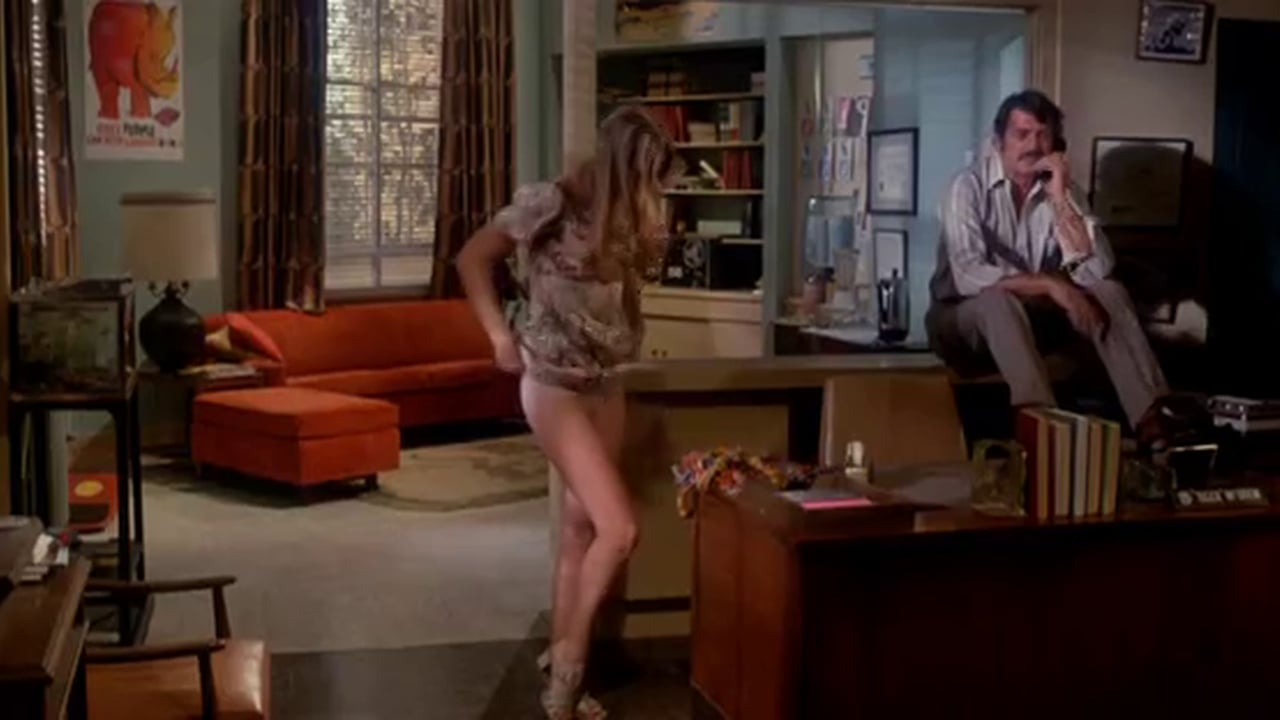
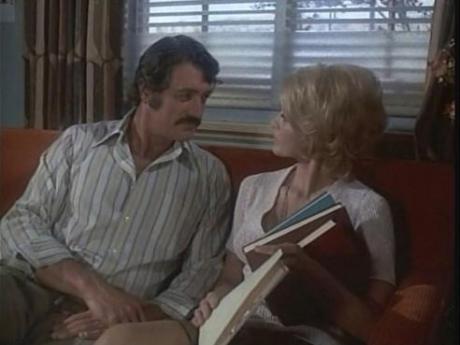
Ponce is taken under the wing of high school guidance counselor Tiger McDrew (Rock Hudson, complete with porn star mustache). Quickly figuring out exactly what Ponce needs, Tiger sets him up with a teacher played by Angie Dickinson. However, Tiger has other concerns than just Ponce. Tiger, it turns out, is a sex addict who is sleeping with nearly every female student at the school. But, American society is so oppressive and puts so much pressure on the American male that Tiger has no choice but to kill every girl that he sleeps with…
This is one of the only film I can think of that not only makes excuses for a serial killer but also presents him as being a heroic character. And, while it’s tempting to think that the film is being satirical in its portrayal of Tiger and his murders, it’s actually not. Don’t get me wrong. The film is a very broad comedy. The high school’s principal (Roddy McDowall) is more concerned with the football team than with all of the girls turning up dead at the school. The local sheriff (Keenan Wynn) is a buffoon. The tough detective (Telly Savalas) who investigates the murders gets a few one liners.
But Tiger, most assuredly, is the film’s hero. He’s the only character that the audience is expected to laugh with, as opposed to at. He is the character who is meant to serve as a mouthpiece for screenwriter Gene Roddenberry’s view on America’s puritanical culture. If only society was less hung up on sex, Tiger wouldn’t have to kill. Of course, the film’s celebration of Tiger’s attitude towards sex is not extended towards the girls who sleep with him. Without an exception, they are all presented as being empty-headed, demanding, shallow, and annoying, worthy only of being leered at by Vadim’s camera until Tiger finally has to do away with them.
(The film’s attitude towards women makes Getting Straight look positively enlightened.)
Rock and Angie
ANYWAY! I spent about 40 minutes watching this movie before I gave up on it. Actually, if you want to be technical about it, I gave up after 5 minutes. But I stuck with it for another 35 minutes, waiting to see if the film was going to get any better. It didn’t and finally, I had to ask myself, “Why am I actually sitting here and wasting my time with this misogynistic bullshit?” So, I stopped watching and I did so with no regrets.
What I had forgotten is that I had set the DVR to record the film while I was watching it, just in case I later decided to review it. So, last week, as I was preparing for this series of Back to School posts, I saw Pretty Maids All In A Row on my DVR. I watched the final 51 minutes of the film, just to see if it ever got better. It didn’t.
However, on the plus side, Rock Hudson does give a good performance in the role of Tiger, bringing a certain seedy desperation to the character. (I’m guessing that this desperation was Hudson’s own contribution and not an element of Roddenberry’s screenplay, which more or less presents Tiger as being a Nietzschean superman.). And beyond that, Pretty Maids serves as evidence as to just how desperate the Hollywood studios were to makes movies that would be weird enough to appeal to young people in the early 70s.
Watching the film, you can practically hear the voices of middle-aged studio executives.
“What the Hell are we trying to do with this movie!?” one of the voices says.
“Who cares!?” the other voice replies, “the kids will love it!”
When I first started at the University of North Texas, I lived in the Bruce Hall Dormitory and every day, I could count on the fact that there would be at least one fat and bearded resident in the lobby talking about how 9-11 was an inside job and how the only reason we were in Iraq was so Dick Cheney’s buddies could get rich.
By the time I graduated, everyone was convinced that the Republicans were going to steal the election from Barack Obama. Some people, of course, were hoping that was exactly what would happen because they were convinced that Obama was actually a Muslim from Kenya.
With each passing year of the Obama administration, there’s been a new conspiracy theory. Some people claimed that Obamacare was actually a Socialist plot. Others said that the Koch Brothers were behind the Tea Party. Meanwhile, Occupy Wall Street spoke ominously of how 1% of the population exploited the other 99%. As I sit here typing this, there is undoubtedly a desperate Obama partisan somewhere who is writing up his 100th blog post claiming that the Republicans somehow sabotaged the Obamacare website.
And, of course, living and working in Dallas, I am constantly reminded of the biggest conspiracy theory of all time. In just a few days, it will be the 50th anniversary of the assassination of John F. Kennedy and you better believe that my hometown is currently being invaded by wild-eyed men who are incapable of uttering a sentence without including terms like “grassy knoll,” “military-industrial complex,” and “coup d’etat.”
Yes, these are paranoid times. Nobody trusts anyone. All motives are suspect. With each passing day, it seems that more and more people are convinced that their daily failures and fortunes can all be blamed on shadowy forces. The world is a random place where a billion stories play out at once and not a single one of them is going to have a happy ending. People cling to their paranoia for much the same reason that some people cling to their concept of God. It gives them a false sense of security and reason in an otherwise chaotic universe.
As for me, I may not be a believer in conspiracies but, at the same time, I do find myself fascinated by both the theories and the films that they occasionally inspire. If movies ultimately serve as a reflection of society’s secret fears, insecurities, and desires, can it be any surprise that so many movies seem to be just as a paranoid as the audiences that go to see them?
For that reason, I am proud to announce that today is Day One of the 44 Days of Paranoia! For the next 44 days, we will be taking a look at some of the best and worst conspiracy-themed and paranoia-inducing films ever made.
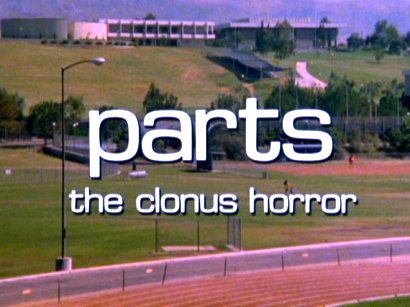
Let’s start things off by taking a look at the 1979 sci-fi conspiracy film, Clonus (a.k.a. Parts, the Clonus Horror).
Clonus opens on a compound the looks a lot like a community college. Living on the compound is a group of people who all appear to be extremely friendly and trusting. Every single one of them has a permanent smile plastered across his or her fresh faces. They spend their spare time jogging, working out, and — well, that’s about it. At the same time, none of them smoke, drink, or do anything else that could possibly cause any damage to their bodies.
So, at this point, you can probably guess that they’re either Mormons or they’re clones. (If you’re not sure, take another look at the film’s title…)
When the clones aren’t busy jogging, they’re talking about how much they hope that, one day, they will be allowed to go to “America.” There’s actually something rather touching about how excited they all get whenever they hear that one of them is getting sent to America. They’re a bit like the rubber aliens in Toy Story, putting all of their faith in “The Claw” and its ability to lift them up to a better life. Of course, what the clones don’t realize is that “going to America” is just a euphemism for being put under sedation and having their organs forcibly removed.
Eventually, one clone (played to awkward blank-faced perfection by Tim Donnelly) starts to question just why exactly he and his friends are being kept on the compound. He eventually escapes and discovers that not only has he been in America all along but that he only exists so that the rich and powerful can harvest his organs. Donnelly meets an idealistic journalist (Keenan Wynn) who happens to be acquainted with the family of a sinister presidential candidate (played by Peter Graves). When Wynn and Donnelly threaten to expose the truth, they find themselves targeted by the U.S. government which, in typical conspiracy-film style, is more than willing to kill to protect its secrets.
If the plot of Clonus sounds familiar, that’s because Michael Bay pretty much remade the film in 2005. In fact, Clonus director Robert Fiveson felt Bay’s The Island was so similar to his film, that he filed a lawsuit for copyright infringement. But whereas The Island was the epitome of a film that was more expensive than memorable, Clonus is an effectively creepy little film that, though dated, is still occasionally even thought-provoking. Though it may have been the result of the film’s budgetary limitations, Clonus eschews flashy effects for atmosphere and even the blandness of some of the locations adds to the film’s sense of low-key but palpable menace. If ever one needed proof that a low budget can occasionally be the best thing to ever happen to a film, Clonus is that proof. The film is generally well-acted and, best of all, it all builds up to one of those wonderfully downbeat endings that appear to have been so popular in the 70s.
Much like another recent and similar film — the excellent Never Let Me Go — Clonus works because it’s disturbingly plausible. It’s a bit of a cliché to say that a film makes science fiction feel like science fact but Clonus is one of those films that accomplishes just that.
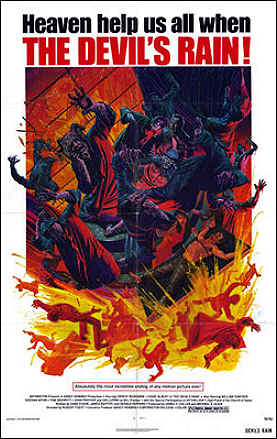
Satanic priest Jonathan Corbis (Ernest Borgnine) has spent decades pursuing the Preston family. The Prestons, it turns out, have a book of powerful Satanic magic in their possession. After Corbis causes the Preston patriarch to melt in the rain, Mark Preston (William Shatner) decides to confront Corbis and his followers…
Released in 1975, the Devil’s Rain was presumably made to capitalize on the success of films like Rosemary’s Baby and The Exorcist. The film itself is a bit incoherent but it’s worth watching just to see shameless overactors William Shatner and Ernest Borgnine acting opposite each other. The cast also includes Ida Lupino, Keenan Wynn, Tom Skerritt, and Eddie Albert, which means that there’s not a single bit of scenery that doesn’t get chewed at some point.
If watch carefully, you can spot John Travolta making his screen debut towards the end of the film.





 Through the Shattered Lens