Film Review: Airport 1975 (dir by Jack Smight)


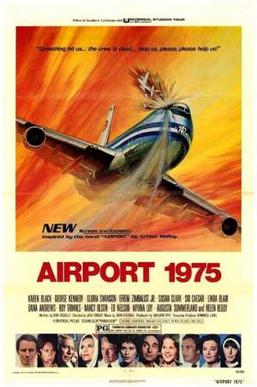
About halfway through 1974’s Airport 1975, Sid Caesar has one of the greatest lines in film history.

“The stewardess is flying the plane?”

Hell yeah, she is!  After a collision with another plane takes out the crew of a Broening 747, it’s up to head flight attendant Nancy (Karen Black) to keep the plane from crashing until another pilot can somehow be lowered into the cockpit of the stricken airliner.  Nancy’s never flown an airplane before but she is dating Al Murdock (Charlton Heston), who may be scared of commitment but who is still described as being one of the greatest pilots who has ever lived.  None other than Joe Patroni (George Kennedy) says that no one knows more about flying than Al Murdock.

George Kennedy is the only cast member to return from the original Airport.  When we previously met Patroni, he was the cigar-chewing chief mechanic for Trans World Airlines.  In Airport 1975, he’s suddenly an executive with Columbia Airlines.  His wife (Susan Clark) and his son (Brian Morrison) are also on the plane.  Joe Patroni and Al Murdock are determined to bring that plane safely to the ground in Salt Lake City and if that means dropping a pilot into the cockpit from a helicopter, that’s what they’ll do.  It’s all a question of whether or not Nancy can keep that plane from crashing while they round up a helicopter and a pilot.

Airport 1975 is so famous for being the movie where the stewardess is flying the plane that it’s often overlooked that it’s also the film where Linda Blair plays a young girl in need of a kidney transplant.  When Sister Ruth (Helen Reddy) sees that the girl has a guitar with her, Ruth sings a folk song that has everyone on the airplane smiling.  (If I was on a plane and someone started playing folk music, I’d probably jump out.  That may seem extreme but seriously, you don’t want to test me on how much I dislike the folk sound.)  This scene was, of course, parodied in Airplane!  In fact, it’s pretty much impossible to watch Airport 1975 without thinking about Airplane!

It’s also overlooked that Gloria Swanson is one of the many stars to appear in this film but Swanson is the only one playing herself.  Gloria Swanson starts as Gloria Swanson and I assume that this 1974 film was set in 1975 in order to generate some suspense as to whether or not Swanson was going to survive the crash.  Swanson talks about how, in 1919, Cecil B. DeMille flew her over California.  She does not talk about Joseph Kennedy or Sunset Boulevard and that’s a shame.  As I watched Airport 1975, I found myself thinking about how different the film would have been if Gloria Swanson had been the one who had to pilot the plane instead of Karen Black.

“Gloria Swanson is piloting the plane?”

As entertaining as that would have been, it would have meant missing out on Karen Black’s intense performance as Nancy.  At times, Nancy seems to be so annoyed with the situation that one gets the feeling that she’s considering intentionally crashing the plane into one of Utah’s mountains.  At other times, she seems to be at a strange sort of peace with whatever happens.  There’s a scene where she attempts to clear some of the clutter in the cockpit and an instrument panel falls on her head and it’s such a powerful moment because I know the exact same thing would have happened to me in that situation.  There’s another moment where I’m pretty sure she accidentally kills the first pilot who attempts to drop into the cockpit and again, it’s a mistake that anyone could have made.  The film doesn’t call her out on it because the film understand that none of us are perfect, except for Charlton Heston.

Speaking of which, Karen Black’s emotional performance contrasts nicely with the performance of Charlton Heston.  This is perhaps the most Hestonesque performance that Charlton Heston ever gave.  Al Murdock is confident, he doesn’t suffer fools, and he’s condescending as Hell.  Every time he calls Nancy “honey,” you’ll want to cringe.  And yet, it’s hard not to appreciate someone who can be so confident while wearing a tight yellow turtleneck.  Charlton Heston watches as the first pilot to attempt to enter the cockpit plunges to his death and immediately declares that it’s his turn to try.  “Get me in that monkey suit!” he snaps and it’s such a Heston moment that you have to love it.

There’s a ton of people in this movie.  Norman Fell, Jerry Stiller, and Conrad Janis play three rowdy drunks.  Erik Estrada, Efrem Zimbalist, and Roy Thinnes are the unfortunate members of the flight crew.  Dana Andrews has a heart attack while piloting a small private plane.  Myrna Loy appears not as herself but as Mrs. Delvaney, who spends almost the entire flight drinking.  Christopher Norris plays Bette, who says that she may look like a teenager but she prefers to be called “Ms. Teenager” and that she’s trained in Kung Fu.  Beverly Garland played Dana Andrews’s wife.  Larry Storch is an obnoxious reporter.  Character actor Alan Fudge plays Danton, the Salt Lake City controller who keeps Nancy calm until Charlton Heston can start snapping at people.

The first time that I watched Airport 1975, I was pretty dismissive of it but, over the years, I’ve rewatched it a few times and I have to admit that I’ve fallen in love with this wonderfully ridiculous film.  There’s just so many odd details, like American Graffiti showing up as the plane’s in-flirt entertainment and Sid Caesar saying that he’s only on the flight because he has a small role in the movie and he finally wanted to see it.  (It seems like it would have been cheaper to just go to a drive-in but whatever.)  And there’s Karen Black, giving the performance of a lifetime and letting us all know that, in 1975, the stewardess flies the airplane!

And she does a damn good job of it too!

Horror Scenes I Love: The Doll Attacks In Trilogy of Terror


Today’s horror scene that I love comes from 1975’s Trilogy of Terror, directed by Dan Curtis and starring Karen Black.

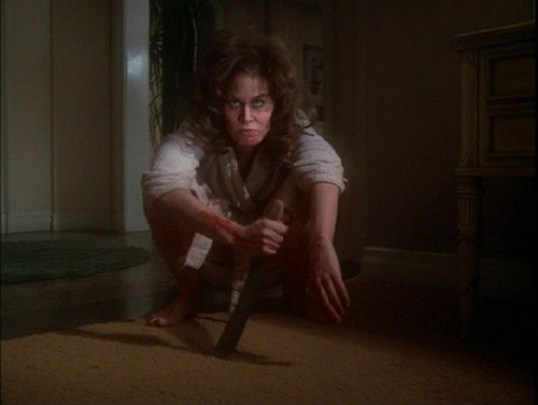
In this scene, Karen Black discovers that the doll she recently purchased as a birthday gift has a mind of its own.

October Hacks: Out of the Dark (dir by Michael Schroeder)


In 1989’s Out of the Dark, a man dressed in a clown costume is killing phone sex operators.  He lurks in the darkness and jumps out of the shadows to commit his dastardly crimes.  Especially during the first hour or so, the film has its share of both suspense and gruesome moments.  In the style of Italian giallo and pre-Halloween American slasher pics, the film actually tries to create some mystery about who the killer could be.  Lt. Frank Meyers (Tracey Walter) suspects that the killer might photographer Kevin Silvers (Cameron Dye).  Kevin and his girlfriend, Kristi (Lynn Danielson-Rosenthal), think that the police should be taking a closer look at David Stringer (Bud Cort), an accountant who has an office in the same building as the phone sex company.  Meanwhile, Detective Langella (Divine) thinks that the murders might be linked to a serial killer who is targeting prostitutes.

The main problem with Out of the Dark is that it’s pretty obvious from the start who the killer is and it’s hard not to judge the people who can’t figure it out for themselves.  The movie doesn’t really offer up enough viable suspects to keep you guessing and than it spends so much time trying to make it look like one of the suspects is guilty that any experienced film watcher will automatically know that he isn’t.  The viewers are supposed to be shocked by the killer’s identity but there’s nothing shocking about it.  It’s pretty obvious.

On the plus side, Out of the Dark does have a one-of-a-kind cast.  Divine and Tracy Walter play detectives.  Bud Cort is intense and nerdy as the bitter accountant.  Cameron Dye is vacuously handsome as the photographer.  Geoffrey Lewis shows up as an alcoholic.  Lainie Kazan plays an aging prostitute.  Tab Hunter drives a car.  Paul Bartel manages a motel and gets upset when he sees the blood pooling in one of his rooms.  And finally, Karen Black plays the owner of the phone sex company and gives a far better performance than the material actually deserves.  Black brings some much needed emotional reality to the film.

As I said at the start of this review, Out of the Dark has its moments.  The clown costume is truly creepy and the opening murder is all the more disturbing because it happen outside and in a public park.  (You do have to wonder how no one noticed a weirdo dressed like a clown wandering around.)  A scene in which the clown attacks a phone sex operator who has agreed to serve as bait is also well-done and genuinely frightening.  The story moves at a quick and steady pace and it deserves some credit for ending on a definitive note as opposed to trying to copy the ambiguity that was so popular with other slasher films of the era.

If only the identity of the killer had actually been a surprise, Out of the Dark would probably be considered a classic.  As it is, it’s just another well-made slasher film.

Horror Film Review: Trilogy of Terror (dir by Dan Curtis)


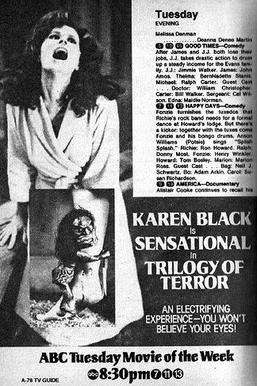
1975’s Trilogy of Terror is a true classic, a rare made-for-television horror film that could have just as easily and effectively been released in theaters.

As one can surmise from the title, it features three stories.  Each story is directed by Dan Curtis and written by Richard Matheson.  Each story also features Karen Black in the lead role, giving Black a chance to play not just one but four very different characters over the course of one film.  One of the things that makes this film work so well is Karen Black’s totally committed performance.  Sadly, Karen Black later expressed some regret about having appeared in the film because it led to her being typecast as a horror actress, which she definitely hadn’t been before.  (One need only watch Karen Black in Five Easy Pieces, Nashville, or Family Plot to see what a good actress she was.  Even in something like Easy Rider, where she had only a small role and very few lines, her talent is obvious.)  As a result, Black was no longer considered for the big studio films that she had appeared in previously and instead, she spent the remained of her career appearing in low-budget horror films.  That’s a shame because Trilogy of Terror really does show what a strong actress Black was.

The first segment features Black as Julie, a seemingly uptight teacher who somewhat surprisingly agrees to go out on a date with Chad (Robert Burton), a sleazy college student.  Chad drugs Julie’s drink during their date and later undresses her and takes pictures which he then uses in an attempt to blackmail Julie into basically being his sex slave.  Julie, however, turns out to have a big secret of her own and Chad discovers too late that he was the one who was being manipulated.  This segment was the least interesting of the three stories but the ending was very satisfying.  Anyone who has ever dated a “nice guy” who turned out to actually be a jerk will enjoy Julie’s revenge.

The second segment is enjoyably sordid, an over-the-top soap opera that I can’t talk too much about without spoiling the plot.  Black plays Millicent, a repressed brunette, who is hatefully obsessed with her twin sister, blonde Theresa (Black again).  Millicent fears that Therese is planning to corrupt and destroy her boyfriend, Thomas (John Karlen).  Millicent explains to her therapist (George Gaynes) all of the terrible things that Therese has done.  Of course, the truth turns out to be much more complicated.  This story was entertaining and featured a surprisingly effective twist.

The third segment is the one that everyone remembers.  Amelia (Karen Black) lives alone in a high-rise apartment and has recently purchased, as a present for her anthropologist boyfriend, a wooden fetish doll in the form of a misshapen aboriginal warrior with pointed teeth and a spear.  The doll comes with a scroll that explains that the doll is inhabited by the spirit of a Zuni hunter and that the only thing keeping the doll from coming to life is the gold chain adorning the doll.  Of course, the chain eventually falls off and Amelia finds herself being pursued through her apartment by a viscous doll that is obsessed with killing her.  This is the simplest and the scariest of the Trilogy of Terror’s three stories.  It’s easy to say that it’s just a doll until it pops out of nowhere and stabs Amelia in the ankle.  This story ends on a properly dark note and that final image of Karen Black is haunting.

For a fifty year-old film, Trilogy of Terror holds up remarkably well.  Watch it and witness just how good an actress Karen Black truly was.

Trilogy of Terror (1975, dir by Dan Curtis. DP: Paul Lohmann)

Scenes That I Love: Karen Black Performs in Nashville


The great actress Karen Black would have been 86 years old today.

Karen Black does not receive a lot of screentime in Nashville but she definitely makes an impression as the driven, self-centered, and oddly likeable Connie White.  (“She can’t even comb her hair” — Connie White on Julie Chrisite.)  Here she is, performing one of the songs that she wrote herself for the film.  The audience was largely made up of actual Nashville residents, who reportedly very much appreciated Black’s performance.

Scenes That I Love: Mardi Gras in Easy Rider


Happy Mardi Gras!

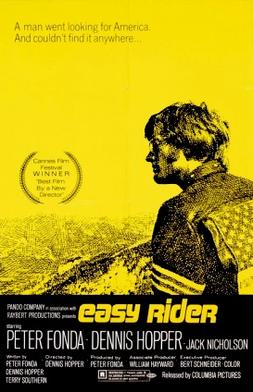
For today’s scene that I love, here is the Mardi Gras sequence from 1969’s Easy Rider.  Featuring Peter Fonda, Dennis Hopper, Karen Black, and Toni Basil walking through the streets of New Orleans, this scene was actually filmed during Mardi Gras.  Those are real Mardi Gras floats and real Mardi Gras participants staring at the camera.  That’s an actual citizen of New Orleans with whom Dennis Hopper appears to have nearly gotten into a fight.  Personally, I relate to Toni Basil in this scene.  She is having a good time no matter what!

I just love how Toni Basil can’t help but dance, no matter what.

Horror on the Lens: Trilogy of Terror (dir by Dan Curtis)


For today’s horror on the Lens we have a made-for-TV movie that was produced and directed by Dan Curtis.

Trilogy of Terror, which aired in 1975, is an anthology film, featuring three segments that were each based on a short story from Richard Matheson.  What makes this particular film special is that each segment features Karen Black playing a radically different character from the previous segment.  The film really is a showcase for this underrated actress, though Black herself later said that the film ruined her career because it typecast her as a horror actress.

The third segment is the one that gets all the attention.  That’s the one with the killer doll.  I like all of the segments, though.  The first one is often considered to be the weakest but anyone who has ever been through a similar situation will appreciate it as tale of revenge.  The second segment has a playful vibe that I liked.  And yes, the third segment is genuinely frightening.

From 1975, here is Trilogy of Terror:

Horror Scenes I Love: The Doll Attacks In Trilogy of Terror


Today’s horror scene that I love comes from 1975’s Trilogy of Terror, directed by Dan Curtis and starring Karen Black.

In this scene, Karen Black discovers that the doll she recently received in the mail has a mind of its own.

Scenes That I Love: Karen Black Performs in Nashville


The great actress Karen Black would have been 85 years old today.

Karen Black does not receive a lot of screentime in Nashville but she definitely makes an impression as the driven, self-centered, and oddly likeable Connie White.  Here she is, performing one of the songs that she wrote herself for the film.  The audience was largely made up of actual Nashville residents, who reportedly very much appreciated Black’s performance.

Have A Happy Mardi Gras With The Gang From Easy Rider!


Happy Mardi Gras!

If you can’t get down to New Orleans today (because maybe you have a sprained ankle like me), fear not!  Mardi Gras has been immortalized in a number of films.  In fact, some have theorized that the whole reason 1969’s Easy Rider was filmed was because Dennis Hopper wanted to go to New Orleans.

The Mardi Gras sequence occurs towards the end of Easy Rider.  After a long and eventful journey, Wyatt (Peter Fonda) and Billy (Dennis Hopper) reach New Orleans and experience Mardi Gras with two women that they met at a brothel (Karen Black and Toni Basil).  However, the Mardi Gras scenes were actually amongst the first to be shot and Hopper actually filmed several hours of documentary footage of New Orleans’s most famous party.  If you watch the footage, you can see bystanders looking directly at the camera.  They were not extras hired for the film.  They were people on the street who became a part of one of the most important indie films in the history of American cinema.  These scenes were shot guerilla style, without permits or, by most reports, any advanced planning.

Hopper also filmed Fonda having an actual bad acid trip.  For obvious reasons, Fonda was not happy about being filmed in that condition but he did say, in later interviews, that Hopper made the right decision to include the footage in the film.

For the record, I relate to Toni Basil in this film.  She’s having fun and dancing no matter what.