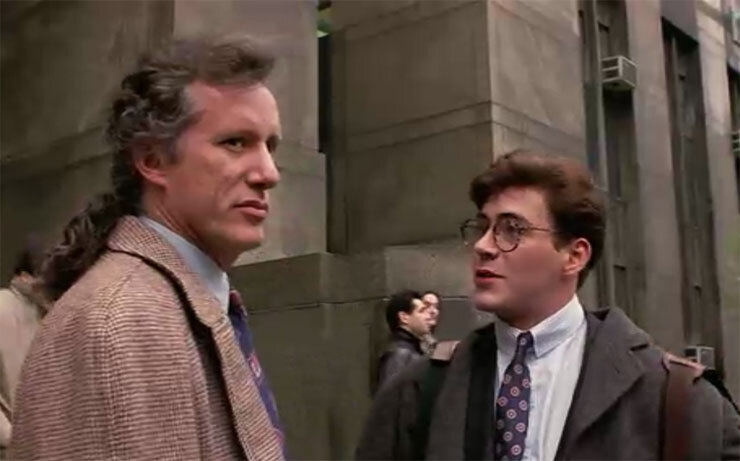
TRUE BELIEVER -James Woods & Robert Downey, Jr. take on the system!


I’ve been going through my movies and re-watching some of my favorites. A movie that clearly falls into that category is TRUE BELIEVER starring James Woods and Robert Downey, Jr. I became a fan of James Woods around 1988 primarily based on the strength of two action films that he worked on around that time, those being BEST SELLER (1987) and COP (1988). I spent hours combing through the rental selections at our local Hastings Entertainment store and I remember both of these movies being in the “New Release” section at the same time. They’re both hard hitting, violent films, and Woods is especially good in both. Being an obsessive completist, I found myself searching out the prior work of the star for some more good movies. It was during this time that TRUE BELIEVER was released to the theaters in February of 1989. I enjoy courtroom dramas, and knowing the intensity that Woods brings to his films, I had no doubt I would like it.

The story revolves around Eddie Dodd (Woods), an attorney who used to fight for the cause of the little guy, but now mostly finds himself protecting drug dealers from the law. Enter Roger Baron (Downey Jr.), a recent law school graduate who idolizes Dodd, and is now disappointed to see his legal hero reduced to his current cynical state. When a Korean mother comes into the law offices one day and says her son, Shu Kai Kim, has spent 8 years in prison for a crime he didn’t commit, cynical Dodd doesn’t want to take the case. Young Baron shames him into it though, and soon the two men find themselves taking on the New York District Attorney himself Robert Reynard (Kurtwood Smith) as they try to prove Shu Kai Kim’s innocence and help him taste freedom once more!

Often when people ask me to name my favorite James Woods film, I’ll quickly answer TRUE BELIEVER even though there are many good films to choose from. There are a few reasons for that. First, even though the film is a serious legal thriller with many dark undertones, director Joseph Ruben has given his movie a dark sense of humor. Woods and Downey, Jr. are able to find the humorous elements inherent in their characters and that brings some fun to the otherwise serious proceedings. Second, I really enjoy the story of underdogs taking on the big, bad system. Shu Kai Kim is an underdog who maintains his innocence when all the evidence appears flawlessly stacked against him. Eddie Dodd, the once feared civil rights lawyer who is now a hopeless burnout, is an underdog who appears to be out of his league as he goes up against the most powerful attorney in New York. These underdog story lines give us something to really root for as the story plays out. And finally, the performances are phenomenal from top to bottom. James Woods, an actor known for his electric intensity, is at the top of his game and Kurtwood Smith is a great adversary. Robert Downey, Jr. brings a bright-eyed enthusiasm to the role that compliments the cynical Woods nicely. And Yuji Okumoto as Shu Kai Kim shows us quite a transformation from a man who goes from almost being dead inside as a result of his eight years in prison, to a man who allows a glimmer of hope to seep in for a second chance. I think Okumoto is great in the role. The story takes many twists and turns and I enjoy every moment as it plays out.

TRUE BELIEVER is definitely one of my favorites!
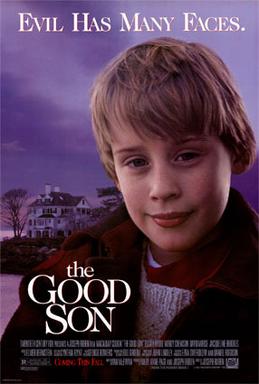
Mac Attack: The Good Son (1993, directed by Joseph Ruben)


“Hey, Mark, don’t fuck with me,” 12 year-old Henry (Macaulay Culkin) says to his cousin Mark (Elijah Wood) in The Good Son‘s signature scene.  But fuck with him Mark does because Mark knows that evil exists and that Henry’s evil.  Henry killed his brother and he tries to kill his sister, Connie (Quinn Culkin), by throwing her onto thin ice.  When Mark, whose mother has recently died, decides that Henry’s mother, Susan (Wendy Crewson), is going to be his new mom, Henry gets jealous and tells Mark that he would rather kill Susan than allow her to have another son.  Eventually, Mark and Henry both end up dangling from a cliff with Susan holding onto them.  Susan has to decide who to save, her evil son or the distant relation that she barely knows.  She makes her choice and the camera lingers on the corpse of the less fortunate child on the rocks below.  For most mothers, it probably wouldn’t even be a difficult decision.  Of course you would save your own child!  But Susan has to think about it.  Maybe she can see the future and knows that Elijah Wood has the Lord of the Rings to look forward to while Macaulay is destined for something much different.

The Good Son caused a lot of controversy when it came out in 1993, not because it was about a murderous child but because that murderous child was played by the then-biggest star in America.  How would people who loved watching Macaulay seriously injure two burglars react to watching Macaulay kill people?  The movie actually did well at the box office but it also revealed that the Macaulay Culkin was a limited actor.  Elijah Wood was a good actor but Mark still comes across like a little creep.  Trying to steal his cousin’s mother?  What did he think was going to happen?

Finally, The Good Son was written by Ian McEwan, of all people.  In McEwan’s defense, he only wrote the first draft and that was long before Macaulay Culkin was miscast as Henry.  Apparnetly, Macaulay’s father and manager, Kit Culkin, demanded that his son be cast as a psycho murderer before he would allow Maccaulay to appear in Home Alone 2.  I guess Kit thought making his son look evil would be a good career movie.  If only someone had been willing to say, “Hey, Kit Culkin, don’t fuck with the movie.”

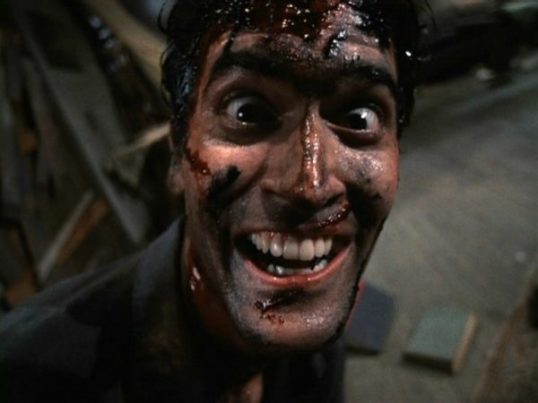
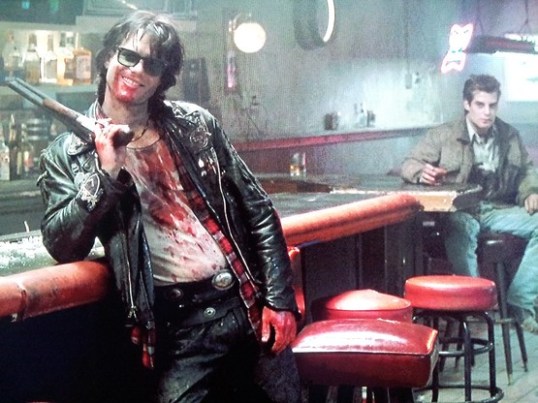
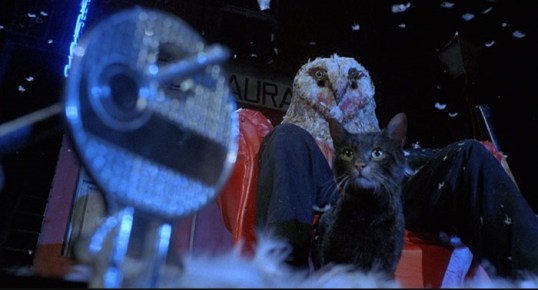
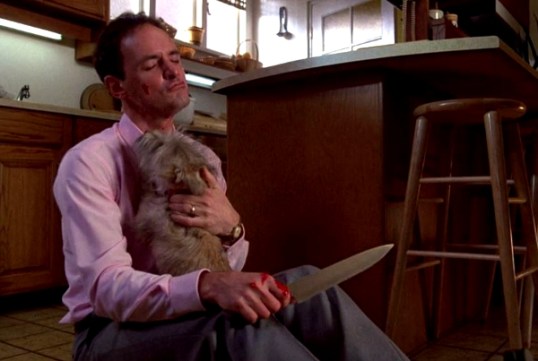
4 Shots From 4 Films: Evil Dead II, Near Dark, Stage Fright, The Stepfather


4 Shots From 4 Films is just what it says it is, 4 shots from 4 of our favorite films. As opposed to the reviews and recaps that we usually post, 4 Shots From 4 Films lets the visuals do the talking!

This October, we’re using 4 Shots From 4 Films to look at some of the best years that horror has to offer!

4 Shots From 4 1987 Horror Films

Evil Dead II (1987, dir by Sam Raimi)

Near Dark (1987, dir by Kathryn Bigelow)

Stage Fright (1987, dir by Michele Soavi)

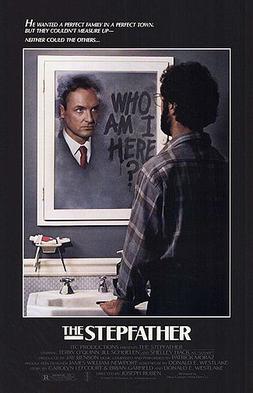
The Stepfather (1987, dir by Joseph Ruben)

Horror Film Review: The Stepfather (dir by Joseph Ruben)


Who is Jerry Blake?

That is the question at the heart of the classic 1987 horror thriller, The Stepfather.

Most of the people who know Jerry (brilliantly played by Terry O’Quinn) would say that he’s just a really nice guy.  He’s responsible.  He’s a good employee.  He can be trusted.  He works in real estate and spends his days selling perfect homes to perfect families.  Jerry always has a friendly smile and hearty manner.  He’s the perfect neighbor, precisely because he’s so boring.  You don’t have to worry about Jerry not taking care of his yard or throwing a loud party or … well, doing anything anyone else would do.  Sure, Jerry seems to be a little bit old-fashioned and sure, sometimes he’s a little bit too good to be believed.  But what’s wrong with that?  I mean, the man makes birdhouses!  Jerry is so dedicated to creating perfect families that he even tries to make the perfect home for the birds in his back yard!

In fact, the only person who seems to have any doubts about Jerry is his new stepdaughter, Stephanie (Jill Schoelen).  Stephanie is a teenager so, occasionally, she’s less than perfect.  Sometimes, she gets into a fight at school.  Sometimes, she talks back.  To be honest, to me, nothing she does seems like it’s really that big of a deal.  But Jerry simply cannot handle the fact that Stephanie is making his new family just a little less than perfect.  When Jerry catches Stephanie and her boyfriend sharing a very chaste kiss, he freaks out.  KISSING!?  Why that could only lead to one thing…

But it’s not just that Jerry is kind of controlling and seems to be living in a 1950s sitcom.  There’s also the fact that sometimes, Jerry goes down in the basement and just starts yelling and throwing stuff.  That’s what Jerry does when he gets angry.  He hides in the basement and he totally loses control.  When Stephanie overhears him, Jerry just gives her a bland smile and says that he was blowing off some steam.

Stephanie suspects that something’s wrong with Jerry but, of course, no one believes her.  However, we know that Stephanie’s right to be suspicious.  At the start of the film, we saw Jerry walking out of his old house, leaving behind the dead bodies of his wife and children.  At that time, of course, Jerry’s name was Henry Morrison.  Henry’s previous family disappointed him so he killed them and then vanished, changing his identity and marrying Stephanie’s mother, Susan (Shelley Hack).

Jerry wants everything to be perfect.  He’s an old-fashioned guy with old-fashioned values and, whenever anyone disappoints him, he kills them and changes his identity once again.  He’s the type who will kill you but then make sure that your seat belt is fastened when he puts you back in your car.  “Buckle up for safety,” Jerry says.

There’s a 2009 remake of The Stepfather.  For some reason, it regularly shows up on Lifetime.  Ignore the remake and track down the original.  Long before he played John Locke on Lost, Terry O’Quinn gave a simply amazing performance in the role of Jerry Blake.  Jerry is so friendly and likable that, even though we know he’s a murderer, it’s still hard not to fall under his spell.

Why, we wonder, can’t the world be as perfect as Jerry wants it to be?

Because Jerry’s world is not the real world.  In the real world, family are never perfect but they love each other anyway.  In Jerry’s world, it’s more important that things appear to be perfect than that anyone actually be honest or, for that matter, happy.

The Stepfather is a chillingly effective thriller, featuring a brilliant performance from Terry O’Quinn.  If you haven’t seen it, see it!

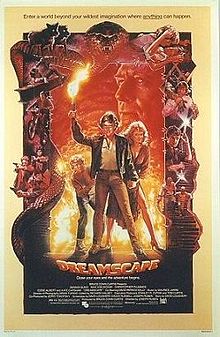
Halloween Film Review: Dreamscape (1984, directed by Joseph Ruben)


220px-Dreamscapeposter

Before there was Inception, there was Dreamscape!

DSDreamscape opens with the image of a woman running down a street while a red mushroom sprouts above the city behind her.  Just as a radioactive cloud envelopes the woman, the scene cuts to a man named John (Eddie Albert) waking up with a scream.  John is the President of the United States and he has been having reoccurring nightmares about nuclear war.  The dreams have shaken him to the extent that he plans of signing a disarmament treaty with the Soviet Union.

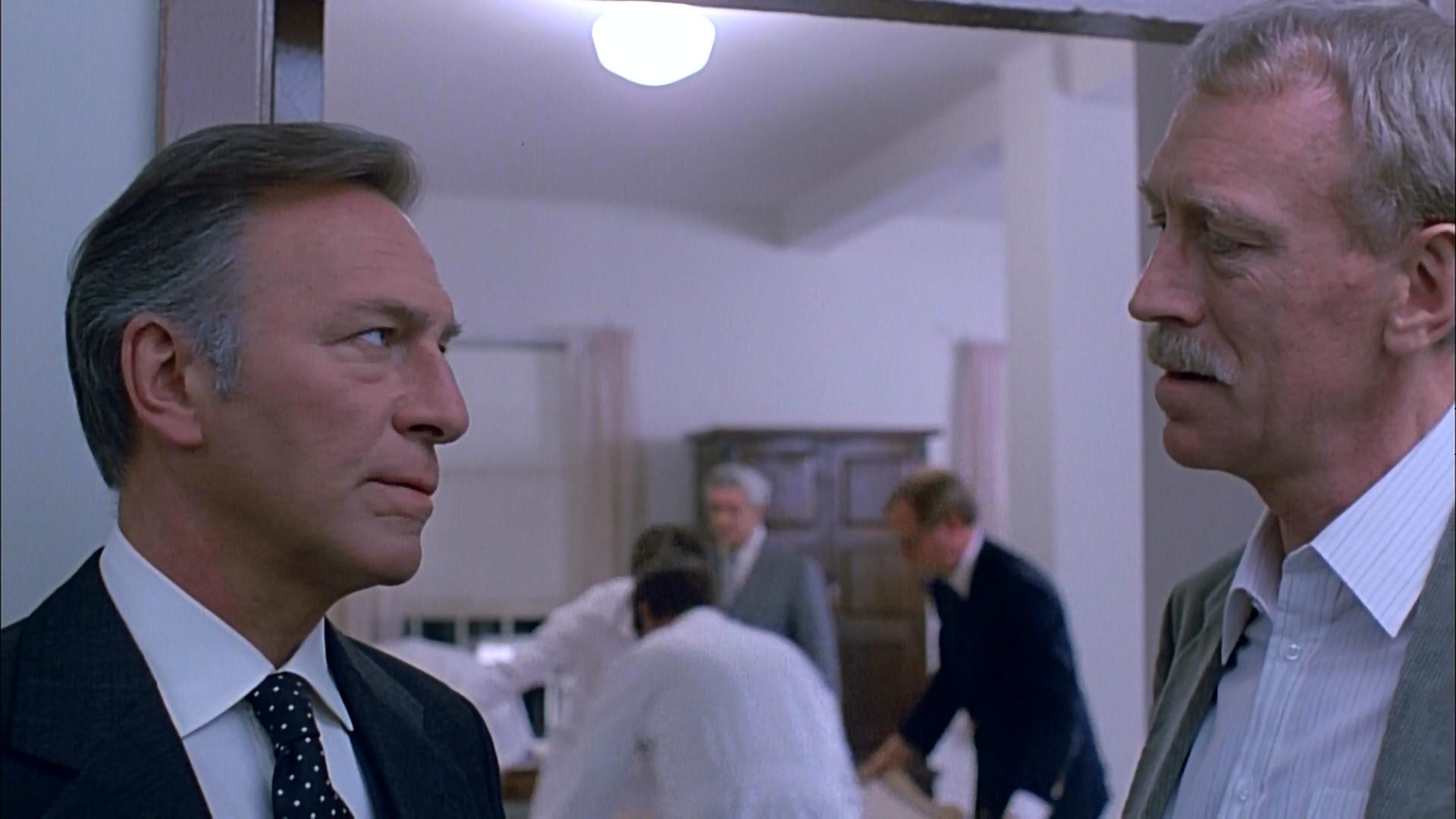
dreamscape-maxchrisBob Blair (Christopher Plummer, playing one of the slick villain roles that dominated his career until he finally won an Oscar for Beginners) is a political reactionary who works for a shadowy agency that is even feared by the CIA.  Determined to stop the President from signing that treaty, Blair recruits psychotic martial arts enthusiast Tommy Ray Glatman (David Patrick Kelly, of “Warriors, come out to play…” fame) to assassinate the President.  Tommy is a psychic who can enter people’s dreams and when you die in a dream, you die in real life.

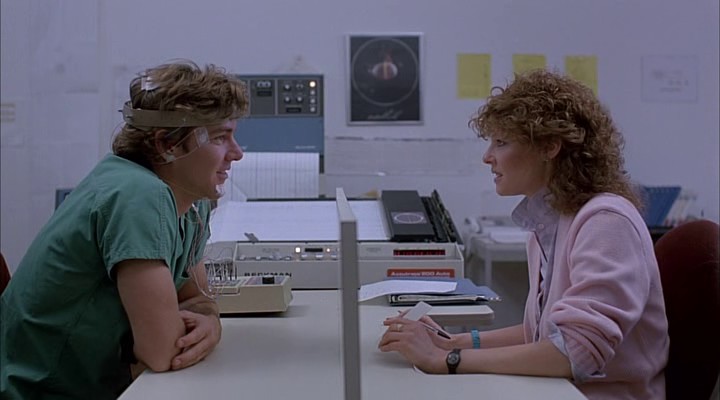
Dreamscape_David_Patrick_KellyTommy is a part of a government-funded research project that is headed by Dr. Peter Novotny (Max Von Sydow) and Beth DeVries (Kate Capshaw).  Tommy was the program’s superstar until the arrival of Alex Gardner (Dennis Quaid).  Until he was recruited by Dr. Novotny, Alex was using his psychic abilities for gambling and womanizing.  Now, Alex has to use his abilities to save the President’s life.

Dreamscape_Capshaw1Dreamscape came out the same year as Wes Craven’s Nightmare on Elm Street and they do share a few things in common.  During one scene set in the President’s nightmare, Tommy even has razor-sharp claws.  But ultimately, Nightmare and Dreamscape are two very different films.  Whereas Nightmare was a horror film, Dreamscape is an adventure film with horror elements.  In fact, Dreamscape feels like four different films all mashed together.  It’s a political conspiracy story, with Christopher Plummer plotting to kill the President.  It’s an adventure story, with Dennis Quaid as an appealing rogue.  It’s a love story, as Alex and Beth fall in love while researching dreams.  At times, it is also a very dark comedy, like when Alex enters the dream of a man who is terrified that his wife is cheating on him with everyone that they know.

Fans of cult cinema will appreciate that Dreamscape features one of David Patrick Kelly’s best villainous performances.  In the role of Tommy, he not only gets to do his usual bravura work as a weasley psychopath but he also gets to bust out an impressive impersonation of Bruce Lee as well.

dreamscape-4Along with David Patrick Kelly at his demented best, Dreamscape also features the Snakeman, a claymation monster who may look cheesy today but probably gave many youngsters nightmares back in 1984.  Like the Snakeman, all of the film’s special effects have aged but it does not detract from the film.  Since the special effects were used to create the film’s dreams, it doesn’t matter that they no longer look 100% realistic.  Dreams are supposed to be strange so the cheesiness of some of the special effects actually works to Dreamscape‘s advantage.

Dreamscape may not be as well-known as Inception or Nightmare on Elm Street but it is still a fun and entertaining excursion into the dream world.

Dreamscape

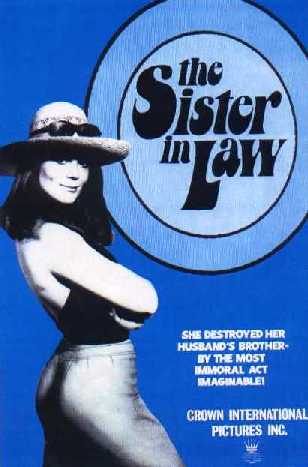
Embracing the Melodrama #47: The Sister-in-Law (dir by Joseph Ruben)


The_Sister-in-Law(SPOILERS BELOW)

After watching enough old movies, I’ve become convinced that the early 1970s must have been the darkest and most cynical time in American history.  It seems like almost every film released from roughly 1970 to 1977 was required to end on a down note.  Even the happy endings were full of ambiguity.  (American Graffiti, a feel-good film according to the reviews that were written at the time of its initial release, ends with one of the characters dying in a car accident and another one MIA in Vietnam.)  I’m not complaining, of course.  I love a sad ending.

Maybe that’s why I so love the 1973 film The Sister-in-Law.  The film starts out as a typical melodrama from Crown International Pictures but it has one of the darkest endings that I’ve ever seen.  In fact, the ending is so dark that it’s pointless to review The Sister-in-Law without telling you how the movie ends.  So, consider this to be your final SPOILER WARNING:

CIP_LogoOkay, ready?

Robert Strong (played by John Savage) is a genuinely likable musician who has spent the last year or so hitchhiking across America.  He decides to visit his wealthy older brother, Edward (Will MacMillan).  It quickly becomes apparent that Robert and Edward are almost insanely competitive with each other.  A friendly day of fun in the pool ends with Edward nearly downing his younger brother.

Robert gets back at Edward by having an affair with Edward’s wife, Joanna (Anne Saxon).  However, Robert eventually breaks things up with Joanna and starts sleeping with Deborah (Meredith Baer), who happens to Edward’s former mistress.

Edward, however, has problems beyond dealing with his wife and his mistress.  It turns out that he’s made all of his money by smuggling drugs into America from Canada.  Now, the Mafia is demanding that Edward bring in a huge shipment of heroin.  Edward, however, convinces his brother to do it for him.

Robert and Deborah drive up to Canada and pick up the heroin.  However, as they do so, they talk about how sick they are of being used by Edward.  So, Robert and Deborah pull over next to a waterfall and, in a surprisingly lyrical scene, they dump all the heroin into the water supply.

And then they make love in the forest.

Well, the mafia wants to know what happened to their heroin.  So, Edward and Joanna get on an airplane and flee the country.  Meanwhile, Robert and Deborah are pulled over by two gangsters.  Robert is pulled out of the car and executed in the middle of the street.  The gangsters drive away.  Deborah collapses to her knees and sobs over Robert’s dead body.

The end.

Seriously, that’s how the movie ends.  The gangsters get away with it.  Hateful Edward and his self-centered wife escape the country.  Deborah is in tears.  And Robert, the one truly likable person in the entire film, lays dead in the street.

Not even David Fincher could make a film this dark.  And, honestly, the darkness at the heart of The Sister-in-Law feels considerably more potent and tragic than anything you could find in any Fincher film.  As played by a very young John Savage (who, just last year, played the President in Bermuda Tentacles), Robert is such a likable guy that you’re glad you got to spend a little bit of time with him before he was brutally murdered in the middle of the street.  Robert’s violent death sticks with you.

(Savage also sung several of the surprisingly catchy songs on the film’s soundtrack.)

Despite or perhaps because of the ultra-dark ending, The Sister-in-Law is one of my favorite Crown International films.  If nothing else, it proves that 1973 was apparently even darker than 2015.

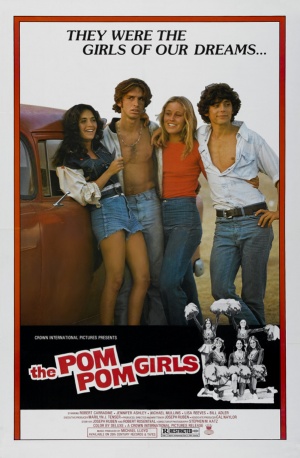
Back to School #19: The Pom Pom Girls (dir by Joseph Ruben)


The Pom Pom Girls was released in 1976, the same year as Massacre at Central High.  It also features two actors who made quite an impression in Central High — Robert Carradine and Rainbeaux Smith.  However, that is where the similarities end because, whereas Central High was a political allegory disguised as an exploitation film, The Pom Pom Girls is an almost prototypical 70s teen comedy.  Whereas Central High was all about subtext, The Pom Pom Girls has no subtext.  Try to look between the lines of The Pom Pom Girls and all you’ll find is blank space.  And, finally, while Central High remains a difficult film to see, I’ve lost track of how many of my Mill Creek box sets include The Pom Pom Girls.

300px-Pompom_girls_2

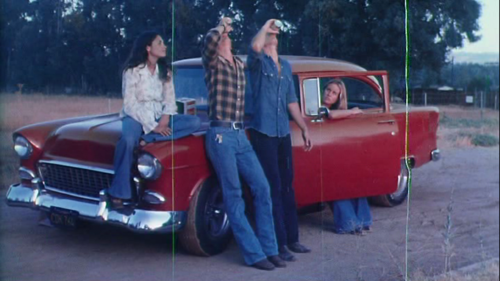
The Pom Pom Girls is about … well, close to nothing.  Johnnie (Robert Carradine) and Jesse (Michael Mullins) are students at Rosewood High School in California.  Because the film was made in 1976, they spend most of their time driving around in a van and listening to MOR radio stations.  Johnnie and Jesse are also star football players, which is one of the odd things about the film because, while Carradine is genuinely likeable and Mullins makes for a plausible sullen high school student, neither one of them comes across as if they could be football players.  The big game comes up against rival Hardin High, so there’s a prank war that involves a little more nudity than the ones on Saved By The Bell ever did.  Johnnie and Jesse also have girlfriends, both of whom are cheerleaders.  Jesse cheats on his girlfriend but apparently, the audience is supposed to sympathize with him because she refused to go to the beach with him.  Johnnie, meanwhile, has a leather jacket-wearing nemesis named Duane (Bill Adler), who is upset because Johnnie is dating his ex.  As often happens, it all ends with a recreation of the famous “chicken run” from Rebel Without A Cause.  We watch a car explode from three different angles. In order to leave you with some suspense, I will not mention whether anyone was in the car.

You’re welcome.

And a fun time was by all...

And a fun time was by all…

One of the strange things about The Pom Pom Girls is that while the two main characters and their girlfriends are all presented as being rebels, they’re also presented as being the most popular kids in school.  Johnnie and Jesse are the captains of the football team.  They’re dating the captains of the cheerleading squad.  Despite the movie’s attempts to convince us otherwise, these people are not rebels fighting the establishment.  Instead, they are the establishment.  This is actually something that The Pom Pom Girls has in common with Richard Linklater’s far superior Dazed and Confused.  The difference, however, is that Dazed and Confused actually calls its character out on the hypocricy of their posturing while The Pom Pom Girls just tries to have the best of both worlds.  Johnnie is both a star football player and the class clown who breaks the rules.  Jesse is both a great team player and an angry individualist.  I guess that’s the 70s for you.

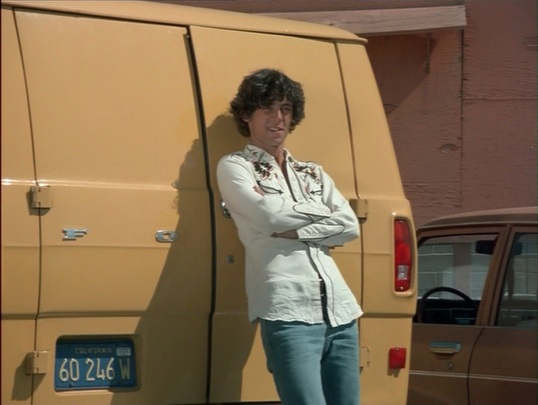
He owns a van.  It has shag carpeting and a strobe light.

He owns a van. It has shag carpeting and a strobe light.

Back in high school, I was often asked to try out for cheerleading but I never did.  For one thing, I didn’t see why I should have to try out when they could have just easily approached me and said, “Hi, will you please be the new head cheerleader?”  Even beyond that, I couldn’t stand the idea of always having to be happy.  And, perhaps most importantly, my sister was already a cheerleader and I wanted to establish my own thing.  However, I still made Erin watch The Pom Pom Girls with me and I asked her if the film was a realistic portrait of high school cheerleading.  In response, she rolled her eyes which I believe was her way of saying no.

But, even if it isn’t exactly Bring It On, The Pom Pom Girls still does have some worth as a time capsule of the clothing, attitudes, and vans of the 70s.  To be honest, that’s probably the only thing of value that The Pom Pom Girls has to offer because, otherwise, it’s basically a film about a likable guy who spends all of his time hanging out with a guy who will literally not stop whining about being a football player and how nobody is willing to go to the beach with him.

Incidentally, The Pom Pom Girls was released by Crown International Pictures.  Much like the company’s previous film, The Young Graduates, the main message here appears to be that the 70s kind of sucked.

CIP_Logo