Retro Television Review: Miami Vice 2.7 “Junk Love”


Welcome to Retro Television Reviews, a feature where we review some of our favorite and least favorite shows of the past!  On Mondays, I will be reviewing Miami Vice, which ran on NBC from 1984 to 1989.  The entire show can be purchased on Prime!

This week, Sonny and Rico somehow still manage to work undercover.

Episode 2.7 “Junk Love”

(Dir by Michael O’Herlihy, originally aired on November 8th, 1985)

“What’s a four letter word for dirt?” Switek asks, while on a stakeout.

“Mud,” Zito offers before correcting himself, “I mean …. sand!”

However, according to Switek, the correct answer is Vice!

And indeed, there’s a lot of dirt to be found in this week’s rather sordid episode of Miami Vice.  A raid on a brothel leads the Vice Squad to arrest a notorious smuggler and pimp named Ivory Jones (legendary Jazz musician, Miles Davis) and one of Ivory’s girls, a strung-out junkie named Rosella (Ely Pouget).  When they find out that Rosella is apparently the girlfriend of a notorious dealer named Juan Carlos Silva (Jose Perez), they decide to use her and Ivory to take Silva down.  While Tubbs is convinced that Rosella will say anything get her next fix, Crockett is convinced that Rosella is someone who truly wants to change her life.  Hmmm …. isn’t Crockett usually the cynical one?

Silva is sexually obsessed with Rosella, to the extent that he’ll even kill the members of his own organization if he thinks they’re interested in her.  The episode’s twist comes towards the end, when Gina does some research and discovers that Silva is not only Rosella’s lover but also her …. ick! …. father!  Ewwwww!  As with so many episodes of Miami Vice, Junk Love ends with Sonny watching helplessly as a victimized woman throws away her freedom so that she can shoot her tormenter.  Miami Vice was a show that always managed to be downbeat, even when the bad guys met a deserved end.

This episode felt like an attempt to recreate the emotional drama of the season one episode that featured Bruce Willis as an arms dealer with an abused wife.  Both episodes even feature the same basic ending, just with the setting moved from the courthouse steps to a yacht.  Unfortunately, this episode doesn’t work anywhere half as well as any of the episodes that aired during the first season.  Jose Perez may be playing an evil character but he simply does not have an intimidating enough screen presence to be convincing in the role.  Miles Davis, meanwhile, delivers his lines convincingly enough but his character disappears in such a way that it almost feels as if he left the set before all of his scenes were filmed.

The main thing that I found myself thinking about, as I watched this episode, was how could Sonny Crockett and Rico Tubbs still convincingly go undercover after two years of busting drug kingpin after drug kingpin.  You would think the entire Miami underworld would be on the lookout for them.  Instead, Sonny is still somehow convincing everyone that he’s actually “Sonny Burnett,” aspiring drug dealer.  I’m starting to think the criminals in Miami might not be that smart.

Retro Television Review: King Of The Building 1.1 “Pilot”


Welcome to Retro Television Reviews, a feature where we review some of our favorite and least favorite shows of the past!  On Thursdays, I will be reviewing King of the Building, which aired on CBS in 1987.  The entire show is currently streaming on YouTube!

This week, Richard Lewis is a doorman.

Episode 1.1 “Pilot”

(Dir by James Komack, originally aired on July 31st, 1987)

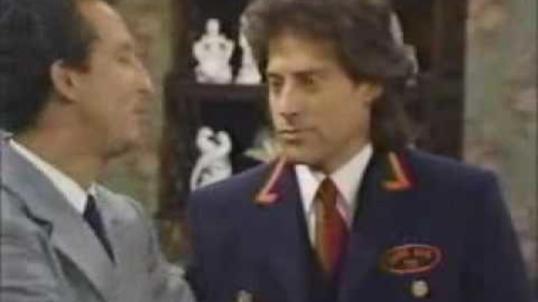
Joey (Richard Lewis) is the …. KING OF THE BUILDING!

Well, no.  Actually, he’s just a doorman for a Park Avenue apartment building.  The owner of the building, Mr. Jamison (Simon Jones), is the real king of the building but the elderly residents all prefer to deal with Joey.  That’s because Mr. Jamison is greedy and venal and always looking for an excuse to kick people out of their apartments.  His latest target is Mrs. Gladstone (Billie Bird), who has dementia and thinks that Joey is her son, Elliot.

(Mrs. Gladstone has a sitcom form of dementia, where all of her mistakes are quirky and she never loses her temper or gets paranoid or disappears for hours on end.)

When Mr. Jamison brings in a social worker (Lora Staley) to try to get Mrs. Gladatone ruled incompetent, Joey and the other workers at the building conspire to make it appear as if all of Mrs. Gladstone’s confusion is due to Mr. Jamison keeping her apartment in disrepair.  The social worker declares that Mrs, Gladstone will be fine as long as Joey is working at the building.

(Personally, I would think this would lead to Mr. Jamison just firing Joey so he could then get rid of Mrs. Gladstone but that doesn’t seem to occur to him.  Of course, Joey also mentions that he’s a member of a union so maybe Joey has his job for life.  I hope it pays well.)

This was a pilot for a series that presumably would have followed Joey as he protected the elderly residents from Jamison.  It only aired once and it didn’t lead to a series.  Watching the pilot, it’s easy to see why.  Richard Lewis, who passed away two days ago, was a comedian who was acclaimed and famous for his ability to comedically explore what it meant to be truly neurotic.  There’s not really anything neurotic or obsessive or even particularly interesting about Joey.  He gets nervous and he complains a lot but, in the end, he’s just a blue collar doorman who doesn’t like his boss.  Lewis is likable but miscast in the role.  Watching him, one gets the feeling that Lewis was holding back all of his natural instincts to play the rather subdued and sensible Joey.

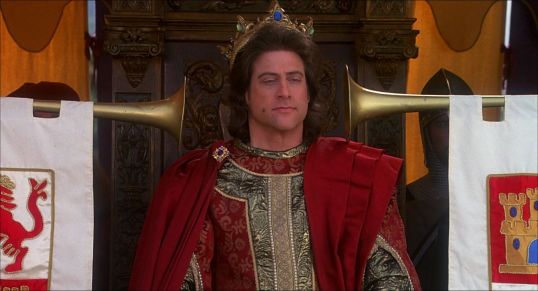
Despite the failed pilot, Richard Lewis would continue to appear in television and moves for the rest of his life and he became a bit of a cultural institution.  On Curb Your Enthusiasm, he often played the voice of reason to Larry David and proved that one could play sensible without losing his edge.  And, of course, a generation will always remember him as King John.

Rest in peace, Richard Lewis.

Film Review: Short Eyes (dir by Robert M. Young)


Last night, fully intent on just viewing one movie before going to bed, I decided to watch the 1977 film, Short Eyes.

Why I thought that was a good idea, I’m not sure. Even though I didn’t know much about the film, I did know that it was a gritty prison drama that was written by an ex-con, filmed in an actual New York prison, and that a few prisoners appeared in small roles in the film. So, I really can’t claim that I didn’t realize that I was about to watch something that probably wasn’t going to be deal with particularly pleasant subject matter. I think my main reason for watching it, to be honest, was just that it had been sitting there on my Prime watchlist for nearly a year. My main motivation can be summed up as “If not now, when?” Of course, if I had know that “Short Eyes’ was apparently prison slang for someone who is a pedophile, I might have thought twice about watching.

The Short Eyes of the title is Clark Davis (Bruce Davison), a young man from a vaguely wealthy background who is being held on charges of raping a young girl. Clark is one of only three white men being housed in his cell block. As Clark soon discovers, everything in prison is determined by your race and what you’re accused of doing. As a white man, he’s already in the minority and, because he’s a “short eyes,” he soon discovers that not even the other whites are willing to watch his back. The only person who is vaguely sympathetic to Clark is Juan (Jose Perez), a longtime prisoner who is determined to not allow prison to turn him into an animal. Juan tells Clark that he needs to get a transfer to protective custody but it soon becomes apparent that’s not going to happen. The prison guards feel no obligation to protect Clark and Clark himself almost seems to have a death wish.

As Clark explains to Juan, he’s not sure whether he’s guilty or not. He says that he blacks out and sometimes, he’s not sure what he did. Clark thinks he’s innocent but, at the same time, he also confessed to Juan that he has molested other girls. Juan knows that Clark’s a dead man if he doesn’t get out of prison but he also know that, even if Clark is innocent this time, he won’t be in the future. When the other prisoners decide to kill Clark, Juan has to decide whether to let it happen or to risk his safety by trying to stop it.

Short Eyes is one of the most thoroughly unpleasant films that I’ve ever watched but that obviously was the point. This is a film about the reality of prison, that it’s a dirty, brutal, and inhumane place where the weak are targeted and anyone who goes against the system — whether it’s the system enforced by the guards or the even more important system created by the prisoners — will be punished. It’s not at all fun to watch but, if anyone wants to know why incarceration tends to just create hardened criminals as opposed to rehabilitating them, they should find some answers in the film’s portrait of prison life.

The film is based on a play and, in many scenes, it’s a bit too theatrical for its own good. Clark delivers a lengthy monologue about his previous actions and, while it’s well-delivered by Davison, it also goes on and on and you never quite understand why he’s opening up to Juan in the first place. (Juan, himself, angrily responds that he never asked to be Clark’s father confessor.) The scenes of the prisoners just hanging out and talking are also well-acted but again, they tend to drag on for a bit too long. Musicians Curtis Mayfield and Freddy Fender both appear as anonymous prisoners and both sing songs, which brings the film’s already uneven narrative momentum to a complete halt. Just as the inmates will never be able to escape prison, the film never escapes its theatrical origins. While the decision to film Short Eyes in an actual operating prison brings a good deal of authenticity to the production, the production’s staginess ultimately works against it.

At its best, this is a well-acted portrait of people trapped in a man-made Hell. Jose Perez gives an excellent performance and Bruce Davison will make your skin crawl as Clark, a character about whom most viewers will have very mixed feelings. Nathan George and Joseph Carberry are both properly intimidating as the heads of, respectively, the black prisoners and the whites.

This is definitely not a film to watch late at night, unless you’re actively trying to generate nightmares. (Of course, if that’s your goal, have it!) As for me, I stayed up an extra two and a half hours just so I could watch another movie after Short Eyes. As a result, I spent all of Saturday tired but I still think I made the right decision.

A Movie A Day #167: Stick (1985, directed by Burt Reynolds)


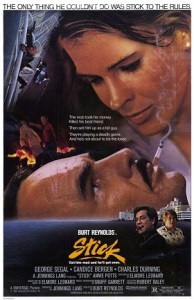
Stick (Burt Reynolds) is a veteran car thief who has just gotten out of prison.  No sooner has Stick arrived home in Florida then he accompanies his friend, Rainy (Jose Perez), on a drug deal that goes bad.  When Rainy is killed, Stick goes into hiding.  He manages to get a stable job, working as a chauffeur for an eccentric millionaire (George Segal).  He gets a new girlfriend (Candice Bergen) and starts to bond with his teenage daughter (Tricia Leigh Fisher).  Stick wants to go straight but, before he can, he knows that he has to confront the men who murdered Rainy.

Stick starts out strong.  The first half of the film finds Burt, who was often as underrated as a director as he was as an actor, in pure Sharky’s Machine mode, mixing the steamy Florida atmosphere with quirky character comedy and hardboiled action.  Adapting his own novel, Elmore Leonard wrote the screenplay and Stick seems like a classic Leonard hero, a criminal with his own moral code.  

But then Stick falls apart during the second half and it becomes obvious why both Reynolds and Leonard often cited this film as being one of the biggest disappointments of their careers.  Universal Studios disliked Burt’s first cut of the film and brought in a second screenwriter, who beefed up the action scenes and added the subplot with Stick’s teenage daughter.  Reynolds reshot the second half of the movie, no longer playing Stick as a tough criminal but instead as another variation on the Bandit.  The end result is a very disjointed movie, with Burt looking bored.

It does not help that the movie’s main villain is played by Charles Durning, who wears an orange fright wig and several Hawaiian shirts.  Durning was an actor who gave many great performances but never was he as miscast as when he played a drug dealer in Stick.