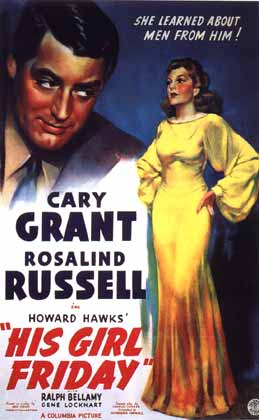
The Fabulous Forties #44: His Girl Friday (dir by Howard Hawks)


His_Girl_Friday_poster

The 44th film in Mill Creek’s Fabulous Forties box set was the classic 1940 comedy, His Girl Friday.

Earlier this week, when I mentioned that Cary Grant’s Oscar-nominated work in Penny Serenade was not the equal of his work in comedies like The Awful Truth and The Philadelphia Story, quite a few people took the time to let me know that their favorite Cary Grant film remains His Girl Friday.  And I can’t blame them.  Not only does His Girl Friday feature Cary Grant at his best but it also features Rosalind Russell at her best too.  Not only that but it’s also one of the best films to ever be directed by the great Howard Hawks.  There are a lot of career bests to be found in His Girl Friday, and that’s not even counting a supporting cast that is full of some of the greatest character actors of the 1940s.

The film itself is a remake of The Front Page, that classic story of an editor trying to keep his star reporter from leaving the newspaper in order to get married.  (Along the way, they not only manage to expose municipal corruption but also help to hide and exonerate a man who has escaped from death row.)  The action moves fast, the dialogue is full of quips, and the whole thing is wonderfully cynical about … well, everything.  The major difference between The Front Page and His Girl Friday is that the reporter is now a woman and she’s the ex-wife of the editor.  When Cary Grant’s Walter Burns attempts to convince Rosalind Russell’s Hildy Johnson to cover just one last story, he’s not only trying to hold onto his star reporter.  He’s also trying to keep the woman he loves from marrying the decent but boring Bruce Baldwin.

Bruce, incidentally, is played by Ralph Bellamy.  Bellamy also played Grant’s romantic rival in The Awful Truth.  To a certain extent, you really do have to feel bad for Ralph.  He excelled at playing well-meaning but dull characters.  As played by Bellamy, you can tell that Bruce would be a good husband in the most uninspiring of ways.  That’s the problem.  Hildy deserves more than just a life of boring conformity and Walter understands that.  Not only do Walter and Hildy save the life of escaped convict Earl Williams but, in doing so, Hildy is also saved from a life of being conventional.

As we all know, it’s fashionable right now to attack the news media.  Quite frankly, modern media often makes it very easy to do so.  For that matter, so do a lot of a movies about the media.  To take just two of the more acclaimed examples, there’s a smugness and a self-importance to both Good Night and Good Luck and Spotlight that becomes more and more obvious with each subsequent viewing.  (Admittedly, Edward R. Murrow was prominent way before my time but, if he was anything like the pompous windbag who was played by David Strathairn, I’m surprised that television news survived.)  Far too often, it seems like well-intentioned filmmakers, in their attempt to defend the media, end up making movies that only serve to remind people why the can’t stand the old media in the first place.

Those filmmakers would do well to watch and learn from a film like His Girl Friday.  His Girl Friday is a cheerfully dark film that is full of cynical journalists who drink too much and have little use for the type of self-congratulation that permeates through a film like Spotlight.  Ironically, you end up loving the journalists in His Girl Friday because the film never demands that you so much as even appreciate them.  There are no long speeches about the importance of journalism or long laments about how non-journalists just aren’t smart enough to appreciate their local newspaper.  Instead, these journalists are portrayed as hard workers and driven individuals who do a good job because deliberately doing anything else is inconceivable.  They don’t have time to pat themselves on the back because they’re too busy doing their job and hopefully getting results.

If you want to see a film that will truly make you appreciate journalism and understand why freedom of the press is important, watch this unpretentious comedy from Howard Hawks.

In fact, you can watch it below!

The Fabulous Forties #9: Jungle Book (dir by Zoltan Korda)


Jungle_Book_FilmPoster

The 9th film in Mill Creek’s Fabulous Forties DVD box set was 1942’s Jungle Book.  Based on the novel by Rudyard Kipling (which was later made into an animated Disney film and of which a remake is scheduled to be released next week), Jungle Book was directed by Zoltan Korda and produced by Zoltan’s brother, Alexander.  Today, the Hungarian-born Korda Brothers are best remembered as being pioneers of the British film industry.  However, during World War II, they relocated their film making to the United States.  Jungle Book was one of the most critically and commercially successful of their American films.

Jungle Book opens in colonial India.  An elderly Indian storyteller is visited by a British woman (Faith Brook) who wants to hear a story from his youth.  The rest of the film plays out in flashback, a structure that allows Jungle Book to walk a thin line between reality and fantasy.  Is the storyteller telling the exact truth or is he exaggerating his tale?  That’s left up to the viewer to decide.  Personally, I chose to believe that he’s telling the exact truth.  It’s more magical that way.

The storyteller starts by telling the woman about the Indian jungle and the animals that live within it.  Some of the animals are kind and some of them are cruel but they all serve a purpose.  The most feared of the animals is a tiger named Shere Kahn.  When a baby disappears from a nearby village, the villagers assume that he, like his father, was killed by Shere Kahn.  What they do not know is that the baby actually wandered into the jungle and was raised by wolves.

The baby grows up to be Mowgli (Sabu), a feral young man who can talk to the animals.  When Mowgli is captured by the villagers, he is unknowing adopted by his real mother, Mesusa (Rosemary DeCamp).  At first, the wild Mowgli struggles to adapt to human ways and one of the villagers, Buldeo (Joseph Calleia), insists that Mowgli has “the evil eye.”

As Mowgli becomes a little more civilized (though he’s never exactly tamed), he starts to fall in love with a Mahala (Patricia O’Rourke).  Unfortunately, Mahala is the daughter of Buldeo and Buldeo is none to happy when Mowgli and Mahala start to spend all of their time exploring the jungle together.  However, that’s before Mowgli and Mahala come across a lost palace that is full of treasure.  When the greedy Buldeo finds out about the treasure, he demands that Mowgli tell him where the palace is.  Driven mad by Mowgli’s refusal to tell him, Buldeo goes to more and more extreme measures to find the treasure…

Jungle Book is a big epic film, one that proudly announces that it was shot in Technicolor.  The sets are big, the live animal footage (as opposed to the stock footage usually used in films like this) is impressive, and it’s just a fun movie to watch.  (Even though I was watching a typically cheap Mill Creek transfer, I was still impressed with the films visuals.)  Indian actor Sabu makes for a charismatic Sabu but the film’s best performance comes from Joseph Calleia, who brings unexpected depth to his villainous character.

(Movie lovers, like you and me, probably best know Joseph Calleia as Orson Welles’s tragic partner in Touch of Evil.)

You can watch the original Jungle Book below!

http://www.youtube.com/watch?v=MUHNtxQ82z8

(Jungle Book is in the public domain so, if the video above gets taken down — as often seems to happen with embedded YouTube videos — I would suggest just going to YouTube and doing a search for Jungle Book 1942.  You’ll find hundreds of other uploads.  I picked the one above because it did not appear to have any commercials.)

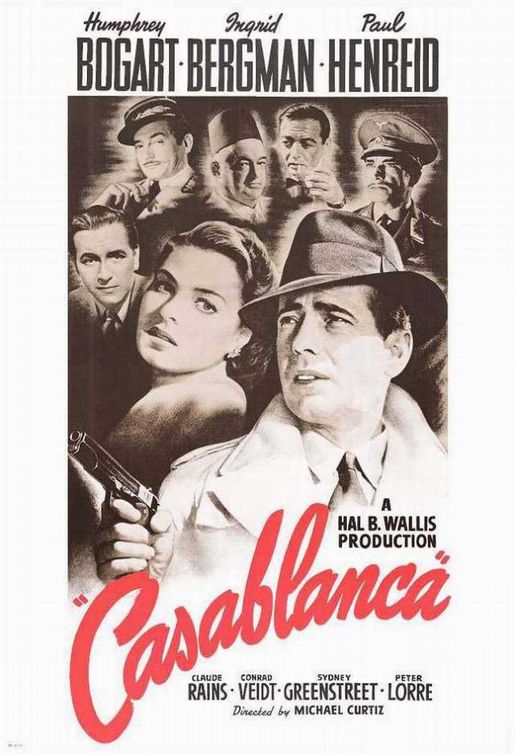
Embracing the Melodrama Part II #15: Casablanca (dir by Michael Curtiz)


CasablancaPoster-Gold

(This review contains spoilers but seriously, you should know all of this already.)

Is there anything left to be said about Casablanca?

Probably not.

As a film reviewer, I’m not supposed to admit that.  I’m supposed to come up with some sort of new, out-of-nowhere, batshit crazy way to look at Casablanca.  I’m supposed to argue that Rick was actually meant to be a survivor of abuse or that Victor Laszlo was some sort of precursor to President Obama or something.  Or, if that doesn’t work, I’m supposed to intentionally troll everyone by writing something like, “10 reasons why Casablanca is overrated” or “I hate Casablanca and I don’t care who knows it!”

But I’m not going to do that.

The fact of the matter is that Casablanca is as good a film as everyone says it is.  It is a film that everyone should see.  It is a film that quite rightfully was named best picture of 1943.  It deserves to be celebrated.  It deserves to be seen.  In fact, stop reading this review right now and go watch it.  Don’t let me waste another second of your time.

The thing with Casablanca is that it’s such an iconic film that everyone knows what happens, regardless of whether they’ve actually watched the entire film or not.  They know that the film takes place in Casablanca during World War II.  They know that Casablanca is full of refugees, spies, and people who are hiding from their past.  They know that Casablanca is policed by the charmingly corrupt Capt. Louis Renault (Claude Rains).  They know that Major Strasser (Conrad Veidt) is the Nazi in charge.  (I nearly said that Strasser was the “evil Nazi in charge” but when you identify someone as a Nazi, is it really necessary to add that they’re evil?)  They know that Rick (Humphrey Bogart) is the American expatriate who owns Rick’s Cafe Americain and that everyone comes to Rick’s.  They know that Rick’s slogan is that he doesn’t stick his neck out for anyone but they also know that his cynicism hides the fact that he’s still in love with Ilsa (Ingrid Bergman).  They know that when Ilsa shows up at Rick’s and needs him to help her husband, Victor Laszlo (Paul Henreid), escape from Occupied Europe, Rick is forced to decide whether or not to get involved in the resistance.

And, whether you’ve seen the film or not, you know that it all ends on a foggy airstrip.  Ilsa wants to stay in Casablanca with Rick but Rick tells her that she has to get on the plane with Laszlo because, if she doesn’t, she’ll regret it.  Ilsa goes with Laszlo, leaving Rick behind.

And it may have been the right thing to do but how many viewers would have done the same if they had been in Ilsa’s high heels?  Throughout the entire movie, we hear about how wonderful Laszlo is but, whenever he actually shows up on screen, it’s always a little bit surprising to discover just how boring a character Victor Laszlo really is.  Unlike the troubled and deceptively cynical Rick, there’s not much going on underneath the surface with Laszlo.  Just as Rick overshadows Laszlo, Bogart’s performance overshadows Paul Henreid’s.  Bogart and Bergman have all the chemistry and the charisma.  Henreid, on the other hand, comes across as stiff and a little dull.  But, as the film suggests, World War II was not a time for self-doubt and self-interest.  World War II was a time when the world needed straight-forward, determined men like Victor Laszlo.

And, if the world needed Laszlo and Laszlo needed Ilsa, then that meant Ilsa had to get on that plane.

That said, I’ve always liked to think that Ilsa ended up leaving Laszlo in 1945 and immediately made her way back to Morocco.  Rick and Ilsa belonged together.

But until Ilsa comes back, Rick has his friendship with Renault.  “Louis,” he says, “I think this is the beginning of a beautiful friendship.”  Did Bogart realize, when he delivered that line, that literally thousands of people would be repeating it decades later?  Bogart’s performance is probably one of the most imitated performances of all time.  Anyone who sees Casablanca thinks that they can talk about gin joints and hills of beans in Bogart’s trademark style.  Of course, they can’t and it’s a testament to the power of Bogart’s performance that it remains effective even after being endlessly imitated.

On Valentine’s Day of 2014, I saw Casablanca at the Alamo Drafthouse in Austin.  It was an amazing and romantic experience.  See Casablanca on the big screen.  It’ll make you love life and bring life to your love.

Needless to say, Casablanca is an intimidating film to review.  So, I’ll just say this: Casablanca is even better than you think it is.  If you haven’t seen it, go watch it.  If you have seen it, go watch it again.

Just resist the temptation to say, “Play it again, Sam,” in your best Bogart-like voice.

Because, seriously, Rick never actually says that line.

Shattered Politics #18: The Man Who Shot Liberty Valance (dir by John Ford)


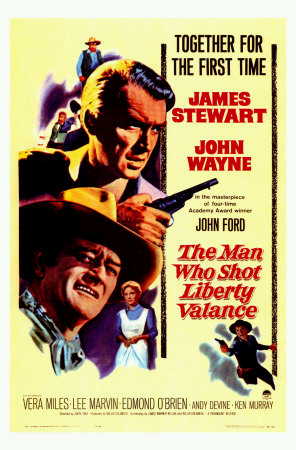
The_Man_Who_Shot_Liberty_Valance“When the legend become fact, print the legend.” — Maxwell Scott (Carleton Young) in The Man Who Shot Liberty Valance (1962)

Though I understand and respect their importance in the history of both American and Italian cinema, I have never really been a huge fan of westerns.  Maybe its all the testosterone (“A man’s got to do what a man’s got to do…”) or maybe it’s all the dust but westerns have just never really been my thing.

However, I will always make an exception for The Man Who Shot Liberty Valance, which is not just a great western but a great film period.

But you already knew that.  It’s a little bit intimidating to review a film that everyone already knows is great.  I even opened this review with the exact same quote that everyone uses to open their reviews of The Man Who Shot Liberty Valance.  To a certain extent, I feel like I should have found a quote that everyone hasn’t already heard a thousand times but then again, it’s a great quote from a great film and sometimes, there’s nothing wrong with agreeing with the critical consensus.

The Man Who Shot Liberty Valance opens with a train stopping in the small western town of Shinbone.  The residents of the town — including newspaper editor Maxwell Scott (Carleton Young) — are shocked when Sen. Rance Stoddard (James Stewart) and his wife Hallie (Vera Miles) get off the train.  Sen. Stoddard is considered to be a front-runner to become the next Vice President of the United States.  Scott is even more shocked to discover why the Stoddards are in town.  They’ve come to Shinbone to attend the funeral of an obscure rancher named Tom Doniphon (played, in flashback, by John Wayne).

Sitting in the funeral home with Doniphon’s coffin (and having reprimanded the local mortician for attempting to steal Tom’s boots), Rance tells Scott why he’s come to pay respect to Tom Doniphon.  We see, in flashback, how Rance first came to Shinbone 25 years ago, an idealistic lawyer who — unlike most of the men in the west — refused to carry a gun.  We see how Rance was robbed and assaulted by local outlaw Liberty Valance (a wonderfully intimidating and bullying Lee Marvin), we discover how Rance first met Hallie while working as a dishwasher and how he eventually taught her how to read, and we also see how he first met Tom Doniphon, the only man in town strong enough to intimidate Liberty Valance.

At first, Rance and Doniphon had an uneasy friendship, epitomized by the condescending way Doniphon would call Rance “pilgrim.”  Doniphon was in love with Hallie and, when he attempted to teach Rance how to defend himself, he was largely did so for Hallie.  Rance, meanwhile, was determined to bring law and society to the west.

And, eventually, Rance did just that.  When Shinbone elected two delegates to the statehood convention in the territory’s capitol, Rance attempted to nominate Doniphon for the position but Doniphon refused it and nominated Rance instead, explaining that Rance understood “the law.”  When Liberty Valance attempted to claim the other delegate spot, Rance and Doniphon worked together to make sure that it instead went to newspaper editor Dutton Peabody (Edmond O’Brien).  And when Liberty Valance attempted to gun Rance down in the street, Rance shot him.

Or did he?

That’s the question that’s at the heart of The Man Who Shot Liberty Valance.  However, as a film, The Man Who Shot Liberty Valance is far less interested in gunfights than it is in politics.  Perhaps the most important scene in the film is not when Rance and Liberty meet out on that dark street.  Instead, it’s the scene at the statehood convention where the reformers (represented by Rance) and the cattlemen (represented by John Carradine) battle over who will be the territory’s delegate to Washington.  Between John Carradine orating, the horses riding in and out of the hall, Edmond O’Brien drinking, James Stewart looking humble, and John Wayne glowering in the background, this is one of the best political scenes ever put on film.

When Rance first arrives in the west, there is no political system in place.  With the exception of the ineffectual town marshal (Andy Devine), there is no law.  The peace is kept by men like Tom Doniphon and, oddly enough, by Liberty Valance as well.  (Whether he realizes it or not, Shinbone’s fear of Liberty has caused the town to form into a community.)  What little official law there is doesn’t matter because the majority of the Shinbone’s citizens can’t read.

When Rance arrives, he brings both education and the law.  He makes Shinbone into a town that no longer needs Liberty Valance but, at the same time, it no longer need Tom Doniphon either.  Hence, it’s Rance Stoddard who goes from dishwasher to U.S. Senator while Tom Doniphon dies forgotten.  Rance represents progress and unfortunately, progress often means losing the good along with the bad things of the past.

(It’s no coincidence that when Rance and Hallie return to Shinbone, the first person that they see is the former town marshal, who no longer wears a star and who, we’re told, hasn’t for years.  Time has passed by.)

It’s a bittersweet and beautiful film, one that features four great performances from Stewart, Wayne, Marvin, and Vera Miles.  Personally, I like to think that maybe Sen. Stoddard had a daughter who married a man named Smith and maybe they had a son named Jefferson who later made his way to the Senate as well.

It would be fitting.