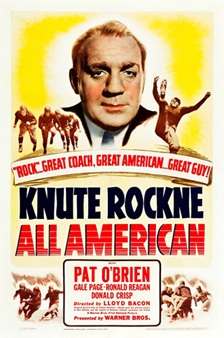
The son of a Norwegian carriage builder who immigrated to the United States in 1892, Knute Rockne (Pat O’Brien) attends Notre Dame, revolutionizes football as both a player and a coach, and leads Notre Dame to upset victory after upset victory. Other coaches look to Rockne and see how to build and inspire a team and learn the importance of taking chances when the game is on the line.
This rah-rah biopic of real-life coach Knute Rockne elevates the character to near sainthood. I was surprised that he didn’t heal any sick children or single-handedly end World War I. Pat O’Brien is just the right age to play Rockne as an aging, veteran coach but the movie also has him playing Rockne as a college student. It’s strange to see Rockne telling his father that he’s decided to go into coaching and that he hopes he won’t be a disappointment to his family when both the father and the son appear to be the same age.
If there is one thing about this movie that really works, it’s the performance of future President Ronald Reagan as George Gipp, a college baseball player who is recruited to the football team after Rockne sees how far and how high he can kick the ball. Gipp becomes a surrogate son to Rockne and Ronald Reagan’s innate likability is put to good use. As an actor in forgettable B-movie, Reagan could seem stiff and uncomfortable but, as George Gipp, he seems surprisingly relaxed and natural. It’s easy to see why this film temporarily made him a star. The scene when George Gipp, on his death bed, tells Knute to tell the team to “win one for the Gipper” is a classic tear-jerker moment and Reagan’s image as being the selfless Gipper, the man who was all about inspiring the team at even the worst of moments, served him well when he went into politics.
(It also served the makers of Airplane! well when Leslie Nielsen needed to give Robert Hays an inspiring speech to get Hays back into the cockpit of that plane. Win one for the Zipper!)
Ronald Reagan’s performance is the only thing about Knute Rockne, All American that has aged well. The movie made me want to win one for the Gipper.
In the 1931 Best Picture nominee Arrowsmith, Ronald Colman stars as Martin Arrowsmith, a doctor who is trying to save lives without compromising his ethics.
Arrowsmith is mentored by the famed bacteriologist, Max Gottlieb (A.E. Anson) and married to a nurse named Leora (Helen Hayes). At first, Arrowsmith makes his living as the local doctor in Leora’s small hometown in South Dakota. However, Arrowsmith is ambitious and wants to do more with his life and career than just take care of a small town. He wants to cure the world of disease. When he’s offered a position at the prestigious McGurk Institute in New York, he enthusiastically accepts. Having just suffered a miscarriage, Leora supports Arrowsmith’s decision and travels to New York with him. No matter what happens, Leora is always there to support her husband, even when he doesn’t seem to appreciate it.
When Arrowsmith thinks that he’s discovered an antibiotic serum that appears to be capable of curing all sorts of diseases, he attempts to stay true to the methods taught to him by Dr. Gottlieb. He takes his time. He tests carefully. He doesn’t rush out and give the serum to everyone. However, Arrowsmith finds his methods continually sabotaged by his colleagues, who hope to raise money by telling the press about a miracle serum that can “cure all diseases!” When Arrowsmith later finds himself combatting an outbreak of the Bubonic Plague in the West Indies, he again tries to employ the scientific method but finds himself being pressured by government officials to give his untested serum to every single person on the island. Eventually, Arrowsmith’s ethics are pushed to their limits when even Leora falls ill.
Arrowsmith was based on a best-selling novel by Sinclair Lewis, though the plot was changed to make the story more palpable for film audiences. In the novel, Arrowsmith is a bit of cad who regularly cheats on his wife. In the film, Arrowsmith is passionate and driven but the exact nature of his relationship with wealthy Joyce Lanyon (Myrna Loy) is left so ambiguous that it actually leaves one wondering why the character is in the film at all. What both the film and the novel have in common is an emphasis on the importance of science and the scientific method. Arrowsmith’s idealism runs into the harsh reality of life during an epidemic. Government officials are more concerned with saying that they’ve done something as opposed to considering whether their actions have ultimately done more harm than good. In its way, Arrowsmith predicted the COVID era.
Arrowsmith was the first John Ford film to be nominated for Best Picture and its financial success allowed Ford the freedom to go on to become one of Hollywood’s most important directors. Seen today, Arrowsmith feels a bit creaky and self-important, with little of the visual flair that Ford brought to his later films. Ronald Colman’s performance as Arrowsmith seems a bit stiff, especially when compared to the much more lively (and sympathetic) performance of Helen Hayes. Arrowsmith is a big and serious film and, if we’re going to be honest, it’s a little bit boring. Still, it’s interesting to see the issues of today being debated 90 years in the past.
As for the Oscars, Arrowsmith was nominated for Best Picture, Adaptation, Cinematography, and Art Direction. It lost in all four of the categories in which it was nominated. That year, Best Picture was won by Grand Hotel, which curiously didn’t receive any other nominations at all.
Shane (David Carradine) is awakened in the night by the sound of someone outside his bunk. He sees an old man (John Qualen) looking in the window. He grabs his gun and gets outside in time to see the old man driving off over the ridge in a horse drawn buggy. The next morning Shane is telling Mr. Starett (Tom Tully), Marian (Jill Ireland) and Joey (Chris Shea) about what had happened during the night. At this point, Shane seems unsure if it was even real. They muse that it may have been a “hant,” or a ghost.
Shane takes Joey to Grafton’s General store. While he’s trying on some new leather boots, he accidentally bumps into a drunk cowboy (Carl Reindel) causing his whiskey to spill. The drunk confronts Shane. Shane is able to beat up the cowboy without having to kill him. And then the same old man from the night before comes in and just looks at every man in the bar. He appears to be searching for someone. He comes up to Shane and says, “You’re Shane.” Shane doesn’t remember the old man, and the old man just turns and leaves.
That night, Marian, unable to sleep walks outside and sees Shane talking to the old man. Shane tells her he’s an old friend that she should go back to bed. Shane invites him into his bunkhouse. That night the old man tells Shane that he killed his son 4 years earlier in Black Falls, CO. He even shows Shane a picture of his son. Shane doesn’t remember him at first. As he looks at the picture, he begins to have short flashbacks of the young man. He’s eventually able to remember the entire exchange with the young man in a saloon in Colorado. He did kill the man, but it was in self defense. He tells the old man that he did kill his son and that he’s sorry. He tells him that it was either his son or him, and that’s the only reason he killed him. Shane then asks the old man what he wants…. I won’t spoil it for you, but the answer was surprising!
Episode 2 is all about Shane being haunted by his past. David Carradine does the heavy lifting as his character tries to come to terms with the fact that he’s killed so many men that he can’t even remember them all. He even considers leaving the Starett ranch because he’s concerned that other people could show up in the future wanting to get vengeance on him. Old man Starett isn’t involved in the action at all in this episode. Marian is mostly there to encourage Shane to not be so hard on himself. There is a scene where he puts a blanket on her when he’s about to leave the ranch for good. She’s sleeping and takes Shane by the hand like she’s touching her husband’s hand. It will be interesting to see how far the series takes their relationship, but that will be for another episode. And Joey is not very involved outside of telling the family about Shane kicking the drunk cowboy’s butt early in the episode. I could hear “Linus” a little bit in his voice since I know that he would be voicing the character that same year in “It’s the Great Pumpkin, Charlie Brown.” That was pretty cool. John Qualen is good in his guest starring role as the old man whose son was killed by Shane in the past. Qualen has been in so many TV shows and movies in his career going back to the early 30’s. He’s a very recognizable actor.
All in all, I thought this was a solid episode. There was some real tension built up at the end of the when Shane is confronted again by that same drunk cowboy, and I was a little surprised by the resolution.
Welcome to Retro Television Reviews, a feature where we review some of our favorite and least favorite shows of the past! On Sundays, I will be reviewing the made-for-television movies that used to be a primetime mainstay. Today’s film is 1972’s Getting Away From It All! It can be viewed on YouTube.
For Fred Clark (Larry Hagman) and Mark Selby (Gary Collins), life is New York City just isn’t that much fun anymore. The weather is terrible. The traffic cannot be navigated. The only people ruder than the cabbies are the doormen. Fred and Mark have come up with the perfect plan. They’ve decided to move to a small country town and purchase a house on a small island. In fact, they’re going to buy the entire island! It’s surprisingly cheap. Fred and Mark don’t ever really stop to wonder why the island is available for so little money. Seriously, if you’re buying an island, you should probably ask yourself those questions.
Mark’s wife, Alice (E.J. Peaker), is enthusiastic about the idea. Less excited is Fred’s wife, Helen (Barbara Feldon). Helen enjoys living in the city and having a nice job in an office building. She gets along with her boss (played by Jim Backus, one of many veteran actors to show up in a small role in this film). Perhaps hoping that Fred will change his mind once he’s confronted with the reality of actually living in the country, Helen finally gives in.
It does turn out that the island is not quite the paradise that Fred and Mark were expecting. The only way to get out to the island is in a leaky rowboat. The house is falling apart and, as Helen is disgusted to learn, it also doesn’t have indoor plumbing. There’s no electricity either but fortunately, the local handyman is working on it. His name is Herbie and he’s played by a very young and thin Randy Quaid. If you’ve ever wanted to hear Randy Quaid speak with an exaggerated New England accent, this is the film for you. There’s nothing convincing about Quaid’s accent but it still seems only fair, considering all of the Yankee actors who have butchered the Southern accent over the years.
Just when it looks like Fred and Mark have managed to make the Island livable, they get a disturbing letter. As the new owners of the Island, they owe 20 years worth of back taxes. As Fred puts it, the tax bill is more than either of them can afford. If they can’t raise the money, the town will take back the Island. Fred and Mark consider trying to get jobs but it turns out that neither one of them knows much about being fisherman. They then decide to charm the town into nullifying the tax bill. That turns out to be more difficult than either man imagines.
Getting Away From It All is a comedy that deals with a universal theme, the desire to escape from the harshness of everyday life and find a perfect place to which to escape. That said, the film’s main reason for existing is a parade of comedic cameos. Jim Backus, Vivian Vance, Joe E. Ross, Burgess Meredith, Paul Hartman, and J. Pat O’Malley all appear in small roles, appearing just long enough for 1972 viewers to say, “Hey, I recognize that person!” The end result is a rather shallow film that has a few chuckle-worthy moments. (Again, Randy Quaid pretending to be from Maine has to be worth something.)
In the end, for all of the film’s celebration of getting away from it all, it’s hard not to feel that Gary, Mark, Alice, and Helen will all end up back in Manhattan sooner than later. Some people are just city folks.
When a gang of outlaws attempt to rob a bank in the small frontier town of Plainview, the local sheriff is one of the first people to get gunned down. It falls upon two local men, George Henderson (Frank Ferguson) and storeowner Jack Wright (Fred MacMurray), to run the outlaws out of town. While most of the gang escapes, Jack and Henderson manage to kill the gang’s leader, Alvin Dennis.
At first, Jack and Henderson are declared to be heroes and Henderson is appointed sheriff. However, when Henderson is found murdered, the town realizes that Alvin’s brother, Bob (Skip Homeier), has returned to get revenge. The inevitable confrontation is delayed by the arrival of a U.S. marshal who stays in town for two weeks to maintain the peace but everyone knows that, once he leaves, Bob is going to be coming after the mild-manned Jack. The townspeople go from treating Jack like a hero to shunning him. They even offer Jack and his wife (Dorothy Malone) money to leave town but Jack refuses to give up his store or to surrender to everyone else’s fear.
At Gunpoint is a diverting variation on High Noon, with Fred MacMurray stepping into Gary Cooper’s role as the upstanding man who the town refuses to stand behind. What sets At Gunpoint apart from High Noon is that, unlike Cooper’s Will Kane, MacMurray’s Jack Wright isn’t even an experienced gunslinger. Instead, he’s a mild-mannered store owner, the old west’s equivalent of an intellectual, who just managed to get off a lucky shot. If he can’t find a way to get the cowardly town to back him up, there’s no way that he’s going to be able to defeat Bob and his gang.
At Gunpoint features an excellent cast of Western character actors, including John Qualen, Irving Bacon and Whit Bissell. Especially good is Walter Brennan, playing one of the only townspeople to have any integrity. While this western may not have the strong political subtext or the historical significance of High Noon, it’s still a well-made example of the genre. It’s a western that even people who don’t normally enjoy westerns might like.
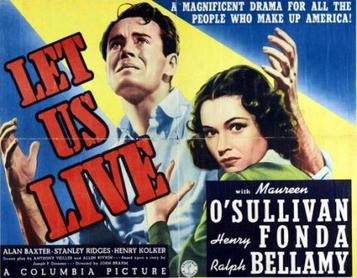
In the 1939 film, Let Us Live!, Henry Fonda plays Brick Tennant. Brick is a poor but honest taxi driver who has always lived a law-abiding life and who is looking forward to marrying waitress named Mary Roberts (Maureen O’Sullivan). However, when a taxi is used as a getaway car in a violent robbery that leaves a policeman dead, Brick finds that he’s a suspect.
At first, Brick isn’t too worried. It turns out that every taxi driver in Boston is apparently being considered a suspect. Brick is just 1 out of 120. However, when the police bring Brick in to take part in a lineup, one of the witnesses insists that Brick and his friend, Joe Linden (Alan Baxter), were involved in the robbery. Despite the fact that Brick and Mary were at a church, planning their wedding, during the robbery, Brick and Joe are arrested and put on trial for murder. Despite Brick’s initial faith in the system, he and Joe are convicted and sentenced to die.
On death row, Brick faces the inhumane reality of American justice. He watches as other prisoners slowly lose their mind as a result of neglect and abuse. He watches as another prisoner drops dead in front of him, to the indifference of the guards. Even when Mary tells him that she’s still looking for evidence that will exonerate him, Brick says that he no longer cares. The state of Massachusetts is determined to kill him and he doesn’t believe that there’s any way stop them. As Mary puts it, Brick is now dead inside.
Still, Mary continued to investigate. Helping her is a police detective named Everett (Ralph Bellamy). Everett comes to realize that two innocent men are sitting on Death Row but will he and Mary be able to find the real culprits before the state executes Brick and Joe?
While watching Let Us Live, I found it impossible not to compare the film to The Wrong Man, another film in which Henry Fonda played an innocent man being railroaded by the system. Both The Wrong Man and Let Us Live were based on a true stories, though Let Us Live takes considerably more liberty with its source material than The Wong Man does. Whereas The Wrong Man is a docudrama that’s full of moody atmosphere courtesy of director Alfred Hitchcock, Let Us Live is much more of a fast-paced, melodramatic B-move.
That said, Let Us Live! is still a definitely effective look at how an innocent man can be railroaded by a system that’s often more concerned with getting a quick conviction than actually searching for the truth. Sadly, the issues that Let Us Live deals with are just as relevant today as they were in 1939. The film’s power comes from Henry Fonda’s performance as Brick. It’s truly heart-breaking to watch Brick go from being a cheerful optimist to a man who has been so broken down by American justice that he can’t even bring himself to celebrate the news that he might be released. The film ends on a grim note, a reminder that some damage cannot be undone.
Let Us Live! is another good but obscure film that I discovered through TCM. Keep an eye out for it!
Like many film noirs, this 1950 film opens with a murder.
On a dark night in San Francisco, a man attempts to blackmail an unseen person called “Danny Boy” and gets shot for his trouble. The gunshot is heard by a frustrated painter, named Frank Johnson (Ross Elliott), who is out walking his dog. Frank sees the dead body being pushed out of a car and then catches a shadowy glimpse of the killer. When the killer open fires on him, Frank runs for it.
Like a good citizen, Frank goes to the police but, when he learns that the victim was due to testify against a local gangster, Frank panics and vanishes. When Inspector Ferris (Robert Keith) goes to see Frank’s wife, Eleanor (Ann Sheridan), he’s shocked to discover that Eleanor isn’t shocked by Frank’s disappearance and that she doesn’t seem to care one way or the other. As Eleanor explains it, Frank is a notorious coward and, years ago, their once strong marriage became a loveless charade. Frank’s vanished and Eleanor doesn’t care.
Or does she?
While it quickly becomes obvious that Eleanor is telling the truth about not knowing where Frank is, she’s not being totally honest about no longer caring about him. For instance, when she learns that Frank has been hiding a heart condition from her, Eleanor goes to the doctor to pick up his medicine, just in case he should happen to come by the house. Of course, it’s not always easy to get out of the house, especially now that the police are watching Eleanor.
Eleanor wants to track down Frank without involving the police and it seems like there’s only one person who is interested in helping he do that.. Played by Dennis O’Keefe, this person is a tough reporter and he says that he wants to do an exclusive story on Frank. He offers to help Eleanor track him down and he even says that he’ll pay $1,000 for the chance to interview Frank. The reporter and Eleanor are soon searching San Francisco, retracing Frank’s day-to-day life and discovering that Frank loved Eleanor more than she ever realized….
What’s that? Oh, did I forget to mention the reporter’s name?
His name is Danny.
That’s right. Eleanor is trying to find Frank so that she can save his life and working with her is the one man who wants to kill him!
Needless to say, this leads to a great deal of suspense. On the one hand, you’re happy that Eleanor is rediscovering how much she loves Frank. On the other hand, you spend almost the entire movie worried that Eleanor is going to lead Danny right to him. Shot on location in San Francisco and featuring all of the dark shadows and tough dialogue that one could possibly hope to get in a film noir, Woman On The Run is an underrated suspense gem. Full of atmosphere and steadily building suspense, Woman on the Run features a great and acerbic performance from Ann Sheridan and a genuinely exciting climax that’s set at a local amusement park. Seriously, roller coasters are super scary!
Woman on the Run was directed by Norman Foster. If you’ve recently watched The Other Side of the Wind on Netflix, you might recognize the name. A longtime friend of Orson Welles, Foster played the role of Billy Boyle in Welles’s final film.
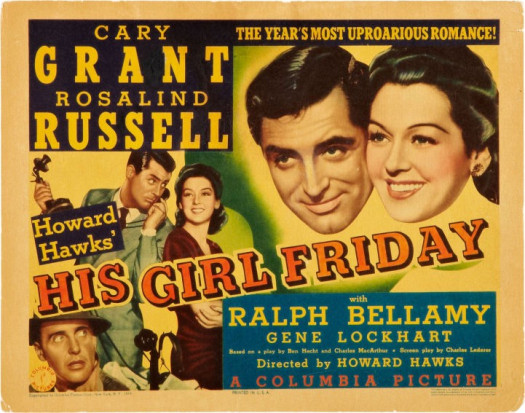
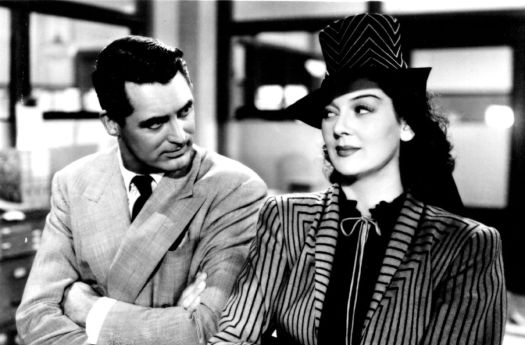
In my opinion, Howard Hawks’ HIS GIRL FRIDAY is one of the greatest screwball comedies ever made, a full speed ahead movie that’s pretty much got everything a film fan could want. A remake of the 1930 Lewis Milestone classic THE FRONT PAGE (itself an adaptation of Ben Hecht and Charles MacArthur’s Broadway smash), Hawks adds a delightful twist by turning ace reporter Hildy Johnson into editor Walter Burns’ ex-wife… and casting no less than Rosalind Russell and Cary Grant in the roles!
The two stars are in top form as the bickering ex-spouses, with their rapid fire banter nothing short of verbal dynamite. Grant in particular spouts off words quicker than a rapper (where did he get all that wind!) and his facial expressions and comic squeals (reminiscent of Curly Howard!) are simply priceless! Roz is more than his match as Hildy, with one lightning-fast zinger after another. Miss…
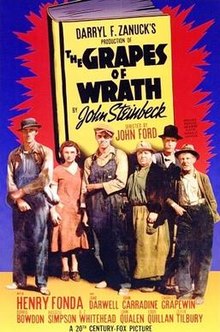
(With the Oscars scheduled to be awarded on March 4th, I have decided to review at least one Oscar-nominated film a day. These films could be nominees or they could be winners. They could be from this year’s Oscars or they could be a previous year’s nominee! We’ll see how things play out. Today, I take a look at the 1940 best picture nominee, The Grapes of Wrath!)
How dark can one mainstream Hollywood film from 1940 possibly be?
Watch The Grapes of Wrath to find out.
Based on the novel by John Steinbeck and directed by John Ford, The Grapes of Wrath tells the story of the Joad family and their efforts to neither get sent to prison nor starve to death during the Great Depression. When they lose their farm in Oklahoma, they head for California. Pa Joad (Russell Simpson) has a flyer that says someone is looking for men and women to work as pickers out west. The 12 members of the Joad Family load all of their possessions into a dilapidated old truck and they hit the road. It quickly becomes apparent that they’re not the only family basing all of their hopes on the vague promises offered up by that flyer. No matter how much Pa may claim different, it’s obvious that California is not going to be the promised land and that not all the members of the family are going to survive the trip.
Tom Joad (Henry Fonda) is the oldest of the Joad sons. He’s just been released from prison and he’s killed in the past. Having been in prison during the start of the Great Depression, Tom doesn’t realize how bad things truly are until he arrives home and sees someone he grew up with using a tractor to knock down a house. (It’s just business, of course. The owners of the house can’t pay their bills so the house gets destroyed.) The film’s story is largely told through Tom’s eyes and Henry Fonda gives a sympathetic performance, one the gets the audience to empathize with and relate to a character who is a total outsider.
As for the rest of the Joad Family, Ma (Jane Darwell) is the glue who holds them together and who refuses to allow them to surrender to despair. (And yet even Ma is forced to make some tough choices when the starving children of one work camp ask her to share her family’s meal with them.) Rosasharan (Dorris Bowdon) is pregnant while Grandpa (Charley Grapewin) is too sickly for the trip but doesn’t have anywhere else to go. And then there’s Casy (John Carradine), the former preacher turned labor organizer. Casy is not blood-related but he soon becomes a member of the family.
The Joads have a healthy distrust of the police and other authority figures and that turns out to be a good thing because there aren’t many good cops to be found between Oklahoma and California. Instead, the police merely serve to protect the rich from the poor. Whenever the workers talk about forming a union and demanding more than 5 cents per box for their hard work, the police are there to break heads and arrest any troublemakers on trumped up charges. Whenever a town decides that they don’t want any “Okies” entering the town and “stealing” jobs, the police are there to block the roads.
The Grapes of Wrath provides a portrait of the rough edges of America, the places and the people who were being ignored in 1940 and who are still too often ignored today. John Ford may not be the first director that comes to mind when you think of “film noir” but that’s exactly what The Grapes of Wrath feels like. During the night scenes, desperate faces emerge from the darkness while menacing figures lurk in the shadows. When the sun does rise, the black-and-white images are so harsh that you almost wish the moon would return. The same western landscape that Ford celebrated in his westerns emerges as a wasteland in The Grapes of Wrath. The American frontier is full of distrust, anger, greed, and ultimately starvation. (Reportedly, the film was often shown in the Soviet Union as a portrait of the failure of America and capitalism. However, it was discovered that Soviet citizens were amazed that, in America, even a family as poor as the Joads could still afford a car. The Grapes of Wrath was promptly banned after that.) John Ford is often thought of as being a sentimental director but there’s little beauty or hope to be found in the images of The Grapes of Wrath. (Just compare the way The Grapes of Wrath treats poverty to the way Ford portrayed it in How Green Was My Valley.) Instead, the film’s only hint of optimism comes from the unbreakable familial bond that holds the Joads together.
As dark as it may be, the film is nowhere near as pessimistic as the original novel. The novel ends with a stillborn baby and a stranger starving to death in a barn. The film doesn’t go quite that far and, in fact, offers up some deus ex machina in the form of a sympathetic government bureaucrat. (Apparently, authority figures weren’t bad as long as they worked for the federal government.) That the book is darker than the movie is not surprising. John Steinbeck was a socialist while John Ford was a Republican with a weakness for FDR. That said, even though the film does end on a more hopeful note than the novel, you still never quite buy that things are ever going to get better for anyone in the movie. You want things to get better but, deep down, you know it’s not going to happen. Tom says that he’s going to fight for a better world and Fonda’s delivers the line with such passion that you want him to succeed even if you know he probably won’t. Ma Joad says the people will never be defeated and, again, you briefly believe her even if there’s not much evidence to back her up.
Even when viewed today, The Grapes of Wrath is still a powerful film and I can only guess what it must have been like to see the film in 1940, when the Great Depression was still going on and people like the Joads were still making the journey to California. Not surprisingly, it was nominated for best picture of 1940, though it lost to Alfred Hitchcock’s Rebecca.
When two aging fishermen (Thomas Mitchell and John Qualen) attempt to buy a new boat, they run into a problem with local mobster, Harold Goff (John Garfield). As Goff explains, if they do not pay him $5.00 a week, something bad could happen to their boat. When one of the fisherman’s daughter (Ida Lupino) falls in love with Goff, she makes the mistake of letting him know that her father is planning on giving her $190 so that she can take a trip to Cuba. When Goff demands the money for himself, the fishermen attempt to go to the police, just to be told that there is nothing that the authorities can do. Goff tricked them into signing an “insurance” contract that allows him to demand whatever he wants. The two fishermen are forced to consider taking drastic measures on their own. Out of the Fog is an effective, early film noir, distinguished mostly be John Garfield’s sinister performance as Harold Goff.
Out of the Fog is also memorable as an example of how Hollywood dealt with adapting work with political content during the production code era. Out of the Fog was based on The Gentle People, a play by Irwin Shaw. In the play, which was staged by The Group Theater in 1939, Harold Goff was obviously meant to be a symbol of both European fascism and American capitalism. In the play, the two fisherman had Jewish names and were meant to symbolize those being persecuted by the Third Reich and its allies. In the transition for stage to film, Jonah Goodman became Jonah Goodwin and he was played by the very talented but definitely not Jewish Thomas Mitchell. The play ended with Harold triumphant and apparently unstoppable. Under the production code, all criminals had to be punished, which meant the ending had to be changed. Out of the Fog is an effective 1940s crime thriller but, without any political subtext, it lacks the play’s bight.
One final note: while Out of the Fog had a good cast, with up and comer John Garfield squaring against old vets Thomas Mitchell and John Qualen, the original Broadway play’s cast was also distinguished. Along with contemporary film stars Sylvia Sidney and Franchot Tone, the play’s cast was a who’s who of actors and directors who would go on to be prominent in the 1950 and 60s: Lee J. Cobb, Sam Jaffe, Karl Malden, Martin Ritt, and Elia Kazan all had roles.
 The son of a Norwegian carriage builder who immigrated to the United States in 1892, Knute Rockne (Pat O’Brien) attends Notre Dame, revolutionizes football as both a player and a coach, and leads Notre Dame to upset victory after upset victory. Other coaches look to Rockne and see how to build and inspire a team and learn the importance of taking chances when the game is on the line.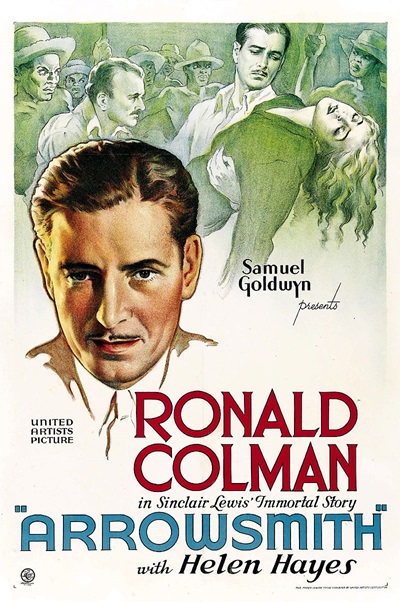




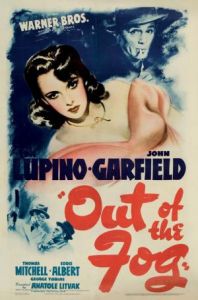 When two aging fishermen (Thomas Mitchell and John Qualen) attempt to buy a new boat, they run into a problem with local mobster, Harold Goff (John Garfield). As Goff explains, if they do not pay him $5.00 a week, something bad could happen to their boat. When one of the fisherman’s daughter (Ida Lupino) falls in love with Goff, she makes the mistake of letting him know that her father is planning on giving her $190 so that she can take a trip to Cuba. When Goff demands the money for himself, the fishermen attempt to go to the police, just to be told that there is nothing that the authorities can do. Goff tricked them into signing an “insurance” contract that allows him to demand whatever he wants. The two fishermen are forced to consider taking drastic measures on their own. Out of the Fog is an effective, early film noir, distinguished mostly be John Garfield’s sinister performance as Harold Goff.
 Through the Shattered Lens