Film Review: The Conjuring: The Devil Made Me Do It (dir by Michael Chaves)


The year is 1981 and Ed and Lorraine Warren (Patrick Wilson and Vera Farmiga, of course!) have just screwed up another exorcism.  Only Ed hears as Arne Johnson (Ruairi O’Connor) begs the demon that has possessed 8 year-old David Glatzel (Julian Hilliard) to enter him instead.  Unfortunately, Ed also has a heart attack and passes out before he can tell Lorraine what has happened.

The next month, a hollow-eyed Arne is walking down a road.  He’s just murdered his sleazy landlord, stabbing the man 22 times.  It seems like an open-and-shut case, except for the fact that Arne claims that he was possessed by a demon and that it was the demon who actually committed the crime.  At first Arne’s lawyer is planning to go for an insanity plea but then Ed and Lorraine invite her to come have dinner with them and to see their favorite doll, Annabelle.  The film immediately cuts to Arne’s visibly shaken lawyer announcing to the court that her client pleads “not guilty by reason of demonic possession.”

It’s a funny scene and I was a little bit surprised to see it because, in the past, The Conjuring films have always been distinguished by how seriously they took themselves.  The first two films both unfolded in atmospheres of growing dread, following families that not only had to deal with societal evolution but also with angry spirits.  The first two Conjuring films worked not only as horror films but also as period pieces, as stories about changing times.  Though Ed and Lorraine were always the main investigators, the first two films devoted as much time to exploring the dynamics of the haunted families as it did to portraying the Warrens.

The Conjuring: The Devil Made Me Do It (or, as we’ll call it in the interest of space, The Conjuring 3) takes a different approach, which I imagine has much to do with Michael Chaves directing the film instead of James Wan.  This time, Arne and the possessed family all remain ciphers.  We never learn much about who they are or who they were before they met the Warrens.  We don’t know what Arne was like before he became possessed and, as such, it’s hard to get emotionally invested in him once he does end up with a demon inside of him. 

Instead, the film emphasizes Ed and Lorraine Warren and their work to uncover the occultist who was behind the original possession.  Ed worries about Lorraine as she has psychic visions and wanders around yet another dirty basement.  Lorraine worries that Ed is going to give himself another heart attack as he hobbles through the woods in search of an evil spirit.  Lorraine proves her powers to a skeptical detective.  Ed complains that he doesn’t want people treating his wife’s abilities like a carnival sideshow but he still allows himself a slight smile when she selects the correct murder weapon.  Of course, at one point, Suspicious Minds is heard on the radio and we briefly flashback to Patrick Wilson singing the song in The Conjuring 2.  Once again, the film argues that Ed and Lorraine’s romance, their endless love, makes them uniquely capable of battling the Devil.

The film has its moments, largely because Patrick Wilson and Vera Farmiga are adorable as Ed and Lorraine.  At the same time, though, there’s a definite “greatest hits” feel to the third Conjuring film.  There’s little about the film that feels truly spontaneous or surprising and most of the scenes feel like reworkings of scenes that worked in the previous two films.  As good as Farmiga and Wilson are in their roles (and as much as I appreciate the idea of a Catholic super hero film franchise), Ed and Lorraine work best when they’re relating to and helping other characters.  The Conjuring 3 often solely focuses on them and the end result often feels more like an Insidious sequel than a Conjuring film.

The Conjuring 3 is enjoyable enough.  It gets the job done, while never reaching the emotional heights of the first two films.  It has enough jump scares to be a fun movie to watch on a rainy night but it’s not one that really sticks in your mind after it ends.

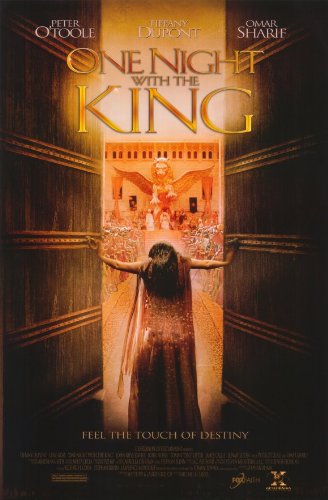
The_Conjuring_-_The_Devil_Made_Me_Do_It

Film Review: One Night With The King (dir by Michael O. Sajbel)


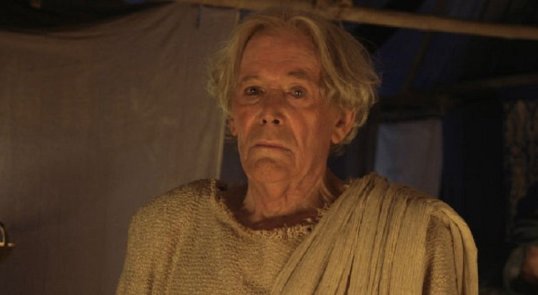
The 2006 Biblical film, One Night With The King, opens with God ordering King Saul to conquer and execute all of the Amalekites and their livestock.  However, as so often happened whenever God ordered him to do something, Saul manages to screw everything up.  He does conquer the Amalekites but he decides to keep their best livestock for himself and he also declines to execute the Amalekite king or his pregnant wife.  The prophet Samuel (played by an uncomfortably frail-looking Peter O’Toole) shows up and tells Saul that he’s screwed up for the last time.  Samuel goes off to execute the Amalekite king.  However, the queen escapes into the desert.

And that’s the last we see of her.  It’s also the last we see of O’Toole who, despite being top billed, has about a minute of screen time.

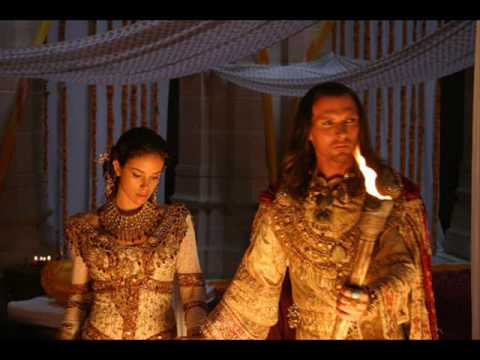
Jump forward several hundred years.  We are now in the city of Susa, Persia.  It’s the center of the known world.  We know this because characters tend to say stuff like, “We are living in the center of the known world.”  Xerxes (Luke Goss) is the king of Persia, a somewhat uncouth man who is obviously used to getting everything that he wants.  Xerxes is plotting on marching off to war.  However, his current wife is opposed to the war and refuses to attend Xerxes’s pre-war banquet.  Scandal!  Xerxes’s advisor, Prince Memucan (Omar Sharif, who co-starred with Peter O’Toole in Lawrence of Arabia), suggests that perhaps Xerxes should get a new wife.

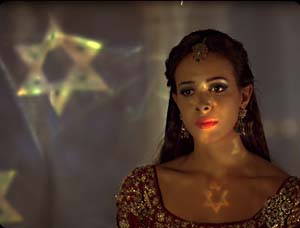
Every female virgin in the city is brought to Xerxes’s palace so that, under the watchful eye of the king’s eunuch, Hegai (Tommy Lister, Jr.), they can compete for the chance to become queen.  Among the women is the beautiful Hadassah (Tiffany Dupont), who is the niece of one of the king’s scribes, Mordecai (John Rhys-Davies).  Hadassah does not tell the king that she’s related to Mordecai and instead says that her name is Esther.  With the help of Hegai, Hadassah soon emerges as the favorite to become the new queen.

Meanwhile, an evil man named Haman (Boo!  Haman!  Boo!) has shown up on the scene.  Haman (played by James Callas) is a descendant of the Amalekites that Saul failed to destroy.  (Dammit, Saul!)  A greedy astrologer, Haman (Boo!) has been appointed to the position of vizier by Xerxes.  Haman (hiss!) demands that all of the king’s servants bow before him.  However, because he has a pagan symbol sewn onto his clothes, Mordecai refuses to do so.  Driven by hate (Boo!), Haman makes plans to execute not only Mordecai but every other Jew in Persia.  With the king unaware of Haman’s intentions, only Hadassah can stop his plans but to do so, she’ll have to risk seeing the king unsummoned….


The story of Esther, Mordecai, the king, and the moment that Haman (Boo!) discovers that karma is a bitch has always been one of my favorites so I’ve always enjoyed One Night With The King whenever I’ve watched it.  Don’t get me wrong.  It has its flaws.  Though the film does a pretty good job of recreating the past on a low budget, it’s still one of those films that’s full of awkward exposition, cringe-worthy dialogue, and more than a few inconsistent performances.  (Sharif and O’Toole, for instance, both go through the motions, doing just enough to pick up a paycheck.)  At the same time, Luke Goss is properly rough-around-the-edges as the king and Tiffany DuPont is well-cast as Hadassah.  Tommy Lister, Jr. appears to be having a lot of fun in the role of the world’s most unlikely eunuch and, as a result, he’s entertaining to watch.  Visually, it’s a pretty film and the costumes are to die for, as they should be in any film about a royal romance.  And, even if the story is at times awkwardly told, it still reaches a deeply satisfying conclusion.

James Callas is convincingly evil and properly detestable as Haman (Boo!  Haman!  Boo!).  Haman is an archetype of evil, the ant-Semite whose evil legacy has continued to haunt the world in the centuries since he met his own fate.  Though the film at times spends too much time playing up the romance between the king and Hadassah (which, while nice to watch, is not the point of the source material), One Night With The King does include enough scenes of Haman (hiss!) ranting to make clear the link between Haman and the anti-Semitism of the Nazis and those modern day hate mongers who try to hide their bigotry behind claims that they are “only criticizing Israel.”  Haman’s evil makes his final fate all the more satisfying but the film leaves no doubt that, unless the world remains vigilant, there will always be new Hamans threatening to come to power.  That’s an important enough message to make up for many of the film’s missteps.

One Night With The King is a flawed, low-budget film.  But I like it.


Scenes I Love: The Lord of the Rings: The Return of the King


“Arise, arise Riders of Théoden (Riders of Rohan)! Fell deeds awake: fire and slaughter! Spear shall be shaken, shield be splintered, a sword-day, a red day, ere the sun rises! Ride now, ride now! Ride for ruin… and the world’s ending! Death! Death! Forth Eorlingas!” – Theoden, King of Rohan

This marks the final “Scenes I Love” series from Peter Jackson’s fantasy epic, The Lord of the Rings. The last couple days have seen a favorite scene picked from the first two film. Today’s pick was a tie between two scenes. One a third of the way into The Return of the King with the second being two-thirds in and a logical consequence of the first scene picked. I could’ve easily picked one over the other, but I’ve always seen the two as connected in some way. I also didn’t want to pick one over the other so we have two scenes instead of one. I say that’s a bonus for everyone.

The first scene was (continues to be one of my most favorite scenes ever put on film) the lighting of the beacons which signals Gondor’s call for aid to it’s far neighboring kingdom of Rohan. This scene just builds and builds until the rousing “Gondor theme” reaches it’s peak and shows each beacon lighting up one right after the other until it reaches the mountain peaks outside Rohan. No matter how often I see this scene (especially now on blu-ray) I can’t help but still feel a sense of awe at what Peter Jackson and his crew pulled off. One buys into the scene and just marvels at the sequence. A film which, up until the lighting of the beacons, had such a hopeless tone to it suddenly had hope appear.

The second scene finally sees the culmination of the lighting of the beacons. Rohan has responded in force as every able-bodied man and his horse have gathered on a rise above Pelennor Fields. With Theoden knowing the forces of Sauron arrayed and besieging Mina Tirith dwarfs even his own cavalry force he nonetheless orders his men to charge the Mordor lines to help break the siege. His speech in this scene trumps even Aragorn’s own rousing speech later on in the film which is saying much. The charge of the Rohirrim down into the Mordor lines gets a nice assist from Howard Shore’s score which begins with the “Rohan theme” signalling the arrival of the Rohirrim to the battle then transitioning to the “Nature theme” which is heard for the first time in full orchestral mode before returning to the “Rohan theme” as the Rohirrim charge finally crashes into the Mordor lines.

The charge itself looked great when I saw it on the big-screen and still the best way to see it. Barring not seeing it on the big-screen the best option would be to see it on blu-ray and on a large HDTV screen. The wide, overhead shot of the massed cavalry gradually gaining speed with Theoden at the elongating tip in the middle makes for great, epic filmmaking. The scene sells itself as Jackson used hundreds of extras in real armor and on charging horses (with CGI copies expanding their numbers into the thousands) to show true weight to the scene. I recommend to those who want to revisit this scene to watch it again but using their surround sound system on high and feel the thundering hooves of the charging Rohirrim until they crash into the Mordor lines. It’s the only way to see and experience the scene.

Quickie Review: Running Scared (dir. by Wayne Kramer)


Director Wayne Kramer’s follow-up to his directorial debut (The Cooler) shows that he has a flair for drama and suspense that borders the line between reality and surrealism. Running Scared has such a gritty, washed out look right from the get-go that one starts to think it’s a film lifted right out of the 70’s. But that is only part of what Kramer does in creating a look and feel for Running Scared. Kramer actually uses every kind of trick in a director’s book to give his film such an over-the-top sense that the audience really doesn’t know what to expect just around the next dark corner.

Running Scared‘s first ten minutes sets up what the rest of the next two hours are going to be like. Kramer direct’s this ten minutes like a man possessed. The direction and editing is frantic and frenetic. Some have said that it’s all been done before by Tarantino, Woo and a dozen other action-stylists out of Hong Kong, but I disagree. Kramer’s style owes alot more to the grandfather of excessive film violence and that’s Sam Peckinpah. I’m not comparing Running Scared to Peckinpah’s seminal classic The Wild Bunch, but the pace and look of the chaotic shoot-out in the tiny apartment to start the film brings to mind the opening and closing shoot-outs of Peckinpah’s film.

Kramer knows he’s not making a social statement or even an intellectually relevant film. What he does know is that he wants to tell a fairy tale of one man’s hectic day and all the craziness he has to go through during that day. And this is what Running Scared really has turned out to be. A fairy tale set in an modern, dank, urban landscape where our hero (though anti-hero is more like it) and the two kids in his life must travel a surreal place filled with mack-daddy pimps, hooker with a heart of gold, corrupt cops and even a pair of child pedophiles who also turn out to be husband and wife. Running Scared is a like Grimms fairy tale as seen and told in a modern setting.

The cast of actors Kramer has assembled all do a good job in populating this violent, profane modern fairy tale. I’d be the last to think that Paul Walker was an actor who had any talent, but his performance in this film has given me pause to think that maybe its not him, but the projects he’s been doing that’s given him a bad reputation as an actor (which continues to this day as he continues to put himself in bad projects). Gone is the California surfer dude persona he seems to saddle himself with in most of his roles. He actually inhabits the low-level mobster soldier he plays as Joey Gazelle. This film may not be his breakout performance but it will open up some eyes. The boy’s got some skill he’s never been able to show before. The other actor who makes a standout performance is one Cameron Bright who plays Oleg. The neighbor kid whose theft of a mob gun Joey is suppose to make disappear turns Joey’s life upside down. Cameron’s almost like Pinocchio in that its through him that we see all the crazy characters he runs across. It’s a testament to Kramer’s direction that he’s able to get such good performances from Walker, Bright and the rest of the cast in a film that’s as confusing, complicated and surreal as this film turned out to be.

Running Scared was a wonderful surprise of a film for 2006. It’s an unabashed fun, thrilling urban fairy tale that goes for broke in everything it does. Wayne Kramer’s direction shows that his very good work in filming The Cooler wasn’t a fluke and one-time deal. He’s no Tarantino and surely not in the same league as Sam Peckinpah whose films this one owes alot to in style and feel, but he’s slowly making a name for himself as one who can do good work. Oh, Paul Walker does a good job in it as well.