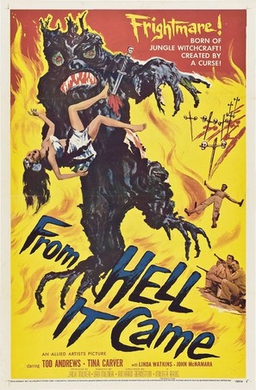
Horror Film Review: From Hell It Came (dir by Dan Milner)


“And to Hell it can go!” — The Critics

Sometimes, you’ll come across something that simply defies easy description.  It’s something that actually has to be seen to be believed.  I could describe to you the monster at the center of 1957’s From Hell It Came but I don’t know that, even with my extensive vocabulary, I really have the capability to capture just how absurd and weird this thing is.

In this case, a picture says more than a thousand words ever could:
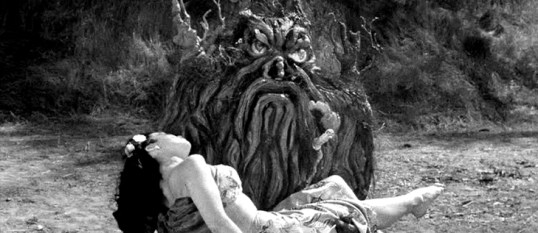
The monster in From Hell it Came is a walking tree that has a rather angry (not to mention immobile) face.  After Prince Kimo is framed for the murder of his father, the chief of a tribe that lives on a South Sea island, he is sentenced to execution.  He announces that he will seek revenge on everyone who framed him.  He’s then stabbed in the heart and encased in the trunk of a hollow tree.  (Apparently, the knife is left in his heart which seems kind of unnecessary but who am I to argue?)  Later, Kimo comes back as a walking tree who tosses his enemies into quicksand.  The knife is still sticking out of the tree, which would suggest that Kimo was physically transformed.  However, the native insist that Kimo has actually become one of their legendary monsters, the fearsome Tabanga.

Along with the natives, there is also a group of American doctors on the island.  They’ve been sent to conduct research and to also give the natives medicine to help them deal with an outbreak of the plague.  The natives don’t trust the medicine.  They trust the magic of their medicine men.  Since this film came out in 1957, the doctors react to this by rolling their eyes and talking down to everyone.  If there’s one thing that has remained consistent over the decades, it’s that the worst way to get people to do anything is to talk down to them.

The doctors are the first to discover the tree stump that will eventually become the Tobanga.  They take the stump back to their laboratory, where they discover that the stump is radioactive due to some nearby atomic tests.  The next day, the stump comes to life and leaves the laboratory.  One of the most interesting things about this film is that the scientists are skeptical about the natives claim that the tree stump is one of their legendary monsters come to life but they are willing to accept that radiation created a walking stump.  Radiation bringing a tree stump to walking life actually makes even less sense than magic doing it.

While the tree is killing its enemies, the American doctors deal with their own drama.  For instance, Dr. Terry Mason (Tina Carver), is a woman and that greatly disturbs her male colleagues, all of whom  can’t understand why she’s not currently married and raising a family.  Meanwhile, Mrs. Mae Kilgore (Linda Watkins, an American actress who played the role with an amazingly bad British accent) owns the local trading post and is not happy about having a killer tree wandering around the island.  Mrs. Kilgore is prone to saying things like, “I saw the bloomin’ thing!”

In the end, the Americans finally figure out how to deal with the murderous tree.  “Your American magic is better,” the current chief of the natives says.  “Hell yeah!” I shout in response, “AMERICA!”  From Hell It Came is a thoroughly ludicrous movie but, once you watch it, you’ll never forget that tree.
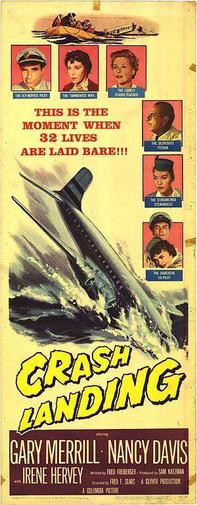
 

Crash Landing (1958, directed by Fred F. Sears)


Flying from Lisbon to New York City, a commercial airline is flying over the ocean when two of its engines fail.  When the propellers fail to restart, Captain Steve Williams (Gary Merrill) realizes that he will have to land the plane in the ocean.  The Navy is standing by to rescue the passengers.  It’s just a question of whether or not Steve and his crew can land the plane without injuring the passengers or causing the plan to break in half.

This is a disaster film that doesn’t really have a disaster.  The members of the crew all work professionally and efficiently to make sure that the landing is a success, even though none of them have ever had to ditch a plane before.  The Navy shows up on time and ready to help.  With one exception, the passengers react calmly and do what they’re told.  An Orthodox priest prays for the plane.  The flight attendants neatly pack all of the kitchen utensils.  The only drama comes from a boy who is traveling with his dog Wilbur and is upset to hear that Wilbur will have to stay in the back of the plane, where he will probably drown.  The boy’s father says, “I’ll buy you a new dog,” and the boy asks that his baseball cap be placed by Wilbur’s cage so that Wilbur knows his owner was thinking of him.  Don’t worry kid!  Steve Williams isn’t going to let your dog die.

It’s strange to see a disaster film without any real drama.  The crew thinks that Williams can be overbearing but it turns out he knows what he’s doing.  At home, his wife (Nancy Davis, in her final film role) thinks that Steve is too hard on their son.  Their son is going to grow up knowing how to land airplanes in water.  This is almost the Sully origin story.  Otherwise, the film emphasizes the way that everyone works together and doesn’t panic.  The scene where the plane lands in the water features some good special effects but otherwise, the movie is pretty dull.  It could have used Leslie Nielsen and Peter Graves.

Actress Nancy Davis retired from movies after this one but she remained in the public eye as the wife of future President Ronald Reagan.

Here Are The WGA Nominations!


The Writers Guild of America announced their film nominations earlier today!  As always, the WGA nominations should be taken with a grain of salt, as several potential Oscar nominees — Brooklyn, Room, The Hateful Eight — were not eligible to be nominated for a WGA award.

With that in mind, here are the nominees!

ORIGINAL SCREENPLAY
Bridge of Spies, Written by Matt Charman and Ethan Coen & Joel Coen; DreamWorks Pictures

Sicario, Written by Taylor Sheridan; Lionsgate

Spotlight, Written by Josh Singer & Tom McCarthy; Open Road Films

Straight Outta Compton, Screenplay by Jonathan Herman and Andrea Berloff; Story by S. Leigh Savidge & Alan Wenkus and Andrea Berloff; Universal Pictures

Trainwreck, Written by Amy Schumer; Universal Pictures

ADAPTED SCREENPLAY

The Big Short, Screenplay by Charles Randolph and Adam McKay; Based on the Book by Michael Lewis; Paramount Pictures

Carol, Screenplay by Phyllis Nagy; Based on the Novel The Price of Salt by Patricia Highsmith; The Weinstein Company

The Martian, Screenplay by Drew Goddard; Based on the Novel by Andy Weir; Twentieth Century Fox

Steve Jobs, Screenplay by Aaron Sorkin; Based on the Book by Walter Isaacson; Universal Pictures

Trumbo, Written by John McNamara; Based on the Biography by Bruce Cook; Bleecker Street Media
DOCUMENTARY SCREENPLAY

Being Canadian, Written by Robert Cohen; Candy Factory Films

Going Clear: Scientology and the Prison of Belief, Written by Alex Gibney; HBO Documentary Films

Kurt Cobain: Montage of Heck, Written by Brett Morgen; HBO Documentary Films

Prophet’s Prey, Written by Amy J. Berg; Showtime Documentary Films