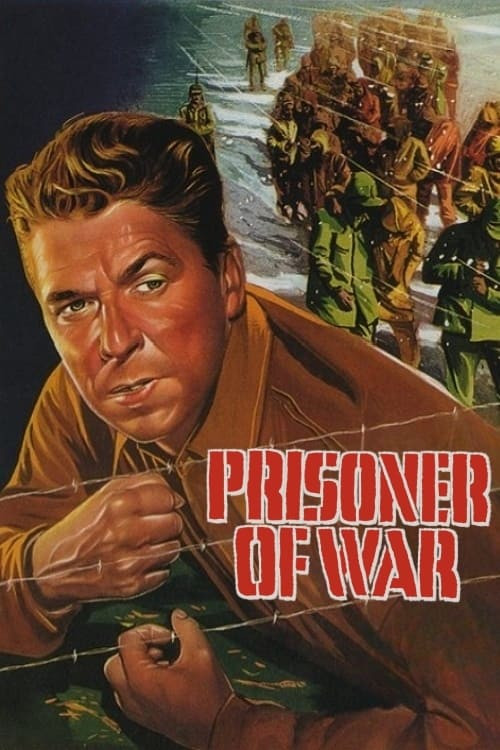
Prisoner of War (1954, directed by Andrew Marton)


The setting is the Korean War.  After getting information that American POWs are being tortured and brainwashed in North Korean prisoner-of-war camps, Major Hale (Harry Morgan) assigns Webb Sloane (Ronald Reagan) to go undercover.  After parachuting behind enemy lines, Webb spots a group of POWs being marched through the snow and joins the group.  From the minute that Webb joins the march, he begins to observe war crimes.  The death march itself, with the POWs being forced to move in freezing weather, is itself a war crime.  At the POW camp, Webb discovers the presence of an arrogant Soviet interrogator (Oscar Homolka) and a routine designed to break the POWs down until their ready to betray their native country.  Some POWS, like Captain Stanton (Steve Forrest), refuse to break.  Others, like cowardly Jesse Treadman (Dewey Martin), break all too quickly.  Webb sends the information back to Hale and eventually tries to make his escape.

It’s not terrible.  That the North Koreans and, later, the North Vietnamese tortured their POWs and forced some of them to denounce America is a matter of the historical record and, for a 1954 film, Prisoner of War doesn’t shy away from the brutality of the torture that POWs were often subjected too.  Of all of Reagan’s film, Prisoner of War had the strongest anti-communist message, though Reagan himself feels miscast as a hard-boiled secret agent.  (Reagan’s affability comes through even in a film set in a POW camp.)  Sending someone undercover into a prisoner of war camp and then hoping that they’ll find a way to escape doesn’t sound like the most efficient way to determine if the Geneva Convention is being violated.

The film features a dog who is found by one of the POWs.  Don’t get attached.

Retro Television Review: The Judge and Jake Wyler (dir by David Lowell Rich)


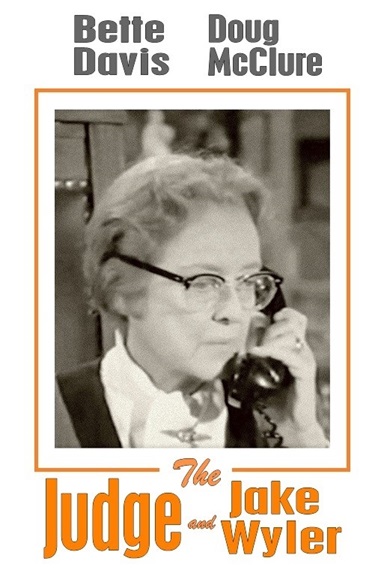
Welcome to Retro Television Reviews, a feature where we review some of our favorite and least favorite shows of the past!  On Sundays, I will be reviewing the made-for-television movies that used to be a primetime mainstay.  Today’s film is 1972’s The Judge and Jake Wyler!  It  can be viewed on YouTube.

Judge Meredith (Bette Davis) is a retired criminal court judge who has developed a severe case of hypochondria.  She lives in a mansion that she never leaves.  Anyone who comes to see her must be personally vacuumed by her butler before they can be allowed to stand in her presence.  She hates people who take too long to get to the point and she also has little use for people who are rude on the phone.  She especially dislikes cigarettes and refuses to have even an unlit one in her presence.

Jake Wyler (Doug McClure) is an ex-con who is currently on supervised probation.  Despite his criminal past, he’s a likable and amiable guy and, every morning, he wakes up with a new woman in his bed.  Jake enjoys tweaking authority and he always has a pack of cigarettes on him somewhere.

Together, they solve crimes!

They actually do!  The judge is dealing with retirement by running her own detective agency, one that is exclusively staffed by people that she previously sentenced to prison.  Jake does most of the leg work as far as the agency is concerned.  The Judge calls him every morning and demands to know why he’s not working harder.  Jake would rather just sleep-in but working for the judge is a part of his parole.  She could easily send him and everyone else working for her back to prison.  This sounds like a pretty unfair situation to me and the Judge is so demanding that I think it could be argued that she’s an abusive boss.  But, because this is a pilot for a TV show and the Judge is played by Bette Davis, everyone is very loyal to her.

At the start of the film, Jake reveals to Robert Dodd (Kent Smith) that his wife, Caroline (Lisabeth Hush), has been cheating on him with Frank Morrison (Gary Conway).  When Robert is later found dead in a hospital room, the official verdict is that he committed suicide.  However, his daughter, Alicia (Joan Van Ark), claims that her father was murdered.  At first, both Jake and the Judge suspect that Alicia just wants to collect a bigger life insurance settlement but it turns out that Dodd’s beneficiary wasn’t even Alicia.  The money is going to his second wife, the one who was cheating on him.  While the Judge yells at people on the phone, Jake investigates the death of Robert Dodd.

The Judge and Jake Wyler is a mix of comedy and mystery.  Jake has a way with a quip and the majority of the suspects, including John Randolph and Eric Braeden, all have their own eccentricities.  Director David Lowell Rich does a good job of keeping the action moving and the mystery itself is actually pretty interesting.  Surprisingly, the show’s only real flaw is Bette Davis, who seems to be rather bored in the role of Judge Meredith.  Even though the character seems to have been specifically written for her trademark caustic line delivery, Davis delivers her lines with little enthusiasm.  One gets the feeling that she wasn’t particularly happy about the idea of having to do a television pilot.

Davis need not have worried.  The Judge and Jake Wyler did not turn into a series.  That said, the movie is an entertaining and diverting murder mystery.

Retro Television Review: The Astronaut (dir by Robert Michael Lewis)


Welcome to Retro Television Reviews, a feature where we review some of our favorite and least favorite shows of the past!  On Sundays, I will be reviewing the made-for-television movies that used to be a primetime mainstay.  Today’s film is 1972’s The Astronaut!  It  can be viewed on YouTube!

NASA has successfully landed a man on Mars!  The entire world watches as Col. Brice Randolph (Monte Markham) makes his way across the Martian surface.  However, suddenly, the signal goes out.  Viewers are assured that this is the sort of thing that happens all the time with interstellar travel.  What they don’t know is that the signal went down because Brice suddenly died.  While the surviving members of the mission return to Earth, NASA tries to figure out how to keep anyone from finding out what happened to Brice.  NASA director Kurt Anderson (Jackie Cooper) knows that the President wants to cut the budget and the death of an astronaut would probably provide the perfect excuse for taking money away from NASA and canceling the Mars program.

Anderson’s solution is to recruit a substitute.  Eddie Reese (Monte Markham) has a slight resemblance to Brice, one that can be perfected through plastic surgery.  While the mission returns from Mars, Eddie goes through a crash course to teach him how to talk, walk, and think like Col. Brice Randolph.  Eddie is told that he’ll have to be Brice until the NASA scientists can figure out what led to Brice’s death.  Once they do know what went wrong with the mission, Eddie will have to go into NASA’s version of the witness protection.

Eddie proves to be a quick learner and it helps that he, like so many others, looked up to Brice.  However, while Eddie can fool almost everyone else, he cannot fool Brice’s wife, Gail (Susan Clark).  When Eddie actually treats Gail with kindness and shows sympathy for her nervous condition, she realizes that there’s no way that Eddie is actually her husband.  Apparently, Brice was not quite the saintly figure that the public believed him to be.  Eddie and Gail soon fall in love for real but when NASA finally discovers what led to Brice’s death, it looks like their new life together might be over as abruptly as it begun.

The Astronaut is a low-key conspiracy …. well, I hesitate to call it a thriller.  There’s little of the things that one typically associated with a conspiracy thriller.  There’s no black helicopters.  There’s no shadowy assassins.  There’s no army of men walking around in black suits.  Instead, there’s just a bunch of nervous bureaucrats who are desperate to keep the rest of the world from discovering just how much they screwed up.  As played by Jackie Cooper, the head of NASA isn’t so much evil as he’s just way too devoted-to-his-job for his own good.  In many ways, this is probably one of the most realistic conspiracies ever portrayed on film.

In the end, The Astronaut is a portrait of two lonely people who find love in the strangest of circumstances.  Susan Clark and Monte Markham make for a likable couple and the viewer really does hope that things will work out for them.  What this film lack in conspiracy thrills, it makes up for in human drama.  It appealed to both my romantic and my rabid anti-government sides.  What more could one ask?

Film Review: The Greatest Story Ever Told (dir by George Stevens)


The 1965 biblical epic, The Greatest Story Ever Told, tells the story of the life of Jesus, from the Nativity to the Ascension.  It’s probably the most complete telling of the story that you’ll ever find.  It’s hard to think of a single details that’s left out and, as a result, the film has a four hour running time.  Whether you’re a believer or not, that’s a really long time to watch a reverent film that doesn’t even feature the campy excesses of something like The Ten Commandments.

(There’s actually several different version of The Greatest Story Ever Told floating around.  There’s a version that’s a little over two hours.  There’s a version that’s close to four hours.  Reportedly, the uncut version of the film ran for four hour and 20 minutes.)

Max von Sydow plays Jesus.  On the one hand, that seems like that should work because Max von Sydow was a great actor who gave off an otherworldly air.  On the other hand, it totally doesn’t work because von Sydow gives an oddly detached performance.  The Greatest Story Ever Told was von Sydow’s first American film and, at no point, does he seem particularly happy about being involved with it.  von Sydow is a very cerebral and rather reserved Jesus, one who makes his points without a hint of passion or charisma.  When he’s being friendly, he offers up a half-smile.  When he has to rebuke his disciples for their doubt, he sounds more annoyed than anything else.  He’s Jesus if Jesus was a community college philosophy professor.

The rest of the huge cast is populated with familiar faces.  The Greatest Story Ever Told takes the all-star approach to heart and, as a result, even the minor roles are played by actors who will be familiar to anyone who has spent more than a few hours watching TCM.  Many of them are on screen for only a few seconds, which makes their presence all the more distracting.  Sidney Poitier shows up as Simon of Cyrene.  Pat Boone is an angel.  Roddy McDowall is Matthew and Sal Mineo is Uriah and John Wayne shows up as a centurion and delivers his one line in his trademark drawl.

A few of the actors do manage to stand out and make a good impression.  Telly Savalas is a credible Pilate, playing him as being neither smug nor overly sympathetic but instead as a bureaucrat who can’t understand why he’s being forced to deal with all of this.  Charlton Heston has just the right intensity for the role of John the Baptist while Jose Ferrer is properly sleazy as Herod.  In the role Judas, David McCallum looks at the world through suspicious eyes and does little to disguise his irritation with the rest of the world.  The Greatest Story Ever Told does not sentimentalize Judas or his role in Jesus’s arrest.  For the most part, he’s just a jerk.  Finally, it’s not exactly surprising when Donald Pleasence shows up as Satan but Pleasence still gives a properly evil performance, giving all of his lines a mocking and often sarcastic bite.

The Greatest Story Ever Told was directed by George Stevens, a legitimately great director who struggles to maintain any sort of narrative momentum in this film.  Watching The Greatest Story Ever Told, it occurred to me that the best biblical films are the ones like Ben-Hur and The Robe, which both largely keep Jesus off-screen and instead focus on how his life and teachings and the reports of his resurrection effected other people.  Stevens approaches the film’s subject with such reverence that the film becomes boring and that’s something that should never happen when you’re making a film set in Judea during the Roman era.

I do have to admit that, despite all of my criticism of the film, I do actually kind of like The Greatest Story Ever Told.  It’s just such a big production that it’s hard not to be a little awed by it all.  That huge cast may be distracting but it’s still a little bit fun to sit there and go, “There’s Shelley Winters!  There’s John Wayne!  There’s Robert Blake and Martin Landau!”  That said, as far as biblical films are concerned, you’re still better off sticking with Jesus Christ Superstar.

Big Bad Bob: Robert Mitchum in MAN WITH THE GUN (United Artists 1955)


gary loggins's avatarcracked rear viewer

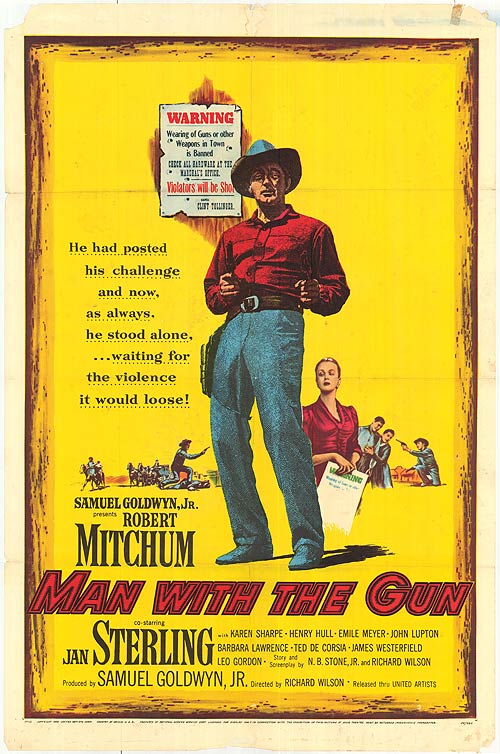
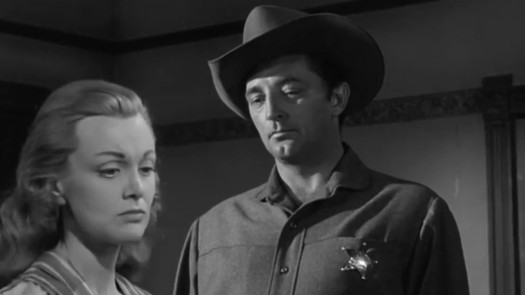
Rugged Robert Mitchum is pretty much the whole show in MAN WITH THE GUN, a film by first  time director (and Orson Welles protege) Richard Wilson. It seems a strange choice at this juncture of Mitchum’s career. He was just coming off four big films in a row (RIVER OF NO RETURN, TRACK OF THE CAT, NOT AS A STRANGER, NIGHT OF THE HUNTER ), then makes a low budget Western that harkens back to his days making ‘B’ Zane Grey Westerns at RKO. But that was Mitchum; always the maverick who did things his way.

The film itself isn’t bad: Mitchum plays a notorious gunslinger, a “town tamer” hired by Sheridan City to clean things up from the clutches of boss ‘Dade Holman’ (who isn’t seen til the end, but whose influence is everywhere). There’s a subplot with his ex-wife Jan Sterling, now running the dance hall girls at…

View original post 354 more words

6 More Chilling Classics: Jesse James Meets Frankenstein’s Daughter, Scream Bloody Murder, Silent Night Bloody Night, Sisters of Death, War of the Robots, and Werewolf in a Girl’s Dormitory


For the past few months, I’ve been attempting to watch and review every film to be found in Mill Creek’s 50 Chilling Classics box set.  Here’s are 6 quick reviews of the latest few “chilling classics” that I’ve found the time to watch.
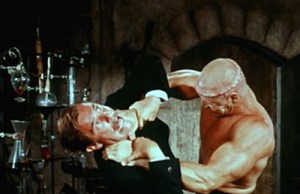
1) Jesse James Meets Frankenstein’s Daughter (Dir by William Beaudine)

This 1966 western/horror hybrid is just about as stupid as you think it is but it’s also a lot of fun if you’re in the right mood.  Notorious outlaw Jesse James (John Lupton) attempts to hold up a stagecoach but, in the process, his hulking partner Hank (Cal Bolder) is serious wounded.  Some helpful peasants direct Jesse and Hank to the mysterious German doctor who happens to live in a nearby dark and scary house.  That doctor is Maria Frankenstein (Narda Onyx) and she’s been conducting experiments to bring dead Mexicans back to life.  Imagine her joy when the nearly dead Hank shows up at her laboratory.  Anyway, Maria performs a brain transplant on Hank and once Hank comes back to life, she informs him that his new name is “Igor.”  Yes, she does.  That plot description pretty much tells you everything you need to know about the movie but I vaguely enjoyed vaguely paying attention to it.  Maria’s German accent is hilariously overdone, the Frankenstein laboratory is full of pointless electrical things, and a character dies halfway through the film just to later show up again with no explanation.  It’s that type of movie.
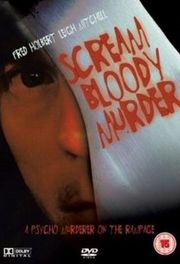
2) Scream Bloody Murder (dir. by Marc Ray)

So Matthew (played by Fred Holbert) is a disturbed young man who murders his father with a tractor and loses a hand in the process.  He’s sent off to a mental asylum for a few years and while there, he’s given a sharp and potentially deadly hook as a replacement for his hand.  Seriously, why would you give a weapon like that to a mental disturbed person who has just murdered his own father?  That’s just one of the many mysteries that goes unexplored in 1973’s Scream Bloody Murder, an occasionally watchable slice of entertainment that is ultimately too slow and predictable to really be effective.  Once Matthew is released from the asylum, he goes on the expected murder spree and goes all Collector-like on a prostitute named Vera (played by Leigh Mitchell, who also plays Matthew’s doomed mother in a clever bit of Oedipal casting).  Mitchell and Holbert both give surprisingly good performances and director Marc Ray comes up with a few visually inventive scenes of mayhem but, for the most part, this film never quite lives up to the excessive promise of its premise.
3) Silent Night Bloody Night (dir. by Theodore Gershuny)

Filmed in 1972 and subsequently released in 1974, Silent Night Bloody Night is a real treat, an atmospheric thriller that has a wonderfully complicated plot that will keep you guessing.  On Christmas Eve, Jeff Butler (James Patterson) comes to an isolated town to arrange the sell of his grandfather’s home.  As we discover through some wonderfully dream-like flashbacks, Jeff’s grandfather died nearly 40 years ago when he was set on fire in his own home.  With the help of local girl Diane (Mary Woronov), Jeff investigates his grandfather’s death and discovers that the town is full of secrets and people who are willing to kill to maintain them.  Director Theodore Gershuny uses the low budget to his advantage and the sepia-toned flashbacks are truly disturbing and haunting.  Ultimately, Silent Night Bloody Night feels like a dream itself and the mystery’s solution is less important than the journey taken to reach it.
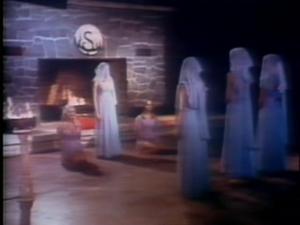
4) Sisters of Death (dir. by Joseph Mazzuca)

Technically, this isn’t the best film to be found in the Chilling Classics box set but it’s still one of my personal favorites.  The 1977 film opens with a very baroque sorority initiation that ends with one of the sisters being killed in a game of Russian Roulette.  A few years later, the surviving sisters are invited to an isolated and lavish estate where it turns out that the dead girl’s father (well-played by Arthur Franz) is looking for revenge.  This film is predictable and a lot of the plot depends on people refusing to use any common sense but Sisters of Death is such a fun little melodrama that I can’t complain too much.  The film plays out like a surprisingly violent Lifetime movie and it all ends on a wonderfully cynical note.
5) War of the Robots (dir. by Alfonso Brescia)

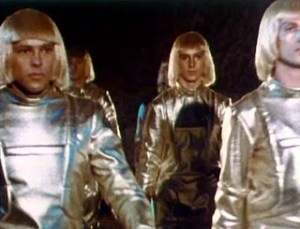
Whatever you do, don’t watch War of the Robots alone.  Seriously, you need somebody there — preferably several people — so you can take turns making snarky comments and rude jokes.  Otherwise, you’ll just be stuck watching this amazingly bad science fiction film from 1978 and wondering how much more of it you can take.  Set in the generic future, War of the Robots tells the story of what happens when two human scientists are kidnapped by a bunch of robots.  Capt. John Boyd (Antonio Sabato) is sent to get the scientists back and the end result?  A war of the robots.  Or something like that.  This is one of those films where it’s difficult to really pay that much attention to what’s happening on-screen.  However, it’s worth seeing just for the chance to spot the wires that are enabling the model spaceship to hang over the “alien” landscapes.  Naturally, since this film was made in the 70s, everyone wears space suits with really wide lapels.

6) Werewolf in a Girls Dormitory (dir. by Paolo Heusch)

First released in 1961, Werewolf in a Girls Dormitory is an Italian/Austrian co-production.  It was originally titled Lycanthropus and while Werewolf In A Girls Dormitory is a lot more memorable, it also makes this film sound like a lot more fun than it actually is.  This slow and oddly somber film tells the story about a series of murders that occur at a school for delinquent girls.  The school’s newest teacher is the obvious suspect but then again, the killer might just be a werewolf.  I liked the look of this film — the film is lit to emphasize shadows and it gives the whole thing a very noir-like feel — but, much like Scream Bloody Murder, this movie was just too slow to really be effective.

So, out of this batch of 6, I would definitely recommend that you track down and see Silent Night Bloody Night and Sisters of Death.  I would also definitely suggest that you do your best to avoid War of the Robots.  As for the other 3, they’re all better than The Wicker Tree.