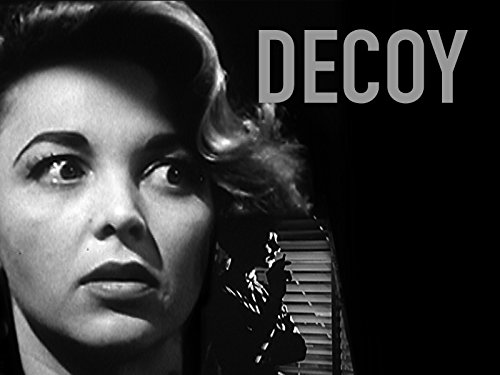
Welcome to Retro Television Reviews, a feature where we review some of our favorite and least favorite shows of the past! On Thursdays, I will be reviewing Decoy, which aired in Syndication in 1957 and 1958. The show can be viewed on Tubi!
This week, Casey gets involved in the shady world of college athletics.
Episode 1.6 “The Savage Payoff”
(Dir by Teddy Sills, originally aired on November 18th, 1957)
When a college basketball player is killed in a car accident, the police discover evidence that he may have been throwing games for the mob. Lt. Franklin (Bill Zuckert) suspects that the dead player’s best friend and roommate, Dave Carter (Don Hastings), might be taking money as well. Disguising herself as the dead player’s sister, Casey introduces herself to Dave and befriends him in an attempt to discover the truth. It turns out that the gangsters have been paying Dave off but, at the last minute, Dave decides not to throw the game and instead leads the team to victory.
This episode bothered me a little. When the episode begins, there is no real evidence that Dave has been taking money from the mob. Instead, Lt. Franklin just assumes that Dave is guilty and, with only his hunch to go on, he assigns Casey to befriend Dave and try to prove his guilt. Obviously, there are times when the police have to go undercover but it was still hard not to feel that the police should have at least had some sort of solid evidence before upending Dave’s life. The fact that Dave was both mourning his friend and was obviously attracted to Casey just made the whole thing feel all the more icky. Indeed, a lot of Casey’s action in this episode seem like they would be considered to be entrapment.
Probably the most interesting thing about this episode was that Dave was played by a young Don Hastings. If you’re like me and you grew up with an aunt who loved As The World Turns, you’ll immediately recognize him as Dr. Bob Hughes. Hastings played Dr. Hughes for a record-setting 50 years and even spoke the show’s final lines when he said, “Good night” on September 17th, 2010. Hastings gave a convincing performance as Dave. I was happy to see him take a stand and refuse to fix the game. I was also happy that Casey didn’t have to take him to jail. That would have been depressing.
Speaking of jail, there’s where Casey’s going next week! We’ll see what happens!
On tonight’s episode of One Step Beyond, fashion designer Karen Wadsworth (Joanne Linville) believes that she has the power to cause people to die just by wishing death upon them. Her psychiatrist tells her that this simply isn’t possible and then dares her to try one little test of her supposed powers.
This episode features a good performance by Joanne Linville and, if nothing else, it perhaps makes the case that we should be a little bit less quick to wish the worst upon other people. Just imagine all of the damage that Karen could have caused if she had ever set up a twitter account.
This episode originally aired on October 25th, 1960.
Yeah, yeah, I know. That sounds kinda silly, doesn’t it? However, November is traditionally the month that classic film bloggers tend to concentrate on writing about film noir. It provides a bit of grit and cynicism in between the horror fun of October and the holiday schmaltz of December.
I have to admit that I’m a little bit torn when it comes to taking part in Noirvember. On the one hand, I love a good film noir and there’s quite a few obscure and underrated ones available on YouTube right now. On the other hand, as a natural-born contrarian, I don’t like the idea of hopping on any bandwagons.
In the end, my love of film noir won out. So, welcome to my first entry in 30 More Days of Noir.
The 1950 film, Bunco Squad, tells the story of Tony Weldon (Ricardo Cortez), a con man who specializes in using a phony psychic routine to swindle rich people out of their money. He runs a fake enlightenment center and he claims that he can speak to the dead. His latest target is the wealthy Jessica Royce (Elisabeth Risdon). After he finds out that her son was killed during the invasion of Normandy, he and his associates go out of their way to trick her into believing that Tony can contact her son and that her son wants her to leave all of her money to Tony’s organization. It’s actually kind of interesting watching as Tony and his gang manage to track down information about Jessica and her son, asking the most mundane of questions to find out things that Jessica believes only her son would know. Watching Tony operate, I was reminded of those documentaries and news reports that you see about phony faith healers and other people who claim they can speak to the dead but who actually just go on very vague fishing expeditions. (“I’m sensing something about the letter L. Does that mean anything to you?”)
Tony is not just a con artist. He’s also a murderer, one who specializes in cutting brake lines on cars. If you try to expose Tony, you’re probably going to end up driving off of a cliff. I guess you can get away with that when you’re a con artist in California. Myself, I live in North Texas where the land is totally flat. Someone could cut my brake lines and I would probably just keep going forward until I eventually ran out of gas. Once that happened, someone would probably pull over and offer to give me a lift to the nearest gas station. That’s one reason why someone like Tony Weldon could never pull off any of his crimes in my home state.
Fortunately, the detective of the LAPD’s Bunco Squad know what Tony’s doing. The only problem is that they have to get some proof that Tony is swindling Ms. Royce and they have to manage to do it before Tony gets a chance to tamper with all of their brakes. Leading the Bunco Squad is Steve Johnson (Robert Sterling) and you better believe that there’s no way someone named Steve Johnson is going to be anything other than honest and upright. Working with a real-life magician named Dante, Johnson attempts to expose all of Tony’s tricks.
It’s probably open for debate whether or not Bunco Squad is a true noir. On the one hand, Tony and his schemes are very noirish. On the other hand, Steve and the members of the Bunco Squad are so upright that there’s none of the ambiguous morality that you find in the best film noirs. I guess I would call this a half-noir.
The best thing about Bunco Squad is that it’s only 67 minutes long, which is all the time that it needs to tell a compact and occasionally interesting story. There’s no excessive padding to try to force the story out to an unwieldy 90 minutes. Instead, Bunco Squad jumps right into its story and it doesn’t let up until things come to an end. The other good thing about Bunco Squad is that you’ve got Ricardo Cortez, giving a charmingly evil performance as Tony Weldon. The film’s heroes are a pretty dull bunch but Cortez brings a nice charge of danger to the proceedings.
Bunco Squad is an obscure film but it moves quickly and the story is interesting enough to hold your attention for an hour. It can be found on YouTube.
On tonight’s episode of One Step Beyond, fashion designer Karen Wadsworth (Joanne Linville) believes that she has the power to cause people to die just by wishing death upon them. Her psychiatrist tells her that this simply isn’t possible and then dares her to try one little test of her supposed powers.
This episode features a good performance by Joanne Linville and, if nothing else, it perhaps makes the case that we should be a little bit less quick to wish the worst upon other people. Just imagine all of the damage that Karen could have caused if she had ever set up a twitter account.
This episode originally aired on October 25th, 1960.
Listen, there’s a lot of things that can be said about the 1952 Best Picture winner, The Greatest Show on Earth. Not only was it one of three Cecil B, DeMille films to be nominated for best picture (along with 1934’s Cleopatra and 1956’s The Ten Commandments) but it was also the only one to win. It brought Cecil B. DeMille his first and only nomination for best director. (DeMille lost that directing Oscar to John Ford but he still took home an award, as the producer of The Greatest Show On Earth.) The Greatest Show on Earth not only featured Charlton Heston in his first starring role but, with a finale that featured everyone involved in the same spectacular train crash, it also set the standard for the countless disaster movies that would follow.
But, with all of that in mind, the main thing that you’ll remember about this movie is that Jimmy Stewart was Buttons the Clown.
Buttons is a beloved member of the Ringling Bros. and Barnum & Bailey’s Circus. He travels with the circus across the country, entertaining children and generally helping out wherever he can. Everyone loves Buttons, despite the fact that no one has ever seen him without his makeup. (That said, you only have to hear him speak to immediately recognize him as being played by Jimmy Stewart.) Not even the circus’s no-nonsense manager, Brad Braden (Charlton Heston, naturally), knows what Buttons actually looks like. Everyone assumes that Buttons is just a dedicated performer, a method clown.
However, it turns out that Buttons has a secret. Of course, nearly everyone at the circus has a secret but Buttons’s secret is a little bit more serious than just a love triangle or a case of professional jealousy. There’s a reason why Buttons is surprisingly good at providing first aid to the members of the circus. Before he was a clown, Buttons was a doctor. And, while he was a doctor, he killed his wife.
NO! NOT JIMMY STEWART!
In Buttons’s defense, it was a mercy killing and he feels really bad about it. That, of course, doesn’t matter to the FBI agent (Henry WIlcoxon) who suspects that the doctor may be hiding among the circus performers. At first, Buttons views that train crash as the perfect opportunity to escape but then he finds out that many of his fellow performers have been seriously injured. A doctor is needed. Perhaps even a doctor in clown makeup….
Even under all that makeup, Jimmy Stewart does a great job of bringing Buttons to life. Sometimes, we associate Stewart so much with his famous way of speaking that we overlook just what a good actor Jimmy Stewart actually was. Even before you discover why Buttons is running from the cops, Stewart does a good job of capturing the sadness and the regret that lies at the heart of Button. He’s truly a tragic clown.
Buttons’s status as a fugitive is just one of the many subplots to be found in The Greatest Show On Earth. There’s a lot of drama (not to mention parades and performances) to get through before that train crashes. Brad, for instance, is struggling to keep the circus from going bankrupt. Meanwhile, his girlfriend, Holly (Betty Hutton), is torn between him and the arrogant but charming Great Sebastian (Cornel Wilde). In fact, every woman in the circus — including Gloria Grahame and Dorothy Lamour — is in love with the Great Sebastian. Sebastian is a bit self-centered but he’s famous enough to ensure that the circus won’t have to be closed. Or, at least, he is until he’s injured in a trapeze accident. Will Sebastian ever perform again? Meanwhile, there’s a jealous elephant trainer named Klaus (Lyle Bettinger) and a crooked concessionaire named Harry (John Kellog). A local gangster, Mr. Henderson (Lawrence Tierney), is trying to muscle his way into the circus’s business. Is it any surprise that Brad always seems to be in something of a bad mood? He’s got a lot to deal with!
And yes, it’s all a bit overblown and a bit silly. And yes, the film really does feel like it was meant to be a commercial for Ringling Bros. And yet, in its way, the film definitely works. There’s a sincerity at the heart of the film, one that’s epitomized by Cecil B. DeMille’s opening narration. “”A fierce, primitive fighting force that smashes relentlessly forward against impossible odds: That is the circus — and this is the story of the biggest of the Big Tops — and of the men and women who fight to make it — The Greatest Show On Earth!” DeMille was 71 years old when he made The Greatest Show On Earth and he was coming to the end of a legendary filmmaking career. DeMille was one of the founders of the American film industry and you can argue that, if not for some of his silent spectacles, Hollywood would have always remained just a neglected suburb of Los Angeles. If anyone understood that importance of that old saying, “The show must go on!,” it was Cecil B. DeMille. And really, that’s what The Greatest Show On Earth is all about. It’s a tribute to the performers who refuse to give up. Love triangles? Fugitive clowns? Injured acrobats? Lawrence Tierney? No matter what, the show must go on!
The Greatest Show On Earth is often described as being one of the worst films to win the Academy Award for Best Picture. That has more to do with the quality of the films that it beat — High Noon, The Quiet Man, Moulin Rouge, and Ivanhoe — than the film itself. The Greatest Show On Earth is old-fashioned and a bit silly but it’s still entertaining. Should it have beaten High Noon? That would be a definite no. But it’s still better than Crash.
For today’s horror on the lens, we have the 1970 made-for-TV movie, Night Slaves!
In this atmospheric film, an estranged married couple (James Franciscus and Lee Grant) find themselves in a small town. It seems like a friendly enough place. I mean, Leslie Nielsen is the sheriff! How could anything go wrong in a town protected by Leslie Nielsen?
However, at night, the town changes. Only Franciscus seems to notice all of the townspeople wandering about like zombies. Is he going crazy or has he stumbled across something sinister?
This last Christmas, along with several other wonderful and sexy gifts, I received The Fabulous Forties DVD box set. Released by the good people at Mill Creek (who have yet to come across a single public domain film that they couldn’t repackage as being a classic), this box set contained 50 films from that wonderful decade.
Since my proclivity for serial reviewing is well-known, you’re probably not surprised that I’ve decided to watch and review all fifty of the films to be found in the Fabulous Forties box set. And, once I’ve finished with the Fabulous Forties, I will move on to the Nifty Fifties, the Sensational Sixties, the Swinging Seventies, and the Excellent Eighties! Since each box set contains 50 films, I will have watched and reviewed 250 films by the time this is all finished. It might take a while but that’s okay. Arleigh keeps us well-supplied with energy drinks here at the Shattered Lens bunker and I am determined to keep going until the job is done.
(And, if need be, there’s always Dexedrine…)
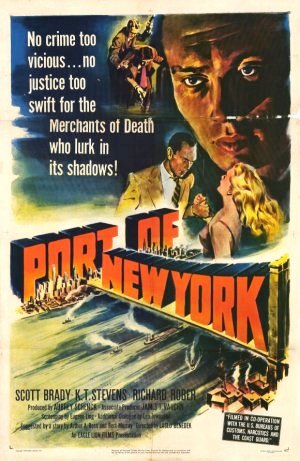
Let’s get things started with the first film in the box set, 1949’s Port of New York!
This low-budget, black-and-white film opens with a series of shots of cargo ships sailing into New York Harbor. A narrator, speaking in the type of tone that one would usually associate with an old educational film, informs us that, every day, thousands of ships sail into New York Harbor. Most of those ships are delivering important supplies and conducting important business. However, occasionally, the harbor is used by drug smugglers. (GASP!) Fortunately, both the federal and the state government employ brave and honest men who will stop at nothing to battle the scourge of opium.
(And, fortunately, since this film was made in 1949, they can do whatever they want without having to worry about the Supreme Court getting in the way.)
If it’s not already apparent, Port of New York is a bit of a time capsule. The drug smugglers are unambiguous in their villainy and the decency and honesty of law enforcement is taken for granted. Port of New York was filmed on location in New York and I enjoyed getting a chance to see what New York looked like in 1949.
As for the film’s plot — well, it’s nothing surprising. The port authority discovers that a shipment of morphine, which was meant to be delivered to a pharmaceutical company, has instead been stolen. A million dollars worth of narcotics is missing and the U.S. Government is going to find it! Meanwhile, Toni Cardell (K.T. Stevens) approaches a narcotics agent and says that she has information that could take down one of New York’s biggest gangster. However, before she can tell all the she knows, Toni is murdered.
(The detective who failed to keep Toni from leaving his office and going off to get killed looks down at her body, shrugs, and says, “This one’s on me.”)
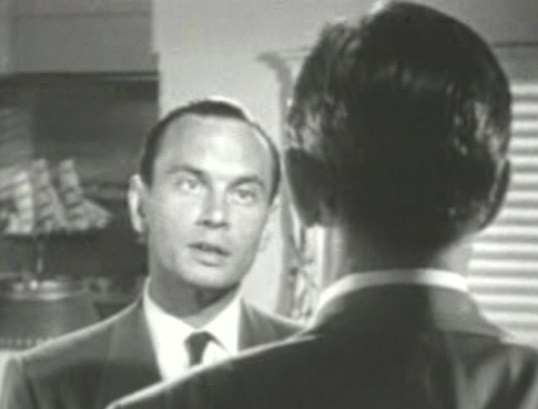
Who killed her? That’s what Mickey Waters (Scott Brady) and Jim Flannery (Richard Rober) spend the movie figuring out. However, we already know that Toni was murdered by her boyfriend, a suave gangster named Paul Vicola. Paul is played, in his film debut, by Yul Brynner and he gives a charismatic performance, turning Paul into a memorable monster. Brynner still had a full head of hair when he did this movie, though his hairline was definitely moving backwards.
Over the course of their investigation, Waters and Flannery discover that a second-rate comedian named Dolly Carney (Arthur Blake) is being supplied by Vicrola. The scenes where they interrogate Dolly, who is going through withdraw, are some of the best in the film and are distinguished by Blake’s empathetic performance. However, beyond those scenes, there’s really nothing surprising to be found in Port of New York. It’s a thoroughly predictable police procedural that’s distinguished by the presence of Yul Brynner and not much else. That said, the action in this 82-minute film moves quickly and I enjoyed it as a historical artifact.



 Through the Shattered Lens