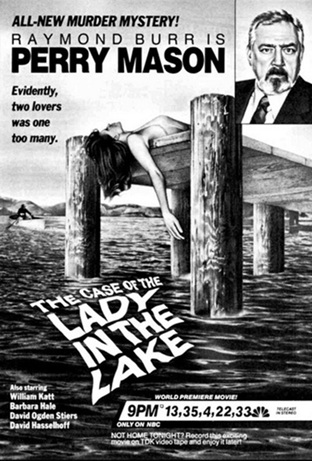
Fifteen years ago, the sister of Sara Wingate (Doran Clark) was murdered at a lake near the family home. Traumatized, Sara had a nervous breakdown. It was only when she married Billy Travis (David Hasselhoff), a former tennis player, that Sara started to get over her fear of the lake. When Sara disappears while walking along the lake, Billy is arrested and charged with murdering her. Because Perry’s is an old friend of Sara’s uncle (John Ireland), he takes the case. If you’re going to get arrested for murder, you better hope one of your relatives knows Perry Mason.
This movie wasn’t bad. It had a twist at the end, which I saw coming but which was still unique for the Perry Mason movies. The actual guilty party is pretty obvious but the mystery wasn’t as important as usual in this one. The supporting cast was pretty good, though David Hasselhoff seemed to be too calm for someone accused of murder. As Perry, Raymond Burr uses his cane again and leans against something whenever he has to stand up. Della jokes that Perry won’t be skiing anymore. Most of the action falls to Paul Drake, Jr. (William Katt), who gets beaten up even more than usual but who also gets to be the big hero in the end.
This was the last Perry Mason film for both William Katt and David Ogder Stiers, who played the district attorney. I’m going to miss both of them. William Katt’s hair was huge in this one and I was really looking forward to seeing how much bigger it could get.
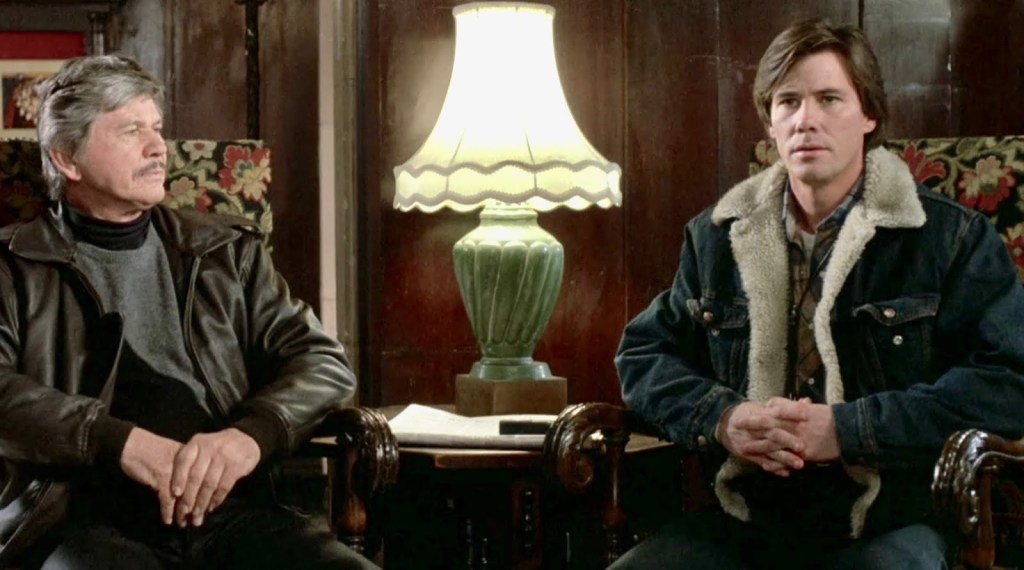
Charles Bronson and Gene Davis, together again 5 years after TEN TO MIDNIGHT (1983)
A couple of years ago, I decided I would rank my favorite Charles Bronson films. The rules were fairly simple… 1) only starring roles, so movies like THE MAGNIFICENT SEVEN and THE GREAT ESCAPE were excluded, 2) no TV movies were included, and 3) my rankings were based on how much I like watching the movies, and not on some BS critical consensus. It was an interesting undertaking, and while I’ve played around with the rankings a little bit, for the most part I’ve kept them the same from that initial ranking. Because I’m obsessed with Charles Bronson, it’s fun for me to write about him and share things about his movies. As such, about once a week or so, I’ll probably share a movie from my list, give my ranking, and talk a little bit about the films. These will not necessarily be reviews, but mostly just some basic thoughts on the films.
My first Bronson movie of the week is MESSENGER OF DEATH (1988), which I rank as 33rd out of 41 Bronson starring roles. What’s interesting is that even though that’s a pretty low ranking, I still enjoy the film for trying to do something different with Bronson at that point in his career in the late ’80s, mainly by casting him as a reporter and not as a cop. He destroys the opposition with superior investigative reporting skills, without having to resort to oversized handguns. Now that his filmography is complete, and has been for over 25 years, I’ve grown to appreciate the times Bronson tried something a little different (with the exception of LOLA). MESSENGER OF DEATH also benefits from a solid cast of veteran actors and actresses, including Trish Van Devere, Laurence Luckinbill, Daniel Benzali, Charles Dierkop, Jeff Corey, John Ireland, and Gene Davis. It’s fun watching these seasoned performers, many of whom have worked with Bronson in the past, do their thing. And last, but not least, with filming locations at the Colorado National Monument and the mountain town of Glenwood Springs, CO, it’s definitely a beautiful film to look at! The older I get the more I appreciate movies that get out of the cities and show us beautiful sights around the country and world. Jeff shared some of his own thoughts on MESSENGER OF DEATH back in 2017!
As of the date of this post, MESSENGER OF DEATH is streaming on Amazon Prime and Tubi if you want to watch it yourself. It’s a film that I’ve enjoyed more with repeat viewings. I’ve also included the trailer below for your viewing pleasure. Feel free to let me know your thoughts on MESSENGER OF DEATH, starring the legendary Charles Bronson!
In honor of Bruce Campbell’s 67th birthday, I decided to watch a movie he’s featured in that I’ve never seen before. I thought the horror-comedy SUNDOWN: THE VAMPIRE IN RETREAT looked like it might be fun so I went for it!
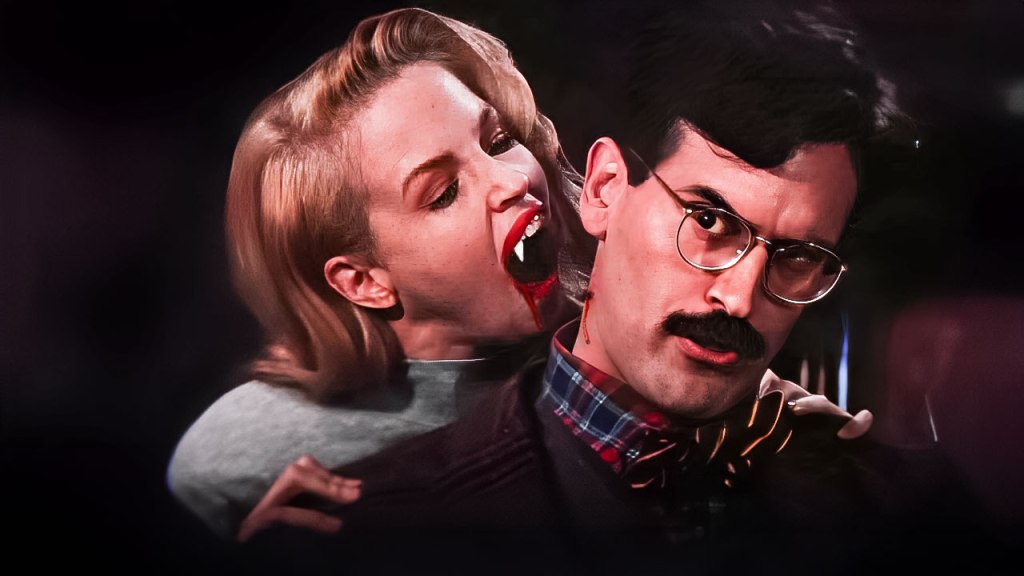
In the desert town of Purgatory, a colony of vampires led by Count Mardulak (David Carradine) want to live in peace, abstaining from human blood, and instead, drinking a blood substitute called “Necktarine,” which is produced in a local factory. They also use high powered sunscreen that allows them to go out in the day time as long as they wear thick sunglasses, big hats or umbrellas, and gloves. Unfortunately, the blood factory begins experiencing production issues, so Mardulak asks David Harrison (Jim Metzler), the unsuspecting human who designed the production process, to come to town and fix their problems. Harrison brings his family with him, including his wife Sarah (Morgan Brittany), and their two daughters. The Harrison family soon find themselves in the middle of an other worldly war as Jefferson (John Ireland) and Shane (Maxwell Caulfied), rebellious local vampires, plot to overthrow Mardulak so they can return to their murderous ways. Meanwhile, Robert Van Helsing (Bruce Campbell), the great grandson of the famed vampire hunter, walks into town, ready to romance the local vampire beauty Sandy (Deborah Foreman) and drive stakes into the hearts of as many bloodsucking freaks as possible!
As far as I’m concerned, SUNDOWN is a blast as a completely absurd horror-comedy that puts an interesting spin on traditional vampire legend, with its endless sunscreen slathering and a growing local weariness over “Necktarine” adding to the good times. It’s campy and silly, with purposely terrible stop motion bat effects, over-the-top family drama, and lots of cheesy one-liners, but of course that’s all part of the charm.
The B-movie dream cast is what I enjoyed the most about SUNDOWN. David Carradine plays it pretty straight as the town leader Count Mardulak, which is effective when you consider all of the craziness going on around him. Bruce Campbell, and his mustache, steals all of his scenes with his goofy charm and misguided heroics. And, of course, the inimitable M. Emmet Walsh is perfect as old man Mort, a vampire who loses his temper and beheads a disrespectful city slicker. He just can’t help himself. Throw in other veteran character actors like Bert Remsen and John Ireland and it’s easy to enjoy the movie no matter how silly it all gets.
On a personal note, I did want to point out a couple of performances in SUNDOWN that have Arkansas connections. First, Jim Metzler had a solid part a couple of years after this movie in the crime thriller ONE FALSE MOVE (1991), which was co-written by Billy Bob Thornton and partially filmed in Eastern Arkansas. It’s a great movie and Metzler is good in it. Second, Elizabeth Gracen has a small part in the film. Gracen, whose actual name is Elizabeth Ward, won the title of Miss Arkansas in 1981 and then went on to win Miss America in 1982. My uncle Billy was her hair stylist as she made her run to beauty pageant immortality. Other notable Gracen life events include her affair with Arkansas Governor Bill Clinton in 1983, her appearance in Steven Seagal’s MARKED FOR DEATH in 1990, and her Playboy spread in 1992. Interestingly, 18 years old at the time, I saw the layout when my girlfriend’s mom bought the issue and let me look at it!
Overall, SUNDOWN lets us know right off the bat the kind of absurd movie we’re dealing with, so you’ll either be into it or want to just move on. I was into it, mainly due to its strong cast. It’s not perfect, and it overstays its welcome by a good 15 minutes, but SUNDOWN is a fun watch for fans of silly horror-comedies and the excellent cast. I had a great time with it!
Every Monday night at 9:00 Central Time, my wife Sierra and I host a “Live Movie Tweet” event on X using the hashtag #MondayMuggers. We rotate movie picks each week, and our tastes are quite different. Tonight, Monday June 2nd, we are showing FAREWELL, MY LOVELY (1975) starring Robert Mitchum, Charlotte Rampling, John Ireland, Sylvia Miles, Anthony Zerbe, Harry Dean Stanton, Jack O’Halloran, Joe Spinell, and Sylvester Stallone.
FAREWELL, MY LOVELY finds Los Angeles private eye Philip Marlowe being hired by paroled convict Moose Malloy to find his girlfriend Velma, a former seedy nightclub dancer. All kinds of intrigue ensues as Robert Mitchum puts his droopy-eyed, world-weary spin on the famous detective!
So join us tonight for #MondayMuggers and watch FAREWELL, MY LOVELY! It’s on Amazon Prime. The trailer is included below:
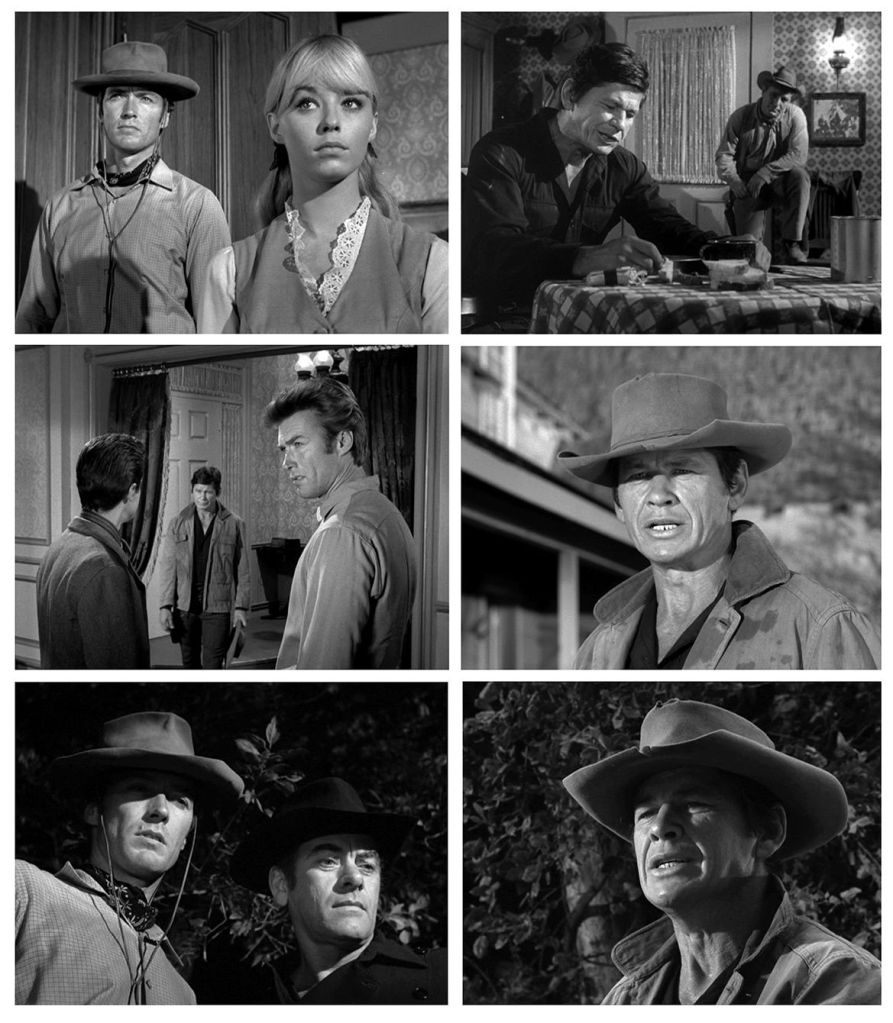
This episode of the classic western TV series RAWHIDE opens as Rowdy Yates (Clint Eastwood) and his group of drovers agree to drive 750 head of cattle belonging to rancher Mason Woodruff (Larry Gates) to market. The deal gets off to a bad start when Roman Bedford (Brendon Boone), who’s part of Yates’ outfit, finds himself trying to romance Vicki Woodruff (Jill Haworth), the daughter of the ranch owner. Woodruff’s foreman and world class A-hole, Del Lingman (Charles Bronson) sees Roman making his move and gets pissed. You see, Del wants Vicki for himself, so he tries to bully Roman into a gunfight. Luckily for young Roman, Rowdy and Mason Woodruff are able to momentarily diffuse the situation before the cowboy can be blown away by the experienced gunman. Unable to accept the humiliation that he suffered at the hands of Del, Roman challenges him to a duel to settle the score. Roman is a good shot, but he’s not a fast draw, so a couple of the men with Yates’ crew, Jed Colby (John Ireland) and Simon Blake (Raymond St. Jacques), try to teach him some tricks that just may give him a chance against Del’s superior gunplay. To complicate matters even further, Mason Woodruff has a hidden criminal past that Roman may know about. Because of this, the rancher has another reason to want Roman dead, and Del Lingman is just the man to take care of the problem. Who will survive the duel at daybreak?!!
As hard as it is to believe, my viewing of “Duel at Daybreak” is the only episode of RAWHIDE that I’ve ever watched, and it’s special to me for two reasons. First, the episode premiered on my mom’s 14th birthday, November 16, 1965. And second, it’s the only time that tough guy icons Clint Eastwood and Charles Bronson would appear on screen together. For historical reference, this was the last season of RAWHIDE, with only three episodes of the classic series to come after this. Eastwood was at the beginning of his legendary movie career after filming FISTFUL OF DOLLARS (1964) and FOR A FEW DOLLARS MORE (1965) for director Sergio Leone. Bronson, who was already a well-respected character actor, was two years away from making THE DIRTY DOZEN (1967) and three years away from breaking out as an international superstar by playing Harmonica in Leone’s masterpiece, ONCE UPON A TIME IN THE WEST (1968).
For the episode itself, Charles Bronson is the true standout as Del Lingman. He’s the kind of mean SOB who would goad a man into a gunfight, kill him, and then sit down for dinner without a care in the world. Bronson has a face that makes for a good villain, and he often played the bad guy in his early TV shows and movies. He projects real menace and danger in this role. Clint Eastwood’s Rowdy Yates may be the star of the show and the trail boss, but he’s a bit more of a secondary character in this specific episode as the main tension is between Bronson and the young cowboy played by Brendon Boone. Looking back now, it’s an incredible missed opportunity that the “duel at daybreak” wouldn’t feature Eastwood versus Bronson. Eastwood mostly tries, and fails, to play peacemaker in the episode. The two legends do exchange a potentially badass back and forth when Eastwood is trying to deescalate the situation and keep Bronson from shooting the young cowboy over a little mud on his pants:
Rowdy Yates: “Putting a high price on a pair of pants, ain’t you?”
Del Lingman: “Perhaps you’d like to pay for them.”
Rowdy Yates: “Any time, mister.”
It’s a good scene, but it’s just a shame that they didn’t get a chance to mix it up at the end.
As Charles Bronson’s biggest fan, I enjoyed seeing a couple of actors who worked with him in the 80’s. John Ireland, who plays Jed Colby in this episode, co-starred with Bronson in MESSENGER OF DEATH (1988) as Morman patriarch Zenus Beechum. It’s not one of Bronson’s best, but one of the highlights of the film is its strong cast. Ireland has roles in so many great films, including MY DARLING CLEMENTINE (1946), RED RIVER (1948), GUNFIGHT AT THE O.K. CORRAL (1957) and FAREWELL MY LOVELY (1975). He would appear in 11 episodes of RAWHIDE. Raymond St. Jacques, who plays Simon Baker in this episode, has a very memorable role in Bronson’s disturbing hitman thriller THE EVIL THAT MEN DO (1984). In a unique twist in the Bronson filmography, Jacques’ bodyguard character Randolph gets duped into thinking he’s about to get some three-way action with Bronson and Theresa Saldana only to end up dead with a knife sticking out of his throat. It’s a memorable meet and kill. I noticed he played a character named “Coffin” Ed Johnson in COTTON COMES TO HARLEM (1970). With a name like that, he’s got to be good! He would appear in 13 episodes of RAWHIDE.
Overall, “Duel at Daybreak” is a special episode of RAWHIDE since it put Eastwood and Bronson on screen together for the only time in their careers. I wish they could have fought with fists or guns, but it wasn’t meant to be. Beggars can’t be choosers, and at this point, I’ll gladly take what we got.
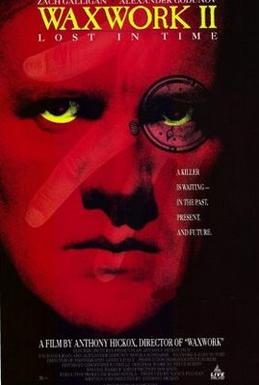
1992’s Waxwork II opens with the finale of the first Waxwork. The cursed waxwork is burning to the ground, taking out the monsters within, along with Sir Wilfred (Patrick Macnee) and Wilfred’s army of do-gooders. Only Mark (Zach Galligan) and Sarah (now played by Monika Schnarre) are able to escape. Fleeing the burning building, they manage to catch a cab. Sarah wonders what they’re going to do now. Mark replies that they’re going to go back to school and pretend that none of this ever happened.
Good luck with that! It turns out that one other thing did escape from the waxwork. A disembodied hand follows Sarah home and murders her abusive stepfather. Sarah manages to drop the hand down the garbage disposal, destroying it but also destroying the only proof she had that she didn’t kill her stepfather. Sarah is put on trial for murder and the jury does not appear to be impressed with her “It was a supernatural creature” defense.
What she and Mark need is proof that the waxwork was full of monsters. Fortunately, a trip to Sir Wilfred’s house reveals not only a recording of Sir Wilfred explaining how there’s an alternative universe known as the Kartagra but also a compass that can be used to find portals into the Kartagra. Mark and Sarah enter the Kartagra, searching for proof of Sarah’s innocence.
Mark and Sarah go from one universe to another, meeting iconic horror characters along the way. Just as with the exhibits in the first film, each universe features it own set monsters and its own distinctive style. For instance, Mark finds himself suddenly cast in the role of Henry Clerval, best friend of Baron Frankenstein (Martin Kemp) and the lover of the Baron’s wife, Elizabeth (who is actually Sarah). Of course, the Baron has more to worry about than his wife cheating with his best friend. There’s also the angry monster living in the basement and the angry villagers that are due to start pounding on the front doors of the mansion.
Later, Mark finds himself in a black-and-white recreation of The Haunting of Hill House, working with a researcher (Bruce Campbell) and two psychics to investigate reports of a ghost at an old house. Mark must bring peace to the ghost while avoiding all of the slapstick complications that one might expect when Bruce Campbell shows up as a paranormal researcher. While Mark is dealing with that, Sarah is floating in space, trying to protect the crew of her dingy spaceship from an acid spewing alien.
You get the idea. Waxwork II is essentially an affectionate collection of homages to other, better-known horror films and it must be said that Waxwork II does an excellent job of recreating each film, from the crisp black-and-white of haunted house scene to the grittiness of the Alien sequences to the over-the-top swordplay of a trip to a medieval world. There’s even a trip to the mall from Dawn of the Dead! Wisely, Waxwork II doesn’t take itself particularly seriously, with many scenes developing into outright comedy. Zach Galligan gives an enjoyable and nicely modulated comedic performance, even holding his own with Bruce Campbell.
At 104 minutes, Waxwork II runs a bit too long for its own good but it ends on a sweet note that nicely wraps up the entire saga. It’s a film that works as both a continuation of Waxwork and as an entertaining film on its own.
In the late 1970s, the Rev. Jim Jones was a very powerful man.
The leader of the California-based People’s Temple, Rev. Jones had made a name for himself as a civil right activist. As a minister, he made it a point to reach out to the poor and to communities of color. (It was said, largely by Jones, that he had been forced to leave his home state of Indiana by the Ku Klux Klan.) Local politicians eagerly sought not only Jones’s endorsement but also the donations that he could easily raise from the members of the People’s Temple. Though there were rumors that he was more of a cult leader than a traditional preacher, Jones was appointed chairman of the San Francisco Housing Authority. Everyone from Governor Jerry Brown to San Francisco Mayor George Moscone appeared with Jim Jones at campaign events. Among the national figures who regularly corresponded with Jim Jones were First Lady Rosalyn Carter and Vice President Walter Mondale.
Of course, what actually went on behind the closed doors of the People’s Temple was a bit of secret. Jones was a self-proclaimed communist who claimed to have had visions of an upcoming nuclear war between the U.S. and Russia. In his sermons, he often claimed that it would be necessary for both him and the rest of the People’s Temple to eventually leave the United States. Jones spoke of enemies that were trying to destroy him, like the reporters who investigated Jones’s claim of being a faith healer and who followed up on reports that Jones was sexually exploiting both the women and the men who followed him. Jones secretly started to make plans to leave the United States in 1973 but it would be another four years before he and a thousand of his followers arrived in Guyana. The People’s Temple Agricultural Project sat in the jungle, isolated from oversight. It was informally known as Jonestown.
Over the next year, Jonestown did not exactly thrive. Rev. Jones demanded that his people work hard and he also demanded that they spend several hours a day studying socialism and listening to him preach. Jones ran his commune like a dictator, refusing to allow anyone to leave (for their own safety, of course). Anyone who questioned him was accused of being an agent of the CIA. In the U.S, the families of Jonestown’s citizens became concerned and started to petition the government to do something about what was happening in Guyana. A few people who did manage to escape from Jonestown told stories of forced labor, suicide drills, rape, and torture. The People’s Temple claimed that those people were all lying and, because Jones still had his government connections, he was largely left alone.
Finally, in 1978, Congressman Leo Ryan, a Democrat who had a history of opposing the political establishment, flew down to Guyana so that he could see Jonestown for himself and also bring back anyone who wanted to leave. Despite the efforts of Jones to disguise the truth about life in Jonestown, several people did ask to leave the colony with Rep. Ryan. Jones sent his most loyal men to meet and open fire on Rep. Ryan’s entourage at a nearby airstrip. Rep. Ryan and four others were shot and killed, making Ryan the first Congressman to be assassinated since 1868. Nine others, including future Rep. Jackie Speier, were wounded in the attack.
Back at Jonestown, Jim Jones announced that his prophecy was coming true and that the imperialists would soon descend on Jonestown. Though 85 of Jones’s followers managed to escape into the jungle, the other 909 residents of Jonestown subsequently died. Though some showed signs of having been murdered by Jones’s followers, the majority committed suicide by drinking poisoned Flavor-Aid. Jim Jones shot himself in the head.
The world was horrified and the term “drinking the Kool-Aid” entered the discourse. And, of course, many filmmakers were inspired by the horrific events that happened in Jonestown. Ivan Rassimov, for instance, played a Jim Jones-style cult leader in Umberto Lenzi’s Eaten Alive. Meanwhile, Powers Boothe would win an Emmy for playing Jim Jones in a 1980 television miniseries called Guyana Tragedy.
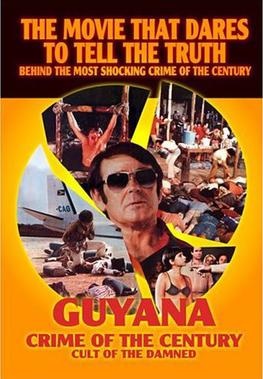
Guyana Tragedy is often described as being the definitive film about Jim Jones. However, a full year before Guyana Tragedy aired, the Mexican director, Rene Cardona Jr., was in theaters with his own version of the Jim Jones story. To anyone who is familiar with Cardona’s style of filmmaking, it’s perhaps not surprising that 1979’s Guyana: Crime of the Century did not win any awards.
Cardona’s film opens with a rather odd title card, explaining that, though the film is based on Jonestown, the names of certain characters “have been changed to protect the innocent.” But if you’re going to start the film by announcing that it’s about the biggest news story of the past year, what’s the point of changing anyone’s name? And for that matter, why is Jim Jones renamed James Johnson and his colony rechristened Johnsontown? Jones was hardly one of the innocents, not to mention that he was dead and in no position to sue when the film came was released. Why is Leo Ryan renamed Lee O’Brien, especially when the film portrays Ryan as being the type of hard-working and honest congressman that anyone would be happy to vote for?
The film opens with Rev. James “Johnson” (played by Stuart Whitman) giving a lengthy sermon about how it’s time for the congregation to move to Guyana, which he describes as being a Socialist paradise. Oddly, in the film, the People’s Temple is portrayed being largely white and upper middle class whereas, in reality, the opposite was true. Indeed, Jones specialized in exploiting communities that were largely marginalized by American society. One reason why Jones’s claim of government persecution was accepted by the members of his church is because the People’s Temple was made up of people who had very legitimate reasons for distrusting the American government.
A few scenes later, Johnson is ruling over “Johnsonville.” Since this is a Cardona film, the viewers are shown several scenes of people being tortured for displeasing Johnson. A child is covered in snakes. Another is shocked with electricity. A teenage boy and girl are forced to kneel naked in front of Johnson as he announce that their punishment for trying to run away is that they will be forced to have sex with someone of Johnson’s choosing. Once the torture and the nudity is out of the way, the film gets around to Congressman O’Brien (Gene Barry) traveling to the Johnsontown. Since the audience already knows what’s going to happen, the film becomes a rather icky game of waiting for O’Brien to announce that he’s ready to go back to the landing strip.
Because the film has been released under several different titles and with several different running times, Guyana: Crime of theCentury has gotten a reputation for being one of those films that was supposedly cut up by the censors. I’ve seen the original, uncut 108-minute version of Guyana and I can tell you that there’s nothing particularly shocking about it. Instead, it’s a painfully slow film that doesn’t really offer much insight into how Jim Jones led over 900 people to their deaths. While Gene Barry make for a convincing congressman, Stuart Whitman gives a stiff performance as the Reverend Johnson. There’s very little of the charisma that one would expect from a successful cult leader. One gets the feeling that Whitman largely made the film for the paycheck.
Of course, Whitman was hardly alone in that regard The film features a host of otherwise respectable actors, including Yvonne DeCarlo, Joseph Cotten, John Ireland, Robert DoQui, and Bradford Dillman. As well, Cardona regular Hugo Stiglitz appears as a photographer. (Stiglitz is perhaps best known for starring in Nightmare Cityand for lending his name to a character in Tarantino’s Inglourious Basterds.) Of the large cast, I appreciated the performances of Cotten and Ireland, who play Johnson’s amoral but well-connected attorneys. (The characters are based on the Temple’s real-life attornes, Charles Garry and Mark Lane. Lane also wrote the first JFK conspiracy book, Rush to Judgment.) I also liked Yvonne DeCarlo’s performance as the most devoted of Johnson’s followers. Even Bradford Dillman’s natural blandness was used to good effect as his character comes to represent the banality of evil when it comes time for him to start administering the Flavor-Aid. But those good performances still can not overcome the film’s slow pace and the fact that the film didn’t bring any new insight to the tragedy.
The film sticks fairly close to what is believed to have actually happened at Jonestown but, in the end, it barely even works as an example of shameless grindhouse filmmaking. It’s not even offensive enough to be enjoyable on a subversive level. Instead, it was just a quick attempt to make some money off of the crime of the century.
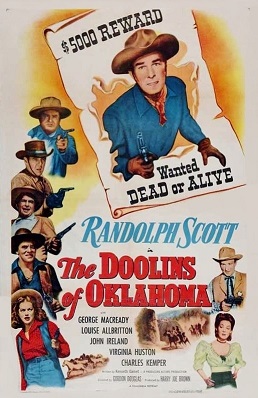
Randolph Scott stars in The Doolins of Oklahoma, a fictionalized account of the career of the real-life western outlaw, Bill Doolin.
Doolin (played, naturally, by Randolph Scott) may have once rode with the fearsome Dalton Brothers but, according to this film, he was actually just an ordinary, salt of the Earth type who wanted to settle down with the right woman and lead a normal life. It looks like he might get that opportunity after the Daltons are killed and Doolin tires of leading his own gang of outlaws. Doolin settles in a Oklahoma town, takes a new name, and falls in love with Elaine (Virginia Hutton). But when both the members of his old gang and a veteran lawman (George Macready) show up in town, Doolin learns that the past cannot be escaped.
The plot of The Doolins of Oklahoma is nothing special, though it’s portrayal of the outlaws being more honorable than law enforcement may have been surprising in 1949. The main thing that distinguishes The Doolins of Oklahoma is the cast, which is full of western veterans like John Ireland, Noah Beery Jr., Charles Kemper, Frank Fenton, and Jock Mahoney. Not surprisingly Randolph Scott is ideally cast as a weary cowboy who just wants to settle down and live the rest of his life in peace. Scott is well-matched by MacReady, as the marshal who will not let anything stand in the way doing his duty as a member of law enforcement. Gordon Douglas directs crisply and energetically and every member of the main cast gets at least one big moment in which to distinguish themselves. The Doolins of Oklahoma may not be a groundbreaking film but it will be enjoyed by fans of the western genre.
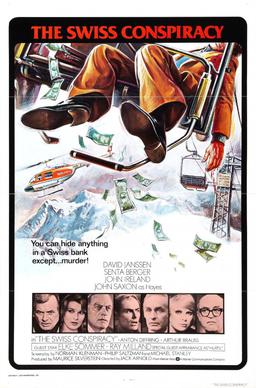
In The Swiss Conspiracy, David Janssen growls his way through another international crime thriller.
Janssen plays David Christopher, a former Treasury agent who is now living in Geneva. When a Swiss bank is contacted by blackmailers who threaten to reveal the secret account numbers of some of its most prominent and unsavory clients, the bank’s president, Johann Hurtill (Ray Milland), hires Christopher to find out who is behind the plot. Unfortunately, one of the account holders is a U.S. gangster named Robert Hayes (John Saxon, naturally) and he’s not happy about having to work with a former fed.
With The Swiss Conspiracy, you know what you’re getting into the minute that the film opens with a narrator giving a lengthy explanation about how Swiss bank accounts work. This is one of those 70s thriller where the budget is low, the plot is often nonsense, and the entire cast seems to be more interested in hitting the slopes than actually making a convincing movie. The cast is full of familiar actors who, at the time of filming, had seen better days. Along with Ray Milland, John Ireland, Anton Diffring, and Elke Sommer all have small roles while “German screen sensation” Senta Berger is cast as the woman who might be in love with David Christopher. Martin Landau is not in this movie but it certainly feels like he should have been.
David Janssen made a lot of movies like this in the 70s. Janssen was a good actor and he was especially skilled at playing grizzled tough guys but in The Swiss Conspiracy, he seems to be more interested in checking out the sights than in anything else. You can’t really blame him because the film was shot on location in Zurich and the local scenery is always more interesting than anything else that’s happening on screen.
The Swiss Conspiracy was directed by Jack Arnold, a veteran B-movie director who was also did The Creature From The Black Lagoon and The Incredible Shrinking Man. His direction in The Swiss Conspiracy is workmanlike and undistinguished but he does make great use of the locations. The Swiss Conspiracy may not be a great movie but I’ll damned if I don’t want to hop on the next plane and head to Switzerland for the week.
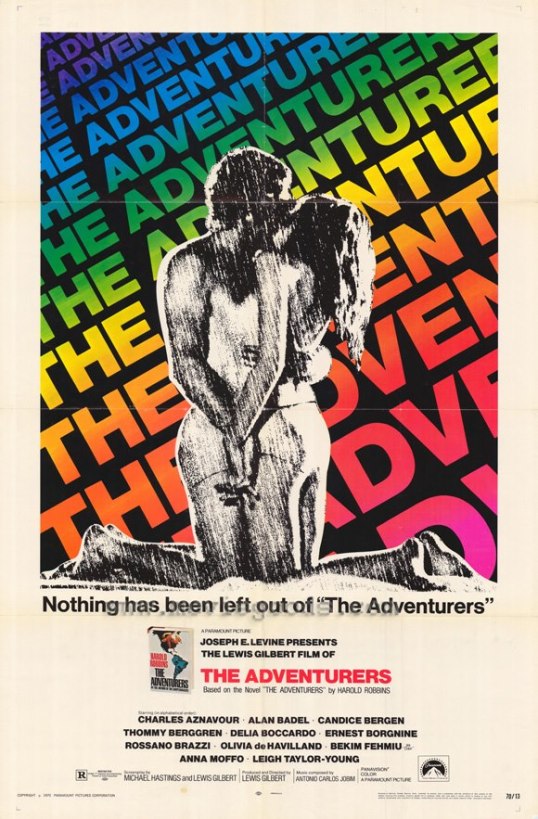
The 1970 film, The Adventurers, is a film that I’ve been wanting to watch for a while.
Based on a novel by Harold Robbins, The Adventurers was a massively expensive, three-hour film that was released to terrible reviews and even worse box office. In fact, it’s often cited as one of the worst films of all time, which is why I wanted to see it. Well, three weeks ago, I finally got my chance to watch it and here what I discovered:
Yes, The Adventurers is technically a terrible movie and Candice Bergen really does give a performance that will amaze you with its ineptitude. (In her big scene, she sits in a swing and, with a beatific look on her face, begs her lover to push her “Higher! Higher!”)
Yes, The Adventures is full of sex, intrigue, and melodrama. Director Lewis Gilbert, who did such a good job with Alfieand The Spy Who Loved Me, directs as if his paycheck is dependent upon using the zoom lens as much as possible and, like many films from the early 70s, this is the type of film where anyone who gets shot is guaranteed to fall over in slow motion, usually while going, “Arrrrrrrrrrrrgh….” A surprisingly large amount of people get shot in The Adventurers and that adds up to a lot of slow motion tumbles and back flips. Gilbert also includes a sex scene that ends with a shot of exploding fireworks, which actually kind of works. If nothing else, it shows that Gilbert knew exactly what type of movie he was making and he may have actually had a sense of humor about it. That’s what I choose to believe.
Despite the fact that The Adventurers is usually described as being a big-budget soap opera, a good deal of the film actually deals with Latin American politics. For all the fashion shows and the decadence and the scenes of Candice Bergen swinging, the majority of The Adventures takes place in the Latin American country of Cortoguay. If you’ve never heard of Cortoguay, that’s because it’s a fictional country. Two hours of this three-hour film are basically devoted to people arguing and fighting over who is going to rule Cortoguay but it’s kind of impossible to really get to emotionally involved over the conflict because it’s not a real place.
Ernest Borgnine plays a Cortoguayan named — and I’m being serious here — Fat Cat. Seriously, that’s his name. And really, how can you not appreciate a movie featuring Ernest Borgnine as Fat Cat?
Fat Cat is the guardian of Dax Xenos (Bekim Fehmiu). Dax’s father is a Cortoguayan diplomat but after he’s assassinated by the country’s dictator, Dax abandons his home country for America and Europe. While he’s abroad, Dax plays polo, races cars, and has sex with everyone from Olivia de Havilland to Candice Bergen. He also gets involved in the fashion industry, which means we get two totally 70s fashion shows, both of which are a lot of fun. He marries the world’s richest heiress (Bergen) but he’s not a very good husband and their relationship falls apart after a pregnant Bergen flies out of a swing and loses her baby.
Throughout it all, Fat Cat is there, keeping an eye on Dax and pulling him back to not only Cortoguay but also to his first love, Amparo (Leigh Taylor-Young), who just happens to be the daugther of Cortoguay’s dictator, Rojo (Alan Badel). In fact, when Fat Cat and Dax discover that an acquaintance is selling weapons to Rojo, they lock him inside of his own sex dungeon. That’s how you get revenge! And when Dax eventually does return to Cortoguay, Fat Cat is at his side and prepared to fight in the revolution. Incidentally, the revolution is led by El Lobo (Yorgo Voyagis), who we’re told is the son of El Condor.
The Adventurers is melodramatic, overheated, overlong, overdirected, and overacted and, not surprisingly, it’s eventually a lot of fun. I mean, the dialogue is just so bad and Lewis Gilbert’s direction is so over the top that you can’t help but suspect that the film was meant to be at least a little bit satirical. How else do you explain that casting of the not-at-all-Spanish Bekim Fehmiu as a Latin American playboy? Candice Bergen plays her role as if she’s given up any hope of making sense of her character or the script and the rest of the cast follows her lead. Ernest Borgnine once said that The Adventurers was the worst experience of his career. Take one look at Borgnine’s filmography and you’ll understand why that’s such a bold statement.
The Adventurers is three hours long but it’s rarely boring. Each hour feels like it’s from a totally different film. It starts out as Marxist agitprop before then becoming a glossy soap opera and then, once Fat Cat and Dax return home and get involved in the revolution, the film turns into “modern” spaghetti western. It’s a film that tries so hard and accomplishes so little that it becomes rather fascinating.
And, if nothing else, it reminds us that even Fat Cat can be a hero….

 Through the Shattered Lens