44 Days of Paranoia #25: Chinatown (dir by Roman Polanski)


Our latest entry into the 44 Days of Paranoia is a dark masterpiece.  Based on a script by Robert Towne, directed by Roman Polanski, and starring Jack Nicholson, 1974’s Chinatown is one of the greatest films ever made.

Chinatown takes place in 1940s Los Angeles.  Private Investigator Jake Gittes (Jack Nicholson) is hired by a woman (Diane Ladd) who claims that her name is Evelyn Mulwray.  She wants Gittes to follow her husband, Hollis, and discover whether he’s having an affair.  Gittes gets some pictures of Hollis with a young woman (Belinda Palmer) and hands them over to Evelyn.

The next day, the pictures are published on the front page of the newspaper and Gittes is confronted by another woman (Faye Dunaway) who explains that she — and not the woman who hired him — is the actual Evelyn Mulwray.  Gittes then learns that Hollis has turned up dead, drowned in a reservoir.

Gittes suspects that Hollis was murdered and launches his own investigation.  This eventually leads Jake to Hollis’s former business partner, Noah Cross (John Huston).  Noah also happens to be the father of Evelyn and he offers double Gittes’s fee if Gittes will track down Hollis’s younger girlfriend.

As his investigation continues, Gittes discovers that Hollis’s murder was connected to both the continued growth of Los Angeles as a city and a truly unspeakable act that occurred several years in the past.  Nobody, it turns out, is what he or she originally appears to be.  To say anything else about the plot would be unfair to anyone who hasn’t seen Chinatown before.

Since I first started reviewing films for this site, one of the things that I’ve discovered is that it’s actually easier to review a bad film than a good film.  It’s easier to be snarky and cynical about the latest film from Michael Bay or Roland Emmerich than it is to explain why a film works.  There’s a famous saying about pornography: “I don’t know what it is but I know it when I see it,” and sometimes that’s the way I feel whenever it comes time to try to review a great film.

Consider Chinatown.  At its heart, Chinatown is an homage to the old film noirs of the 40s and 50s.  Now, I have to admit that I’ve lost track of how many noir homages I’ve seen.  It seems like every director has to make at least one hard-boiled, morally ambiguous detective film.  Chinatown has all of the familiar elements — the hero is a private investigator, Evelyn Mulwray initially appears to be a classic femme fatale, the dialogue is appropriately cynical, and the plot is full of twist and turns.  Even the film’s theme of political conspiracy serves to remind us that most noirs used their detective stories as a way to explore the hidden underbelly of American society.

And yet, with Chinatown, Polanski, Nicholson, Towne, and producer Robert Evans took all of those familiar elements and used them to create one of the greatest films ever made.

Why is Chinatown such a great film?

Some of the credit has to go to Jack Nicholson who, in the role of Jake Gittes, gives perhaps his best performance.  As I mentioned above, Gittes is, in many ways, a stock character but Nicholson brings so much nuance and depth to the role that it doesn’t matter.  Nicholson’s trademark cynicism and sarcasm are both to be found here but he also brings a cocky recklessness to the role.  Gittes is such a charismatic and likable hero and so confident in himself that it makes the film’s ending all the more shocking.

As good as Nicholson is, he’s matched at every turn by John Huston’s Noah Cross.  Noah Cross is one of the most vile characters to ever appear on-screen, which is why Huston’s rather courtly performance is all the more disturbing.  When Gittes confronts Noah about the worst of his many crimes, Cross simply responds that a man is never sure what he’s capable of until he does it.  Huston delivery of the lines leave us with little doubt that Noah believes every word of what he’s just said.

In the end, though, most of the credit has to go to Roman Polanski’s direction and Robert Towne’s script.  Towne’s script provides a genuinely challenging and thought-provoking mystery, while Polanski’s stylish direction keeps the view continually off-balance and unsure of who is telling the truth.  Reportedly, Polanski and Towne had a contentious relationship, with Polanski changing the ending of Towne’s script to make the film much more downbeat.  In the end, Polanski made the right choice.  The film ends the only way that it possibly could.

Or, to quote the famous line: “It’s Chinatown.”

Other Entries In The 44 Days of Paranoia 

  1. Clonus
  2. Executive Action
  3. Winter Kills
  4. Interview With The Assassin
  5. The Trial of Lee Harvey Oswald
  6. JFK
  7. Beyond The Doors
  8. Three Days of the Condor
  9. They Saved Hitler’s Brain
  10. The Intruder
  11. Police, Adjective
  12. Burn After Reading
  13. Quiz Show
  14. Flying Blind
  15. God Told Me To
  16. Wag the Dog
  17. Cheaters
  18. Scream and Scream Again
  19. Capricorn One
  20. Seven Days In May
  21. Broken City
  22. Suddenly
  23. Pickup on South Street
  24. The Informer

44 Days of Paranoia #3: Winter Kills (dir by William Richert)


MPW-39279Yesterday, I took a look at Executive Action, a 1973 docudrama about the assassination of John F. Kennedy.  Today, I want to take a look at another film inspired by the Kennedys, the 1979 satire Winter Kills.

As the film opens, it’s been 16 years since a popular and dynamic President named Tim Kegan was assassinated in Philadelphia.  Despite constant rumors of conspiracy, the official story is that Kegan was killed by a lone gunman and that gunman was subsequently killed by another lone assassin.  The President’s half-brother, Nick (played by Jeff Bridges, who looks so impossibly young and handsome in this film), has disappointed his father (John Huston) by declining to follow his brother into politics.  Instead, he spends most of his time sailing on corporate oil tankers and dating fashion editor Yvette (Belinda Bauer).  This all changes when a dying man named Fletcher (and played, underneath a lot of bandages, by Joe Spinell) asks for a chance to speak to Nick.  Fletcher reveals that he was the 2nd gunman and that he was hired by to kill President Kegan.  Before dying, Fletcher tells Nick where he can find the rifle that was used to kill the President.

Following Fletcher’s directions, Nick finds both the rifle and proof that his brother’s death was the result of a conspiracy.  Determined to find out who was truly behind the conspiracy, Nick goes to see his father, the flamboyant tycoon Pa Kegan (John Huston) who, we discover, is only alive because he frequently gets blood transfusions from young women.  With Pa’s encouragement, Nick is sent on an increasingly bizarre odyssey into the darkest shadows of America, a world that is populated by militaristic businessmen, sinister gangsters, and an unemotional man named John Cerutti (Anthony Perkins) who very well may be the most powerful man in the world.

The martyred President might be named Tim Kegan, his accused assassin might be named Willie Abbott, and the man who shot Abbott might be named Joe Diamond (and might be played by Eli Wallach) but make no mistake about it — Winter Kills is a thinly disguised look at both the Kennedy assassination and the Kennedy family.  Based on a novel by Richard Condon (who also wrote the conspiracy classic, The Manchurian Candidate), Winter Kills takes all of the various Kennedy conspiracy theories and intentionally pushes them to their most ludicrous extremes.  The end result is a film that tries (and occasionally manages) to be both absurd and sincere, a portrait of a world where paranoia is the only logical reaction.

As I discovered from listening to director William Richert’s commentary on the Anchor Bay DVD, Winter Kills had a long and complicated production history.  The film was produced by two marijuana dealers, one of whom was murdered by the Mafia shortly after the film premiered while the other would later be sentenced to 40 years in prison on federal drug charges.  The production actually went bankrupt more than a few times, which led to Richert, Bridges, and Bauer making and releasing another film specifically so they could raise the money to finish Winter Kills.

When Winter Kills was finally released, it got a good deal of attention because of its spectacular cast.  Along with Bridges, Huston, Perkins, and Wallach, the film also features cameo appearances by Tomas Milian, Elizabeth Taylor, Ralph Meeker, Richard Boone, Sterling Hayden, Dorothy Malone, Toshiro Mifune, and a host of other actors who will be familiar to those of us who enjoy watching old movies on TCM.  And yet, according to Richert, the film itself was barely released in to theaters, the implication being that Winter Kills was a film about conspiracies that fell victim to a conspiracy itself.

Given the film’s history and the subject matter, I was really hoping that Winter Kills would turn out to be a great movie.  Unfortunately, it really doesn’t work.  The film struggles to maintain a balance between suspense and satire and, as a result, the suspense is never convincing and the satire is ultimately so obvious that it ends up being more annoying than thought-provoking.  The cast may be impressive but they’re used in such a way that film ultimately feels like it’s just a collection of showy celebrity cameos as opposed to being an actual story.

That said, Winter Kills remains an interesting misfire.  Jeff Bridges is a likable and compelling lead (and he gives the film much-needed focus) and, playing a role that has a lot in common with his better known work in Chinatown, John Huston is a always watchable if not necessaily likable.  Best of all is Anthony Perkins, who plays a role that, in light of what we now know about the NSA, seems oddly prophetic.

Finally, best of all, Winter Kills remains an interesting time capsule.  If nothing else, it reminds us that mistrust and paranoia are not unique to this century.

3260389_l1

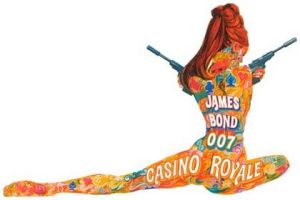
James Bond Film Review: Casino Royale (dir by Ken Hughes, John Huston, Joseph McGrath, Robert Parrish, Val Guest, and Richard Talmadge)


As you probably already know, we here at the Shattered Lens have been counting down the days until the American release of Skyfall by reviewing every single film in the James Bond franchise.  Today, we take a look at the first non-EON Bond film, the epic, psychedelic 1967 spoof Casino Royale.

Where to begin?

When Ian Fleming’s first James Bond novel, Casino Royale, was published in 1953, veteran Hollywood producer Charles K. Feldman bought the film rights.  However, Feldman didn’t buy the rights to Fleming’s subsequent novels and was forced to sit by and watch as Albert Broccoli and Harry Saltzman had unexpected success with Dr. No and the subsequent EON-produced Bond films.  Much as Kevin McClory did with Thunderball, Feldman first attempted to co-produce a serious adaptation of Casino Royale with Broccoli and Saltzman.  However, when Feldman, Broccoli, and Saltzman couldn’t come to an agreement on how each side would be compensated in the proposed production deal, Feldman decided to make Casino Royale on his own.  He also decided that, instead of trying to compete with EON by making a “straight” James Bond film, his version of Casino Royale would be a satirical extravaganza.

Feldman’s vision of James Bond is apparent from Casino Royale’s opening credits.  While the credits are definitely based on the iconic openings of the EON Bond films, they’re also designed to play up the fact that Casino Royale — in the grand tradition of the Hollywood studios at their most excessive — is meant to be a big budget, all-star extravaganza.

Casino Royale actually starts out with a pretty clever premise.  It seems that the name “James Bond,” is simply a code name that has been assigned to several British spies over the years.  As M (played by John Huston, who also directed the first third of the film), explains it, the name “James Bond” strikes such fear in the hearts of Britain’s enemies that the name must be kept alive.

(Speaking for myself, this is an idea that I kinda wish that the official James Bond series would adopt.  If nothing else, it would certainly explain how Pierce Brosnan and Daniel Craig could possibly be the same person.)

The original James Bond (played by David Niven) has long since retired to his stately country estate, where he spends his time playing the piano and complaining about how the agents who have inherited his name are sullying his reputation with excessive womanizing and violence.  It turns out the Sir James Bond is a man renowned for his “celibate image.”  At the start of the film, Bond is asked to come out of retirement by not only M but the heads of the CIA, KGB, and French secret service as well.  SMERSH, an organization of female assassins that’s led by the mysterious Dr. Noah, has been eliminating agents worldwide and only the original (and very chaste) Bond can defeat them.  Bond, however, refuses and M responds by ordering a mortar attack on Bond’s estate.  The estate is blown up but so is M and Bond soon finds himself returning to London as the new head of MI6.

Interestingly enough, David Niven was one of the actors who was considered for the role of James Bond in Dr. No.  Reportedly, Ian Fleming was quite enthusiastic for Niven to take the role but, by the time that Dr. No went into production, Niven was considered to be too old.  There’s a nice bit of irony here in seeing David Niven playing a retired James Bond who spends a good deal of the film complaining about the men who have subsequently assumed his name.

Once Niven takes over MI6, he orders that, in order to confuse SMERSH, all British agents (including female agents) will be known as James Bond.  The rest of the film is divided into episodes that feature these new James Bonds battling SMERSH and the mysterious Dr. Noah.

Among these agents, there’s the handsome Coop (played by Terrence Cooper) who has been trained to resist all sexual temptations.

There’s Mata Bond (Joanna Pettet), the daughter of Sir James Bond and Mata Hari.

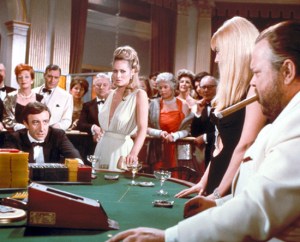
There’s Vesper Lynd (Ursula Andress) who is sent to seduce and recruit the expert gambler Evelyn Tremble (Peter Sellers) so that Tremble can beat SMERSH agent Le Chiffre (Orson Welles) at the Casino Royale.

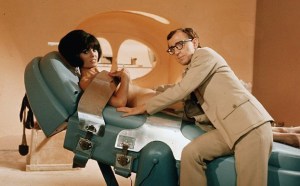
Best of all, there’s Sir James Bond’s nephew, Jimmy Bond.  Jimmy Bond is played by Woody Allen and … well, let’s just take a look at Jimmy’s first scene in the film:

Casino Royale had a notoriously troubled production history and most of those troubles seemed to center on Peter Sellers.  While the film was designed to be a broad, slapstick comedy, Sellers reportedly insisted on trying to play his role straight and even rewrote his lines to make his scenes more dramatic.  Welles eventually grew so disgusted with Sellers that he refused to be in the same room with him.  This caused quite a bit of difficulty since Sellers was in almost every scene that featured Welles.  Eventually, Sellers walked off the film and the film had to be hastily (and awkwardly) rewritten to account for his sudden absence.

When one watches Casino Royale today, it’s hard to escape the conclusion that Sellers was essentially correct.  While most of Casino Royale often feels disjointed and incoherent, the scenes featuring Sellers, Andress, and Welles are some of the strongest in the film.  Sellers’ dramatic approach doesn’t negate the film’s comedy.  If anything, it makes the comedy even stronger because Sellers actually seems to be invested in the reality his character, regardless of how ludicrous a situation that character may find himself in.

When I watched Casino Royale, I was struck by the stark contrast between the parts of the film that worked and the parts that didn’t.  This is a movie that truly swings from one extreme to another.  Either the film’s satire is working  brilliantly (mostly in the scenes featuring Woody Allen and Peter Sellers) or it’s falling completely flat (like in an extended sequence that features Deborah Kerr as a SMERSH assassin).

I found myself laughing more at the little scenes than the big set pieces.  For instance, I loved it when David Niven embraces Miss Moneypenny (Barbara Bouchet) just to be then told that she’s actually the daughter of the original Miss Moneypenny.  I don’t know much about the actor Terrence Cooper (though, according to Wikipedia, he was also a contender to take the role of James Bond in the official series) but I enjoyed the brief sequence where Moneypenny “tests” him to see if he can take on the Bond identity.  Unfortunately, the film doesn’t really have enough of these small, clever moments.

Ultimately, I found that Casino Royale works best when viewed as a time capsule.  Casino Royale was made at a time when the established major Hollywood studios (and veteran producers like Charles K. Feldman) were struggling to remain relevant.  Foreign films (including, it must be said, the James Bond films) were challenging the common assumptions of what could and what couldn’t be shown on-screen and the studio system reacted by trying to make films that would appeal to younger audiences while also reassuring older audiences that the movies hadn’t really changed that much.  The end result were films like Casino Royale that featured the occasional psychedelic sequence along with cameos from old (and safe) Hollywood stars like George Raft, William Holden, and Charles Boyer.  Casino Royale is the type of self-indulgent film that could only have been made in 1967 and, as such, it’s a valuable time capsule for all of us cinematic historians.

I also have to admit that, as excessive as Casino Royale may be, I happen to love excess.  Casino Royale might be overlong and occasionally incoherent but the costumes are simply to die for.  The film is a visual feast, if nothing else.

Casino Royale was released to scathing reviews and terrible box office but, in the years since, it has become something of a cult favorite.  Our own Trash Film Guru has identified Casino Royale as his favorite Bond film.  Myself, I found the film to be extremely flawed and yet oddly fascinating to watch.  Casino Royale is a total mess and that is both its greatest flaw and greatest strength.

Tomorrow, we’ll return to the official James Bond series by taking a look at You Only Live Twice.  

What Lisa Marie Watched Last Night: Myra Breckinridge (dir. by Michael Sarne)


Last night, as I struggled to get some sleep, I ended up turning on the television to HBO and watching a truly infamous film — 1970’s Myra Breckenridge.  Based on a novel by Gore Vidal (a writer that I generally have little use for), Myra Breckinridge is infamous for being one of two X-rated film released by 20th Century Fox in 1970.  (The other one was Russ Meyer’s Beyond The Valley of the Dolls.)

Why Was I Watching It?

Because I’ve read a lot of books devoted to “the worst films ever made.”  And all of them mention 1970’s Myra Breckinridge as being one of the worst ever made.  And having seen the film, I can say that they’re right.

What’s It About?

Well, that’s a good question.  Okay, there’s a bisexual film critic named Myron Breckinridge (played by an actual film critic named Red Reed).  Myron gets a sex change operation from a pot-smoking doctor played by John Carradine.  “It won’t grow back,” Carradine warns him.

Next thing you know, Myron is Myra and is now being played by Raquel Welch.  Pretending to be Myron’s window, Myra goes to the acting school that is run by Myron’s uncle Buck (John Huston) and ends up falling in love with an acting student (played, pretty badly in her film debut, by Farrah Fawcett).  Unfortunately, Fawcett’s in love with a cowboy from Oklahoma so Myra ends up anally raping the cowboy with a big dildo.

Oh, and a 70 year-old Mae West in the film for some reason.  She plays a talent agent. 

It all sounds a lot more interesting than it actually is.

What Worked?

Nothing.  Just in case I’m not being clear, allow me to clarify: Nothing.  Seriously, this may indeed be the worst movie I have ever actually sat through.  What’s said is that it didn’t even work on a “so-bad-its-good” level.  I love trashy film but Myra Breckinridge isn’t really interesting enough to be trashy.  It’s just an amazingly boring film that thinks it’s about sex. 

I’ve also read some who have claimed that this film, bad as it is, has a certain camp appeal.  And, if you’ve never actually seen a campy film, you might think that Myra Breckinridge is camp.  However, camp is not boring.  Myra Breckinridge is.

Actually, there is one scene that has an odd, “you’ve-got-to-see-this-crap” appeal to it and here it is.  Mae West sings “Hard to Handle.” 

What Doesn’t Work:

The entire freaking film.  Seriously.  I mean, I don’t even know where to begin or what specifically to point out because, if you simply take this film’s failings on a problem-by-problem basis, it creates the false impression that the film is somewhat watchable. 

Okay, here’s a few things that I simply will not be able to live with myself if I don’t take a few moments to be a bitch about:

1) There’s a lot of bad movies that are distinguished by interesting or, at the very least, watchable performances.  It’s as if the actors realize that they’re going to go down with the ship unless they bring something new to the film.  (Meanwhile, so-called great films feature some of the worst performances this side of Avatar…)  Unfortunately, Myra Breckinridge is not one of those films.  The cast alternates beyond going insanely overboard (like John Huston and Rex Reed) to delivering their lines with a dull contempt that seems to be directed as much at us as at themselves (like Raquel Welch.)

By the way, Raquel Welch is actually one of my favorite of the old school film stars.  For me, she’s a bit of a role model, a strong Latina who never felt the need to apologize for being both a sex symbol and an intelligent, succesful woman.  But Welch really does give a pretty bad performance here.  Then again, I would argue that she gives the material exactly the amount of effort it deserves.

2) As bad as the cast is, no one is as terrible as Mae West.  The 70 year-old West came out of retirement to play her role here.  Anyway, it’s hard to understand why she’s in this film.  At one point, when she meets a 6’7 actor, she says she’s only concerned with the seven inches.  Now, imagine this being said by your great-great-great-grandma and you have some idea what it’s like to watch her performance here.

3) This film was made in 1970 and it attempts to be all counter-cultural by having “hippies” wandering around in the background.  As well, we get a lot of hard-hitting political satire.  By that, I mean that various fat men in cowboy hats pop up and complain about “smut” and “nudity” in the movies.  I guess the audience is supposed to go, “Oh my God, they’re talking about movies like this!”  It’s for this reason that I think that Myra Breckinridge is actually secretly meant to be a piece of right-wing propaganda.

4) Finally, for no real reason, clips from old 20th Century Fox films are littered throughout the film, popping up randomly to…well, I was going to say “comment on the action,” but few of them manage to do that.  Basically, it works like this: you see Raquel Welch anally raping a man with a dildo.  And then you see a clip of Stan Laurel for a few seconds.  Then, you’re back to Raquel anally raping the man.  Suddenly, there’s a clip of Claudette Colbert smiling.  Suddenly, Raquel’s back and she’s still anally raping the man.  And by the way, I’m not just making this up so I’ll have an example.  This is what actually happens in the film. 

5) And again, allow me to clarify that this film — which features Raquel Welch using a dildo to anally rape a man — is still one of the most boring things ever made.

6) “Okay,” you’re saying, “if you hated it so much then why did you sit through the entire freaking movie, Lisa?”  I did it because, once I start watching a movie, I can’t stop watching until it ends.  That’s my addiction.  That’s my curse.  That’s a duty that I’ve proudly accepted as a film lover.  And not even Myra Breckenridge is going to keep me from doing my duty.

“Oh my God!  Just like me!” Moments:

Yes, I know that this is where I traditionally offer up some sort of teasingly vague comment about my first year at college or where I admit that I’m scared of dogs, heights, swimming, and the area directly behind the television.  And you would be justified in thinking that a film that claims to celebrate sexual freedom and bisexuality would give me the perfect excuse to be all sorts of TMI.

But you know what?  There were absolutely no “Oh my God!  Just like me!” TMI moments in Myra Breckenridge because there was not one single moment that, in any way, rang true or seemed to possess any sort of insight about…well, about anything.  For an X-rated film that was specifically about sexuality, Myra Breckinridge left me as dry as the Sahara.

So, sorry — for the first time, I can say that I watched something that had absolutely no “OMG!  Just like me!” moments.

Lessons Learned:

I will watch anything.