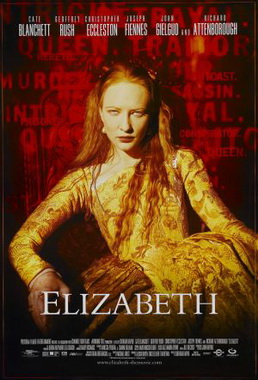
Embracing the Melodrama Part II #97: Elizabeth (dir by Shekhar Kapur)


Elizabeth_Poster“I am no man’s Elizabeth!”

— Queen Elizabeth I (Cate Blanchett) in Elizabeth (1998)

I have to admit that I always feel guilty about the fact that I love movies about British royal history.  After all, I have roots in Northern Ireland and I was raised Catholic.  If anything, I should refuse to watch films about British royalty on general principle.  I should be writing more reviews of films like Bloody Sunday.

But I can’t help myself.  Whether it’s because I enjoy looking at all of the costumes or I just have a thing for movies set in drafty old castles, I have a weakness for films about British royalty.  (And I will also admit that I sat through the entire royal wedding and I have a bit of a girlcrush on both Pippa and Kate Middleton.  As I said, I just can’t help myself.)

Of course, some of it definitely has to do with the fact that I’m an unapologetic history nerd.  I am fascinated with how people lived in the past.  And, of course, anyone who shares my obsession understands that, when it comes to history, there’s both the official story and the truth.  The official story is something that’s passed down over the centuries.  It’s what we learn in school.  The truth, however, is always far more obscure.  The truth is what historians piece together from what little gossipy evidence has managed to survive the passage of time.

We all know that the official story of Queen Elizabeth I is that she was England’s greatest Queen, she defeated the Spanish Armada, and she never married.  She was the “Virgin Queen,” forsaking love to serve her nation.  That’s the official story but is it the truth?

That’s the question at the heart of the 1998 Best Picture nominee Elizabeth.  Now, don’t get me wrong.  I’m not arguing that Elizabeth represents the truth.  Historically, the film is messy and full of speculation that is less based on evidence and more on the desire to keep things cinematic.  But still, Elizabeth is an interesting film specifically because it takes a historical figure and dares to suggest that she may have been human before she became an icon.

Cate Blanchett gives a great performance in the role of Elizabeth.  When we first meet her, she’s a somewhat silly girl who is less concerned with politics and religion and more concerned with her boyfriend, Robert Dudley (Joseph Fiennes).  Elizabeth is also the protestant half-sister of Catholic Queen Mary (Kathy Burke).  Mary is planning on ordering Elizabeth’s execution but dies of stomach cancer before she gets around to singing the order.

Suddenly, Elizabeth is Queen of England.  Young and insecure, she is, at first, manipulated by advisors like William Cecil (Richard Attenbrough), who pressures her to marry the cross-dressing Henry III (Vincent Cassel) of France.  Meanwhile, the Pope (John Gielgud) signs an order calling for Elizabeth’s death.  Catholic nobleman Thomas Howard (Christopher Eccleston) and mysterious priest John Ballard (Daniel Craig) conspire to assassinate Elizabeth.  With even Robert Dudley giving her reason to distrust him, Elizabeth discovers that her only ally is the enigmatic and ruthless “spymaster,” Francis Walsingham (Geoffrey Rush). It all ultimately ends in a sequence that basically transports the finale of The Godfather to the Elizabethan era.

I really should not like Elizabeth.  It’s undoubtedly an anti-Catholic film, though it’s nothing compared to the histrionic anti-Catholicism of its sequel, Elizabeth: The Golden Age.  But I can’t help myself, I enjoyed Elizabeth.  It was impossible for me not to relate to Cate Blanchett’s passionate performance.  (And there was just something so incredibly hot about the way Joseph Fiennes, with his intense eyes, would stare at her.)  When you ignore the film’s protestant bias and just concentrate on the performances and the gorgeous production design, you can’t help but love Elizabeth.

Lisa Watches An Oscar Winner: Chariots of Fire (dir by Hugh Hudson)


Chariots_of_fire

It took me two viewings to really appreciate the film Chariot of Fire.

First released in 1981, Chariots of Fire won the Oscar for best picture.  It’s also one of the few British productions to take the top award.  (British films are regularly nominated but the winner is usually an American production.)  A few nights ago, it was broadcast on TCM and I watched it for the first time.  And I have to admit that I struggled to follow the film.

It’s not that the film’s story was exceptionally complicated.  At heart, it’s an inspirational sports film and it features all of the clichés that one usually associates with inspirational sports films — i.e., come-from-behind victories, eccentric trainers, athletes who are determined to compete under their own terms, training montages, and a memorable score.  (The score for Chariots of Fire was so effective that it’s still used as the background music for countless Olympic specials.)

No, I struggled to follow the film because it really was just so extremely British, featuring everything from Cambridge to Gilbert and Sullivan to a rigidly enforced class system to casual anti-Semitism,  This may have been a sports film but it was a very reserved sports film.  If Chariots of Fire had been an American film, we would have gotten countless shots of people screaming, “YESSSSS!  GO! GO! GO! GO!” Instead, the characters in Chariots of Fire are far more likely to say, “Good show, old boy.”  Whereas an American sports film would have scored a montage of competition to the sound of “Eye of the Tiger,” Chariots of Fire features a men’s chorus singing, “For he is an Englishman….”

It takes a bit of getting used to and perhaps I knew that because, even as I was watching Chariots of Fire, I still set the DVR to record it.  The first time I watched the film, I was overwhelmed by the culture shock and the resolute Britishness of it all.  My reaction was to think that, much like The Big Chill, Chariots of Fire was a “you just had to be there” type of film, the type of film that was once impressive but now just inspires you to go “meh.”

And I was prepared to write a review stating just that.  But, somehow, in the back of my mind, I knew that I should give Chariots of Fire another chance before I dismissed it.  Maybe it was the fact that I couldn’t get the damn music out of my head.  Who knows?  But I couldn’t think about the film’s opening — with all those men running on the beach and getting mud all over their white uniforms — without smiling.

So, seeing as how I am currently snowed in for the weekend, I spent this morning watching Chariots of Fire for a second time and I’m glad that I did.  Because you know what?  Chariots of Fire is actually a pretty good film.  It tells the story of Eric Lidell (Ian Charleson) and Harold Abrahams (Ben Cross), two British runners who competed at the 1924 Olympics.  Harold is a student at Cambridge.  He’s an angry young man who is running to prove all of the anti-Semites wrong.  (Of course, Harold is angry in a very sort of upper class British way).  Eric is the son of missionaries who views running as a mission from God and who refuses to run on a Sunday.  The film looks gorgeous, Charleson and Cross both give good performances, and that music demands an emotional response.  While Chariots of Fire may not be a great film, it’s definitely a likable film and there’s something to be said for that.

Plus, did I mention that the music’s great?

http://www.youtube.com/watch?v=L-7Vu7cqB20


Lisa Marie Does Julius Caesar (dir. by Joseph L. Mankiewicz)


As some of you may know, I’ve spent the past two years on a mission.  It is my goal to eventually see and review every single film that has ever been nominated for best picture.  After taking a few months off, I am now ready to continue that quest.  For that reason, I recently sat down and watched the 1953 best picture nominee Julius Caesar.

Julius Caesar is an adaptation of William Shakespeare’s classic play about political intrigue, assassination, and demagoguery in ancient Rome.  (Technically, what follows is full of spoilers but come on, people — it’s Shakespeare!)  The citizens of Rome love their leader, Julius Caesar (played here by a very imperial Louis Calhern) but a group of senators led by Cassius (John Gielgud) fears that Caesar’s popularity will lead to the collapse of the Roman Republic.  Cassius recruits Caesar’s close friend Brutus (James Mason) into a conspiracy to assassinate Caesar on the Ides of March.  However, once the deed has been done and Brutus has explained the motives behind the assassination to the Roman public, the previously underestimated Mark Antony (Marlon Brando) delivers his famous “Lend me your ears!” speech and soon, the people of Rome turn against the conspirators.  In the end, the conspiracy’s efforts to save the Roman Republic instead leads to the birth of the Roman Empire.

Speaking as someone who loves both Shakespeare and history, it was an interesting experience to watch this particular version of Julius Caesar.  As directed by Joseph L. Mankiewicz (who later revisited the material in the infamous 1963 Best Picture nominee Cleopatra), Julius Caesar present a very traditional (and occasionally stagey) interpretation of Shakespeare’s play.  However, by this point, we’ve become so used to Shakespeare being presented with a gimmick (like modern-day costumes, for instance) that the traditional approach almost feels like something new and unexpected.  That said, Julius Caesar is definitely not the Shakespearean film to show to your friends who stubbornly insist that Shakespeare is boring or impossible to follow.  Julius Caesar was obviously made by people who appreciate Shakespeare and that remains the film’s best audience.  

When Julius Caesar was first released in 1953, it received a lot of attention because of the casting of Marlon Brando as Mark Antony.  An outspoken method actor who had been nicknamed “the mumbler” precisely because of his own internalized style of acting, Brando was considered to be too contemporary of an actor to be an effective Shakespearean.  Once the film was released, critics agreed that Brando had proven that, even while mumbling, he made for an electrifying Mark Antony and that, despite only having a few scenes, his charismatic presence dominated the entire film.  Out of an impressive cast, Brando received the film’s only nomination for acting.

It is true that, even when seen today, Brando does dominate the entire film.  He delivery of Mark Antony’s famous oration over Caesar’s bloody corpse remains one of the best Shakespearean performances to have ever been preserved on film.  It’s odd to watch this young, sexy, and energetic Brando and compare him to the legendary eccentric that we all usually think of whenever we hear the man’s name. 

That said, Brando’s performance would not be half as effective if it wasn’t surrounded by the more traditional (but no less compelling) performances of James Mason and John Gielgud.  Mason brings a brooding intensity to the role of Brutus and Gielgud is the Cassius by which all future Cassiuses must be judged.  Their performances might not be as flamboyant as Brando’s but they’re no less important.  Ultimately, the clash between the acting style of Brando and the styles of Gielgud and Mason nicely parallel the conflict over the future of the Roman Republic.

Julius Caesar won the Oscar for best art design and was nominated for picture, actor, cinematography, and original score.  Brando lost the award for best actor to Stalag 17’s William Holdenwhile the Oscar for best picture of 1953 went to a far more contemporary film, From Here To Eternity.  Brando, however, would win best actor the next year for his performance in On The Waterfront. 

Poll: Lisa Marie Submits To Your Will


Last year, I gave up control to the reader of the site and you know what?  I kinda liked it in a sneaky, dirty little way.  So I figured, why not do it again?

Of course, I’m sure you’ve already guessed that I’m referring to my What Movie Should Lisa Marie Review poll.  This is the poll that led to me reviewing Anatomy of a Murder. 

Here’s how it works.  Earlier today, I put on a blindfold and then I randomly groped through my DVD collection until I had managed to pull out ten movies.  I then promptly stubbed my big toe on the coffee table, fell down to the floor, and spent about 15 minutes cursing and crying.  Because, seriously, it hurt!  Anyway, I then took off the blindfold and looked over the 10 movies I had randomly selected.  Two of them — Dracula A.D. 1972 and A Blade in the Dark — were movies that I had already reviewed on this site.  So I put them back and I replaced them with two movies of my own choosing — in this case, Eternal Sunshine of the Spotless Mind and The Unbearable Lightness of Being.

Between now and next Sunday (March 27th), people will hopefully vote in this poll.  On Sunday, I will watch and review whichever movie has received the most votes.  Even if that movie turns out to be Incubus. *shudder*  (Have I mentioned how much I love Eternal Sunshine of the Spotless Mind?)

Now, of course, there’s always the possibility that no one will vote in this poll and I’ll end up looking silly.  Those are the risks you take when you set up an online poll.  However, I have a backup plan.  If nobody votes, I will just spend every day next week shopping for purses at Northpark Mall and then blogging about it.  And by that, I mean blogging every single little detail.  So, it’s a win-win for me.

Anyway, here’s the list of the 10 films:

1) Barbarella — From 1968, Jane Fonda plays Barbarella who flies around space while getting molested by …. well, everyone.  Directed by Roger Vadim.

2) Barry Lyndon — From 1975, this best picture nominee is director Stanley Kubrick’s legendary recreation of 18th-century Europe and the rogues who live there.

3) Caligula — Yes, that Caligula.  From 1979, it’s time for decadence, blood, and nudity in the Roman Empire.  Starring Malcolm McDowell, Helen Mirren, Peter O’Toole, John Gielgud, John Steiner, and Theresa Ann Savoy.

4) Eternal Sunshine of the Spotless Mind — Oh my God, I love this movie.  Jim Carrey breaks up with Kate Winslet and deals with the pain by getting his mind erased by Tom Wilkinson, Mark Ruffalo, Kirsten Dunst, and an amazingly creepy Elijah Wood.

5) Incubus — From 1969, this low-budget supernatural thriller not only stars a young William Shatner but it also features the entire cast speaking in Esperanto.  For.  The.  Entire.  Movie.

6) Inland Empire — If you want to give Lisa nightmares, you can vote for David Lynch’s disturbing 3-hour film about lost identity, sexual repression, human trafficking, and talking rabbits.

7) Kiss Me Deadly — From 1955, this Robert Aldrich-directed cult classic features hard-boiled P.I. Mike Hammer and a host of others chasing after a mysterious glowing box and accidentally destroying the world in the process.

8 ) Mandingo — From 1975, this infamous little film is a look at slavery, incest, and rheumatism in the pre-Civil War South.  Starring James Mason, Ken Norton, Perry King, and Susan George.  Supposedly a really offensive movie, one I haven’t sat down and watched yet.

9) Sunset Boulevard — From 1950, hack screenwriter William Holden ends up the kept man of psychotic former screen goddess Gloria Swanson.  Directed by Billy Wilder.

10) The Unbearable Lightness of Being — From 1988, Philip L. Kaufman’s adaptation of Milan Kundera’s classic novel (one of my favorite books, by the way) features Daniel Day-Lewis, Juliette Binoche, and Lena Olin having sex and dealing with ennui.  After I first saw this movie, I insisted on wearing a hat just like Lena Olin did.

Everyone, except for me, is eligible to vote.  Vote as often as you want.  The poll is now open until Sunday, March 27th.

(Edit: Voting is now closed but check below for the results! — Lisa)