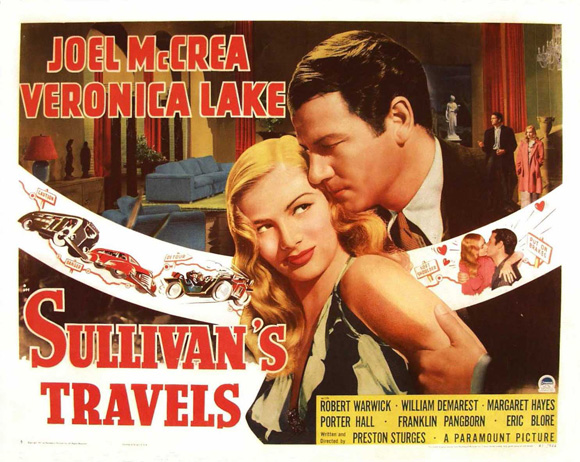
In 1941’s Sullivan’s Travels, Joel McCrea plays a filmmaker who disguises himself as a transient so that he can experience what’s really going on outside of Hollywood. Veronica Lake plays “the Girl,” who ends up sharing his journey.
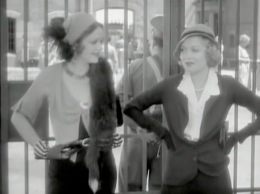
In today’s scene that I love, McCrea and Lake meet for the first time.
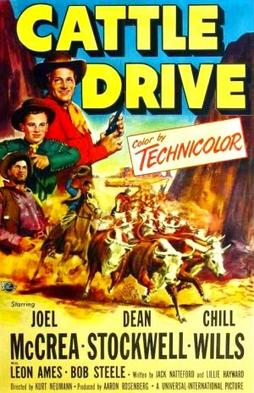
In this coming-of-age Western, Dean Stockwell plays Chester Graham, Jr., the spoiled and unruly son of a railroad owner (Leon Ames). While riding on his father’s train and making trouble for the conductor, Chester overhears his father talking about sending him to a military school. When the train makes as top, Chester impulsively runs away. The train leaves without him and Chester finds himself stranded in the middle of the wilderness. That’s when he sees cowboy Dan Matthews (Joel McCrea) trying to catch a wild stallion.
Dan is a part of a cattle drive. Knowing that he can’t leave Chester to die in the wilderness, Dan brings him back to his camp. The other members of the company aren’t too keen on having to look after a spoiled brat along with the cattle and Chester isn’t too happy to hear that he’ll be expected to work if he expects to get fed. But with no choice but to work together, Chester, Dan, and the rest of the company make the journey to Santa Fe. Chester finally drops his attitude enough to work with the company’s cook (Chill Wills) while Dan deals with a rival cowboy named Currie (Henry Brandon). Chester learns about responsibility and Dan finally finds the courage to consider settling down.
Of the many westerns that Joel McCrea made over the course of his career, he considered Cattle Drive to be his favorite and it’s easy to see why. Cattle Drive features McCrea doing what he did best, playing a tough but good-hearted and down-to-earth cowboy who looked after an outsider. If you were ever lost in the old west, Joel McCrea is precisely the type of cowboy that you would hope would come to your rescue. The plot features almost every single cattle drive cliché that you could imagine but McCrea plays his role with a winning combination of grit and compassion and he and Dean Stockwell, who is also very good, make a good team. Shot in Death Valley and Utah, Cattle Drive feels and look authentic and should be enjoyed by anyone looking for good, heartfelt western.
Zaroff is a Russian nobleman and a hunting enthusiast. However, he’s grown bored with hunting the usual big game trophies. Those don’t provide enough of a challenge for him. Instead, he prefers to hunt humans because humans are the most dangerous game. Humans can think. Humans are clever. Humans are deadly. When big game hunter Bob Rainsford washes up on the island after a shipwreck, he is discovered by Zaroff’s men. Rainsford discovers that Zaroff is a fan of his work. Rainsford also learns that Zaroff is planning to hunt him next.
It’s a tale that we’ve all heard, in one form or another. Ever since Richard Connell’s original short story was published in 1924, The Most Dangerous Game has inspired a countless number of adaptations. Some of those have been direct adaptations while others have merely been inspired by Connell’s plot but, in the end, they all have the same thing in common. No animal is more dangerous than man.
As far as my research has revealed, the very first cinematic adaptation of The Most Dangerous Game came out in 1932. It was produced by Ernest Schoedsack and Merian C. Cooper, the same team that would later be responsible for the original King Kong. Joel McCrea played Rainsford while Zaroff is played by Leslie Banks. In order to provide some romance and perhaps to pad out the film to over an hour, a few extra shipwreck survivors are added. There’s two sailors who don’t last long. There’s also Eve Trowbridge and her brother, Martin. Eve and Martin are played by Fay Wray and Robert Armstrong, both of whom would star in King Kong. Zaroff’s imposing servant, Ivan, is played by Noble Johnson who also appeared in King Kong. Are you picking up on a theme here?’
Other than the addition of the extra characters, this film version is pretty faithful to its source material. Again, we have Zaroff “rescuing” Rainsford and then having a long philosophical discussion with him before announcing that it is Rainsford who will be hunted. Unsurprisingly, the film’s Rainsford is a bit more heroic than the one who appears in the short story. The literary Rainsford looks forward to defeating Zaroff at his own game while the film’s Rainsford is more concerned with getting off the island and protecting Eve.
All in all, it’s an entertaining film. Of course, by today’s standards, it’s a bit creaky. I mean, the film is 88 year old. Still, Joel McCrea remains a convincing and compelling hero while Leslie Banks is enjoyably hammy in the role of Zaroff. Zaroff is a role that calls for an actor who is willing to give into his most theatrical impulses and Banks doesn’t let the film down. The jungle scenery is properly shadowy and even the miniatures used during the shipwreck sequence have a charm all their own.
Unfortunately, The Most Dangerous Game is one of those films that has slipped into the public domain. As a result, there’s a lot of less-than perfect versions floating around. (The version that I recently watched on YouTube was so grainy that it was nearly unwatchable.) Fortunately, this film is a part of the Criterion Collection. That’s the one to add to your collection.
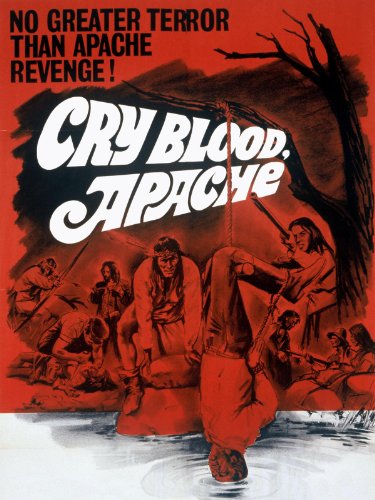
A group of old west outlaws stumble across an Apache camp. Though everyone’s friendly at first, the outlaws discover that the Apaches have gold so they kill all of the Apaches except for one, Jemme (Maria Gahua). They drag Jemme off with them, intent on having their way with her after forcing her to lead them to more gold. Only one member of the gang, Pitcallin (Jody McCrea), is willing to protect Jemme and treat her with kindness. (In fact, Pitcallin is such a nice and decent person that it doesn’t make any sense for him to be riding with the outlaws in the first place.) Meanwhile, Jemme’s brother (Marcus Rudnick) discovers the camp and, upon discovering his family dead, cries and screams for several minutes. Then he sets off for revenge against the gang.
The best thing about Cry Blood, Apache is that it opens with Joel McCrea, father of Jody, playing the elderly Pitcallin and riding his horse to the where the old Apache camp used to be. While the old Pitcallin is looking around, he hears the voices of the former members of the gang and then the rest of the film is told in flashback. This makes it seem like Cry Blood, Apache is going to be about an old outlaw coming to terms with the terrible things that happened in the past. Unfortunately, Joel McCrea’s only in the movie for about two minutes and since the movie sat on the shelf for three years before it was finally released, it’s probable that his scenes were shot long after the rest of the movie. Along with starring in the film, Jody McCrea also produced it and Joel probably only agreed to lend some star power to the movie as a favor to his son. But teasing western fans with Joel McCrea, just to then bring out Jody McCrea is just plain unfair.
Other than the opening scenes with Joel McCrea, the rest of this film is so poorly put together that it’s a struggle to sit through. Cry Blood, Apache is edited in such a haphazard manner that it’s nearly impossible to follow the plot. While the gang searches for more gold, Jemme’s brother searches for the gang but the film never makes it clear how close the brother is to finding the gang so there’s zero suspense generated. Jody McCrea was too naturally amiable to play a believable outlaw. There was nothing tough about him. Meanwhile, both Marcus Rudnick and Maria Gahua overact to such an extent that scenes that should be emotionally wrenching become unintentionally humorous instead.
Cry Blood, Apache was directed by Jack Starrett, who went on to direct far better movies than this one. He also appears in the film as a member of the gang, the bible-quoting Deacon. Even though he’s got long hair and is considerably younger in his film, most viewers will hear his voice and immediately recognize him as Galt, the sadistic cop from First Blood.
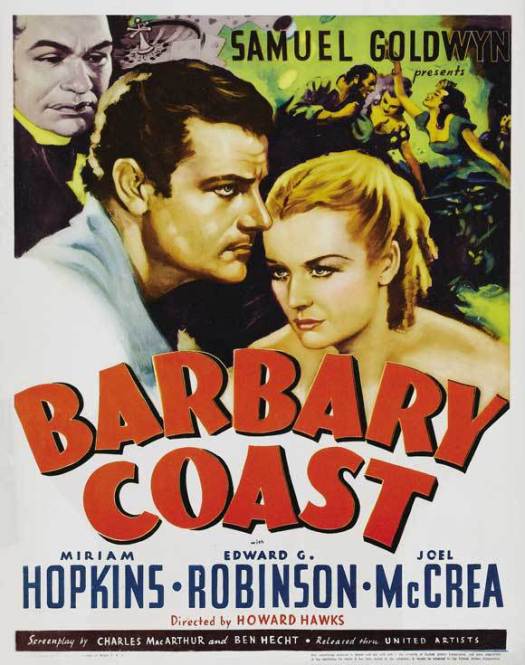
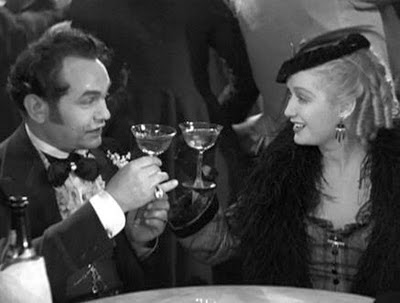
BARBARY COAST probably would’ve been better had it been made during the Pre-Code era. Don’t misunderstand; I liked the film. It’s an entertaining period piece directed by Howard Hawks , with his trademark overlapping dialog and perfect eye for composition, rivaled by only a handful (Ford and Hitchcock spring immediately to mind). But for me, this tale of rowdy San Francisco during California’s Gold Rush was too sanitized by Hays Code enforcer Joseph Breen, who demanded major script changes by screenwriters Ben Hecht and Charles MacArthur.
The result is a film that’s just misses the classic status mark. It’s 1849, and Susan Rutledge arrives in Frisco to marry her rich boyfriend, who has struck it rich in the gold strike. When she finds out he’s been killed by gambling czar Luis Chandalis, owner of the Bella Donna saloon, avaricious Susan sets her sights on him. Chandalis becomes enamored of her…
If someone you know is one of those film fans wondering what’s all the hubbub about “Pre-Code” films, may I make a suggestion? Watch BED OF ROSES with them, a totally amoral concoction from director Gregory LaCava , with Constance Bennett and Pert Kelton getting about as sinful as Stormy Daniels without actually performing onscreen sex! This one’ll have your eyes popping out seeing what they could get away with back in 1933, when the Great Depression was at its lowest and lust was riding high!
Lorry Evans (our gal Constance) and her pal Minnie Brown (the devilishly delightful Kelton) have just been released from a Louisiana slammer after serving time for hooking. You’d think they’d have learned their lesson, but no… soon as they get out, Minnie sweet talks a trucker for a ride, offering to pay by hopping in the back with him while Lorry drives! These two…
(When Maddy Loves Her Classic Films invited me to join in on the Alfred Hitchcock Blogathon, I jumped at the chance! I’ve just completed the Ball State/TCM 50 YEARS OF HITCHCOCK course, and have been knee-deep in his movies for a month now!)
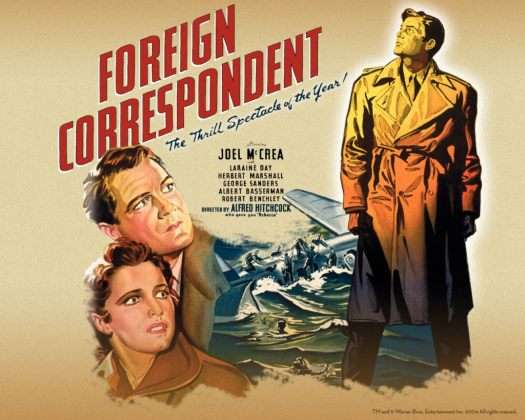
Alfred Hitchcock’s second American film found the Master of Suspense back in the spy game with FORGEIGN CORRESPONDENT, this time with American star Joel McCrea caught up in those familiar “extraordinary circumstances” we’ve all come to love. Like REBECCA that same year, this film was nominated for Best Picture, an extraordinary circumstance indeed for a director new to these shores. Offhand I can only think of three other directors to hold that distinction – John Ford (also in ’40), Sam Wood (1942), and Francis Ford Coppola (1974). Good company, to say the least! (And please correct me if I’m wrong, any of you film fans out there).
I’m no expert on Preston Sturges, having seen only two of his films, but after viewing SULLIVAN’S TRAVELS I now have a craving to see them all! This swift (and Swiftian) satire on Hollywood stars Joel McCrea as a successful slapstick comedy director yearning to make important, socially conscious films who gets more than he bargained for when he hits the road to discover what human misery and suffering is all about.
John L. “Sully” Sullivan sets his studio bosses on their collective ear when he tells them he wants to film an adaptation of ” O Brother, Where Art Thou?”, a serious novel by ‘Sinclair Beckstein’. The head honcho balks, wanting Sully to do another comedy, but Sully’s not dissuaded, deciding to see what life among the downtrodden is first-hand. He dresses in rags and sets out on his quest, followed by a gaggle of PR flacks in a bus. Somehow he…
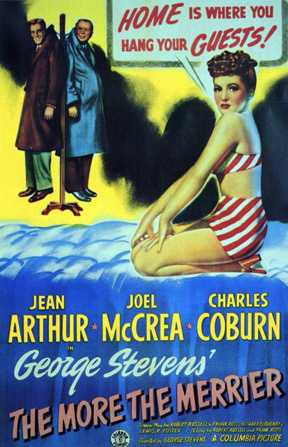
After I finished with Watch On The Rhine, I decided to watch another film from 1943. Like Watch On The Rhine, The More The Merrier is a film about life during wartime and it takes place in Washington, D.C. However, that’s all that they have in common. Whereas Watch On The Rhine was a serious and somber affair, The More The Merrier is thoroughly delightful little comedy.
The More The Merrier opens with a retired millionaire named Benjamin Dingle (Charles Coburn) arriving in Washington D.C. He’s been asked to serve as an adviser for a commission that has been tasked with solving America’s housing shortage. (This was apparently a very real concern during World War II.) However, as soon as Dingle arrives, he finds directly effected by the problem that he’s supposed to be solving. His hotel room won’t be available for two days and he has no where to stay. After a quick look through the newspaper, Ben finds an ad for a roommate.
When he arrives at the apartment, he discovers a long line of men waiting outside. They’re all in the same situation as him and are hoping that Connie Milligan (Jean Arthur) will select him for her roommate. However, Connie picks Ben, largely because he’s old and rich and she won’t have to worry about him hitting on her on like most guys nor does she have to worry about him borrowing her clothes or getting jealous of her, like she would have to with a female roommate. Connie is engaged to a boring but well-paid bureaucrat named Charles Pendergrast (Richard Gaines). She doesn’t really love Pendergrast (and he has an annoying habit of shushing her) but, after growing up poor because her mother married for love, Connie is determined to not to make the same mistake.
Ben and Connie struggle, at first, to adjust to each other’s habits. Connie keeps to an exact schedule and claims to not have any use for frivolity. Ben is the exact opposite. The early scenes of them trying (and, of course, failing) to stay out of each other’s way are hilarious, with both Coburn and Arthur giving brilliant comedic performances. (I’m jealous of how wonderfully Jean Arthur could express exasperation.) Connie’s apartment is already small and it gets even smaller once she sublets half of it to Benjamin Dingle.
However, things are about to get even more crowded. One day, while out exploring Washington, Ben runs into Joe Carter (Joel McCrea), a sergeant who has a few days before he’s scheduled to be shipped overseas and who has no place to stay. Generously, Ben agrees to sublet half of his half of the apartment to Joe. Of course, Ben does this without telling Connie.
When, after another hilarious and artfully done sequence of the three new roommates wandering around the apartment and just barely missing each other, Connie discovers what Ben has done, she orders both Ben and Joe to leave the apartment. Ben agrees to do so, if she gives him back his security deposit. Unfortunately, Connie already spent that money on a hat…
So, they’re stuck together. Connie is attracted to Joe and Joe to Connie but Connie is also determined to marry Pendergrast. (When Joe scornfully says that he bets Pendergrast combs his hair “every hour on the hour,” Connie snaps back, “Mr. Pendergrast has no hair!”) Fortunately, Ben — being older and wiser — can see that Joe and Connie are perfect for each other and he starts doing everything he can to bring the two together.
As Ben says more than once, “Damn the torpedoes! Full speed ahead!”
Jean Arthur is one of my favorite actresses of Hollywood’s Golden Age. She had this perfect “no bullshit” attitude, mixed with an unexpected vulnerability. In The More The Merrier, she’s just as credible when she’s ordering Ben and Joe to leave as when she’s breaking into tears after she catches Ben reading her diary. In the role of Ben, Charles Coburn is warm, kind, and wonderfully eccentric. (When Joe asks him what does for a living, Ben cheerfully replies, “I’m a well-to-do retired millionaire. How ’bout you?”) And then you have Joel McCrea, in the role of the “cute but dumb” Joe Carter. He’s not really that dumb but he certainly is cute. Wisely, McCrea never tries to be funny. Instead, he gets most of his laughs just by reacting to all of the craziness going on around him.
Briskly directed by George Stevens, The More The Merrier features a snappy script from Frank Ross, who was married to Jean Arthur. It’s full of hilarious lines but, at the same time, there’s an undercurrent of melancholy to it as well. Hanging, like a shadow over all of the comedy and the romance, is the fact that Joe is soon going to be shipped overseas. Even while you laugh, you’re very aware that there’s a chance he might not be coming back. That reality brings an unexpected depth to the film’s otherwise cheerful love story.
The More The Merrier was nominated for best picture but it lost to Casablanca. However, Charles Coburn did win the Oscar for best supporting actor.
Before watching a film like 1940’s Foreign Correspondent, it helps to know a little something about history.
Nowadays, when we think about World War II, there’s a tendency to assume that, from the minute that Hitler came to power in Germany and started to invade the rest of Europe, the entire world united against the Nazis. The truth is actually far more complex. The world was still recovering from World War I and throughout the 1930s, even as the Axis powers were growing more and more aggressive, respected intellectual leaders and politicians continued to argue that peace must be maintained at all costs. Pacifism was such a popular concept that otherwise intelligent people were perfectly willing to make excuses for Hitler and Mussolini. For five years, the UK followed a policy of appeasement towards Nazi Germany. Even after war broke out between Britain and Germany, the U.S. remained officially neutral. In the 1940 presidential election, President Franklin D. Roosevelt — running on a platform of neutrality — was overwhelmingly reelected over internationalist Wendell Willkie.
Foreign Correspondent, an American film made by a British director, opens before the start of World War II. An American newspaper editor, Mr. Powers (Harry Davenport), is frustrated because none of his foreign correspondents seem to be able to understand the truth of the situation in Europe. They all claim that there is going to be no war in Europe but Mr. Powers feels differently. He also feels that the newspaper’s most celebrated and respected foreign correspondents are just a bunch of out-of-touch elitists. Instead of sending another upper class academic, Mr. Powers decides to send a hard-boiled crime reporter to cover the situation in Europe. Johnny Jones (Joel McCrea) has never been to Europe and that’s exactly why Mr. Powers decides to send him. In one of the film’s more clever moments, he does, however, insist that Johnny write under the more distinguished sounding name of “Huntley Haverstock.”
(Foreign Correspondent‘s pointed criticism of out-of-touch elitists repeating the establishment line remains just as relevant today as it was in 1940.)
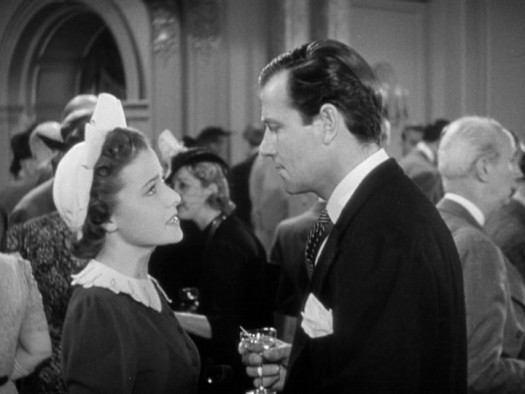
From the minute the brash and tough Johnny arrives in Europe, he finds himself caught up in a huge conspiracy. He’s been assigned to report on a group known as the Universal Peace Party and, since this film was directed by Alfred Hitchcock, we automatically know that any organization with the word “Peace” in its name has to be up to something shady. The Universal Peace Party has been founded by Stephen Fisher (Herbert Marshall), who appears to sincere in his desire to avoid war. Johnny meets and falls in love with Fisher’s daughter, Carol (Laraine Day).
From the minute that Johnny witnesses the assassination of distinguished Dutch diplomat Von Meer (Albert Bassermann), he suspects that things are not how they seem. Working with Carol and a British journalist named Scott ffolliot* (delightfully played by the great George Sanders), Johnny discovers that Von Meer was not killed at all. Instead, a double was assassinated and Von Meer was kidnapped by a group of spies.
But who are the spies? After nearly getting killed by one of Fisher’s bodyguards, Johnny starts to suspect that Stephen Fisher might not be as into world peace as was originally assumed. Complicating matters, however, is the fact that Johnny is now engaged to marry Carol…
Foreign Correspondent is a wonderfully witty thriller, one that has a very serious message. While the film is distinguished by Hitchcock’s typically droll sense of humor (eccentric characters abound and the scene where Edmund Gwenn keeps getting interrupted before he can attempt to push Joel McCrea off of a tower is both funny and suspenseful), the film’s message was that America could not afford to stay neutral as war broke out across Europe. As the all-American Johnny Jones says at the end of the film:
“All that noise you hear isn’t static – it’s death, coming to London. Yes, they’re coming here now. You can hear the bombs falling on the streets and the homes. Don’t tune me out, hang on a while – this is a big story, and you’re part of it. It’s too late to do anything here now except stand in the dark and let them come… as if the lights were all out everywhere, except in America. Keep those lights burning, cover them with steel, ring them with guns, build a canopy of battleships and bombing planes around them. Hello, America, hang on to your lights: they’re the only lights left in the world!”
Foreign Correspondent was nominated for best picture of 1940 but it lost to another far different Hitchcock-directed film, Rebecca.
——
* Yes, that is how he spells his last name. As he explains, his family dropped the capital name in his surname after an ancestor was executed by Henry II. Since it was George Sanders doing the explaining, it somehow made perfect sense.





 Through the Shattered Lens