Before watching a film like 1940’s Foreign Correspondent, it helps to know a little something about history.
Nowadays, when we think about World War II, there’s a tendency to assume that, from the minute that Hitler came to power in Germany and started to invade the rest of Europe, the entire world united against the Nazis. The truth is actually far more complex. The world was still recovering from World War I and throughout the 1930s, even as the Axis powers were growing more and more aggressive, respected intellectual leaders and politicians continued to argue that peace must be maintained at all costs. Pacifism was such a popular concept that otherwise intelligent people were perfectly willing to make excuses for Hitler and Mussolini. For five years, the UK followed a policy of appeasement towards Nazi Germany. Even after war broke out between Britain and Germany, the U.S. remained officially neutral. In the 1940 presidential election, President Franklin D. Roosevelt — running on a platform of neutrality — was overwhelmingly reelected over internationalist Wendell Willkie.
Foreign Correspondent, an American film made by a British director, opens before the start of World War II. An American newspaper editor, Mr. Powers (Harry Davenport), is frustrated because none of his foreign correspondents seem to be able to understand the truth of the situation in Europe. They all claim that there is going to be no war in Europe but Mr. Powers feels differently. He also feels that the newspaper’s most celebrated and respected foreign correspondents are just a bunch of out-of-touch elitists. Instead of sending another upper class academic, Mr. Powers decides to send a hard-boiled crime reporter to cover the situation in Europe. Johnny Jones (Joel McCrea) has never been to Europe and that’s exactly why Mr. Powers decides to send him. In one of the film’s more clever moments, he does, however, insist that Johnny write under the more distinguished sounding name of “Huntley Haverstock.”
(Foreign Correspondent‘s pointed criticism of out-of-touch elitists repeating the establishment line remains just as relevant today as it was in 1940.)
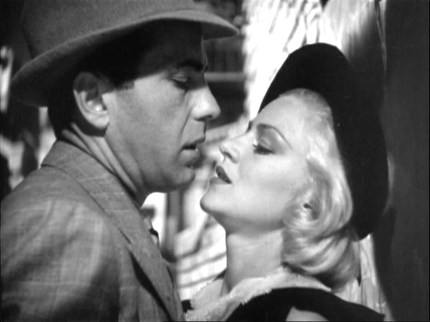
From the minute the brash and tough Johnny arrives in Europe, he finds himself caught up in a huge conspiracy. He’s been assigned to report on a group known as the Universal Peace Party and, since this film was directed by Alfred Hitchcock, we automatically know that any organization with the word “Peace” in its name has to be up to something shady. The Universal Peace Party has been founded by Stephen Fisher (Herbert Marshall), who appears to sincere in his desire to avoid war. Johnny meets and falls in love with Fisher’s daughter, Carol (Laraine Day).
From the minute that Johnny witnesses the assassination of distinguished Dutch diplomat Von Meer (Albert Bassermann), he suspects that things are not how they seem. Working with Carol and a British journalist named Scott ffolliot* (delightfully played by the great George Sanders), Johnny discovers that Von Meer was not killed at all. Instead, a double was assassinated and Von Meer was kidnapped by a group of spies.
But who are the spies? After nearly getting killed by one of Fisher’s bodyguards, Johnny starts to suspect that Stephen Fisher might not be as into world peace as was originally assumed. Complicating matters, however, is the fact that Johnny is now engaged to marry Carol…
Foreign Correspondent is a wonderfully witty thriller, one that has a very serious message. While the film is distinguished by Hitchcock’s typically droll sense of humor (eccentric characters abound and the scene where Edmund Gwenn keeps getting interrupted before he can attempt to push Joel McCrea off of a tower is both funny and suspenseful), the film’s message was that America could not afford to stay neutral as war broke out across Europe. As the all-American Johnny Jones says at the end of the film:
“All that noise you hear isn’t static – it’s death, coming to London. Yes, they’re coming here now. You can hear the bombs falling on the streets and the homes. Don’t tune me out, hang on a while – this is a big story, and you’re part of it. It’s too late to do anything here now except stand in the dark and let them come… as if the lights were all out everywhere, except in America. Keep those lights burning, cover them with steel, ring them with guns, build a canopy of battleships and bombing planes around them. Hello, America, hang on to your lights: they’re the only lights left in the world!”
Foreign Correspondent was nominated for best picture of 1940 but it lost to another far different Hitchcock-directed film, Rebecca.
——
* Yes, that is how he spells his last name. As he explains, his family dropped the capital name in his surname after an ancestor was executed by Henry II. Since it was George Sanders doing the explaining, it somehow made perfect sense.
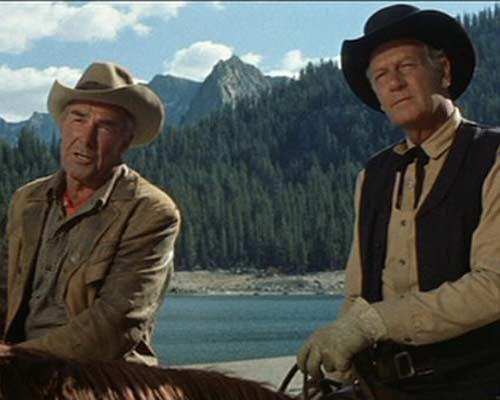
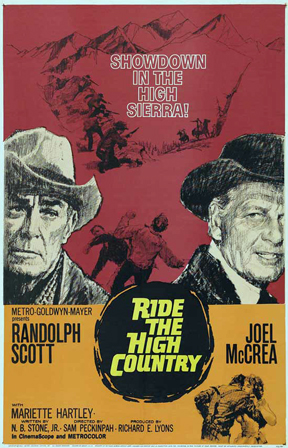 It’s the turn of the 20th century and the Old West is fading into legend. When they were younger, Steve Judd (Joel McCrea) and Gil Westrum (Randolph Scott) were tough and respect lawmen but now, time has passed them by. Judd now provides security for shady mining companies while Gil performs at county fairs under the name The Oregon Kid. When Judd is hired to guard a shipment of gold, he enlists his former partner, Gil, to help. Gil brings along his current protegé, Heck Longtree (Ron Starr).