Ray (Armand Assante) is a formerly viscous ex-con who has just gotten out of prison and is now determined to go straight and live on the right side of the law. After spending nearly a decade behind bars, all he wants to do is to reunite with his girlfriend, Lacy (Marcia Gay Harden), and make her his wife. However, there’s a problem. While Ray was locked up, Lacy moved on. She’s now engaged to Elliott (Sam Neill), a liberal attorney who, unlike Ray, is a pacifist. Even though Lacy is still attracted to Ray, she does not want to get back together with him.
Unfortunately, there’s a second problem. Ray may have gone straight but his former criminal associates don’t believe him. They want Ray to help them pull off a major crime and when Ray says that is no longer his thing, they react by kidnapping Lacy. If Ray ever wants to see Lacy again, he’s now got to return to his life of crime.
There’s also a third problem. Ray may be an experienced criminal but Elliott insists on tagging along with him while he’s following the kidnappers’s orders. So now, Ray not only has to commit several crimes but he has to do it with an inexperienced partner who doesn’t even believe in firing guns!
Fever is one of those HBO films that used to show up all the time on cable in the 90s. I watched it a few times back in the day, just because I was a teenage boy and the movie featured a good deal of nudity. Even at that time, though, I thought it was a slow and frequently boring movie. Rewatching it for this review, I was shocked to discover that it was even slower than I remembered. It seems like it takes forever for Ray and Elliott to finally team up and for the movie to get going. Though the plot description may make it sound like a buddy comedy, it’s actually a very tough and grim picture. Armand Assante and Sam Neill are not actors known for their light touch and they both give very serious and gritty performances. Unfortunately, the film’s pace never really matched the intensity of its stars and the film’s storyline isn’t strong enough to hold up under scrutiny. Once you start to wonder if Ray would really let Elliott tag along with him, the movie itself falls apart.
Armand Assante is a good actor who rarely seems to appear in good films. Fever is a good example of that. Assante gives an excellent and complex performance (and both Sam Neill and Marcia Gay Harden are pretty good too) but Fever itself never really clicks.
For my next back to school review, I want to take a look at one of the best films that you’ve probably never heard of, the 1986 made-for-TV film Brotherhood Justice!
Brotherhood of Justice takes place at a California high school. It’s a school that is pretty much ruled by the football team and the divide between the children of the upper and the working class is often violently apparent. After several acts of violence, drug dealing, and vandalism, the school’s principal (Joe Spano) is left with a choice. He can either hire full-time security guards and turn his school into an armed camp or he can meet with the most popular seniors and ask them to do their part to maintain order at the school.
He goes with the latter option.
At first, quarterback Derek (Keanu Reeves) is excited about doing his part to make the school a better place. He and his friends quickly form the Brotherhood of Justice and make out a list of trouble makers. At first, Derek and his friends are just roughing up drug dealers and demanding that all students show some school pride. (In order to maintain their anonymity, they all wear masks to hide their faces. However, no effort is made to disguise anyone’s voice, which means that this film takes place in a world where no one can recognize the voice of Keanu Reeves.) However, things quickly escalate. One member of the Brotherhood — Les (Billy Zane) — is especially enthusiastic and he has a thing for knives.
Meanwhile, Derek is having issues with his girlfriend, Christie (Lori Loughlin). Christie, who is apparently incapable of recognizing her boyfriend’s voice whenever he’s wearing a mask, thinks that the Brotherhood is idiotic. Christie also has a new job as a waitress and one of her co-workers is Victor (Kiefer Sutherland). Victor obviously likes Christie and he also bravely stands up to the Brotherhood when they try to harass a student who is named Pasty. (I kid you not.)
When Derek grows disillusioned with the Brotherhood, they decide that the situation with Christie must be distracting him. So, they decide to blow up Victor’s car…
It’s all in the name of justice!
Obviously, one of the best things about Brotherhood of Justice is that it’s a chance to see Neo and Jack Bauer compete over Aunt Becky while Cal Hockley plays with a switch blade in the background. (Oddly enough, Derek’s younger brother is played by Danny Nucci, who later appeared with Zane in Titanic.) But there’s more to Brotherhood of Justice than just the curiosity value of the cast.
That plot hole about the voices aside, Brotherhood of Justice is actually a really good movie and one that everyone should watch. If anything, it’s even more relevant today than it probably was when it was originally made. It’s easy to be dismissive of the self-righteous and judgmental Brotherhood but actually, how different are they from the outrage brigade who show up everyday on twitter? When the Brotherhood demands that everyone follow the rules and love their school, how different are they from those assholes who, today, claim that anyone who disagrees with the president or questions the moral authority of the government is somehow guilty of treason? If the Brotherhood existed today, they would be cyberbullying and doxxing anyone who they felt had failed to say or think the right thing.
Let’s face it — we currently live in a fascist culture. In its own modest but important way, Brotherhood of Justice is one of those films that can tell us why.
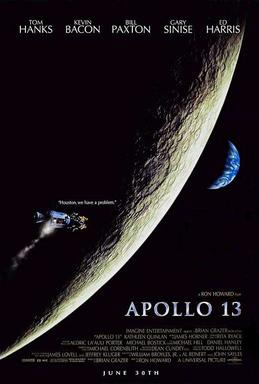
I just finished watching the TCM premiere of the 1995 Best Picture nominee, Apollo 13. Of course, it wasn’t the first time I had seen it. Apollo 13 is one of those films that always seems to be playing somewhere and why not? It’s a good movie, telling a story that is all the more remarkable and inspiring for being true. In 1970, the Apollo 13 flight to the moon was interrupted by a sudden explosion, stranding three astronauts in space. Fighting a desperate battle against, NASA had to figure out how to bring them home. Apollo 13 tells the story of that accident and that rescue.
There’s a scene that happens about halfway through Apollo 13. The heavily damaged Apollo 13 spacecraft is orbiting the moon. Originally the plan was for Apollo 13 to land on the moon but, following that explosion on the craft, those plans have been cancelled. Inside the spacecraft, three astronauts can only stare down at the lunar surface below them.
As Commander Jim Lovell stares out the craft’s window, we suddenly see him fantasizing about what it would be like if the explosion hadn’t happened and if he actually could fulfill his dream of walking on the moon. We watch as Lovell (and, while we know the character is Jim Lovell, we are also very much aware that he’s being played by beloved cinematic icon Tom Hanks) leaves his foot print on the lunar surface. Lovell opens up his visor and, for a few seconds, stands there and takes in the with the vastness of space before him and making the scene all the more poignant is knowing that Tom Hanks, before he became an award-winning actor, wanted to be a astronaut just like Jim Lovell. Then, suddenly, we snap back to the film’s reality. Back inside the spacecraft, Lovell takes one final look at the moon and accepts that he will never get to walk upon its surface. “I’d like to go home,” he announces.
It’s a totally earnest and unabashedly sentimental moment, one that epitomizes the film as a whole. There is not a hint of cynicism to be found in Apollo 13. Instead, it’s a big, old-fashioned epic, a story about a crisis and how a bunch of determined, no-nonsense professionals came together to save the day. “Houston,” Lovell famously says at one point, “we have a problem.” It’s a celebrated line but Apollo 13 is less about the problem and more about celebrating the men who, through their own ingenuity, solved that problem.
That Apollo 13 is a crowd-pleaser should come as no surprise. It was directed by Ron Howard and I don’t know that Howard has ever directed a film that wasn’t designed to make audiences break into applause during the end credits. When Howard fails, the results can be maudlin and heavy-handed. But when he succeeds, as he does with Apollo 13, he proves that there’s nothing wrong with old-fashioned, inspirational entertainment.
Of course, since Apollo 13 is a Ron Howard film, that means that Clint Howard gets a small role. In Apollo 13, Clint shows up as a bespectacled flight engineer. When astronaut Jack Swiggert (Kevin Bacon) mentions having forgotten to pay his taxes before going into space, Clint says, “He shouldn’t joke about that, they’ll get him.” It’s a great line and Clint does a great job delivering it.
Apollo 13 is usually thought of as being a Tom Hanks film but actually, it’s an ensemble piece. Every role, from the smallest to the biggest, is perfectly cast. Not surprisingly, Bacon, Bill Paxton, Gary Sinise, Kathleen Quinlan, and Ed Harris all turn in excellent performances. But, even beyond the marquee names, Apollo 13 is full of memorable performances. Watching it tonight, I especially noticed an actor named Loren Dean, who played a NASA engineer named John Aaron. Dean didn’t get many lines but he was totally believable in his role. You looked at him and you thought, “If I’m ever trapped in space, this is the guy who I want working to bring me home.”
Apollo 13 was nominated for best picture but it lost to Mel Gibson’s film Braveheart. Personally, out of the nominees, I probably would have picked Sense and Sensibility but Apollo 13 more than deserved the nomination.
Well, this is certainly intimidating. I know I’ve said this many time before but it deserves to be repeated: it’s often a hundred times more difficult to review a great film than it is to review a merely mediocre one. When a film fails, it’s usually easy to say why. The acting was bad. The directing was uninspired. The plot didn’t make any sense. Or maybe the film has been so overpraised that you, as a reviewer, are almost obligated to be tougher on it than you would be with any other film. However, it’s never as easy to put into words just what exactlyit is that makes a movie great.
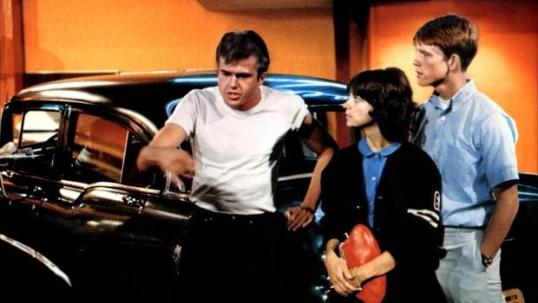
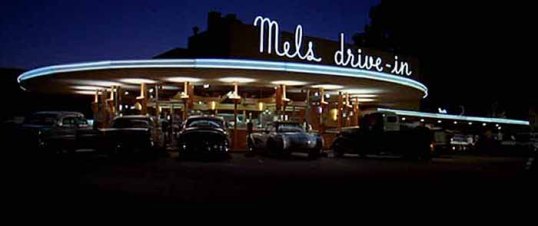
Take the 1973 Best Picture nominee American Graffiti for instance. I could tell you that this is a very well-acted film and that it features an ensemble of very likable performers, many of whom subsequently went on to become stars and celebrated character actors. Then again, you can say the same thing about countless other films.
I could say that director George Lucas does such a good job putting this film together that it’s hard to believe that he’s the same man who would later be responsible for all three of the Star Wars prequels. Then again, I could also say the same thing about how odd it is that the same man who directed the entertaining Final Destination 5was also responsible for the far less enthralling Into The Storm.
I could tell you that the film serves as a valuable time capsule in that not only does it feature a loving recreation of small town America in the early 60s but that it’s also a chance to see what Richard Dreyfuss, Ron Howard, and Charles Martin Smith all looked like when they still had hair. But then again, I also praised The Young Graduates for being a time capsule as well.
Let’s face it — it’s difficult to define the intangible qualities that make a film great. Often times, it’s a case of simply knowing it when you see it. I’ve seen American Graffiti a few times. The last time I saw it was at a special Sunday showing at the Alamo Drafthouse. And, on that early Sunday afternoon, the theater was packed with people who had paid for the chance to see the 40 year-old film on the big screen. I’m 28 years old and it’s significant that, while the majority of the audience was older than me, there were quite a few people who were younger. American Graffiti is one of those films that obviously spoke to audiences when it was first released and continues to speak to audiences today.
As I mentioned in my review of Rebel Without A Cause, films about teens tend to age quickly and, often times, one generation’s masterpiece will turn out to be a later generation’s joke. When a film like Rebel or American Graffiti survives the test of time, it’s because the film has managed to capture a universal truth about what it means to be young and to have your entire life ahead of you.
American Graffiti takes place over the course of one long night in Modesto, California in 1962. The film follows several different characters, the majority of whom have just graduated from high school. What these characters all have in common is that one phase of their life has ended and a new one is about to begin. Over the course of that one night, all of them are forced to say goodbye to their past identities and, in some instances, are forced to face their future.
For instance, there’s Curt (an amazingly young Richard Dreyfuss), a neurotic intellectual who spends the night trying to decide whether or not he actually wants to leave for college in the morning. Complicating Curt’s decision is a mysterious blonde who mouths “I love you” at him before driving away. While searching for her, Curt finds himself unwillingly recruited into the Pharoahs, a somewhat ludicrous small town gang that’s led by Joe (played, in hilariously clueless fashion, by Bo Hopkins.) Curt, incidentally, is my favorite character in the film. He’s just adorable, which admittedly is not a reaction that one often has to Richard Dreyfuss.
(Curt is also featured in one of my favorite scenes, in which he smokes a cigarette with a lecherous teacher named Mr. Wolf.)
Curt’s sister (Cindy Williams) is dating Steve Bolander (Ron Howard). Steve is the former class president and, unlike Curt, he’s very excited about leaving home. Ron Howard gives such a likable performance that it actually takes a few viewing to realize just how big of a jerk Steve really is.
And then there Terry (Charles Martin Smith) who wears big glasses and has bad skin. Terry gets to spend the night driving around in Steve’s car and manages to pick up a girl named Debbie (Candy Clark). For Terry, this is his night to actually be somebody and what makes it all the more poignant is just how obvious it is that Terry will probably never get another chance. Though he may not realize it, those of us watching understand that this is literally going to the be the best night of Terry’s life.
(Incidentally, much like Ron Howard, Charles Martin Smith would go on to become a film director and gave the world the amazingly sweet Dolphin Tale.)
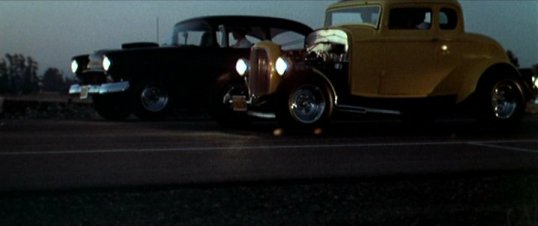
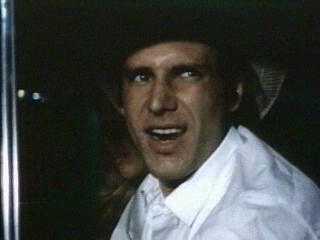
And finally, there’s John Milner (Paul Le Mat). John is a little older than the other main characters. He spends most of his time in his car, driving around and getting challenged to race. He’s the epitome of late 50s/early 60s cool, with an attitude and a look that he obviously borrowed from James Dean and Marlon Brando. Over the course of the night, he is forced to deal with a bratty 13 year-old stowaway (MacKenzie Phillips) and a mysterious challenger named Bob Falfa (played by a youngish Harrison Ford, who wears a cowboy hat and speaks with a country twang).
The film follows these characters through the night and then, at the end of it, we get the famous epilogue where we discover that all of the male characters have pretty much ended up exactly how we thought they would. In some cases, that’s a good thing. And in other cases, it’s not. It’s a good ending that’s kept from being great by the fact that none of the film’s female characters rate so much as even a mention.
So, what else can be said about American Graffiti?
 Ray (Armand Assante) is a formerly viscous ex-con who has just gotten out of prison and is now determined to go straight and live on the right side of the law. After spending nearly a decade behind bars, all he wants to do is to reunite with his girlfriend, Lacy (Marcia Gay Harden), and make her his wife. However, there’s a problem. While Ray was locked up, Lacy moved on. She’s now engaged to Elliott (Sam Neill), a liberal attorney who, unlike Ray, is a pacifist. Even though Lacy is still attracted to Ray, she does not want to get back together with him.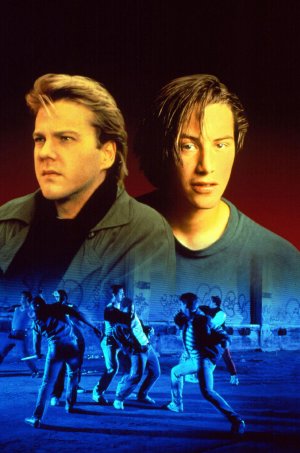



 Through the Shattered Lens