In the old west, a cowboy named Emmet (Scott Glenn) teams up with a reformed outlaw named Paden (Kevin Kline) and they bust Emmet’s wild younger brother, Jake (Kevin Costner), out of jail. After Mal (Danny Glover) helps the three of them escape from a posse, they all end up going to the town of Silverado, where all four of them have business. Emmett and Jake want to protect their sister from the corrupt son (Ray Baker) of a cattle baron who was previously killed by Emmett. Mal wants to save his sister Rae (Lynn Whitfield) from an evil gambler (Jeff Goldblum). Paden discovers that Cobb (Brian Dennehy), his former partner-in-crime, is now the sheriff of Silverado and working for the cattle barons. When Paden tries to protect the new settlers (including Rosanne Arquette), it leads to a confrontation with his former partner.
In the 80s, when he wasn’t directing films like The Big Chill and The Accidental Tourist, Lawrence Kasdan specialized in paying homage to the films of Hollywood’s golden age. He started his directorial career with Body Heat, a modern film noir. He worked on the screenplays of both Empire Strikes Back and Raiders of the Lost Ark. With Silverado, Kasdan tried to resurrect the western.
Silverado is a traditional western with a few modern touches, like casting Jeff Goldblum as a gambler and John Cleese as the sheriff who wants to execute Kevin Costner. Silverado also has more humor than a typical western, largely thanks to Kevin Kline. Silverado starts out as a comedy before turning serious and grim once the four heroes finally reach Silverado.
Kasdan’s love of the genre is obvious in every frame of Silverado but, in trying to tell multiple stories at once, the movie spreads itself too thin. I like that Kasdan tried to shake things up by casting actors who most people wouldn’t expect to see in a western but both Kevin Kline and Brian Dennehy seem miscast in their roles and their final confrontation never becomes the epic moment that it needs to be. Scott Glenn and Kevin Costner are far more believable in their roles. Danny Glover is also believable but his character is underused.
Silverado was obviously a labor of love for Kasdan and it shows that, if nothing else, Kasdan understood the appeal of the genre and the beauty of the wide open frontier. The movie has its flaws but fans of westerns will appreciate his effort.
Welcome to Late Night Retro Television Reviews, a new feature where we review some of our favorite and least favorite shows of the past! On Fridays, I will be reviewing Friday the 13th: The Series, a show which ran in syndication from 1987 to 1990. The show can be found on YouTube!
This week, Micki, Ryan, and Jack get involved in voodoo!
Episode 2.2 “The Voodoo Mambo”
(Dir by Timothy Bond, originally aired on October 7th, 1988)
This episode opens with Micki and Ryan watching a street party that just happens to be taking place in front of Curious Goods. It’s a Haitian voodoo party and, judging from Micki and Ryan’s comments, it is apparently some sort of annual event that takes place wherever this show is supposed to be set.
(If Curious Goods was set in New Orleans, I could maybe buy this without giving it too much thought. But the show is filmed in Canada and, judging from the states that were specifically mentioned over the course of the first few episode, it appears that Curious Goods is meant to be located in the Northeast. How many voodoo street parties do you see in New Jersey?)
Micki and Ryan want to join the party but Jack insists that they first meet his old friend, Hedley (Joe Seneca). Hedely is a powerful voodoo priest and he has traveled to the city so that his daughter, Stacy (Rachael Crawford, who was on the first season of T & T until her character vanished), can become a priestess. Ryan is obviously attracted to Stacy but the attraction goes nowhere, which I guess is good considering that every woman who likes Ryan ends up dying in some terrible way.
Meanwhile, good-for-nothing Carl Walters (David Matheson) is in danger of losing the mansion that has been in his family’s possession ever since their days as plantation overlords. Carl finds a voodoo mask in the basement. Whenever he puts the mask on, the spirit of a voodoo priestess named Laotia (Suzanna Coy) rips out someone’s throat. Laotia wants to rip out the throats of the city’s top voodoo priests so that she can gain their powers. Carl agrees to help because part of the deal is that Carl will get what he wants as well. I’m not sure what Carl wants, though. Money, I guess. But it doesn’t matter because, of course, Laotia is really only concerned with what she wants.
This episode had some atmospheric moments, especially in the scenes featuring the big party outside of Curious Goods. There’s also some black-and-white footage of actual voodoo ceremonies that is randomly inserted throughout the episode. I assume that black-and-white footage is meant to be a flashback or something like that, though the show never really makes it all that clear. That said, this episode was a bit on the dull side. Carl and Laotia were not particularly interesting and this is the second episode this season to feature an old friend of Jack’s. (That wouldn’t be a problem, except for the fact that we’re only two episodes in.) This episode felt a bit tired, as if someone entered the production office and shouted, “I need an episode about Voodoo! You’ve got 48 hours!”
Next week, hopefully, thing will be a bit more interesting.
Welcome to New York in the 1970s! While the intellectuals flock to the latest Woody Allen movie and the wealthy throw radical chic parties in Manhattan and disturbed young men drive taxis at night and pray for a real flood to clear away all the vermin, most of the city’s citizens are just trying to make it through the day. For many of them, that means spending an hour or two riding the subway. In some ways, the subway is the great equalizer. The minute that you sit down on a filthy train car, it doesn’t matter how old you are or how you vote or the color of your skin. All that matter is finding a way to avoid making eye contact with anyone else.
Four men, all wearing obvious disguised, board the downtown Pelham 1-2-3 train. They all look suspicious but, this being New York, no one wants to make eye contact. Everyone just wants to reach their next stop. The men — who are known as Mr. Blue (Robert Shaw), Mr. Green (Martin Balsam), Mr. Grey (Hector Elizondo), and Mr. Brown (Earl Hindman) — have other plans. Revealing that they’re armed, they take the 18 passengers of the first car hostage. Their leader, Mr. Blue, has a simple demand. He wants a million dollars to be delivered to the car within an hour. If the money’s late, he will kill one hostage every minute, until he receives what he wants.
While the cold-stricken mayor (Lee Wallace) tries to figure out how to 1) raise a million dollars and 2) handle the situation without losing any potential votes in his reelection campaign, Lt. Zach Garber (Walter Matthau) communicates with Mr. Blue via radio. With Mr. Blue underground and Zach above ground, the two of them establish a cautious rapport. Robert Shaw plays Blue as being efficient, polite, but ruthless while Walter Matthau plays Garber with his usual rumpled but intelligent style. As embodied by Matthau, Garber is New York City in human form while Shaw is perfectly cast as the outsider who, for at least an hour or two, has managed to bring the city to its knees.
Even though the original The Taking of Pelham One Two Three is often described as being a Walter Matthau film or a Robert Shaw film, the film’s main character actually is the city of New York City. The film portrays the city as being chaotic, angry, and unpredictable but, at the same time, also resilient and strong. Yes, Garber may spend a lot of time bickering with his co-workers but, in the end, he and Lt. Rico Patrone (Jerry Stiller, another great New York figure) work together to do what has to be done to resolve the situation. For all the time that’s spent on how Mr. Blue and his compatriots take that train hostage, just as much time is spent focusing on how the police, the politicians, and the Transit Authority react to what’s happened. Not having any firsthand knowledge of the New York subway system (beyond being told not to use it when I was in NYC a few years ago), I can’t say whether or not the film is realistic but what’s important is that it feels realistic. Even though the film is full of familiar character actors, it still seems as if you’re just watching a bunch of New Yorkers having a very long day. Though guns are fired and there is a runway train, The Taking of Pelham One Two Three takes a refreshingly low-key approach to its story. There’s no huge action set pieces. The film’s classic final shot hinges not on Garber’s marksmanship but instead on his ability to remember the small details.
The Taking of Pelham One Two Three is one of my favorite heist movies. It’s well-acted. It’s got an interesting plot. It’s got a few moments of unexpected humor. Robert Shaw is a great (and, at times, almost compelling) villain while Walter Matthau and Jerry Stiller make for a great detective team. The great Martin Balsam also turns in a wonderful turn and, even though he’s playing a bad guy, it’s hard not to sympathize him. You need only see his apartment to understand why exactly he felt the city of New York owed him more than it had given him. Best of all, The Taking of Pelham One Two Tree is a tribute to a great American city. The Taking of Pelham One Two Three celebrates New York City in all of its rude, messy, and brilliant glory.
‘Well the blues had a baby/and they named it rock and roll” –
Muddy Waters
Hi, my name’s Gary, and I’m a bluesoholic! Whether it’s Deep South Delta or Electric Chicago, distilled in Great Britain or Sunny California, the blues has always been the foundation upon which rock’n’roll was built. Yet there aren’t a lot of films out there depicting this totally original American art form. One I viewed recently was 1986’s CROSSROADS, directed by another American original whose work I enjoy, Walter Hill.
Hill was responsible for cult classics filled with violence and laced with humor, like HARD TIMES (with Charles Bronson as a 1930’s bare knuckles brawler), the highly stylized THE WARRIORS , the gritty Western THE LONG RIDERS, and SOUTHERN COMFORT (a kind of MOST DANGEROUS GAME On The Bayou). He scored box office gold with the 1982 action-comedy 48 HRS, making a movie star out of…
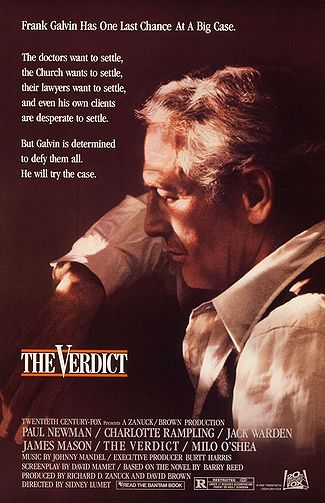
Speaking of the good, old-fashioned star power of Paul Newman, The Hustler and Butch Cassidy and the Sundance Kid were not the only films to receive an oscar nomination as the result of his charisma. There’s also The Verdict, a 1982 best picture nominee that would probably be forgotten if not for Paul Newman’s performance. However, since Paul Newman did play the lead role in The Verdict and he did give an amazing lead performance, The Verdict was nominated for best picture and, 33 years later, it ended up on TCM where I just watched it.
That’s the power of good acting.
Paul Newman plays Frank Galvin, a Boston-based attorney. At one time, Frank was a lawyer at an elite firm. But he has since fallen on hard times. Now, he’s the type of attorney who crashes funerals and hands out his card. He spends his spare time at his favorite bar, playing pinball and telling long jokes while stumbling about in a drunken haze. In many ways, Frank represents everything that people hate about personal injury attorneys but, since he’s played by Paul Newman, you know that he’s going to turn out to be a good guy.
Frank only has one friend left in the world, his former mentor Mickey (Jack Warden). Looking to help Frank out, Mickey sends Frank a medical malpractice suit. A woman at a Catholic Hospital was given an anesthetic during child birth that has led to her now being brain dead. Both the woman’s family and the Archdiocese are looking for a settlement. The family needs the money to pay for her medical care. The Archdiocese just wants the case to go away. All Frank has to do is accept whatever settlement deal is offered…
However, something has changed for Frank. He’s visited the comatose woman and, looking at her trapped in a vegetative state, he’s decided that the hospital needs to be held responsible for its mistake. He rejects the settlement and takes the case to court, looking for both justice for the victim and redemption for himself.
That’s easier said than done, of course. The Archdiocese has hired Ed Concannon (James Mason, perfectly cast), one of the best and most powerful attorneys in Boston. Ed has a huge legal team working on the case. Frank has Mickey. As well, the Judge (Milo O’Shea) makes little effort to hide his contempt for Frank.
Probably the only bright spot in Frank’s life is that he’s met a woman. Laura (Charlotte Rampling) meets him in a bar and soon, they’re lovers and Frank is confiding in her about the case. What he doesn’t suspect is that Laura herself is a spy, hired by Concannon.
It looks like all is lost but then Frank discovers that there is one nurse (Lindsay Crouse) who might be willing to tell the truth about what happened at the hospital…
In many ways, The Verdict is a predictable film. From the minute we first meet him, we know that Frank is going to be redeemed. From the minutes that we hear about the case, we know who we’re supposed to root for and who we’re supposed to hiss. Just about every courtroom cliché is present, right down to a surprise witness or two…
But no matter! The Verdict may be predictable but it works. As he proved with 12 Angry Men, Director Sidney Lumet knew how to make legal deliberations compelling and the entire film is full of small but memorable details that elevate it above its simplistic storyline. As a director, Lumet gets good performances from his cast and, as a result, this is a film where the hero is flawed and the antagonists aren’t necessarily evil. Even the Bishop of the Archdiocese of Boston (who, in most films, would have been a cardboard villain) is given a scene where he’s allowed to show some humanity.
And, of course, Paul Newman is great in the role of Frank. When we first meet Frank, he looks and sounds terrible. Indeed, it’s strange to see Paul Newman playing a character who is essentially such a loser. (Even Eddie Felson in The Hustler had an appealing swagger about him.) It’s during the scenes where Frank considers the woman in a coma that Newman starts to reveal that there’s more to Frank than what’s on the rough surface. By the end of the film, Frank may be a hero but Newman doesn’t play him as such. He’s still has that alcoholic rasp in his voice and his eyes still betray hints of insecurity and a fear that, at any minute, he’s going to screw up and mess everything up. It’s a great performance, one for which Newman received a nomination for best actor.
Speaking of star power, Bruce Willis also shows up in The Verdict. He’s an extra who appears as an observer in the courtroom. He’s sitting a few rows behind Paul Newman. (He’s also sitting beside Tobin Bell, the Jigsaw Killer from the Saw films). It’s probably easiest to spot Willis towards the end of the film, when the verdict is read. Bruce breaks out into a huge grin and almost looks like he’s about to start clapping. Bruce only gets about 10 second of screen time but he acts the Hell out of them!
Thanks to Paul Newman, The Verdict is a memorable and entertaining film. Be sure to watch it the next time it shows up on TCM.
 In the old west, a cowboy named Emmet (Scott Glenn) teams up with a reformed outlaw named Paden (Kevin Kline) and they bust Emmet’s wild younger brother, Jake (Kevin Costner), out of jail. After Mal (Danny Glover) helps the three of them escape from a posse, they all end up going to the town of Silverado, where all four of them have business. Emmett and Jake want to protect their sister from the corrupt son (Ray Baker) of a cattle baron who was previously killed by Emmett. Mal wants to save his sister Rae (Lynn Whitfield) from an evil gambler (Jeff Goldblum). Paden discovers that Cobb (Brian Dennehy), his former partner-in-crime, is now the sheriff of Silverado and working for the cattle barons. When Paden tries to protect the new settlers (including Rosanne Arquette), it leads to a confrontation with his former partner.


 Through the Shattered Lens