Film Review: Cast Away (dir by Robert Zemeckis)


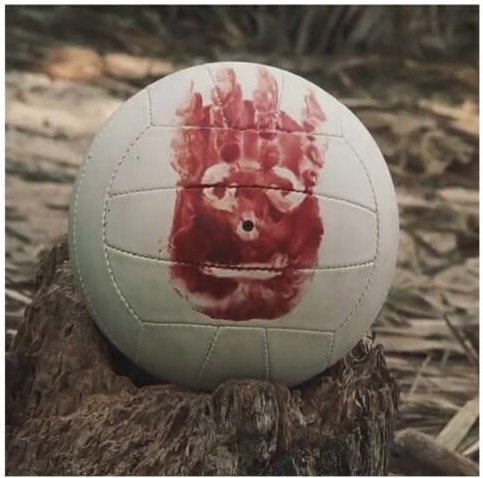
“WILSON!”

Seriously, I’m usually pretty well-behaved when I watch a movie but every time I see the 2000 film Cast Away, I find myself thinking, “Protect Wilson!  You must protect Wilson!”  And then, every time, I feel the sting of tears in my eyes as Wilson, with that red-face and that understanding attitude, goes floating away.

Wilson is a volleyball.  When a FedEx executive named Chuck Noland (played by Tom Hanks) finds himself stranded on a desert island, Wilson becomes his only companion.  A stain from Chuck’s bloody palm creates something that resembles a face on Wilson’s rubber surface and Chuck spends a lot of time talking to Wilson.  It’s how Chuck maintains his sanity, even as he loses weight, sheds most of his clothes, and grows a beard.

Chuck learns how to make fire.  He learns how to catch fish.  He is able to survive due to the supplies that he gathers from the FedEx packages that were being carried on the plane that crashed into the island.  But Chuck never stops dreaming of returning home to his girlfriend (Helen Hunt).  Eventually, Chuck finds the courage to try to make the journey back to civilization.  He brings Wilson with him but ultimately, this is something that Chuck is going to have to do on his own.  Of course, Chuck has failed to consider that he’s been gone for years.  He is presumed dead.  On the Island, time seemed like it was frozen.  For the rest of the world, life has continued.

Cast Away is a film that a lot of people, especially online film commentators, tend to criticize.  The complaint is usually that the film is essentially a commercial for FedEx, that it’s not believable that Tom Hanks could survive on that island for as long as he did, and that the film itself has a weak ending.  I’ll concede that the film does make FedEx look like the nicest corporation on Earth.  (FedEx’s CEO appears as himself, which should tell you something about how the company is presented.)  And I will admit that the film’s time-advancing jump cut, which abruptly takes Hanks from being clean-shaven and husky to being thin and bearded, does leave a lot of unanswered questions.  But I will always defend the film’s ending.  The film ends on a note of ambiguity but how else could it have ended?  Everyone thought Chuck Noland was dead.  His girlfriend had every right to get on with her life and, in fact, it would have been psychologically unhealthy for her if she hadn’t.  As for that final shot, it’s an acknowledgment that Chuck doesn’t know what lies ahead of him in the future.  All he knows is that he life isn’t over yet.  It’s a melancholy ending.  It’s a frustrating ending.  But it’s also the only way the film could have ended and therefore, it’s a perfect ending.

Cast Away is a film that I will always defend and it’s also a film that really only could have worked with Tom Hanks in the lead role.  He plays Chuck as being the ultimate everyman, an affable guy who was just trying to do his job and whose survival of the initial plane crash was largely due to luck.  Hanks is one of those actors who is instantly sympathetic and Cast Away uses his screen persona to good effect.  You want him to survive because he’s Tom Hanks.  He may be playing a character named Chuck Noland but ultimately, he’s Tom Hanks.  He survived being trapped in space.  Surely, he can survive being stranded on an island.  The majority of the film is just Hanks talking to himself.  This would have brought out the worst in so many actors but Tom Hanks makes it work.  And yes, he’ll bring tears to your eyes as he watches Wilson float away.  That’s the power of a good actor.

As for Wilson, I like to think that he washed up in Pensecola.  Recently, I played a little volleyball on a beautiful Florida beach.  Was that you, Wilson?
 

Netflix Noir #3: Crime of Passion (dir by Gerd Oswald)


CrimepassionPosterThe third Netflix Noir that I watched was 1957’s Crime of Passion.

In Crime of Passion, Barbara Stanwyck plays Kathy Ferguson, a San Francisco-based advice columnist.  She is approached by two homicide detectives who request her help tracking down a fugitive who they think might read her column.  Charlie (Royal Dano) is aggressive and outspoken.  When he first meets Kathy, he tells her, “You’re work should be raising a family and having dinner ready when your husband comes home from work.”  His far more passive partner is Detective Bill Doyle (Sterling Hayden).

Kathy writes a column that convinces the fugitive to turn herself in.  (The power of Kathy’s column is shown in an amusing montage where woman after woman is seen reading the column aloud.  Significantly, no men are seen to ever read anything that Kathy has written.)  The resulting fame leads to Kathy getting a job offer in New York.

However, before Kathy can leave, she gets a phone call from Bill.  He asks her out on a date and, one scene later, they’re getting married in the shabby office of a justice of the peace.  Kathy sacrifices her career to be a suburban housewife.

From the minute that Kathy first looks at the small and anonymous house and the boring neighborhood that she’ll be sharing with Bill, it’s obvious that things are not going to work out well.  Even though Kathy even tells Bill, “I hope all your socks have holes in them and I can sit for hours darning them,” the life of domestic servitude is not for her.

Every day, she stays home while Bill goes to work.  At night, she reluctantly plays hostess to the constant gatherings of Bill’s colleagues and their wives.  The women stay in one room while the man gather in another.  Kathy is quickly bored with the inane chattering of the other wives but whenever she tries to go into the other room, she finds herself treated like an unwanted intruder.

And worst of all is the fact that Bill has absolutely no ambition of his own.  He’s got his house.  He’s got his wife.  He’s got his friends.  And he doesn’t feel that he needs anything else.

Kathy takes it into her own hands to advance Bill’s career, first by having an affair with Bill’s boss (Raymond Burr) and finally by trying to find a spectacular crime that Bill can solve.  And, as the suburbs continue to drive her mad, Kathy is not above creating a few crimes on her own…

In many ways, Crime of Passion reminds of another 50s film, Nicholas Ray’s Bigger Than Life.  Both films use the conventions of melodrama to present a surprisingly subversive look at the horrors of suburban conformity.  Unfortunately, Crime of Passion never quite reaches the heights of Bigger Than Life, largely because Sterling Hayden gives such a dull performance as Bill that you never believe that Kathy would have married him in the first place.  (The film would have been far more impressive if Bill had started out as an apparently dynamic character whose dullness was then revealed after Kathy married him.)  However, Barbara Stanwyck is well-cast as Kathy and Raymond Burr plays up his character’s ambiguous morality.  If nothing else, Crime of Passion is one of those film to show anyone who is convinced that nothing subversive was produced in the 1950s.

Embracing The Melodrama #17: The Shame of Patty Smith (dir by Leo A. Handel)


The Shame of Patty Smith

“The story you’re about to see is true.  It’s happening right now.  The subject is illegal abortions.” — The narrator (Barney Brio) at the beginning of The Shame of Patty Smith (1962)

I began this series on embracing the melodrama by taking a look at one of the most anti-abortion films ever made, 1916’s Where Are My Children?  It, therefore, seems only appropriate that the first melodrama that I review from the 1960s should be a film that argued for the right to legal and safe abortion eleven years before the Supreme Court’s historic Roe v Wade decision, 1962’s The Shame of Patty Smith.

As with many a great melodrama, this film features a narrator.  He informs us that Patty Smith (played by an instantly sympathetic actress named Dani Lynn) is an “average girl with an average life and average dreams.”  One night, while she’s out on a date with Alan (Carlton Crane), she is attacked and raped by three thugs in leather jackets who speak like they’ve wandered over from the set of High School Confidential.  Afterwards, Alan tells her, “Three against one … there wasn’t much I could do…still, it was horrible to watch.”  He follows this up by advising her to “Try to forget about the whole thing.”

When Patty discovers that she’s pregnant, Alan refuses to speak to her and the stress causes her to make so many mistakes at her job that she ends up getting fired.  Not wishing to tell her religious parents what has happened, Patty goes to sympathetic Dr. Miller (J. Edward McKinney) and tells him that she simply cannot have a child.  Dr. Miller tells her that he sympathizes with her situation but, legally, he cannot help her.  All he can do is offer to help her put the baby up for adoption after she gives birth.

With the help of her roommate Mary (Merry Anders), Patty starts to search for a doctor who will perform the illegal procedure.  She manages to find one reputable doctor but he explains that he will need 600 dollars in cash because he could quite literally end up in jail for helping her.  Patty does not have that type of money.

Growing increasingly desperate, Patty eventually does find someone to help her.  This “doctor” (who, the narrator informs us, is actually a former pharmacist) works out of a massage parlor.  From the minute that Patty is picked up by one of the doctor’s associates to the moment that she finally steps into the pharmacist’s filthy operating room, The Shame of Patty Smith takes on the feel of a true nightmare.  For the final 30 minutes or so of the film, the screen is filled with such seediness that you literally feel the need to take a shower after watching it.  Director Leo A. Handel directs these scenes as if he were making a horror film (and, in many ways, he was) and Dani Lynn’s sensitive and frightened performance make these scenes all the more disturbing and tragic.

The Shame of Patty Smith is a real surprise.  Largely based on the title and the fact that Something Weird Video included The Shame of Patty Smith as part of a double feature with You’ve Ruined Me, Eddie!, I assumed that this would be your typical low budget melodrama.  I figured that it might be good for a few laughs and that it might have a few moments of unintentional clarity.

Instead, it turns out that The Shame of Patty Smith is a serious-minded, well acted, and thought-provoking look at one of the most important issues facing America today.  One reason that I found Patty Smith to be such a fascinating film was the fact that it was made before Roe v. Wade.  I think sometimes we hear a term like “back alley abortion” so many times that the words run the risk of losing their ominous power but Patty Smith, in detail that is chilling precisely because it is presented in such a matter-of-fact way, actually takes us into the back alley.  Those of us who were born long after the Roe V. Wade decision are often too quick to take for granted the idea that abortion has always been legaland safe and that it always will be.

A film like The Shame of Patty Smith serves to remind us of how things once were and how they very well could be again.

Patty Smith