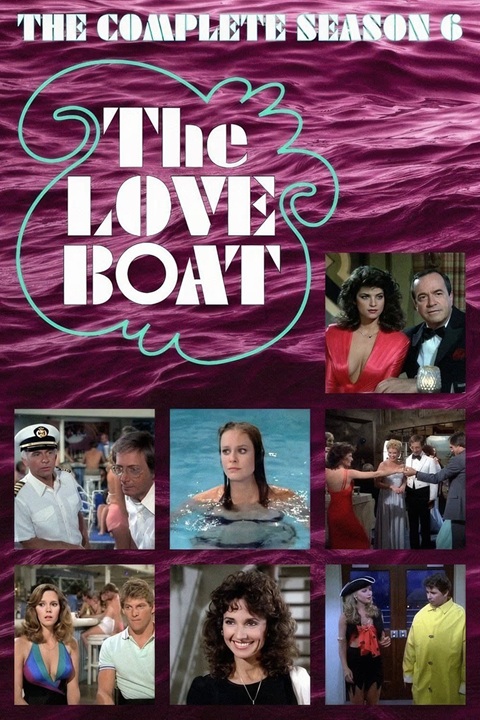
Retro Television Review: The Love Boat 6.17 “Gopher’s Daisy/Our Son, The Lawyer/Salvaged Romance”


Welcome to Retro Television Reviews, a feature where we review some of our favorite and least favorite shows of the past!  On Wednesdays, I will be reviewing the original Love Boat, which aired on ABC from 1977 to 1986!  The series can be streamed on Paramount Plus!
Come aboard!  Love is life’s sweetest reward….

Episode 6.17 “Gopher’s Daisy/Our Son, The Lawyer/Salvaged Romance”

(Dir by Richard Kinon, originally aired on January 29th, 1983)

Gopher has a new exercise machine but only he and the Captain know about it.  All through the cruise, Gopher and Stubing disappear into Gopher’s cabin, put out the “Do Not Disturb” sign and then groan and moan while using the exercise machine.

At the same, the ship has a stowaway.  As a part of her sorority initiation, Jennifer Canfield (Chanelle Lea) has to take a cruise without paying for it.  (That’s an odd initiation ritual.)  Having figured out Gopher’s schedule, Jennifer secretly stays in his room whenever he’s doing his duties.  Julie and Isaac both spot Jennifer sneaking in and out of Gopher’s cabin and they quickly decide that both Gopher and Stubing must have brought her aboard to be their — what?  Their personal sex slave?  That seems to be the implication.  Strangely, neither Isaac nor Julie seem to be too upset about that implication.  Julie has a cocaine problem so I guess I can understand her attitude but Isaac …. well, I expect more from Isaac.

Eventually, Jennifer is caught.  Instead of having her arrested, the Captain allows Julie and Isaac to pay for Jennifer’s fare on the boat.  So, does this mean that Jennifer’s not going to be allowed to join the sorority?

(Myself, I’m just considering the amount of people who have stowed away on the Love Boat over the past few seasons.  Seriously, taking a cruise without paying for it appears to be the easiest thing in the world.)

Meanwhile, James Coco and Doris Roberts play Harriet and Lou, a married couple who board the boat with their son, Jonathan (Adam Arkin).  Now that Jonathan has graduated law school and passed the bar, he thinks that it might be time for him to move into a place of his own.  Harriet is so traumatized at the thought of Jonathan moving out that she demands a divorce from Lou.  Both Harriet and Lou want to be represented by Jonathan.  Run, Jonathan, run!  In the end, the marriage is saved and everything get worked out but seriously, Jonathan needs to do more than just get an apartment of his own.  He needs to move to another state or maybe even another country.

(Also, in the past, there’s no way Julie would have ignored a handsome, single lawyer on the ship.  Unfortunately, Julie now seems to be more concerned with finding her next fix than finding a husband.)

Finally, Allison Newman (Joan Rivers) is a recently divorced woman who starts a tentative shipboard romance with passenger Max Glutovsky (Alex Rocco).  However, when Max tries teacher her how to play shuffleboard and puts his hands around her waist, Allison yells for him to leave her alone and runs away.  Max thinks that Allison is rejecting him because he’s not as rich as she is.  Max, you dumbass!  Allison has just had a mastectomy,  Her husband left her after the operation and now, she’s feeling insecure about getting close to anyone.  Of the three stories, the one worked the best, due to the performances of Rivers and Rocco.

The Rivers/Rocco story was effective.  The storyline with Roberts, Coco, and Arkin was rather shrill and left me feeling sorry for Adam Arkin’s character.  (Casting Doris Roberts as an overly possessive mother made this story feel like an unsuccessful dry run for Everybody Loves Raymond.)  Isaac and Julie thinking Gopher was sex fiend?  That was just silly.  In other words, this was a pretty uneven cruise.

Next week, hopefully things will look up with a two-hour episode set in Greece!

Spaceballs (1987, directed by Mel Brooks)


°ëØ

A long time ago, in a galaxy far far away…

President Skroob (Mel Brooks), the evil and incompetent leader of Planet Spaceball, has squandered all of the air on his planet and is planning on stealing the atmosphere of the planet Druida.  To pull this off, he arranges for the idiotic Prince Valium (Jim J. Bullock) to marry Vespa (Daphne Zuniga), the princess of Druida.  (All together now: “She doesn’t look Druish.”)  Vespa and her droid, Dot Matrix (voice by Joan Rivers), flee Druida with Lord Dark Helmet (Rick Moranis) and Colonel Sandurz (George Wyner) in pursuit.

In debt to the intergalactic gangster, Pizza the Hut (voiced by Dom DeLuise), a mercenary named Lone Star (Bill Pullman) and his associate, the man-dog hypbrid Barf (John Candy), accept a contract from Vespa’s father (Dick Van Patten) to track down his daughter.  They take off in their space Winnebago to bring Vespa home.  Though they start only interested in money, Lone Star and Barf come to learn about love, freedom, and a mystical power known as the Schwartz.  (“No, the Schwartz!”)

Back when I was growing up and just being able to have HBO made you the coolest guy on the block, Spaceballs was one of my favorite movies.  I watched it every time that it came on cable.  As usual with Mel Brooks, there were a lot of double entendres that went over my young head but there was also enough goofy humor that I could laugh at what was going on.  I could quote all the lines.  I laughed whenever Rick Moranis showed up in his Darth Vader-costume.  I laughed at John Candy’s facial expressions.  I laughed when Mel Brooks showed up as Yogurt, the Spaceballs version of Yoda.  Pizza the Hut?  That’s hilarious when you’re a kid!

I recently rewatched the film.  Revisiting it was a lesson in how your memory can trick you.  I could still quote most of the lines with reasonable accuracy but nothing was quite the way I remembered it.  Rick Moranis and John Candy were still hilarious and, being older, I could better appreciated the frustration felt by George Wyner’s Colonel Sandurz.  I also realized what a good performance Bill Pullman gave as Lone Star.  While everyone else mugged for the camera, Pullman played his role straight.

I also discovered that a lot of the scenes that I remembered as being hilarious were actually just mildly amusing.  Mel Brooks was always hit-and-miss as a director, the type who would toss everything and the kitchen sink into his films.  Spaceballs has a lot of hilarious scenes but it’s obvious that Brooks didn’t have the same affection for the source material as he did with Young Frankenstein or Blazing Saddles or even High Anxiety.  Brooks is poking fun at Star Wars because it’s popular but he doesn’t seem to have any strong feelings, one way or the other, about George Lucas’s space epic.

I still laughed, though.  Even if Spaceballs wasn’t the masterpiece that I remembered it being, I still enjoyed rewatching it.  The jokes that hit were funny enough to make up for the ones that missed.  Even with his weaker films, Mel Brooks is a national treasure.

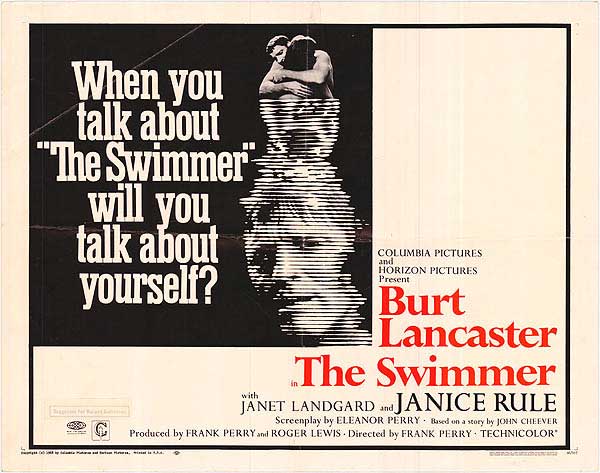
Embracing the Melodrama #23: The Swimmer (dir by Frank Perry)


The Swimmer

The 1968 film The Swimmer opens with Ned Merrill (Burt Lancaster) emerging from the woods that surround an affluent Connecticut suburb.  He’s a tanned, middle-aged man and, because he spends the entire film wearing only a bathing suit, we can tell that he’s still in good shape for a man in his 50s.  When Ned speaks, it’s with the nonstop optimism of a man who has found and claimed his part of the American Dream.  In short, Ned appears to be ideal American male, living in the ideal American community.

However, it gradually starts to become apparent that all is not well with Ned.  When he mysteriously shows up at a pool party being held by a group of his friends, they all seem to be shocked to see him, commenting that it’s been a while since Ned has been around.  Ned, however, acts as if there’s nothing wrong and instead talks about how beautiful the day is and says that he’s heading back to his home.  He’s figured out that all of his neighbor’s swimming pools form a “river” to his house and Ned’s plan is to swim home.

And that’s exactly what Ned proceeds to do, going from neighbor to neighbor and swimming through their pools.  As he does so, he meets and talk to his neighbors and it becomes more and more obvious that there are secrets hidden behind his constant smile and friendly manner.  As Ned gets closer and closer to his actual home, the neighbors are far less happy to see him.

At one house, he runs into Julie (Janet Landgard) who used to babysit for his daughter.  Julie agrees to swim with Ned and eventually confesses that she once had a crush on him.  When Ned reacts by promising to always protect  and love her, Julie gets scared and runs away.

At another house, Ned comes across another pool party.  A woman named Joan (played by a youngish Joan Rivers) talks to him before a friend of her warns her to stay away from Ned.

When Ned reaches the house of actress Shirley (Janice Rule), it becomes obvious that Shirley was once Ned’s mistress.  They discuss their relationship and it quickly becomes apparent that Ned’s memories are totally different from Shirley’s.

And, through it all, Ned keeps swimming.  Even when he’s offered a ride to his house, Ned replies that he has to swim home.

The Swimmer is a film that I had wanted to see ever since I first saw the trailer on the DVD for I Drink Your Blood.  (That’s an interesting combination, no?  I Drink Your Blood and The Swimmer.)  I finally saw the film when it showed up on TCM one night and, when I first watched it, I have to admit that I was a little disappointed.  Stylistically, the film itself is such a product of the 1960s that, even though suburban ennui and financial instability are still very relevant topics, The Swimmer felt rather dated.  I mean, I love a good zoom shot as much as anyone but, often times during the 60s, they seemed to be used more for the sake of technique than the sake of story telling.

However, the second time I sat through The Swimmer, I appreciated the film a bit more.  I was able to look past the stylistic flourishes of the direction and I could focus more on Burt Lancaster’s excellent lead performance.  Lancaster plays Ned as the epitome of the American ideal and, as a result, his eventual collapse also mirror the collapse of that same ideal.  The Swimmer is based on a short story by John Cheever and, quite honestly, the film’s story is a bit too much of a literary conceit to really work on film.  That said, The Swimmer — much like the character of Ned Merrill — is an interesting failure, which is certainly more than can be said of most failures.