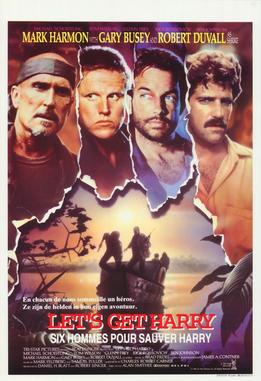
 Let’s Get Harry opens deep in the jungles of Columbia. The newly appointed American Ambassador (Bruce Gray) is touring a newly constructed water pipeline when suddenly, terrorist drug smugglers attack! The Ambassador, along with chief engineer Harry Burck (Mark Harmon, long before NCIS), is taken hostage. Drug Lord Carlos Ochobar announces that both the Ambassador and Harry will be executed unless the U.S. government immediately releases Ochobar’s men. However, the policy of the U.S. government is to not negotiate with terrorists. As grizzled mercenary Norman Shrike (Robert Duvall) explains it, nobody gives a damn about a minor ambassador.
Nobody in a small blue-collar town in Illinois gives a damn about the ambassador either. But they do give a damn about their friend Harry! When its obvious that the bureaucrats up in Washington are not going to do anything, Harry’s younger brother, Corey (Michael Shoeffling, Sixteen Candles), decides that he and his friends are going to go to Columbia themselves and get Harry! Helping him out are Bob (Thomas F. Wilson, Back to the Future), Kurt (Rick Rossovich, Top Gun), Spence (Glenn Frey!), and Jack (Gary Busey). If Jake Ryan, Biff Tannen, Slider, Buddy Holly, and the guy from the Eagles who wasn’t Don Henley can’t get Harry, then who can!?
There were a lot of these “American rescue mission” movies made in the 80s, everything from Uncommon Valor to The Delta Force to the Rambo films. Plotwise, Let’s Get Harry adds little to the genre. It’s about as simplistic and implausible as a Donald Trump campaign speech. A bunch of terrorists are holding American hostages and making us all look bad while the establishment refuses to do anything about it? Don’t worry! Here come a bunch of heavily armed, no-nonsense American citizens to save the day and make America great again!

There are two things that distinguish Let’s Get Harry. First, Let’s Get Harry is one of the many films to have been credited to Alan Smithee. From 1968 to 2000, Alan Smithee was the official pseudonym used by directors who wanted to disown a project. Smithee has been credited as directing everything from Solar Crisis to Morgan Stewart’s Coming Home to The O.J. Simpson Story. In the case of Let’s Get Harry, Smithee was standing in for veteran director Stuart Rosenberg (probably best known for Cool Hand Luke). Rosenberg originally only planned for Mark Harmon to be seen only at the end of the film, much like Matt Damon in Saving Private Ryan. When TriStar Pictures demanded extra scenes featuring Harmon being taken and held hostage, Rosenberg took his name off the film.
(Before Rosenberg signed on to direct, Let’s Get Harry started out as a Sam Fuller project and he received a story credit on the film. With the exception of some of the scenes with Harmon, which may have been shot by a different director, Rosenberg’s direction was adequate but Let’s Get Harry really does cry out for a director like Sam Fuller.)
Secondly, there is the cast, which is a lot more interesting than would be typically found in a low-budget, 80s action film. Not surprisingly, by respectively underplaying and overplaying, Duvall and Busy give the two best performances. Meanwhile, lightweight Mark Harmon gives the worst. Perhaps because of the conflict between Rosenberg and the studio over his character, Harmon spends the entire movie looking lost.
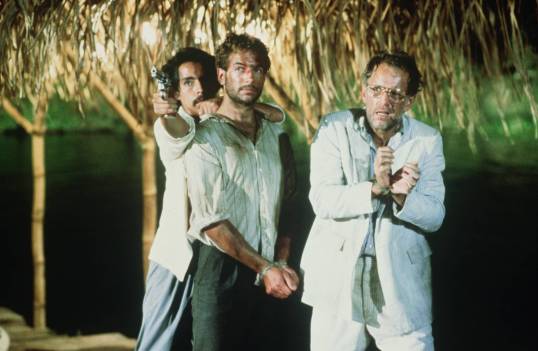
As an exercise in patriotic wish fulfillment, Let’s Get Harry is pure 80s hokum. It may be dumb but it is also entertaining. After all, any film that features not only Robert Duvall, Gary Busey, and Ben Johnson, but also Glenn Frey is going to be worth watching. Let’s Get Harry has never been released on DVD and is currently only available on VHS. Somebody needs to do something about this.
Let’s get Harry on DVD!
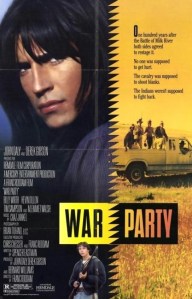 On the hundredth year anniversary of a battle between the U.S. Calvary and the Blackfeet Indians, the residents of small Montana town decide to reenact the battle and hopefully bring in some tourist dollars. The white mayor (Bill McKinny) and the sheriff (Jerry Hardin) both think that it is a great idea. Even the local Indian leader, Ben Cowkiller (Dennis Banks, in real-life a founder and leader of the American Indian Movement), thinks that it will be a worthwhile for the Indians to participate. The Calvary’s guns will be full of blanks. The Indians will play dead. However, as the result of a bar brawl the previous night, one of the local rednecks, Calvin Morrisey (Kevyn Major Howard), shows up with a gun full of bullets. After he shoots one of the Indians, Calvin ends up with a tomahawk buried in his head. Three Indian teenagers, Warren (Tim Sampson), Skitty (Kevin Dillon), and Sonny (Billy Wirth), flee into the wilderness. Thirsty for revenge, a white posse heads off in pursuit.
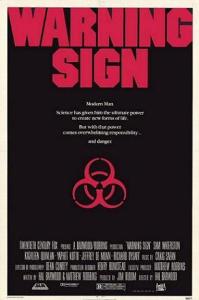 The world might end, again.
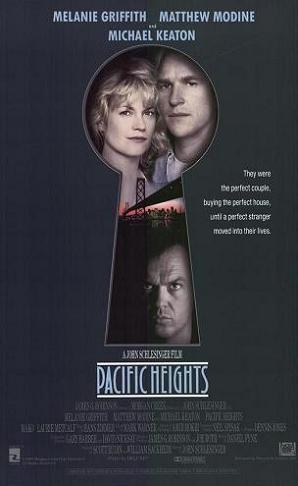 Michael Keaton is the tenant from Hell in Pacific Heights.
 Through the Shattered Lens