With the 2021 Cannes Film Festival underway in France, I thought this would be a good opportunity to spend the next few days looking at some of the films that have won the Palme d’Or in the past. As of this writing, 100 films have won either the Palme d’Or or an earlier version of the award like the Grand Prix du Festival International du Film. Some of those films — like Parasite, The Tree of Life, The Piano, Pulp Fiction — went on to American box office success and Oscar renown. Others, like 2001’s The Son’s Room, may have been snubbed by the Oscars but they went on to great success in their home country. The Son’s Room, for instance, won Italy’s David Di Donatello award for the best film of 2001.
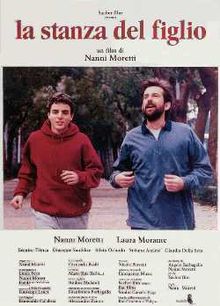
The Son’s Room is a film about a family trying to deal with an unimaginable tragedy. Andrea (Giuseppe Sanfelice) is the 17 year-old son of therapist Giovanni (Nanni Moretti, who also directed) and Paola (Laura Morante). Andrea, it is quickly established, is an almost ideal teenager. He doesn’t resent his parents. He doesn’t get into any sort of major trouble, beyond stealing a valuable fossil as a part of a prank that goes wrong. His parents know that he occasionally gets high but they also understand that it’s no big deal. It’s just a part of being a teenager.
One day, when Giovanni and Andrea have made plans to go jogging, Giovanni gets a call from a patient who has received some troubling news and who needs to see him immediately. Giovanni has to cancel their plans. Andrea instead goes diving with a friend and, in a freak accident, drowns. Giovanni, Paola, and and their daughter Irene (Jasmine Trinca) are left to mourn and to try to find some sort of meaning in Andrea’s death.
The Son’s Room is hardly the first film to be made about the untimely death of a family member. In 1980, Ordinary People won the Oscar for Best Picture for telling a story about a similarly upper class family trying to come to emotional teams with the loss of a brother and a son. What sets The Son’s Room apart from Ordinary People and other similar films is what doesn’t happen. As opposed to what happens in so many other films about families dealing with loss, the death of Andrea does not reveal that his family was secretly dysfunctional. His family doesn’t discover that Andrea was deeply depressed or that his death wasn’t a random accident. Instead, the point of the film is that, even though the family was strong and even though Andrea was happy and had everything to look forward to it, he still died because sometimes, happy people die in freak accidents. It’s not just dysfunctional families that suffer. Even a strong family struggles to deal with grief.
The film follows the family through the stages of grief. At first, the family members fixate on imagining what life would be like if Andrea hadn’t gone swimming that day. They resent Giovanni’s patient, even though the patient couldn’t have known what was going to happen. They try to find someone to blame for Andrea drowning, just to discover that everyone did everything that they were supposed to do. Andrea’s death was random, as death so often is. Then, they’re contacted by a casual acquaintance of Giovanni, a girl named Arianna (Sofia Vigilar) and they’re finally given a chance to find some sort of meaning in what happened.
The Son’s Room is a deeply affecting movie, one that works because it largely eschews the type of melodrama that we’ve come to expect from films like this. The film’s refusal to idealize, blame, or demonize any of its characters makes it a film to which anyone can relate. It’s an honest look at grief but it’s also a film that earns the right to suggest that there’s no need to feel guilty about eventually moving on from sadness. It’s a film that acknowledges that life can be random and scary but it can be pretty wonderful as well.
It’s an effective film, one that was reportedly a popular winner at the 2001 Cannes Film Festival, where its competition included Shrek, The Man Who Wasn’t There, The Piano Teacher, and Mulholland Drive. (Fear not, Mulholland Drive still won the directing award for David Lynch.) 20 years after it was initially released, The Son’s Room holds up well as a look at both grief and the love of a strong family.

 Through the Shattered Lens