Fresh from the police academy, three rookie cops are assigned to a precinct in East L.A. Gus (Scott Wilson) is a father of three who just wants to do a good job and support his family. Sergio (Erik Estrada) is a former gang member who saw the police academy as a way to get out of his old neighborhood, and Roy (Stacy Keach) is a new father who is going to law school at night. Most of the movie centers on Roy, who goes from being an idealistic rookie to being a hardened veteran and who comes to love the job so much that he abandons law school and eventually loses his family. Roy’s wife (Jane Alexander) comes to realize that Roy will never be able to relate to anyone other than his fellow cops. Roy’s mentor is Andy Kilvinski (George C. Scott), a tough but warm-hearted survivor who has never been shot once and whose mandatory retirement is approaching.
Based on an autobiographical novel by real-life policeman Joseph Wambaugh, TheNewCenturion’s episodic structure allows the film to touch on all the issues, good and bad, that come with police work. Gus is shaken after he accidentally shoots a civilian. Sergio feels the burden of patrolling the streets on which he grew up. Roy becomes a good cop but at the cost of everything else in his life and he deals with the stress by drinking. There are moments of humor and moments of seriousness and then a tragic ending. Just as Wambaugh’s book was acclaimed for its insight and its realistic portrayal of the pressures of being a policeman, the movie could have been one of the definitive portraits of being a street cop, except that it was directed in a workmanlike fashion by Richard Fleischer. Instead of being the ultimate cop movie, TheNewCenturions feels more like an especially good episode of PoliceStory or HillStreetBlues. (TheNewCenturions and HillStreetBlues both feature James B. Sikking as a pipe-smoking, martinet commander.)
George C. Scott, though. What a great actor! Scott only has a supporting role but he’s so good as Kilvinski that you miss him when he’s not around and, when he leaves, the movie gets a lot less interesting. Scott makes Kilvinski the ultimate beat cop and he delivers the closest thing that TheNewCenturions has to a cohesive message. A cop can leave the beat but the beat is never going to leave him.
In 1984’s CityHeat, Clint Eastwood plays Lt. Speer, a tough and taciturn policeman who carries a big gun, throws a mean punch, and only speaks when he absolutely has to.
Burt Reynolds plays Mike Murphy, a private investigator who has a mustache, a wealthy girlfriend (Madeleine Kahn), and a habit of turning everything into a joke.
Together, they solve crimes!
I’m not being sarcastic here. The two of them actually do team up to solve a crime, despite having a not quite friendly relationship. (Speer has never forgiven Murphy for quitting the force and Murphy has never forgiven Speer for being better at everything than Murphy is.) That said, I would be hard-pressed to give you the exact details of the crime. CityHeat has a plot that can be difficult to follow, not because it’s complicated but because the film itself is so poorly paced and edited that the viewer’s mind tends to wander. The main impression that I came away with is that Speer and Murphy like to beat people up. In theory, there’s nothing wrong with that. Eastwood is legendary tough guy. Most people who watch an Eastwood film do so because they’re looking forward to him putting the bad guys in their place, whether it’s with a gun, his fists, or a devastating one-liner. Reynolds also played a lot of tough characters, though they tended to be more verbose than Eastwood’s.
That said, the violence in CityHeat really does get repetitive. There’s only so many times you can watch Clint punching Burt while various extras get gunned down in the background before it starts to feel a little bit boring. The fact that the film tries to sell itself as a comedy while gleefully mowing down the majority of the supporting cast doesn’t help. Eastwood snarls like a pro and Reynolds flashes his devil-may-care smile but, meanwhile, Richard Roundtree is getting tossed out a window, Irene Cara is getting hit by a car, and both Kahn and Jane Alexander are being taken hostage. Tonally, the film is all over the place. Director Richard Benjamin was a last-minute replacement for Blake Edwards and he directs without any sort of clear vision of just what exactly this film is supposed to be.
On the plus side, CityHeat takes place in Kansas City in 1933 and the production design and the majority of the costumes are gorgeous. (Unfortunately, the film itself is often so underlit that you may have to strain your eyes to really appreciate it.) And the film also features two fine character actors, Rip Torn and Tony Lo Bianco, are the main villains. For that matter, Robert Davi shows up as a low-level gangster and he brings an actual sense of menace to his character. There are some good things about CityHeat but overall, the film is just too messy and the script is a bit too glib for its own good.
Burt Reynolds and Clint Eastwood had apparently been friends since the early days of their careers. This was the only film that they made together. Interestingly enough, Reynolds gets the majority of the screentime. Eastwood may be top-billed but his role really is a supporting one. Unfortunately, Reynolds seems to be kind of bored with the whole thing. As for Clint, he snarls with the best of them but the film really doesn’t give him much to do.
A disappointing film, CityHeat. Watching a film like this, it’s easy to see why Eastwood ended up directing himself in the majority of his films.
The year is 1910 and the sports world is in a panic. For the first time, a black man has won the title of the heavyweight champion of the world. Jack Jefferson (James Earl Jones) had to go to Australia because no American city would agree to host the fight but he came out of it victorious. The proud and outspoken Jefferson finds himself targeted by both the white establishment and black activists who claim that Jefferson has not done enough for his community.
It’s not just Jefferson’s success as a boxer that people find scandalous. It’s also that the married Jefferson has a white mistress, a socialite named Eleanor Brachman (Jane Alexander, in her film debut). While boxing promoters search for a “great white hope” who can take the title from Jefferson, the legal authorities attempt to arrest Jefferson for violating the Mann Act by supposedly taking Eleanor across state lines for “immoral purposes.” Jefferson and Eleanor end up fleeing abroad but even then, their relationship is as doomed as Jefferson’s reign as the heavyweight champ.
Based on a Pulitzer-winning stage play by Howard Sackler, The Great White Hope features Jones and Alexander recreating the roles for which they both won Tonys. Both Jones and Alexander would go on to receive Oscar nominations for their work in the film version. It was the first nomination for Alexander and, amazingly, it was the only nomination that Jones would receive over the course of his career. (It surprises me that he wasn’t even nominated for his work in Field Of Dreams.) Both Jones and Alexander give powerful performances, with Jones dominating every scene as the proud, defiant, and often very funny Jack Jefferson. Jones may not have had a boxer’s physique but he captured the attitude of a man who knew he was the best and who mistakenly believed that would be enough to overcome a racist culture. (Speaking of racist, legendary recluse Howard Hughes reportedly caught the film on television and was so offended by the sight of Jones kissing Alexander that he thought about buying NBC to make sure that the movie would never be aired again.) Hal Holbrook, Chester Morris, Moses Gunn, Marcel Dalio, and R.G. Armstrong all do good work in small roles.
Unfortunately, The Great White Hope still feels like a filmed stage play, despite the attempts made to open up the action. Martin Ritt was a good director of actors but the boxing scenes are never feel authentic and the middle section of the film drags. Jones and Alexander keep the film watchable but The Great White Hope is never packs as strong of a punch as its main character.
The 1983 film, Testament, is about death. It’s about the death of a family, the death of a town, the death of a way of life, and the death of hope.
And you may be saying, “Well, gee, Lisa — that sounds like a really happy movie.”
Well, it’s not meant to be a happy movie. Testament is a painfully grim movie about the end of the world.
The movie takes place in the town of Hamelin, California, which we’re told is 90 minutes away from San Francisco. It’s a nice town, the type of place where everyone knows each other. Mike (Mako) runs the local gas station and cares for his disabled son, Hiroshi (Gerry Murillo). Elderly Henry Abhart (Leon Ames) spends his time on his radio, talking to strangers across the world. Fania (Lilia Skala) offers up piano lessons. Father Hollis (Philip Anglim) looks over the spiritual needs of the parish. It’s a normal town.
The town is home to the Weatherlys. Carol (Jane Alexander) is a stay-at-home mom who does volunteer work and who is directing the school play. Tom (William Devane) is a common sight riding his bicycle through town every morning before heading off to work in San Francisco. They have three children. Mary Liz (Roxanna Zal) is a teenager who is taking piano lessons. Brad (Ross Harris) is always trying to impress his father and is looking forward to his 14th birthday. Scottie (Lukas Haas, in his first film) is the youngest and never goes anywhere without his teddy bear. They’re a normal family living a normal life in a normal town.
And then, one day, everything changes. Scottie is watching Sesame Street when the program is suddenly interrupted by a clearly terrified anchorman who announces that New York has been bombed. The president is about to speak but, before he can, there’s a bright flash of light, an distant explosion, and the entire town loses power.
At first, the people of Hamelin try to remain hopeful. Though Tom works in San Francisco and San Francisco is among the many cities that have apparently been bombed (by who, we never learn), he also left a message on the family’s answer machine, telling them that he was on his way home. Even with Tom missing, Carol continues to insist the he’ll be coming home at any minute.
Tom doesn’t come home.
The rest of the film follows the slow death of the town. Even though the town was not damaged by the blast, the fallout soon hits. Cathy (Rebecca De Mornay) and Phil (Kevin Costner) bury their newborn baby after it falls ill from radiation poisoning. Mike, Henry, and Fania all start to grow physically ill and, in some cases, dementia sets in. Father Hollis goes from being hopeful to being tired and withdrawn as he tries to attend to each and every death. Larry (Mico Olmos), a young boy whose parents have disappeared, briefly moves in with the Wetherly family. He disappears about halfway through the movie and we never learn if he left or if he died. All we know is that no one mentions him or seems to notice that he’s gone.
Over the course of the film, Carol buries two of her children. By the end of the film, her remaining child is starting to show signs of being sick, as is she. Testament, which opened with bright scenes of a happy town, ends in darkness, with only a handful of people left among the living. Even those who are alive are clearly dying and can only speak of the importance of remembering all of it, what they had and what they lost.
Sounds like a really happy film, right? Well, it’s meant to be depressing. It was made at a time when nuclear war was viewed as being not just probable but also inevitable. Testament is a film that portrayed what a lot of people at the time were expecting to see in the future and, as a result, it’s not meant to be a particularly hopeful movie. It’s a film that accomplishes what it set out to do, thanks to a great (and Oscar-nominated) performance from Jane Alexander and Lynne Littman’s low-key direction. Unlike a lot of atomic war films, Testament does not feature any scenes of burning buildings or excessive gore. That actually what makes it even more disturbing. Even after the war, Hamelin still looks like it did beforehand, with the exception that many of the houses are now empty and that all of the residents are slowly dying.
(Would I have reacted as strongly to the film if I hadn’t watched it at a time when many people are afraid to go outside? Perhaps not. But this pandemic has brought extra power to a lot of films that may not have had as much of an impact in 2018.)
Testament is a powerful film, though not necessarily one that I ever want to watch again.
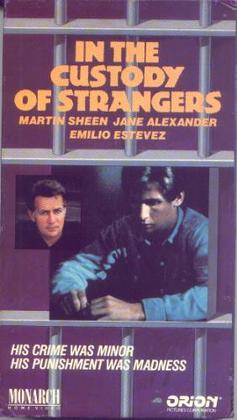
In this television film, Emilio Estevez plays the world’s worst son but his behavior makes sense because he also has the world’s worst father (played by Estevez’s real-life father, Martin Sheen).
When teenager Danny Caldwell (Estevez) gets arrested for crashing into a police car while driving drunk, his mother, Sandy (Jane Alexander), wants to bail him out and bring him home. However, Frank Caldwell (Sheen) is an old-fashioned disciplinarian and he decides that his son needs to spend a night in jail in order to teach him a lesson. Even though, as a juvenile, Danny is given a private cell, he still snaps when the older inmate in the cell next door starts coming onto him. After smashing the man’s head against the cell bars, Danny picks up a battery charge and is sucked into the system.
While Frank and Sandy struggle to get Danny released from jail, Danny falls deeper and deeper into despair and anger. It’s an overcrowded, busy jail and Danny is often left in isolation for both his safety and the safety of the other prisoners. Even though the warden (Kenneth McMillan) is sympathetic to Danny and can tell that he’s not really a hardened criminal, there’s only so much that he can do for him. Meanwhile, on the outside world, Frank stubbornly refuses to admit that he made a mistake by leaving Danny in jail overnight. When a job opportunity presents itself in another state, the unemployed Frank misses some of Danny’s hearings so that he can interview for it, leaving Danny feeling abandoned all over again.
For obvious reasons, the casting of Martin Sheen and Emilio Estevez as father and son works very well in this film. Not only is there the obvious family resemblance but both Sheen and Estevez project the same attitude of anger and resentment towards the world. If Danny has a chip on his shoulder, it’s because he inherited from his father. In The Custody of Strangers does a good job of showing how being imprisoned can often turn someone who made a mistake into a hardened criminal but, even though it’s mostly critical of the criminal justice system, it doesn’t let Frank off the hook either. Frank may say that he was just trying to discipline his son but the film makes clear that what he actually wanted was for jail to do his job as a parent. The results are disastrous and the film ends on a note of ambiguity. After what Danny has been through, it’s clear that he’ll never be the same person again.
Sheen, Alexander, and Estevez all give good performances in In The Custody of Strangers. The only ray of hope that the film offers is the kindly warden and he’s also the film’s biggest flaw because it’s hard to believe that, with everything else going on in the jail, he would have had time to take such a benevolent interest in just one inmate. In real life, Danny Caldwell would have been even more lost than in this movie.
Claire (Alexandra Breckenridge) is a venture capitalist who lives in the big city but dreams of visiting the same small Vermont town that her mother once loved.
Andrew (Jamie Spilchuk) is the latest in a long line of blacksmiths and he also owns an independent bookstore in the same small Vermont town where all of his ancestors have lived.
Together….
THEY SOLVE CRIMES!
Okay, not really. Christmas Around The Corner is a Lifetime Christmas movie, which means that there’s not a single crime to be committed. For that matter, there’s none of the other things that we typically expect from a Lifetime movie. There’s no seductive nannies. There’s no duplicitous best friends. No adultery. No scheming. No runaways. Nope, that doesn’t happen on Lifetime around Christmas time.
Instead, the movie opens with Claire having some sort of major career setback. I’m not really sure what the exact details were but it had something to do with the stock market and a downward pointing arrow and a party that none of her investors came to. It was financial stuff, which I’ve never really been able to follow. What’s important is that Claire decided to get out of New York and spend the holidays in that small town in Vermont.
(Yes, yes, I know. Vermont. I hate Vermont but I won’t go into that right now.)
Anyway, Andrew runs a bookstore that also rents out rooms or something like that. Apparently, when you’re staying at the bookstore, you’re also expected to work in the bookstore. I have such mixed feelings about that. On the one hand, I would love to live over a bookstore. And I probably wouldn’t mind working in a bookstore, as long as I was the owner and could basically spend all day bossing people around and having them rearrange the books. I mean, that seems like it would be a lot of fun. However, I just can’t imagine going on a vacation so I could work.
When Claire arrives in the town, she’s really looking forward to the annual Christmas festival but …. uh oh! The festival has been cancelled! In fact, due to tough times and bad weather, it would appear that no one in town has the Christmas spirit! No one but Claire!
So, can Claire get the town to rediscover its love of Christmas?
Even more importantly, can she use her marketing background to show Andrew a better way to run his bookstore? Of course, she can! Unfortunately, it may all be for naught because Andrew is thinking about selling the bookstore!
Along the way, Andrew and Claire fall in love. Can you blame them? I mean, Andrews’s a blacksmith! Soot is sexy.
As you might expect from a Lifetime Christmas film, Christmas Around The Corner is more than a little predictable but, at the same time, it’s a sweet movie. The town looks beautiful and Alexandra Breckenridge and Jamie Spilchuk have a likable chemistry as the two leads. As anyone who has ever watched a Lifetime Christmas movie knows, these films always have an older voice of wisdom who helps to bring everyone together. This time, that voice of wisdom was provided by the veteran actress Jane Alexander and she did a good job with her role. It’s a likable movie, which is really the main thing that can ever be asked of a movie like this. It’ll make you feel happy and Christmas-y.
Because, after all, Christmas is right around the corner!
— Loren Hardeman Sr. (Sir Laurence Olivier) in The Betsy (1978)
Here’s a little thought experiment:
Imagine if The Godfather had starred Laurence Olivier and Tommy Lee Jones.
That may sound strange but it actually could have happened. When Francis Ford Coppola first started his search for the perfect actor to play Don Vito Corleone, he announced that he could only imagine two actors pulling off the role. One was Marlon Brando and the other was Laurence Olivier.
As for Tommy Lee Jones, he was among the many actors who auditioned for the role of Michael Corleone. At the time, Jones was 26 years old and had only recently made his film debut in Love Story. As odd as it may be to imagine the quintessentially Texan Tommy Lee Jones in the role, Coppola always said that he was looking for a brooder as Michael and that’s definitely a good description of Jones.
Of course, as we all know, neither Olivier nor Jones were ever cast in The Godfather. Marlon Brando played Don Vito and Al Pacino was cast as Michael. However, a few years later, Olivier and Jones would co-star in another family saga that combined history, organized crime, and melodrama. That film was 1978’s The Betsy and, interestingly enough, it even co-starred an actor who actually did appear in The Godfather, Robert Duvall.
Of course, now would probably be a good time to point out that The Godfather is perhaps the greatest American film of all time. And The Betsy … well, The Betsy most definitely is not.
The film’s German poster even gives off a Godfather vibe
Based on a novel by Harold Robbins, The Betsy exposes the secrets of Detroit. Decades ago, Loren Hardeman founded Hardeman Motors and started to build his considerable fortune. Sure, Loren had to break a few rules. He cut corners. He acted unethically. He had an affair with his daughter-in-law and then drove his gay son to suicide. Loren never said that he was perfect. Now in his 80s, Loren has a vision of the future and that vision is a new car. This car will be called the Betsy (named after his great-granddaughter) and it will be the most fuel-efficient car ever made.
Since the film appropriates the flashback structure used in The Godfather Part II, we get to see Loren Hardeman as both an elderly man and a middle-aged titan of industry. Elderly Loren is played by Laurence Olivier. Elderly Loren spends most of the film in a wheelchair and he speaks with a bizarre accent, one that I think was meant to be Southern despite the fact that the film takes place in Michigan. Elderly Loren gets really excited about building his new car and, at one point, shouts out “Wheeeeeee!”
Middle-aged Loren is played by … Laurence Olivier! That’s right. Olivier, who was 71 years old at the time, also plays Loren as a younger man. This means that Olivier wears a hairpiece and so much makeup that he looks a bit like a wax figure come to life. Strangely, Middle-aged Loren doesn’t have a strange accent and never says “wheeeee.”
To build his car, Loren recruits race car driver Angelo Perino (Tommy Lee Jones). Angelo’s father was an old friend of Loren’s. When Angelo agrees, he discovers that the Hardeman family is full of drama and secrets. Not only is great-granddaughter Betsy (Kathleen Beller) in love with him but so is Lady Bobby Ayers (Lesley-Anne Down), who is the mistress of Loren’s grandson, Loren the 3rd (Robert Duvall).
Because he blames his grandfather for the death of his father, Loren the 3rd has no intention of building Loren the 1st’s car. Loren the 3rd wants to continue to make cars that pollute the environment. “Over my dead boy!” Loren the 1st replies. “As you wish, grandfather,” Loren the 3rd replies with a smile.
But we’re not done yet! I haven’t even talked about the Mafia and the union organizers and the automotive journalist who ends up getting murdered. From the minute the movie starts, it’s nonstop drama. That said, most of the drama is so overdone that it’s actually more humorous than anything else. As soon as Laurence Olivier shouts out, “Wheeeee!,” The Betsy falls into the trap of self-parody and it never quite escapes. There’s a lot going on in the movie and one could imagine a more imaginative director turning the trashy script into a critique of capitalism and technology. However, Daniel Petrie directs in a style that basically seems to be saying, “Let’s just get this over with.”
The cast is full of interesting people, all of whom are let down by a superficial script. Nothing brings out the eccentricity in talented performers quicker than a line of shallow dialogue. Jane Alexander, who plays Duvall’s wife, delivers all of her lines in an arch, upper class accent. Edward Herrmann, playing a lawyer, smirks every time the camera is pointed at him. Katharine Ross, as Olivier’s mistress and Duvall’s mother, stares at Olivier like she’s trying to make his head explode. Tommy Lee Jones is even more laconic than usual while Duvall always seems to be struggling not to start laughing.
And then there’s Olivier. For better or worse, Olivier is the most entertaining thing about The Betsy. He doesn’t give a good performance but he does give a memorably weird one. Everything, from the incomprehensible accent to a few scenes where he literally seems to bounce up and down, suggests a great actor who is desperately trying to bring a spark of life to an otherwise doomed project. It’s a performance so strange that it simply has to be seen to be believed.
Tomorrow, we take a look at another melodrama featuring Robert Duvall, True Confessions!
This weekend, I will be seeing Rings, the second sequel to the 2002 film, The Ring. (Of course, The Ring itself is a remake of the Japanese film, Ringu.) Since it’s been a while since we’ve had a new installment in the Ring franchise, I decided to rewatch the first film tonight.
I have to admit that I had a few concerns before I rewatched TheRing. When I first saw The Ring, it scared me to the extent that I actually had nightmares afterward. Even after all these years, the image of that little girl emerging from the well and then crawling out of the television still makes me shiver. But even with that in mind, I still found myself wondering if The Ring would live up to my vivid memories.
After all, it’s been 14 years since The Ring was released and, since that time, it’s been copied and imitated by literally hundreds of other PG-13 rated horror movies. Would the shocks still be effective, now that I knew they were coming and that I would no longer be surprised to learn that the little girl in the well was actually evil?
Add to that, there was the question of technology. In 2002, it seemed all too plausible that people could be trading back and forth a cursed VHS tape. The Ring was made at a time when DVDs were still considered to be exotic. When The Ring first came out, YouTube didn’t even exist. But today, both VHS tapes and VCRs are artifacts of another era. DVDs have been replaced by Blu-rays and Blu-rays are in the process of being replaced by streaming services. For The Ring to work, you had to be able to relate to people watching a VHS tape. Today, all of these people would be too busy watching cute cat videos on YouTube to fall into The Ring‘s trap.
In short, would The Ring still work in the age of Netflix? And would the film still be as scary as it was when it was first released? These were the question that I found myself wondering as I sat down to rewatch The Ring.
And the answer to both questions is … for the most part, yes.
Here’s the good news. All the important things still work. The performances of Martin Henderson, David Dorfman, Amber Tamblyn, and especially Naomi Watts hold up well. Gore Verbinski’s direction is still effective and, as I rewatched the film, I was surprised to see how many odd and quirky details that Verbinski managed to work into the film. (I especially enjoyed the magic-obsessed desk clerk.) The cursed video was still creepy and compulsively watchable and I still felt uneasy while watching Anna Morgan (played by Shannon Cochran) comb her hair in that mirror. Even more importantly, the little girl in the well, Samara Morgan (Daveigh Chase), was still incredibly frightening.
Admittedly, The Ring is dated and some of its effectiveness has been diluted by imitation. Unfortunately, that’s something that happens with any financially successful horror film. Beyond that, as effective as the entire film was, there were parts of The Ring that did feel undeniably silly. There’s a lengthy scene in which Naomi Watts, while on a ferry, attempts to talk to a horse and the horse reacts by jumping into the ocean. I understand that the scene was probably meant to establish that, as a result of watching that videotape, Watts was now cursed. But, still, I kept wondering why Watts was bothering the horse in the first place. I mean, I love horses too but I know better than to disturb one while on a ferry. As well, the film’s opening sequence — in which Amber Tamblyn is menaced and ultimately killed by Samara — no longer felt as effective as it did when I first saw it, largely due to the fact that it’s been copied by so many other horror films. Imitation may be the ultimate compliment but it does tend to dilute the effectiveness of horror.
But, in the end, The Ring held up well enough. The film’s storyline — characters watch a cursed video tape and then, seven days later, are killed by Samara — was simple but enjoyable. And, when David Dorfman delivered his classic line: “No. You weren’t supposed to help her,” I still felt a chill run down my spine.
During my sophomore year of college, I had a political science professor who, every day of class, would sit on his desk and ramble on and on and on about his past as a political activist. He protested Viet Nam, he hung out with revolutionaries, he loved Hugo Chavez, and I assume he probably had a Che Guevara poster hanging in his office. Whenever he wanted to criticize George W. Bush, he would compare him to Richard Nixon and then pause as if he was waiting for the class to all start hissing in unison. He always seemed to be so bitterly disappointed that we didn’t. What he, and a whole lot of other people his age, didn’t seem to understand was that Richard Nixon was his boogeyman. The rest of us could hardly care less.
That was the same problem that faced the 2008 best picture nominee Frost/Nixon.
Directed rather flatly by Ron Howard, Frost/Nixon tells the true story about how a light-weight English journalist named David Frost (played by Michael Sheen) managed to score the first televised interview with former President Richard Nixon (Frank Langella). Both Frost and Nixon see the interviews as a chance to score their own individual redemptions while Frost’s assistants (played by Oliver Platt and Sam Rockwell) see the interview as a chance to put Richard Nixon on trial for Watergate, the Viet Nam War, and every thing else under the sun. That may not sound like a very exciting movie but it does sound like a sure Oscar contender, doesn’t it?
I’ve always secretly been a big history nerd so I was really looking forward to seeing Frost/Nixon when it was first released in 2008. When I first saw it, I was vaguely disappointed but I told myself that maybe I just didn’t know enough about Richard Nixon or Watergate to really “get” the film. So, when the film later showed up on cable, I gave it another chance. And then I gave it a chance after that because I really wanted to like this film. Afterall, it was a best picture nominee. It was critically acclaimed. The word appeared to be insisting that this was a great film. And the more I watched it, the more I realized that the world was wrong. (If nothing else, my reaction to Frost/Nixon made it easier for me to reject the similarly acclaimed Avatar a year later.) Frost/Nixon is well-acted and slickly produced but it’s not a great film. In fact, Frost/Nixon is epitome of the type of best picture nominee that inspires people to be cynical about the Academy Awards.
Before I get into why Frost/Nixon didn’t work for me, I want to acknowledge that this was a very well-acted film. By that, I mean that the cast (Frank Langella, Michael Sheen, Kevin Bacon, Sam Rockwell, and Oliver Platt) all gave very watchable and entertaining performances. At the same time, none of them brought much depth to their characters. Much like the film itself, nobody seems to have much going on underneath the surface. Frank Langella may be playing a historic figure but, ultimately, his Oscar-nominated performance feels like just a typically grouchy Frank Langella performance. Michael Sheen actually gives a far more interesting performance as David Frost but, at the same time, the character might as well have just been identified as “the English guy.” In fact, a better title for this film would have been The Grouchy, the English, and the Superfluous.
For all the time that the film devotes to Rockwell and Platt blathering on about how they’re going to be giving Richard Nixon “the trial he never had,” this film is ultimately less about politics and more about show business. Ron Howard devotes almost as much time to the rather boring details of how the interviews were set up and sold into syndication as he does to the issues that the interview brings up. Unfortunately, for a movie about show business to succeed, the audience has to believe that the show is one that they would actually enjoy watching, This, ultimately, is why Frost/Nixon fails. While the filmmakers continually tell us that the Frost/Nixon interviews were an important moment in American history, they never show us. Yes, everyone has hideous hair and wide lapels but, otherwise, the film never recreates the period or the atmosphere of the film’s setting and, as a result, its hard not to feel detached from the action happening on-screen. For all the self-congratulatory claims made at the end of the film, it never convinces us that the Frost/Nixon interviews were really worth all the trouble. Much like my old poli sci professor, Frost/Nixon never gives us a reason to care.
For a far more interesting and entertaining look at the Watergate scandal, I would recommend the 1976 best picture nominee All The President’s Men. Recreating the story of how two Washington Post reporters (played by Robert Redford and Dustin Hoffman) exposed the Watergate scandal that eventually led to Nixon’s resignation, All The President’s Men is the movie that Frost/Nixon wishes it could be. Despite being made only two years after Watergate, All The President’s Men doesn’t take the audience’s interest for granted. Instead, director Pakula earns our interest by crafting his story as an exciting thriller. Pakula directs the film like an old school film noir, filling the screen with menacing shadows and always keeping the camera slightly off-center. Like Frost/Nixon, All The President’s Men is a well-acted film with a bunch of wonderful 70s character actors — performers like Ned Beatty, Jason Robards, Jack Warden, Martin Balsam, and Robert Walden, and Jane Alexander — all giving effectively low-key and realistic performances. The end result is a film that manages to be exciting and fascinating to those of us who really don’t have any reason to care about Richard Nixon or Watergate.
Both of these two films were nominated for best picture. Frost/Nixon quite rightly lost to Slumdog Millionaire. All The President’s Men, on the other hand, lost to Rocky.
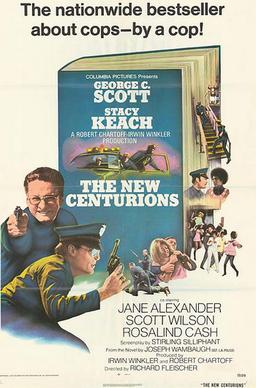 Fresh from the police academy, three rookie cops are assigned to a precinct in East L.A. Gus (Scott Wilson) is a father of three who just wants to do a good job and support his family. Sergio (Erik Estrada) is a former gang member who saw the police academy as a way to get out of his old neighborhood, and Roy (Stacy Keach) is a new father who is going to law school at night. Most of the movie centers on Roy, who goes from being an idealistic rookie to being a hardened veteran and who comes to love the job so much that he abandons law school and eventually loses his family. Roy’s wife (Jane Alexander) comes to realize that Roy will never be able to relate to anyone other than his fellow cops. Roy’s mentor is Andy Kilvinski (George C. Scott), a tough but warm-hearted survivor who has never been shot once and whose mandatory retirement is approaching.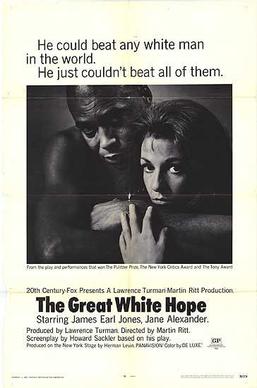





 Through the Shattered Lens