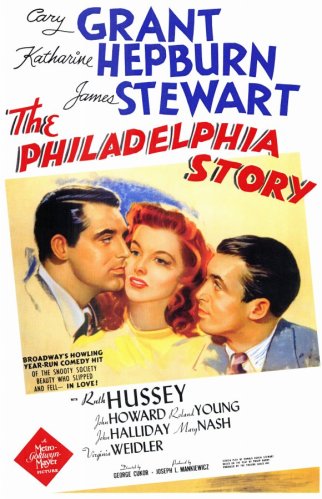
There are a few reasons why The Philadelphia Story was one of those films that I had been meaning to watch for a while. For one thing, The Philadelphia Story was nominated for best picture of 1940 (it lost to Alfred Hitchcock’s Rebecca) and my ultimate goal is to see and review every single film ever nominated for best picture. The other reason is that Jimmy Stewart won an Oscar for his performance in The Philadelphia Story and anyone who doesn’t love Jimmy Stewart has obviously never seen Anatomy of a Murder (not to mention It’s a Wonderful Life!).
Well, The Philadelphia Story was on TCM last night and I finally got to see it and what can I say? I absolutely loved it. For a 74 year-old, black-and-white comedy, The Philadelphia Story is still a lot of fun.
The Philadelphia Story tells the story of Tracy Lord (Katharine Hepburn), a wealthy socialite who is engaged to marry George Kitteridge (John Howard), a self-described “man of the people,” who is widely respect for both his strong moral character and the fact that — unlike most of Tracy’s friends — he made his fortune as opposed to inheriting it.
It would be tempting to reach into the bag of simplistic blogging clichés and call the Lords a 1940s version of Khardashians but I’m not going to do that because the Lords have a lot more wit and class. My favorite member of Tracy’s family was Dinah (Virginia Wiedler), her teenage sister who is sarcastic, cheerfully cynical, and has no problem demanding to be the center of attention. My sister Erin claims that the reason I liked Dinah is because I saw a lot of myself in the character and that’s probably true. However, I have to say that the great thing about both Tracy and Dinah is that they were both wittier, classier, and better dressers than all of the Khardashians and Jenners combined.
Anyway, the evil editor of Spy Magazine, Sidney Kidd (Henry Daniell), wants to get pictures of Tracy’s very exclusive and very private wedding so he sends two of his reporters in under cover. Mike Connor (James Stewart) is a frustrated writer who hates having to lower himself to writing for a tabloid. Photographer Liz (Ruth Hussey) is secretly in love with Mike. Helping Mike and Liz pass themselves off as friends of the family is Tracy’s ex-husband, C.K. Dexter Haven (Cary Grant).
As quickly becomes obvious, Dexter is still in love with Tracy. However, Tracy divorced Dexter because Dexter was an irresponsible alcoholic and, even though Dexter has changed his ways and she is still obviously attracted to him, Tracy is now engaged to the morally upright but boring and judgmental George.
However, Tracy is not just torn between George and Dexter. She is attracted to Mike as well, to the extent that Tracy even takes the trouble to read some of Mike’s short stories. For only the second time in her life, Tracy gets drunk and goes for a midnight swim with Mike. This, of course, leads to the best scene in The Philadelphia Story: Jimmy Stewart singing Somewhere Over The Rainbow.
Seriously, the scene made my entire night.
The Philadelphia Story is based on a play and the film itself is rather stagey in that way that films from the 40s often appear to be to modern viewers. But, once you get used to the fact that the movie was made in 1940 and not 2014, it’s a real delight. The dialogue is funny and it’s delivered by one of the best casts ever. Playing a role that was specifically written for her, Katherine Hepburn is brilliant as the strong-willed but unapologetically romantic Tracy and Cary Grant is just as charming as you would expect Cary Grant to be. Best of all, you’ve got Jimmy Stewart singing Somewhere Over the Rainbow and seriously, how can you not love that?
Just in case you somehow missed your chance to see one of the greatest films ever made, here’s Frank Capra’s classic It’s A Wonderful Life. I’ve seen this movie a countless number of times. I can recite every line by memory. And yet, every time I watch it, I still get tears in my eyes. If you missed it on TV this year, please feel free to watch it below.
So, this year, the toadsuckers at NBC (the same people who put Whitney on the air and who fired Dan Harmon from Community) decided to bump the annual showing of It’s A Wonderful Life on December 14th so that they could re-air the Carrie Underwood version of The Sound of Music.
Really, NBC? The remake of The Sound of Music may have gotten great rating when it first aired but it wasn’t that good. In fact, it was downright annoying at times. Meanwhile, nearly 70 years after it was first released, It’s A Wonderful Life remains a classic.
With that in mind, here’s one of my favorite scenes from one of my favorite movies. And yes, it is a dance scene.
NBC will air It’s A Wonderful Life on December 20th.
Though some might find it hard to believe, I usually try to keep my personal politics separate from my film reviews.
If there’s anything that truly bothers me about critics like Roger Ebert and his kind, it’s that they often seem to be more concerned with promoting their own personal political views than with actually reviewing the film that they’ve just seen. That’s why you find Ebert throwing a fit over a merely mediocre film like Atlas Shrugged while, at the same time, going out of his way to praise the ludicrous remake of Straw Dogs. That’s also why you find a website like Awards Daily devoting a month to posts attacking a “documentary” like 2016 while, at the same time, praising the latest piece of propaganda from Michael Moore (often times before either one of the documentaries has even been viewed).
I won’t claim to be totally unbiased in my reviews. I’ve always been open about the fact that 1) I’m a civil libertarian and 2) I view all politicians (including both our President and the majority of the people who ran against him in 2012) with a certain amount of disdain. That said, for the most part, I try to set aside my own political beliefs when it comes to talking about the movies. When I find that I can’t set those beliefs aside, I make it a point to be honest about my bias.
For instance, today’s scene that I love is a great scene from a great film. But I’d be lying if I said that this selection had nothing to do with Rand Paul’s 13-hour filibuster about why the President (and, by that, I mean any President) does not have the right to blow up American citizens on American soil. While I would hope that everyone understands that my opinion does not necessarily reflect that opinion of any other contributor to the TSL, I’m still not ashamed to admit that both me and my sister, the one and only Dazzling Erin, found the time to watch at least a few minutes of C-Span 2 yesterday and cheer Rand Paul on.
During Paul’s filibuster, a lot of people on twitter made the comparison between his filibuster and Jimmy Stewart’s filibuster in the classic 1939 film, Mr. Smith Goes To Washington.
However, the genius of Frank Capra’s classic look at one idealist trying to survive in a cynical world is that you can enjoy the filibuster scene regardless of whether you’re a Republican, Democrat, or Independent. Whether you think that the comparison between Sen. Paul and Sen. Smith is fair or not, you can still appreciate the scene as an iconic moment in American cinema and as a reflection of the idealism that far too few of our current leaders seem to possess.
Without further ado, here’s the filibuster scene from Mr. Smith Goes To Washington…
Incidentally, just for the sake of humor, I also wanted to include the filibuster scene from Mr. Smith’s unnecessary 1977 remake, Billy Jack Goes To Washington. Unfortunately, the Billy Jack version has not been uploaded to YouTube. So, here’s the trailer for Billy Jack Goes To Washington.
(Billy Jack Goes To Washington, incidentally, proves just how important Jimmy Stewart was to the success of Mr. Smith Goes To Washington. The Billy Jack version is an almost shot-for-shot remake but, without Stewart’s likable sincerity, the story comes across as being so heavy-handed and preachy that you actually find yourself rooting for the members of the corrupt political establishment.)
First off, a confession of my own. When I’m not reviewing movies or chattering away on twitter, I work in a law office. Before anyone panics, I’m not a lawyer, I just hang out with a couple of them. For the most part, I answer the phone, I schedule appointments, and I keep all the files in alphabetical order. On a few very rare occasions, I’ve accompanied my boss to court and the thing that has always struck me about real-life courtroom drama is how boring it all really is. There are no surprise witnesses, no impassioned closing statements, and those all trail rarely, if ever, jump to their feet and start yelling that they’re innocent. For the most part, real life lawyers are usually just as poorly groomed and bored with their work as the rest of us. Don’t even get me started on the judges, the majority of whom seem to have judgeships because they weren’t really making the grade as an attorney.
As a result, it’s rare that I get much out of seeing lawyer-centric movies or tv shows any more. After seeing the reality of it, I find fictionalized courtroom theatrics to be ludicrous and, for the most part, evidence of a lazy writer. However, I’m happy to say that last night, I discovered that — no matter how jaded I may now be about the legal process — Anatomy of a Murder is still one of my favorite movies.
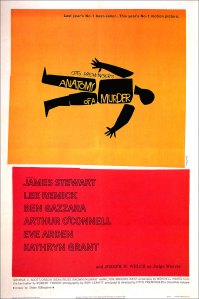
Based on a best-selling novel and directed by the notorious Otto Preminger, Anatomy of a Murder tells the story of Paul Beigler (James Stewart), a former district attorney who is now in private practice after having been voted out of office. Having apparently fallen into a state of ennui, Beigler spends his time drinking with another alcoholic attorney (Arthur O’Connell) and trying to avoid his secretary’s (Eve Arden) attempts to get paid.
However, things change for Beigler when he is hired to defend an army officer named Frederick Manion (Ben Gazzara). Manion has been arrested for murdering a bar own named Barney Quill. Manion says that he was justified in committing the murder because Quill raped his wife, Laura (Lee Remick). Others claim that Manion is himself just a notoriously violent bully and that the openly flirtatious Laura was having an affair with Quill. Despite strongly disliking Manion and disturbed by Laura’s own obvious instability, Beigler takes on the case.
Beigler decides to argue that Manion was temporarily insane when he shot Quill and that he was acting on “irresistible impulse.” As shaky as that line of defense might seem, it’s not helped by the fact that Manion himself is a bit of a brute. Meanwhile, Beigler finds himself facing not the innefectual D.A. in court but instead a young, ambitious prosecutor from the State Attorney General’s Office, Claude Dancer (played by a young and obviously ambitious George C. Scott). As the trial begins, small hints start to appear that seem to indicate that there’s a lot more to the murder of Barney Quill than anyone realizes…
Director Otto Preminger is an odd figure in film history. Up until the early 60s, he was a consistently interesting director who made intelligent, well-acted films that often challenged then-contemporary moral attitudes. However, once the 60s hit, he became something of a parody of the egotistical, old school, autocratic filmmaker and his films seemed to suffer as a result. Like many of the film industry’s top directors, he found himself adrift once the 60s and 70s hit. His decline was so dramatic that, as a result, there’s a tendency to forget that he made some truly great and important films, like Laura, Carmen Jones, The Man With The Golden Arm, and, of course, Anatomy of a Murder.
Anatomy of a Murder represents Preminger at his best. His own natural tendency towards embracing melodrama and shock are perfectly balanced with an intelligent script and memorable performances. Whereas later Preminger films would often come across as little more than big screen soap operas, here he makes the sordid believable and compelling. Preminger has never gotten much attention as a visual filmmaker but here, he uses black-and-white to perfectly capture the grayness of the both the film’s location and the moral issues that the film raises. He keeps the camera moving without ever calling attention to it. As a result, the movie has an almost documentary feel to it.
As previously stated, Preminger gets a lot of help from a truly amazing cast. At first, it’s somewhat strange to imagine a Golden Age icon like Jimmy Stewart appearing in the same film as a dedicated method actor like Ben Gazzara. These are two men who represent not only different philosophies of acting but seemingly from two different worlds as well. However, Preminger uses their differing acting styles to electrifying effect. One of the joys of the movie is watching and contrasting the old style, “move star” turns of James Stewart, Arthur O’Connell, and Eve Arden with the more “naturalistic” approaches taken by their younger co-stars, Gazzara, Lee Remick, and especially George C. Scott. The contrast in style becomes a perfect reflection of the film’s contrast between what is legal and what is correct. All the actors, as both individuals and as an ensemble, give memorable performances. When you look at the cast, you realize that any one of their characters could have been the center of the story without the film becoming any less compelling.
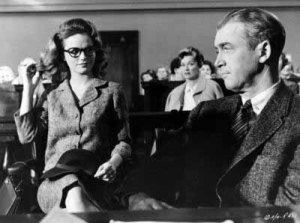
Lee Remick (a notoriously fragile actress who, for years, I knew solely as the poor woman who kept getting attacked by her adopted son in the original Omen) brings out the best in everyone she shares a scene with. Whether she’s making Stewart blush or breaking down on the witness stand, she dominates every scene as an insecure young woman who forces herself to be happy because otherwise, she’d have to confront the fact that she’s miserable. (I should admit that I related more than a bit to Remick’s character. To me, the movie was about her and therefore, about me.)
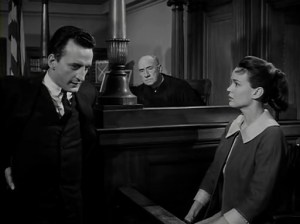
She is perhaps at her best towards the end of the film when she is on the witness stand and is cross-examined by George C. Scott. Starting out as flirtatious and seemingly confident, Remick slowly and believably falls apart as Scott methodically strips away every layer of defense that, until now, she’s spent the entire movie hiding behind. By the end of the scene, Remick has shown as every layer of pain that has built up in Laura Manion over the years. For his part, Scott is simply amazing in this scene. Determined and focused, Scott doesn’t so much cross-examine Remick but seduces her and the audience along with her. As a result, when he suddenly turns off the charm and lunges in for his final attack, it’s devastating for everyone watching. (And, as was correctly pointed out to me by a friend while I was watching the film last night, George C. Scott was quite the sexy beast when he was young.)
Lastly, the film’s judge is played by an actual lawyer by the name of Joseph Welch. Welch wasn’t a great actor but he did make for a great judge.
Of course, it wouldn’t be a Preminger film is a few contemporary morals weren’t challenged and, at the time it was released, Anatomy of a Murder was considered to be very daring because of its frank discussion of topics like rape and spousal abuse. It doesn’t seem quite so daring now but it does seem to be remarkably mature in a way that even most modern movies can’t match. That being said, the film does occasionally embrace the “she must have been asking for it” male viewpoint but still, it’s a remarkably advanced movie for the 1950s.
One of the wonderful things about watching a 51 year-old film is that it provides a chance to see what was considered to be shocking in the years before you or I was born. From watching this movie, I’ve discovered that, in the year 1959, “panties” was apparently a taboo phrase. A good deal of the film’s plot revolves around the panties Lee Remick’s character was wearing the night she was raped and their subsequent disappearance. At one point, there’s even a scene where Welch, Stewart, and Scott struggle to come up with a less offensive term to use when referring to them in the court. (Scott suggests employing a term he heard in France.) Seen 51 years later (in a time when we can not only say “thong” in polite conversation but specifically go out of our way to show off the fact that we’re wearing one), this scene, and the actors’ obvious discomfort whenever they have to say the word “panties”, never fails to amuse me.
Preminger’s other grand challenge to the 50s mainstream was in getting Duke Ellington to compose the film’s jazz soundtrack. At the risk of being called a heretic by some of my closest friends, I’ve never been a big fan of jazz but it works perfectly here. Ellington, himself, makes a cameo appearance and wow, is he ever stoned.
In conclusion, allow me to thank the readers of the site for “ordering” me to watch, once again, a truly classic film. Now, seeing as how close the vote was and that I know, for a fact, that some people voted more than once, I think it would be only fair for me to also rewatch and review the other 9 movies (Lost in Translation, Primer, Hatchet For the Honeymoon, Emanuelle in America, Starcrash, Darling, Sole Survivor, The Sweet House of Horrors, and The Sidewalks of Bangkok) in my poll over the next couple of weeks. I’m looking forward to each and every one of them (well, almost all of them) and, again, thank you for allowing me to start things off with a great film like Anatomy of a Murder.
Last night, with the help of my friend Jeff, I conducted an experiment.
First, I took out my contacts which basically left me blind. Then, just to make sure I was totally without sight, I had Jeff blindfold me. He then took me by the hand and led me over to my DVD collection. Clumsily, I grabbed 10 DVDs at random and handed them back to Jeff. I then proceeded to walk into a wall, at which point I tried to take off the blindfold and ended up losing my balance and falling down flat on my ass.
Why was I risking life and limb to randomly select 10 DVDs?
I did it so you could have the chance to tell me what to do. At the bottom of this article, you will find a poll listing the 10 DVDs I randomly selected. Come next Saturday (June 19th to be exact), I will watch and review whichever movie receives the most votes in the poll. In short, I’m giving you all the power.
Now, to be honest, I’m feeling just a little trepidation about doing this. Whenever you set up a poll, you’re running the risk of absolutely no one voting. Fortunately, I have a plan B in that I recently got the 1st season of Gossip Girlon DVD. If nobody votes in the poll, I’ll just spend next Saturday watching Gossip Girl and writing several long — very long — essays on how different Chuck is in the books as compared to the TV show.
The choice, as they say, is yours.
The 10 movies I blindly selected are listed below in alphabetical order.
1) Anatomy of a Murder (1959) — Jimmy Stewart asks Lee Remick a lot of questions about her panties.
2) Darling (1965) — Julie Christie claws her way to the top of the modeling industry and discovers ennui.
3) Emanuelle in America (1978) — Emanuelle investigates decadence in America. Some people think that this movie contains footage taken from an actual snuff film. We call those people “idiots.”
4) Hatchet For The Honeymoon (1969) — Mario Bava directs this film about a man driven to murder by the sight of an unflattering bridal gown.
5) Lost in Translation (2003) — I will admit that I squealed with joy when I discovered that I had randomly selected one of my favorite movies of all time.
6) Primer (2004) — Engineers play with time and space. Oddly enough, this movie was filmed a few miles away from where I live.
7) The Sidewalks of Bangkok (1986) — Like most of Jean Rollin’s film, this is something of a misunderstood masterpiece.
8 ) Sole Survivor (1982) — An atmospheric little horror film with a sadly generic title.
9) Starcrash (1978) — Strange sci-fi movie in which Christopher Plummer recruits space pirate Caroline Munro to battle a pre-Maniac Joe Spinell. This film also marks the screen debut of David Hasselhoff.
So, those are our ten options. On Saturday, July 19th, I will sit down, watch, and review whichever movie receives the most votes. On that day, for four to six hours, I will give up my independence and submit to the wishes of the majority.

 Through the Shattered Lens