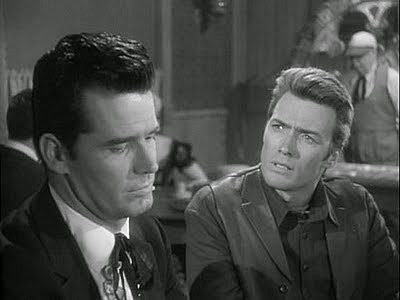
MAVERICK (TV Series) – starring James Garner – S2, E19: “Duel at Sundown” (Guest star – Clint Eastwood)


Bret Maverick (James Garner) stops off and visits his old friend Jed Christianson (Edgar Buchanan). Jed is desperate to break up the hot and heavy romance between his beautiful and wild daughter, Carrie (Abby Dalton), and a good for nothing gunslinger named Red Hardigan (Clint Eastwood). He asks Bret to stay for a while and help break them up. Not really wanting to get involved, Bret changes his tune when he’s offered $1,000 to hang around for a week. There is one serious problem, though, and that’s the fact that Red has a reputation for being extremely fast and accurate with a gun, and he’s not afraid to use it. When Bret actually sees a demonstration of Red’s shooting skills, he knows he’s going to have to come up with a plan to drive Red away that avoids a gunfight at all costs. And that’s exactly what he does. I won’t give away exactly what he does, but it involves his brother Bart (Jack Kelly) and a notorious gunslinger named John Wesley Hardin, and it’s genius! 

As we continue to celebrate the birthday of Hollywood legend Clint Eastwood, I decided I’d watch his 1959 guest starring appearance on the TV series MAVERICK with James Garner. I recently watched Eastwood and Garner work together in the enjoyable “geezers in space” movie SPACE COWBOYS (2000), which came out about 40 years after this. With that fresh in mind, I especially enjoyed seeing them work together while they were both in their prime. “Duel at Sundown” is the first episode I’ve watched of the MAVERICK TV series, and I must say that I had a ball with it. James Garner’s effortless charisma and laid back demeanor as Bret Maverick make his character right down my alley. Nothing seems to rattle the man, and he’s as funny as hell! As of the time of this review, all five seasons of the series are streaming on PlutoTV, so I’m planning on catching some more episodes as I can. As far as the young Clint Eastwood, who was 29 when this show premiered, he definitely looks the part of a future star. Maybe I’m just being influenced by what he’s accomplished over the last 60 years, but his steely intensity, his great head of hair, and his way with the ladies are all on display. And even though his character of Red is a hot headed gunslinger who’s driven by jealousy, there are a couple of times when he flashes that million dollar smile, and you can’t help but like him. For me, it’s fun to watch these megastars in roles when they were just working actors trying to build a career. You can usually see the qualities that will make them the most popular actors in the world, but they’re still going to lose to the star of the series at the end. It’s a rite of passage. 

Overall, “Duel at Sundown” is an excellent introduction to the MAVERICK TV series for me. It’s funny and actually quite clever, as evidenced by the scheme that Bret Maverick comes up with at the end to keep from having to face Red in a gunfight. But the true highlight is seeing Garner, in one of his signature roles, working with a young Eastwood who’s destined for stardom. I highly recommend it! 
An Offer You Can’t Refuse: Dragnet (dir by Jack Webb)


1954’s Dragnet opens with a gangland slaying.  We watch as a man is brutally gunned down in a field in Los Angeles.  The rest of the film deals with the efforts of the LAPD to track down and arrest the killers.

Based on the televisions show that gave birth to the whole “cop show” format, Dragnet features Jack Webb as Sgt. Joe Friday, calmly and efficiently investigating the slaying.  Working with Friday is Officer Frank Smith (Ben Alexander) but the film (just like the show) is ultimately about how the whole criminal justice system works together as a machine designed to protect the citizenry and to punish crime.

Or, at least, that’s the way it’s supposed to work.  Especially if you’re only familiar with Dragnet from its late 60s incarnation and the countless parodies that followed, the 1954 Dragnet can seem surprisingly cynical and rough-edged.  The killings are violent, the criminals are ruthless, and the cops are often frustrated in their attempts to solve crimes.  In this film, at least, justice is not guaranteed.

The shooting victim is identified as a low-level gangster named Miller Starkie and Friday and Smith immediately suspect that he was killed on the orders of West Coast mob boss Max Troy (Stacy Harris).  Friday and Smith know that Troy is guilty and they even figure out who worked with Troy to kill Starkie.  But, throughout the film, they struggle to get any sort of concrete evidence tying Max to the crime.  Dragnet is a police procedural that follows every bit of the investigation, including the attempts to convince a grand jury to indict Max.  One of the more interesting moments in the film is when Friday gives his grand jury testimony and it becomes obvious that the district attorney was right to be skeptical about trying to bring charges.  Friday really doesn’t have enough evidence to justify arresting Max for the crime that everyone knows he committed.  To the film’s credit, it doesn’t attack the grand jury system or suggest that the system is unfairly rigged for the criminals.  Friday may be frustrated but he understands that the system has to protect the rights accused first.  One has to be presumed innocent until proven guilty even when everyone knows that person is guilty.

That said, Friday and Smith and the entire LAPD end up harassing Max Troy in a way that would probably not fly if the film were made today.  At one point, a line of police cars park in front of Max’s house and then all shine their lights into his windows.  Friday and Smith end up following Max everywhere that they he goes, stopping him and randomly frisking him before ordering him to empty his pockets.  Today, I imagine this would lead to lawsuit.  Even in the film, it doesn’t exactly pay off.

What does pay off is sending a police woman (played by Ann Robinson) into Max’s nightclub undercover, with a recording device.  This whole sequence is interesting because it’s apparent that the idea of a tiny recording devices — something that we take for granted nowadays — was apparently a new and exciting concept in 1954.  (Indeed, the one used in this film actually looks a bit bulky.)  For a few minutes, the action stops so Dragnet can show off the LAPD’s latest toy.

I liked Dragnet.  It’s an nicely-paced time capsule and, despite its docudrama style and television origins, director Jack Webb manages to come up with a few memorable visuals.  As someone who has binged the late 60s version of Dragnet, it was interesting to see a tougher and much more cynical version of the series.  While Webb was hardly an expressive actor, his dour demeanor serves him well as Joe Friday and Stacy Harris is appropriately sleazy as the crime boss.  Despite all of Friday’s frustrations, the case eventually comes to a conclusion in the 1954 film, even if it’s not the one that Friday and his bosses wanted.  Max may be able to escape the police but he can’t escape his own health.  Friday and Smith move on to investigate the next case.  As always, the names will be changed to protect the innocent.

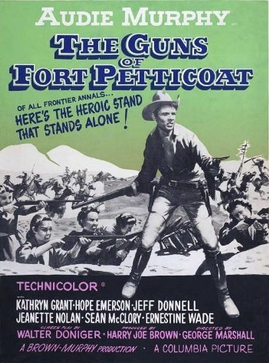
The Guns of Fort Petticoat (1957, directed by George Marshall)


During the waning days of the Civil War, Lt. Frank Hewitt (Audie Murphy) is a man without a country.  A Texan, he joined the Union Army even as his home state was voting to secede from the United States.  In the Army, Hewitt is viewed with distrust by his autocratic superior, Col. John Chivington (Ainslie Pryor).  When Hewitt learns that Chivington has ordered a surprise attack on an unarmed local Indian tribe in order to drive them into Texas where they will attack the nearest settlement for revenge, Hewitt deserts the Army to warn the people left in his hometown.

When Hewitt arrives, he discovers that all of the men in town have left to join the Confederate Army.  Only their wives, mothers, and sisters remain.  Though Hewitt is, at first, accused of being a traitor, he sticks around and trains the women on how to fight not only the incoming Comanches but also any outlaws who ride into town looking to take advantage of the situation.

The Guns of Fort Petticoat is an interesting B-western that holds up well today.  Even though the film ends with a Comanche attack, it’s made clear that the attack would not have happened if not for the actions Col. Chivington.  Chivington, who doesn’t care that the victims of his actions would not be Confederate soldiers but instead just helpless woman and children, is the film’s true villain, even if he only appears in the first and final scenes.  Audie Murphy, who was America’s most decorated World War II veteran, not only starred in but produced the movie.  Murphy was a stiff actor but he looked believable in uniform and obviously knew how to convincingly shoot a rifle and that’s all this role really demands of him.  Kathryn Grant plays the woman who goes from distrusting Hewitt to falling in love with him and she and Murphy work well together.  The final battle between the women and the Comanches is exciting and well-shot by veteran western director George Marshall.  The movie’s final scene may not be totally believable but it’s still very satisfying.

Fans of the western genre and Audie Murphy will find much to enjoy about The Guns of Fort Petticoat.

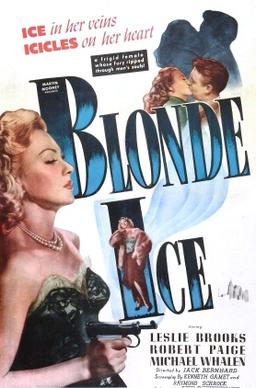
30 More Days of Noir #2: Blonde Ice (dir by Jack Bernhard)


1948’s Blonde Ice tells the story of Claire Cummings (Leslie Brooks), the society columnist for a San Francisco newspaper.  Almost every man that Claire meets falls in love with her.

Les Burns (Robert Paige), the paper’s cynical sports reporter?  Les is so in love with Claire that he keeps getting involved with her despite the fact that she cheats on him with almost every man that she meets.

Al Herrick (James Griffith)?  Yep, he’s still in love with her too.

Carl Hanneman (John Holland), one of the wealthiest men in San Francisco?  Carl is so in love with Claire that he’s willing to marry her even after he catches her kissing Les on the day of the wedding!

Congressional candidate Stanley Mason (Michael Whalen)?  He’s so in love with Claire that he’s willing to sacrifice his political career just to be with her.

How about Blackie Talon (Russ Vincent), the pilot who witnesses Claire doing some things that she probably wouldn’t want the world to know about?  Well, Blackie never gets around to declaring his love for Claire but his obsession with blackmailing her is probably just his way of dealing with the massive crush that he has on her.

The only person who doesn’t appear to be in love with Claire is Dr. Kippinger (David Leonard), a psychiatrist who immediately picks up on the fact that Claire is cold and manipulative.  There’s a reason why Les refers to her as being …. can you guess? …. “Blonde Ice!”

Of course, even with all of these men falling in love with her, no one loves Claire as much as Claire loves herself.  Claire is a narcissist and a sociopath and she has no problem killing one lover and framing another for the crime.  In fact, it’s something that she attempts to do several times over the course of Blonde Ice.  Claire, it has to be said, is pretty clever about it too.  Her natural ability to manipulate, combined with her total lack of empathy for anyone but herself, makes Claire a dangerous character.

Blonde Ice is somewhat obscure as noirs go.  It was clearly a poverty row production, with only a 74-minute running time and a cast largely made up of obscure contract players.  And yet, Blonde Ice is a personal favorite of mine, largely because of the ferocious performance of Leslie Brooks.  Brooks rips into the role of the femme fatale, delivering her cynical lines with aplomb and murdering anyone who gets in her way.  Considering that this film was made in 1948, I was actually a bit shocked at just how high the body count climbed in just an hour and a few minutes.  Claire is basically willing to kill anyone and the film often seems to take a perverse delight in showing how easily she can convince others of her innocence.  Perhaps the most interesting thing about the film is that Claire attempt to frame the same man for not one but two murders and, even after all that, he still doesn’t seem to be emotionally capable of telling her to get out of his life.  In a world of weak men, Claire comes in, takes control, and offers up no apologies.

Obscure though the film may be, Blonde Ice is an enjoyable noir and can be found on YouTube.

At Gunpoint (1955, directed by Alfred L. Werker)


When a gang of outlaws attempt to rob a bank in the small frontier town of Plainview, the local sheriff is one of the first people to get gunned down.  It falls upon two local men, George Henderson (Frank Ferguson) and storeowner Jack Wright (Fred MacMurray), to run the outlaws out of town.  While most of the gang escapes, Jack and Henderson manage to kill the gang’s leader, Alvin Dennis.

At first, Jack and Henderson are declared to be heroes and Henderson is appointed sheriff.  However, when Henderson is found murdered, the town realizes that Alvin’s brother, Bob (Skip Homeier), has returned to get revenge.  The inevitable confrontation is delayed by the arrival of a U.S. marshal who stays in town for two weeks to maintain the peace but everyone knows that, once he leaves, Bob is going to be coming after the mild-manned Jack.  The townspeople go from treating Jack like a hero to shunning him.  They even offer Jack and his wife (Dorothy Malone) money to leave town but Jack refuses to give up his store or to surrender to everyone else’s fear.

At Gunpoint is a diverting variation on High Noon, with Fred MacMurray stepping into Gary Cooper’s role as the upstanding man who the town refuses to stand behind.  What sets At Gunpoint apart from High Noon is that, unlike Cooper’s Will Kane, MacMurray’s Jack Wright isn’t even an experienced gunslinger.  Instead, he’s a mild-mannered store owner, the old west’s equivalent of an intellectual, who just managed to get off a lucky shot.  If he can’t find a way to get the cowardly town to back him up, there’s no way that he’s going to be able to defeat Bob and his gang.

At Gunpoint features an excellent cast of Western character actors, including John Qualen, Irving Bacon and Whit Bissell.  Especially good is Walter Brennan, playing one of the only townspeople to have any integrity.  While this western may not have the strong political subtext or the historical significance of High Noon, it’s still a well-made example of the genre.  It’s a western that even people who don’t normally enjoy westerns might like.

Horror on TV: Kolchak: The Night Stalker 1.8 “Bad Medicine” (dir by Alexander Grasshoff)


On tonight’s episode of Kolchak: The Night Stalker, wealthy women are dying in Chicago and Carl Kolchak is on the case!  It turns out that it’s all connected to priceless jewels and a legendary monster known as the Diabelro, a creature has been cursed to roam the Earth and search for gems.

The Diabelro is played by Richard Kiel, who might be best known for playing Jaws in The Spy Who Loved Me and Moonraker.

This episode originally aired on November 29th, 1974.

Enjoy!

http://www.youtube.com/watch?v=97o7cuBNTAs

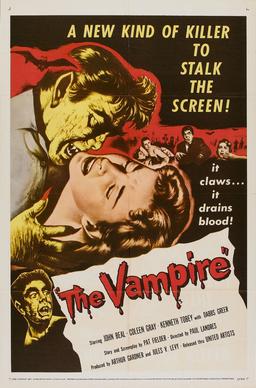
Horror Film Review: The Vampire (dir by Paul Landres)


Headaches are a bitch!

And if you didn’t already know that, you will know it after watching the 1957 film, The Vampire.

Like many films of this kind, The Vampire starts with death.

Actually, I take that back.  Technically, it’s true but it’s also little bit too melodramatic.  And, to be honest, The Vampire starts with a 14 year-old boy, who is very much alive, riding his bicycle down the street of Anytown USA.  He has a box with him, one that has air holes.  On the back of his bike, a cardboard sign reads: “Bobs Pet Zoo!  If Its Alive We Got It!”  Apparently, the kid is smart enough to run his own zoo but not smart enough to know when to use an apostrophe.

Anyway, the kid comes up to a creepy old house, one that looks somewhat out of place in the otherwise pristine suburban neighborhood.  Originally, I thought that maybe Pennywise lived in the house but then I reminded myself that The Vampire was made decades before It.  Instead, the house belongs to Dr. Campbell, a scientist who is doing experiments with blood and who needs a never-ending supply of animal test subjects.  (Boooooo!  Animal testing!  Hiss!)  Apparently, the kid keeps Dr. Campbell supplied with animals.  When the kid enters the house, Dr. Campbell is nowhere to be seen.  It’s not until the kid enters the laboratory that he discovers Campbell, dead and slumped over his desk.

As news spreads of Campbell’s death, his friend, Dr. Paul Beecher (John Beal), searches through Campbell’s belongings and he comes across a mysterious bottle of pills, which he promptly takes home with him.  Dr. Beecher is kindly doctor, the type that we all wish we could deal with whenever we had to go in for a check up.  However, he suffers from terrible migraines.  That night, when he’s literally blinded with a headache, he asks his daughter to get him his pills.  She retrieves a bottle of pills but guess what?  They’re the wrong pills!  They’re not headache pills!  Instead, they’re Dr. Campbell’s vampirism pills!

The pills cause Beecher to blaxk out.  Whenever he comes to, he never has any memory of what he may or may not have done while he was out.  However, strange things are happening to his friends and his patients.  One of his longtime patients dies of fright when he comes by her house.  On her neck, he finds two puncture wounds…

So, it’s not a spoiler for me to tell you that Dr. Beecher has been transformed into a vampire.  And I know what you’re thinking.  Why doesn’t he just stop taking the pills?  The simplest answer is that the pills are addictive.  The more complex answer is that he doesn’t want to.  The pills have brought out his dark side and, now that it’s free, it’s not planning on going anywhere.

In a strange way, The Vampire reminded me of Nicholas Ray’s Bigger Than Life.  In Bigger Than Life, James Mason plays a gentle and good-hearted professor who, after taking steroids, turns into a monster who dreams of creating a master race.  Bigger Than Life was unsettling for the exact same reason that The Vampire is unsettling.  Both suggest that the pills didn’t turn their user into a monster.  Instead, the pills just allowed his true self to come out.

The Vampire was a low-budget film, a B-movie as many would probably call it.  The musical score is overly melodramatic and so are some of the actors.  But I would say that The Vampire is actually a bit of a subversive masterpiece.  This 1957 film suggests that behind the pristine facade of suburbia, there lurked monsters.  Even an outwardly successful and respected man like Dr. Beecher can turn into something totally different behind closed doors, this film is saying.  That’s a message that it as relevant today as it was when this film was first released.  In its own way, The Vampire is a brilliant and important movie.

Horror on TV: Thriller 2.18 “The Storm” (dir by Herschel Daugherty)


For tonight’s televised horror, we have another classic episode of the Boris Karloff-hosted anthology series, Thriller!

In this creepy and atmospheric episode, a newlywed (Nancy Kelly) and her cat attempt to get through a stormy night in an isolated house.  But are they really alone?

Watch, find out, and enjoy!

http://www.youtube.com/watch?v=50WswbK20LM