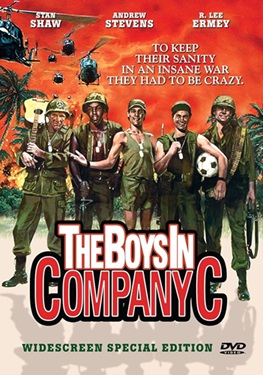
 In 1967, a group of young men arrive at the Marie Corp. Recruit Depot in San Diego. Tyrone Washington (Stan Shaw) is a drug dealer from Chicago who tells everyone not to mess with him and who soon emerges as a natural born leader. Dave Brisbee (Craig Wasson) is a long-haired hippie who tried to feel to Canada and who shows up for induction in handcuffs. Vinny Fazio (Michael Lembeck) is a cocky and streetwise kid from Brooklyn. Billy Ray Pike (Andrew Stevens) is a country boy from Texas. Alvin Foster (James Canning) is an aspiring writer who keeps a journal of his experiences. Sgt. Loyce (R. Lee Ermey, making his film debut) molds them into a combat unit before they leave for Vietnam, where they discover that all of their training hasn’t prepared them for the reality of Vietnam.
The Boys In Company C has the same basic structure as Stanley Kubrick’s Full Metal Jacket, right down to R. Lee Ermey playing the tough drill sergeant. The sharp discipline of basic training is compared to the chaos of Vietnam. Ermey always said that he was playing a bad drill sergeant in Full Metal Jacket because he tore down the recruits but never bothered to build them back up. In The Boys In Company C, Ermey plays a good drill sergeant, one who is tough but fair and who helps Washington reach his potential. It doesn’t make any difference once the company arrives in Vietnam, though. Both The Boys In Company C and Full Metal Jacket present the war in Vietnam as being run by a collection of incompetent officer who have no idea what it’s like for the soldiers who are expected to carry out their orders.
Of course, The Boys In Company C is nowhere near as good as Full Metal Jacket. Full Metal Jacket was directed by Stanley Kubrick and it’s a chilling and relentless look at the horrors of combat. The Boys In Company C was directed by Sidney J. Furie, a journeyman director who made a lot of movies without ever developing a signature style. The basic training scenes are when the film is at its strongest. When the company arrives in Vietnam, Furie struggles with the story’s episodic structure and it can sometimes be difficult to keep track of the large ensemble cast. The Vietnam sequences are at their best when the emphasis is on the soldiers grumbling and bitching as their officers send them on one pointless mission after another. The soccer game finale tries to duplicate the satire of the football game that ended Robert Altman’s M*A*S*H but it does so with middling results. The Boys in Company C is a collection of strong moments that never manage to come together as a cohesive whole.
The movie is still important as one of the first major films to be made about the war in Vietnam. However, it’s since been overshadowed by The Deer Hunter, Apocalypse Now, Platoon, and, of course, Full Metal Jacket.
 Through the Shattered Lens