Lisa Reviews An Oscar Nominee: The Champ (dir by King Vidor)


the_champ_poster

“I want the Champ!  I want the Champ!”

Oh good God, shut up you little brat.

Now, nobody actually tells 8 year-old Dink (Jackie Cooper) to shut up at the end of 1931’s The Champ.  I’d like to think that I probably would have said those words if I had been sitting in the audience but, in all honestly, I probably would have been crying along with everyone else.  I’m sure that a lot of people probably cried when The Champ was first released.

And really, it’s probably unfair to criticize Jackie Cooper for repeatedly wailing, “I want the Champ!” during the film’s final five minutes.  It’s actually probably one of the few authentic moments in the film.  It’s just unfortunate that Cooper’s voice was a bit shrill and, as a result, I found myself covering my ears.

As for what The Champ is about, it’s the story of a boy and his alcoholic father.  Andy Purcell (played with loutish charm by the never particularly subtle Wallace Beery) is a boxer.  He used to be the world champion and people still call him The Champ.  Of course, it’s been a while since he’s been in the ring.  Now, Andy just drinks and gambles and continually lets down his son.  However, Dink is always willing to forgive Andy and Andy does truly love his son.  He even buys him a horse, which gets named Little Champ.

It’s while at the stables that Dink meets an upper class woman named Linda (Irene Rich).  What Dink does not realize is that Linda is … his mother!  She was once married to the Champ but his drinking led to divorce.  Linda wants to adopt Dink and perhaps she should because The Champ really is not a very good father.  He even loses Little Champ in a card game.

Fortunately, the Champ has a chance to win the money needed to buy back the horse.  All he has to do is reenter the ring and beat the Mexican heavyweight…

It all leads to “I want the champ!” being screamed several hundred times in a handful of minutes, enough times to make me fear that I would be deaf before the film ended…

The Champ is an old-fashioned and rather creaky melodrama, one that hasn’t aged particularly well.  Director King Vidor specialized in films about the “common man” and The Champ often feels like it was adapted from the first draft of an unproduced Clifford Odets play.  It’s all very sentimental and so thoroughly lacking in snark or cynicism that, for modern audiences, it’s difficult to relate to.  I’ll leave it to you to decide whether that’s a good or a bad thing.

The Champ does hold a place in Oscar history.  Wallace Beery won the Oscar for Best Actor but, for the first time in the history of the awards, there was a tie and Beery shared the Oscar with Fredric March, who won for Dr. Jekyll and Mr. Hyde.

The Champ was also nominated for best picture but it lost to Grand Hotel, which also features Wallace Beery.
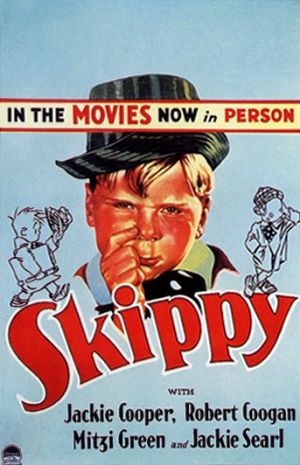
Lisa Reviews An Oscar Nominee: Skippy (dir by Norman Taurog)


Skippy1931

(SPOILERS BELOW!)

Oh my God, they actually killed the dog…

That was my main reaction, this morning, as I watched the 1931 film Skippy.  Skippy aired on TCM earlier this morning and I set the DVR to record it because, long ago, Skippy was nominated for best picture and, for quite some time, it has been my goal to see and review every single film ever nominated for the best picture.

And I have to admit that for the first hour or so, I wasn’t sure if I’d actually be able to get all the way through Skippy.  Skippy is very much a film of the early 30s and you never known how much you appreciate jump cuts, tracking shots, and even the occasional hand-held camera shot until you watch a movie that features none of them.  It’s definitely a different style of story telling and I sometimes found myself struggling to adjust to it.

Add to that, Skippy was a film about children and, while the film’s star, 9 year-old Jackie Cooper, was a natural before the camera, the other child actors often seemed forced.  There was a lot of overacting that, if nothing else, made me appreciate even more Jacob Tremblay’s subtle performance in Room.

There were a few things that I did appreciate about Skippy.  As I’ve stated on the site before, I love history and Skippy was definitely a time capsule.  The film follows 6 year-old Skippy (Jackie Cooper) as he leaves the safety of his upper class home and explores the poor side of the town and the film does a good job of contrasting Skippy’s sheltered home with the nearby neighborhood of Shantyown.  It’s while wandering around Shantytown that Skippy meets and befriend Sooky (Robert Coogan).  Skippy and Sooky accidentally break a windshield that belongs to the evil dogcatcher, Mr. Nubbins (Jack Rube Clifford).  Mr. Nubbins retaliates by taking away Sooky’s dog and demanding that the boys pay him 3 dollars for the dog’s freedom.  Though it’s a mighty struggle that involves many comedic schemes, the boys manage to raise the 3 dollars.  Mr. Nubbins takes the money, says that he’s going to use the money to buy a new windshield, and that he’s going to kill the dog anyway.  So, Skippy and Sooky have to raise three dollars more just to discover that Mr. Nubbins has already shot their dog.

As Sooky sobs, Skippy fights back tears and asks if they can at least have the dog’s body so they can give it a proper burial.

“It’s already been disposed of,” Mr. Nubbins snarls.

And, at this point, I was just sitting there and thinking, “What the HELL!?”  Seriously, I can only imagine what it must have been like to be a child in 1931, watching this film (which was based on a comic strip that all the kids probably read every day), laughing at jokes that were probably quite funny back then, and then suddenly being smacked in the face by Mr. Nubbins announcing that not only was the dog dead but his body had been cremated.  I can only imagine that amount of tears that were shed in those 1931 theaters!

(Making things even worse is the discovery that the town’s rules for dealing with stray dogs were written by none other than Skippy’s father.)

And as I thought more about it, it occurred to me that this is one thing that would never happen in a movie today.  You don’t kill the dog, unless you want Keanu Reeves to show up and kill you.

Sooky breaks into tears as soon as he hears that his dog has been killed.  Skippy manages to hold back until he gets home and then he breaks into sobs.  (According to Jackie Cooper, director Norman Taurog threatened to kill the dog in real life unless Cooper gave him authentic tears.)  Fortunately, all is eventually resolved by both Skippy and Sooky getting new dogs and Skippy’s dad beating up Mr. Nubbins.  Yay!

Anyway, for the most part, Skippy is one of those films that will mostly be interesting to Oscar completists for me.  However, I will always be stunned by the fact that, in the film, Mr. Nubbins actually killed that dog.

Horror on TV: Twilight Zone 5.28 “Caesar and Me”


TheTwilightZoneLogo


Tonight’s episode of The Twilight Zone might remind you of a previous episode entitled The Dummy. Once again, we have a story about a ventriloquist (Jackie Cooper) and a dummy who appears to have a mind of his own. (In fact, the same prop dummy was used in both episodes.) However, Caesar and Me is an even darker take on the conflict between puppet and puppeteer.


Seriously, don’t mess with Caesar.


This episode originally aired on April 10th, 1964.


Embracing the Melodrama Part II #39: Maybe I’ll Come Home In The Spring (dir by Joseph Sargent)


maybeWay back in January, I was looking for something to have playing on TV in the background while I cleaned the house.  I went from station to station until I finally came across a movie that I had never seen before.  It featured a  young-looking Sally Field wandering through a house that was full of stuffy-looking old people.  She stepped out of the house and dived, fully clothed, into a swimming pool.  Everyone in the house was shocked.  Then, one abrupt jump cut later, a bearded David Carradine was hijacking an ice cream truck…

“What the Hell is this?” I wondered.  Checking on the guide, I discovered that I was watching Maybe I’ll Come Home In The Spring, a made-for-television film from 1971.  I put off the cleaning for thirty minutes so that I could watch the rest of the film.

(And, if you know how obsessive compulsive I am about keeping the house clean, then you know what a big deal that was for me.)

After watching the rest of the film on television, I rewatched Maybe I’ll Come Home In The Spring on YouTube.  And I decided that I so wanted to recommend this film that I ended up launching Embracing the Melodrama Part II specifically so I’d have an excuse to write about Maybe I’ll Come Home In The Spring.

Sally Field, who was 25 when this film was first broadcast but looked and sounded much younger, plays Dennie Miller.  After being raised in the oppressively conformist atmosphere of the suburbs, Dennie ran away from home and spent a year with her hippie boyfriend, Flack (David Carradine).  As we learn from several flashbacks that are almost randomly spread out across the film, Dennie’s life with Flack largely amounted to panhandling and trying to avoid the police.  Finally getting tired of living with the controlling Flack, Dennie waited until Flack was busy panhandling and then hitched a ride with a leering truck driver.

Arriving back home after being gone for a year, Dennie is welcomed back by both her father (Jackie Cooper) and her mother (Eleanor Parker).  However, Dennie finds it difficult to readjust to her parent’s conformist life style.  Meanwhile, her emotionally distant parents are uncomfortable with talking to Dennie about the previous year and instead, cho0se to act as if she never left.  Dennie’s younger sister, Susie (Lane Bradbury), both looks up to and resents Dennie.   Susie got used to a life without Dennie and now that Dennie has returned, Susie is forced back into the role of being the kid sister.

Meanwhile, Flack isn’t prepared to let Dennie go.  Fully committed to both the idea of living a life separate from conventional society and to his own self-image as being the ultimate counter-cultural alpha male, Flack travels across California, intent on tracking Dennie down and convincing her to once again leave with him.

I loved Maybe I’ll Come Home In The Spring.  While it is undeniably dated (as any 1971 film about hippies would be), it also touches on a lot of themes and issues that never go out of date.  Whether it was the complicated relationship between Dennie and Susie or Dennie’s discovery that, as a result of her year spent on her own, all of her parent’s friends now view her as being somehow “damaged,” there is so much about Maybe I’ll Come Home In The Spring that rings painfully true.

And while Maybe I’ll Come Home In The Spring does not hesitate to point out the hypocrisy of Dennie’s parents and their friends, it’s equally critical of Flack and his countercultural posturing.  In the end, you come to realize that Flack and Dennie’s father are actually two sides of the same coin.  They’re both convinced that their way is the only way and that they — and they alone — know what is best for Dennie.  In the end, Maybe I’ll Come Home In The Spring is less about mainstream vs. hippie and more about Dennie’s struggle to be an independent woman in a world that doesn’t value or appreciate female independence.

Maybe I’ll Come Home In The Spring is a good film and guess what?  You can watch it below!