To be honest, it’s probably open for debate whether or not Wake In Fright is actually a horror film.
This 1971 Australian film, which tells the story of a school teacher who becomes stranded in a small town in the outback, doesn’t feature any ghosts or werewolves or vampires or zombies or anything else of a supernatural nature. The school teacher meets a large number of people in town, the majority of whom are technically quite friendly. They teach him how to gamble. They take him on a hunt. They give him shelter when he doesn’t have anywhere else to stay. The word “mate” is tossed around so frequently that it soon becomes clear that every man — significantly, there’s only two women in the film and one of them only appears in the teacher’s memories — in the outback is considered to be one.
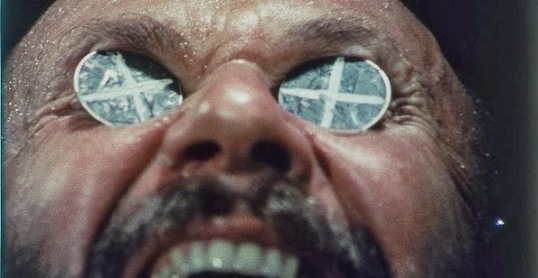
The people of town of Bundanyabba — or “The Yabba,” as they call it — are also very generous with their beer. If they meet you for the first time, they expect you to have a beer with them. If they see you for the first, second, or third time during the day, they expect you to have a beer with them. They wake up in the morning drinking and they go to bed drunk. When John Grant (Gary Bond) first shows up in the Yabba, he can barely handle two beers. By the end of his stay, he’s drinking nonstop.
However, John also discovers that it dangerous to turn down those offers of beer. Turn down a beer and you might get a strange look, if you’re lucky. More likely, you’ll get yelled at. Turn down a beer from the wrong person and you might even get attacked. Everyone in the Yabba is friendly but everyone is also always on the verge of throwing the first punch. Refuse a beer and you might be in trouble. Refuse to enthusiastically take part in a savage and sadistic kangaroo hunt and your mates might starts to talk. When John first arrives, he’s a bit amused by the town and what he sees as being its backwards ways. It’s obvious that he looks down on the people around him and one can sense that they realize that. Perhaps that’s why everyone around him seems to take such joy in watching John slowly lose his identity.

That’s horror at the heart of Wake in Fright. It’s not the horror of the paranormal. Instead, it’s the horror of the isolation. There’s no way to fight the isolation and the madness it brings. Your only choice is to either surrender to it or be destroyed by it. The longer John spends in the Yabba, the more the bleakness of the outback gets to him. It’s a world dominated by brutal men, none of whom are particularly impressed when they find out that John’s teacher and that he has a suitcase full of books. They view John as being soft and, in order to prove that he’s not, John starts to sacrifice his identity. He starts to become just as much of a brute as Dick (Jack Thompson) and Joe (Peter Whittle).

Having lost all of his money, John eventually ends up staying with Doc Tydon (Donald Pleasence). Doc really is a doctor. He’s also, as he cheerfully explains, an alcoholic. When John says that he’s going to find some place else to stay, Doc makes it clear that John isn’t leaving. The film makes good use of Pleasence’s eccentric screen presence. Is Doc simply being friendly or does Doc have more sinister motives fueling his insistence that John stay with him? When Doc gives John advice, is it to help him or is it to further degrade John? Like John, Doc is an educated man and obviously smarter than those around him. And yet, Doc seems very happy in the mad world of the Yabba, drinking, hunting, and gambling. Is John destined to become Doc or can he escape?
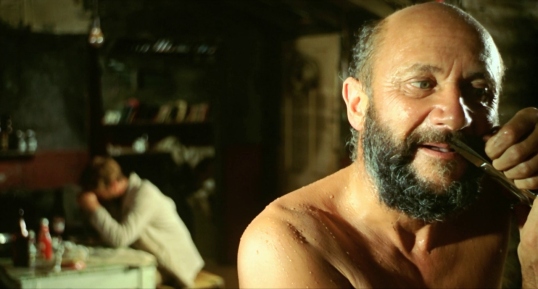
John discovers that leaving the Yabba isn’t easy. Every time he tries, he ends up back in town. All roads seems to lead back to the Yabba. In retrospect, perhaps the most frightening thing about Wake In Fright is that no one seems to be surprised by the sight of the increasingly disheveled and unstable John. Even when he stumbles through town while carrying a rifle, no one gives him a second look. He’s just another part of the scenery.

No, Wake In Fright is not a traditional horror film but it’s a horror film, nonetheless. It’s about the horror of not only losing your identity but perhaps not being quite sure what your identity was in the first place. As played by Gary Bond, John is an often frustrating character but you never stop caring about him. It’s frightening to watch him lose himself, even while you wonder if he ever knew who he truly was in the first place. Bond was a stage actor who only appeared in three films. Wake in Fright was his final film and one of the huge reasons why it’s so effective is because Gary Bond is not an actor who we recognize from other films. We don’t seen an actor when we look at him. Instead, we see a person who, for the first time, is discovering just how unsettling life on the fringes can be.
It’s a powerful film and a controversial one. When John is taken on a kangaroo hunt, footage from an actual hunt was included in the film and it’s a horrific sequence, one that’s made all the more disturbing by the fact that the hunters refuse to acknowledge just how horrific and unjust it all is. Reportedly, when Wake In Fright was first released, someone in a Sydney theater stood up and shouted at the screen, “This is not us!” Actor Jack Thompson, who made his film debut in Wake In Fright, was in the audience and shouted back, “It is us, mate! Sit down!”

For a long time, it was impossible to see Wake In Fright. Only one known print was known to exist and it was a badly damaged one. Fortunately, in 2002, another print was found in Pittsburgh and Wake In Fright was rereleased and rediscovered. When it was first released in 1971, the film’s violence and downbeat atmosphere were both controversial and it struggled at the Australian box office. (Many Australians, like that theatergoer in Sydney, initially viewed the film as being a bit of a personal attack.) Rereleased in 2003 and championed by Martin Scorsese, Wake In Fright was embraced by a new generation of critics, many of whom declared it to be one of the greatest and most important Australian films ever made.
Wake In Fright is a powerful and unsettling film, a portrait of a place that seems to be fueled by toxic masculinity and self-destruction. It’s a disturbing film and not easy to watch. But if you do watch it, it will stick with you and leave you thinking long after the final credits roll.

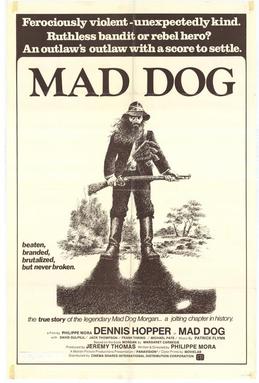 Though he may not be as internationally well-known as Ned Kelly, Dan “Mad Dog” Morgan was one of the most infamous bushrangers in 19th century Australia. Much as with the outlaws of American west, it is sometimes difficult to separate the fact from the legend when it comes to Mad Dog Morgan but it is agreed with Morgan has one of the most violent and bloodiest careers of the bushrangers. Whether Morgan was a folk hero or just a ruthless criminal depends on which source you choose to believe.
 Through the Shattered Lens