Book and Film Review: Get Shorty (by Elmore Leonard and dir by Barry Sonnenfeld)


In 1995’s Get Shorty, John Travolta stars as Chili Palmer.

Chili is a loan shark for the mob, an effortlessly cool guy who lives in Miami and who loves to watch old movies.  Chili may work for the Mafia and he may make his living by intimidating people but he doesn’t seem like such a bad guy, especially when compared to someone like Ray “Bones” Barboni (Dennis Farina).  Bones is an uncouth and rather stupid gangster who steals Chili’s leather jacket from a restaurant.  Chili reacts by breaking Bones’s nose with just one punch.  Bones reacts by trying to shoot Chili but instead, he gets shot by Chili himself.  (The bullet only grazes his forehead.)  Chili can do all this because he’s protected by Momo (Ron Karasbatsos) but, after Momo drops dead after having to walk up several flights of stairs just to then be given a surprise birthday party, Chili suddenly finds himself working for Bones.  (This all happens in the first few minutes of this perfectly paced film.)

Bones, eager to humiliate Chili, sends him to Vegas to collect on a debt owed by a dry cleaner named Leo (David Paymer).  Leo is thought to be dead but Bones wants to collect the money from Leo’s widow.  It’s not the sort of thing that Chili likes to do so instead, he ends up going to Hollywood to collect a debt from B-movie director Harry Zimm (Gene Hackman).  Chili  happens to like Harry’s movies.  He also likes Harry’s current girlfriend and frequent co-star, actress Karen Flores (Rene Russo).

Chili ends up in Hollywood, a town where everyone has some sort of hustle going.  Chili finds himself dealing with drug dealers (Delroy Lindo), egocentric film stars (Danny DeVito), stuntmen-turned-criminals (James Gandolfini), and the widow (Bette Midler) of a screenwriter.  Chili also finds himself looking to escape from the debt collection business by becoming a film producer.  Harry has a script that he wants to make.  Chili proposes a film based on the story of Leo the dry cleaner.  Danny DeVito’s Martin Weir wants to be a “shylock” in a movie just so he can show off his intimidating stare.  (“Is this where I do the look?” he asks while listening to the pitch.)  Get Shorty is a whip-smart satire of Hollywood, one in which the gangsters want to be film people and all of the film people want to be gangsters.  It features wonderful performances from the entire cast, with Travolta epitomizing cool confidence as Chili Palmer.  Hackman, Russo, DeVito, Gandolfini, and Lindo are all excellent in their supporting roles but I have to admit my favorite performance in the film is probably given by Dennis Farina, who turns Bones Barnobi into a very believable (and a believably dangerous) buffoon.

Get Shorty is based on a book by Elmore Leonard.  First published in 1990, the book is a quick and entertaining read, one that reminds us that Leonard was one of the best “genre” writers of his time.  When I read that book, I was surprised to see how closely the movie stuck to the book’s plot.  Much of the film’s dialogue is right there in the book.  It’s a book that practically shouts, “Turn me into a movie!” and fortunately, director Barry Sonnenfeld did just that.
14 Days of Paranoia #5: Payback (dir by Brian Hegeland)


The 1999 film, Payback, opens with Porter (Mel Gibson) lying on a kitchen table while a grubby-looking doctor digs two bullets out of his back.  The scene takes place in almost nauseating close-up, with the emphasis being put on the amount of pain that Porter endures to get rid of those bullets.  Immediately, we know that Porter is not someone who can safely go to a regular hospital.  Porter is someone who exists in the shadows of mainstream society.

He’s also someone who spends a lot of time getting beaten up.  Even back when he was still a big star, Mel Gibson always seemed to spend a good deal of his films getting beaten up and tortured in various ways and that’s certainly the case with Payback.  Porter gets punched.  Porter gets shot.  Porter has a encounter with an over-the-top dominatrix (played by Lucy Liu).  At one point, Porter allows two of his toes to be smashed by a hammer, just so he can trick the his enemies into doing something dumb.  As played by Gibson, Porter stumbles through the film and often looks like he’s coming down from a week-long bender.  It’s interesting to think that Payback is a remake of 1967’s Point Blank, which starred Lee Marvin as Walker, an unflappable career criminal who never showed a hint of emotion or weakness.  Porter, on the other hand, is visibly unstable and spends the entire film on the verge of a complete mental collapse.  A lot of people try to kill Porter and Porter kills almost all of them without a moment’s hesitation.

(Of course, both Porter and Point Blank‘s Walker are versions of Parker, a career criminal who was at the center of several crime novels written by Donald “Richard Stark” Westlake.)

After helping to pull off a $140,000 heist from a Chinese triad, Porter was betrayed and left for dead by his former friend Val Resnick (Gregg Henry) and his wife, Lynn (Deborah Kara Unger).  Porter, who just wants the $70,000 cut that he was promised, starts his quest for the money by tracking down Val and Lynn, and then continues it by going after the three bosses (played by William Devane, James Coburn, and Kris Kristofferson) of “The Outfit,” a shadowy organization that Val had gotten involved with.  Along the way, Porter deals with a motely crew of corrupt cops, violent criminals, and sleazy middlemen.  (David Paymer has a memorable bit as a low-level functionary with atrocious taste in suits.)  Porter also hooks up with a prostitute named Rosie (Maria Bello), who might be the only person that he can actually trust.

I have mixed feelings about Payback.  (So did director Brian Hegeland, who was reportedly fired towards the end of shooting and later released a far different director’s cut.)  Though the film does a good job of capturing the visual style of a good neo-noir, the story itself is so violent and grim that it actually gets a little bit boring.  The film’s advertising encouraged audiences to “Get ready to root for the bad guy,” but there’s really no reason to root for Porter.  He’s an inarticulate and ruthless killer with no sense of humor.  If anything, the people that he kills seem to be far more reasonable and likable than he does.  In Point Blank, Lee Marvin may have been a bastard but he was good at what he did and you at least got the feeling that he wouldn’t go after any innocent bystanders.  In Payback, Porter is such a mess that his continued survival is largely due to dumb luck.  It’s hard to root for an idiot.

That said, the film does do a good job of capturing the feeling of people living on the fringes of society.  The Outfit is not a typical Mafia family but instead, a collection of businessmen who work out of nice offices and, in the case of William Devane’s Carter, come across as being more of a senior executive than a crime boss.  (James Coburn and Kris Kristofferson, meanwhile, come across as being two former hippies who made it rich on Wall Street.  They’re elderly versions of Abbie Hoffman and Jerry Rubin.)  The film does a good job of creating a world where no one trusts anyone and everyone is being watched by someone.  In one memorable scene, the three men sent to watch for Porter discover that he’s been watching them the entire time.  Never forget to look over your shoulder to see who might be following.

Flaws and all, this 1999 film does a good job of capturing the atmosphere of paranoia that, for many, would come to define the early part of the 21st Century.

14 Days of Paranoia:

  1. Fast Money (1996)
  2. Deep Throat II (1974)
  3. The Passover Plot (1976)
  4. The Believers (1987)

A Movie A Day #124: Mad Dog Coll (1992, directed by Greydon Clark and Ken Stein)


New York.  The prohibition era.  The Coll Brothers, Vincent (Christopher Bradley) and Peter (Jeff Griggs), are sick of working for the Irish gangster, O’Malley (William Anthony La Valle).  They want to hang out at the Cotton Club with big time gangsters like Lucky Luciano (Matt Servitto), Legs Diamond (Will Kempe), and Dutch Schultz (Bruce Nozick).  Vincent has fallen in love with Lotte (Rachel York), a singer at the club but the club’s owner, Owney Madden (Jack Conley), makes it clear that Lotte is too good for a low-rent thug.  After killing O’Malley, Vincent and Peter go to work for Dutch Schultz but soon, they grew tired of the low wages that Schultz pays them.  The Colls decide to strike out on their own, leading to all out war with New York’s organized crime establishment.
Vincent Coll was a real-life gangster who actually did go to war with Dutch Schultz and Lucky Luciano.  After a five-year old boy was fatally caught in the crossfire of a gun battle between Coll and his rivals, Vincent was nicknamed “Mad Dog” by the New York press.  Mad Dog Coll presents a highly fictionalized account of Coll’s life, suggesting that the kid was actually shot by one of Coll’s rivals and presenting Coll as an idealistic rebel who refused to be controlled by Luciano’s organized crime commission.  Luciano, Vincent and Peter agree, has sold out and no longer remembers where he came from.

Mad Dog Coll was one of two gangster movies that Menaham Golan produced, back-to-back, in Russia.  In fact, Mad Dog Coll may be the first American film in which Russia stood in for America instead of the other way around.  Though this film was produced after Golan broke up with his longtime producing partner, Yoram Globus, Mad Dog Coll still has a definite Cannon feel to it.  It is low-budget, fast-paced, unapologetically pulpy, and entertaining as Hell.  For a Golan production, the performances are surprisingly good.  Bruce Nozick steals the entire movie as crazy Dutch Schultz.  None of it is subtle but it is enjoyable in the way that only a Greydon Clark-directed, Menahem Golan-produced gangster film can be.  1920s New York is recreated on Russian soundstages. The threadbare production design and cardboard cityscape brings a Jon Pertwee/Tom Baker-era Dr. Who feel to the movie.  All that is missing is The Master brewing up moonshine and the Daleks exterminating the Chicago Outfit.

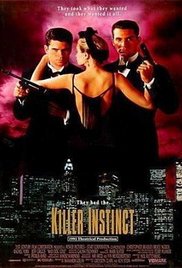
In the U.S., Mad Dog Coll was retitled Killer Instinct, probably to cash in on the recent success of Basic Instinct.  The entire cast was featured in the sequel, the Menahem Golan-directed Hit the Dutchman.

For Your Consideration #2: The Purge: Anarchy (dir by James DeMonaco)


The_Purge_–_Anarchy_Poster

Yes, I know what you’re saying.

“Seriously, Lisa!?  We should give awards consideration to The Purge: Anarchy!?  Are you serious!?”

Yes, actually I am quite serious.  Notice that I didn’t say that we should necessarily give The Purge: Anarchy any awards or that we should even nominate it.  I just said consideration.  For whatever flaws that The Purge: Anarchy may have, it’s actually one of the better and, in its way, one of the more thought-provoking mainstream American films released this year.  Working within the guise of being a simple genre film, The Purge: Anarchy is one of the few films to give serious consideration to the politics and culture that could both lead to and result from dystopia.

What I’m saying is that — despite what the critics may have said last summer — The Purge: Anarchy is actually one of the most subversive and intellectually curious films released this year.  You just have to be willing to look past all of the action conventions and instead focus on the film’s subtext.

The Purge: Anarchy takes place one year after the end of the first Purge film.  America is still led by the New Founding Fathers and every year, for one night, all crime is legal.  As the national media constantly assures everyone, the Purge is responsible for every good thing about America.  And even though there are a few rebels who claim that the Purge is not necessarily a good thing, most people chose to believe that — as long as it’s government-sanctioned — it’s for the best.

Whereas the first Purge film took place solely inside one family’s house and focused on the domestic melodrama within, The Purge: Anarchy focuses on what goes on outside of the gated sanctuaries of the rich.  As quickly becomes apparent, the Purge is less about purging negative feelings and more about keeping the non-rich, non-white population under control.  While the poor kill each other in the streets, the rich pay for the privilege to kill poverty-stricken “volunteers” in the safety of their own homes.  (Some of the volunteers agree to die out of the hope that their family will be sent some money.  Most are just rounded up on the streets, killed, and forgotten.)

Perhaps even more so than the first film, The Purge: Anarchy works because it feels so plausible.  We live in a society where we are continually told that moral rights and wrongs can be determined by man-made laws.  When a man is filmed being literally choked to death by a pack of police officers, we’re told that it was the man’s fault because he was failing to respect authority and many choose to believe it because “the law is the law.”  (Never mind, of course, whether the law is being fairly applied or makes any sense to begin with.)  If a man in uniform is murdered, it’s rightfully called a crime.  If a man in uniform commits a murder, we’re told it’s simply a part of the job.

And so, that’s why I suggest that The Purge: Anarchy deserves greater consideration than it’s been given.  Yes, it is a genre film and yes, it is an installment in an action franchise.  However, it’s also far closer to the truth than many people are willing to acknowledge.