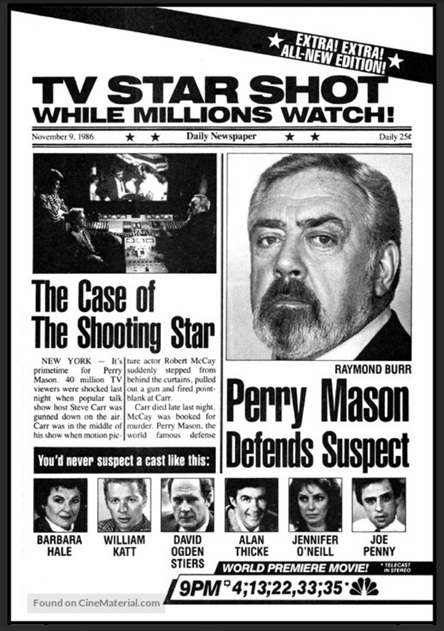
Actor Robert McCay (Joe Penny) decides that it would be hilarious to shoot talk show host Steve Carr (Alan Thicke) on live television. McCay thinks that the gun is loaded with blanks but, before he goes on the show, someone slips a live round into the gun. McCay kills Steve Carr and there are a million witnesses who see him do it. Time to call in Perry Mason (Raymond Burr)!
The third Perry Mason movie isn’t as good as the first two. Shooting someone on television as a joke and then leaving the studio immediately afterwards is a really stupid thing to do. As my sister pointed out while we were watching, even if Robert McCay wasn’t guilty of premeditated murder, he was probably guilty of negligent homicide for not bothering to double check whether or not there was a live round in the gun. McCay goes right back to shooting his movie, even while he’s on trial for murder. As for the trial, it was ridiculous. How many people can confess under cross examination in one trial? “Mistrial!” my sister yelled whenever Perry pulled one of his stunts and I agreed.
Paul (William Katt) teams up with a photojournalist (Wendy Crewson) and his investigation somehow leads to him playing a priest in a cheap vampire movie. For once, Perry didn’t give Paul a hard time about anything. Maybe he realized Paul’s scenes were the best part of The Case of the Shooting Star.
1973’s The Spook Who Sat By The Door opens with Senator Hennington (Joseph Mascolo) in a panic.
The Senator is running for reelection and is struggling to appeal to white voters and minority voters at the same time. White voters are happy that the Senator recently gave a speech in favor of “law and order” but now, he’s polling weakly with black voters. His wife (Elaine Aiken) suggests that the Senator win back black voters by demanding that the CIA hire more black agents.
The CIA responds to the political pressure by hiring Dan Freeman (Lawrence Cook) to be their first black agent. Freeman is given the standard CIA training and taught how to start revolutions in other countries. However, after he completes his training, Freeman is assigned no real responsibilities. He is given a desk job and spends most of his day making copies. Whenever a senator or a reporter visits CIA Headquarters, Freeman is trotted out so that the CIA can claim to be diverse. Freeman understands that he’s a token. He knows that his job is to basically sit by the door and be seen. But Freeman actually has bigger plans.
After spending a few years at the CIA, Freeman resigns and heads back to Chicago to work as a social worker. Using what he learned at the agency, he starts to recruit young black men as freedom fighters. He and the Cobras (as they’re called) launch their own guerilla war against the establishment in Chicago. Some of their tactics are violent and some of them are not. Freeman understands the importance of winning both hearts and minds and he recruits Willy (David Lemieux) to serve as his lead propagandist. Because Willy is light-skinned, he is also assigned to rob a bank because Freeman knows that both the witnesses and the police will mistake him for being white and will be less likely to fire on him. (The other members of the Cobras wear whiteface during the robbery.)
Freeman hopes that he will be able to recruit his childhood friend, Dawson (J.A. Preston), to the cause. Dawson, however, now works as a detective for the Chicago PD and has been assigned to beak up the Cobras. Will Freeman be able to bring over Dawson and what will happen if Dawson resists?
Based on a novel by Sam Greenlee (who was one of the first black men to be recruited to work with the United States Information Agency and who based many of Freeman’s CIA experiences on his own), TheSpook Who Sat By The Door has achieved legendary status as a film that the FBI reportedly tried to keep out of theaters. Theater owners were pressured to either not book the film or to only book it for a week before replacing it with a less incendiary film. As a result, The Spook Who Sat By The Door became a difficult film to see. As often happens, the efforts to censor the film only added to its revolutionary mystique.
Of course, in 2024, one can go on YouTube and watch the film for oneself. It’s definitely uneven film, one that has pacing issues (especially at the beginning) and also one that suffers due to its low budget. Depicting the overthrow of the government on a budget will always be a challenge. Some of the acting is a bit amateurish but Lawrence Cook broods convincingly as Freeman and he’s well-matched by J.A. Preston’s portrayal of the more down-to-Earth Dawson. At its best, there’s a raw authenticity and anger to the film that immediately captures the viewer’s attention. It’s the rare political film to actually feature conversations about actual politics and it’s a film that asks how far people would be willing to go to accomplish change. The Spook Who Sat By The Door suggests that the true villains are the members of the establishment who cynically embraced the civil rights struggle in their words but not in their actions. In the end, Dan Freeman becomes a bit of a fanatic but the film suggests that perhaps a fanatic was what the times demanded.
One of the earliest Blaxploitaion films is TROUBLE MAN, a 1972 entry about Mr T…
…no, not THAT Mr. T! THIS Mr. T…
Thank you! This Mr. T is played by Robert Hooks, a tough talking private eye who drives a big-ass Lincoln Continental and “fixes troubles” on the mean streets of L.A. T gets hired by gangsters Chalky Price and Pete Cockrell to protect their crap games, which are getting ripped off by masked gunmen. Things go awry when Chalky shoots one of the heisters, a dude named Abby who works for rival gangster “Big”. Abby’s body is dumped and word is on the streets T did the killing. Police Capt. Joe Marx puts the heat on T, as does “Big”, so T arranges a late night summit between “Big”, Chalky, and Pete at Jimmy’s Pool Hall . “Big” arrives, but before Chalky and Pete do, some cops raid the joint. These…
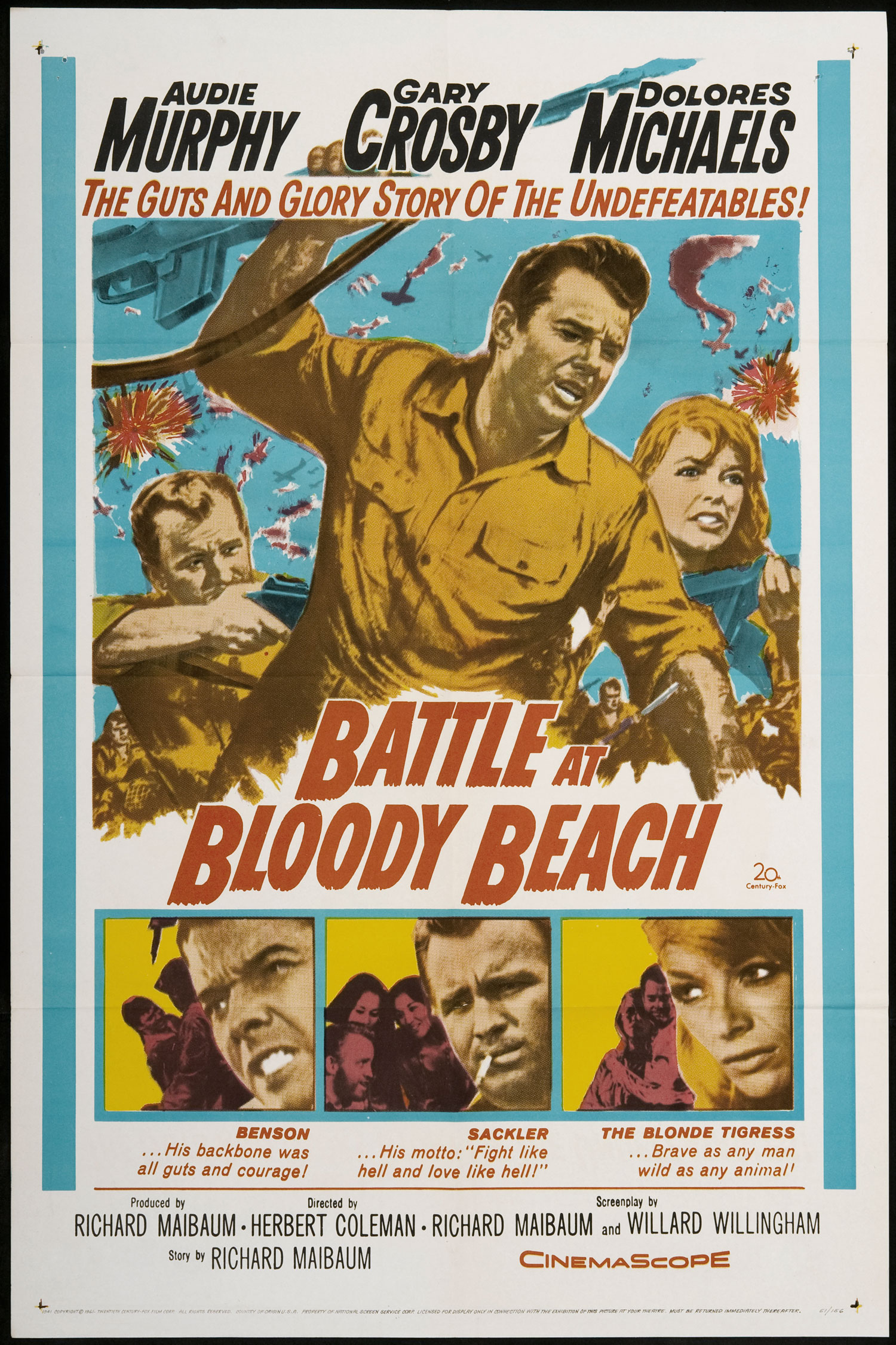
When I was in college, I wrote a paper on Audie Murphy for history class. Murphy was a real American hero, the most decorated combat soldier of World War II. He held off an entire squad of German soldiers alone, armed with a machine gun and bleeding from a leg wound, under fire from both foot soldiers and tank fire. Then he rejoined his men and led an attack on the Germans, driving them back and earning the Medal of Honor for his valiant efforts.
Murphy was noticed by Hollywood upon his return from the war, and soon was cast in a successful series of Westerns: THE KID FROM TEXAS, KANSAS RAIDERS, DUEL AT SILVER CREEK, RED BADGE OF COURAGE, GUNSMOKE, and a remake of DESTRY. His autobiography TO HELL AND BACK was a national best seller, and Audie played himself in the film version. Surprisingly, Murphy only starred in one other war film…
As a small community prepares to execute a remorseless killer, the sky above the town turns pitch black. Even as the Sheriff and the town priest try to figure out what’s happening, the town prepares to administer its own version of justice.
Some reviewers have complained that this Twilight Zone episode is a bit too heavy-handed for its own good but it’s actually one of my favorite episodes, (Then again, I’ve always been against the death penalty and, for the most part, critics only consider a show to be heavy-handed when they disagree with the message.) While the writing may not be subtle, this is a well-acted episode and, while watching it, you truly do get the feeling that a community is slowly giving into the darkness of hatred.
This episode was written by Rod Serling and directed by Abner Biberman. It was originally broadcast on March 27th, 1964.


 Through the Shattered Lens