“Violence is a language written in blood; it tells the story of those who refuse to be silenced.”
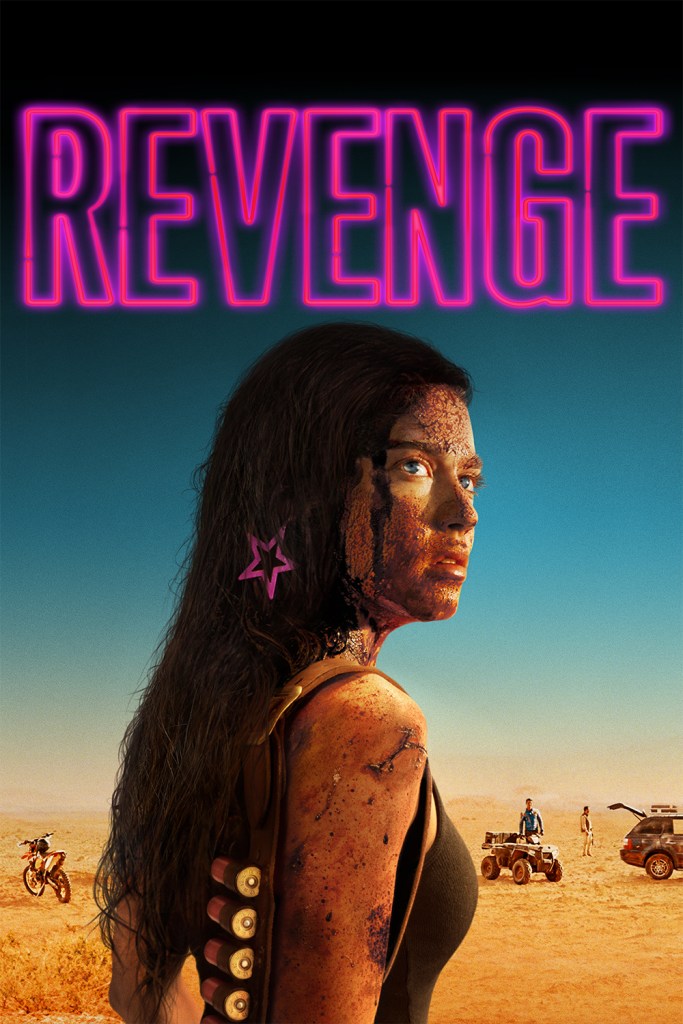
Coralie Fargeat’s 2017 film Revenge is an intense and striking blend of horror and thriller that refreshes the rape-revenge genre with a strong emphasis on female empowerment and resistance. At its core, the film follows Jen, a young woman who is brutally assaulted and left for dead in a desert. Against all odds, she survives and seeks brutal revenge on her attackers. What makes Revenge stand out is its blend of graphic, realistic violence and a striking, highly stylized visual approach, resulting in a film that is both visceral and symbolic.
Revenge sits within a long tradition of rape-revenge films that includes both grindhouse exploitation and serious art films. One of the earliest and most influential films in this tradition is Ingmar Bergman’s The Virgin Spring (1960), a somber and moral exploration of a father’s response to his daughter’s rape and murder in medieval Sweden. Bergman’s film inspired many later works, including Wes Craven’s famously brutal The Last House on the Left (1972), which reinterprets the same story through the lens of exploitation horror. Other notorious examples include I Spit on Your Grave (1978), known for its graphic depiction of sexual violence and violent retaliation. More recent films like Jennifer Kent’s The Nightingale (2018) revisit these narrative themes with psychological and political depth. Fargeat’s Revenge draws on this history, combining symbolic storytelling and thematic depth with the raw brutality and energy of grindhouse exploitation.
The narrative structure of Revenge is familiar: Jen, introduced as the mistress of a wealthy man, is assaulted by his friends. Her lover Richard tries to silence her by pushing her off a cliff, but Jen survives, severely injured and impaled on a tree. Her journey is one of intense physical suffering, but also resurrection and fierce empowerment. The film’s use of bright, vivid colors such as hot pinks and blues shifts the story into a surreal, symbolic space where gender roles are exaggerated and the desert becomes a mythic battleground where Jen fights to reclaim control.
Fargeat depicts Jen’s trauma and physical recovery through graphic and detailed body horror—not simply for shock, but as a visual metaphor for reclaiming agency. For example, Jen’s self-treatment of her impalement wound with a hot beer can brands her skin and symbolizes her rebirth and determination. These elements mark a clear departure from earlier rape-revenge films that sensationalized female suffering, shifting the focus to the survivor’s power and autonomy.
Cinematographer Robrecht Heyvaert’s work enhances this dynamic, contrasting the bright, harsh desert landscape with the cold, sterile luxury of Richard’s home. This contrast symbolizes the clash between raw survival and social control. The violence throughout the film is explicit and often hard to watch, but it is deeply rooted in the reality of trauma rather than fantasy.
Matilda Lutz’s performance as Jen is a key strength of the film. She transforms from a vulnerable, objectified figure into a fierce, focused avenger. The male antagonists are less developed, serving as archetypes of toxic male dominance—entitlement, violence, and cowardice—and their downfall reflects the collapse of that social order.
While Revenge maintains the fast pace and suspense of a thriller, its focus on graphic body horror and trauma places it firmly within the horror genre, aligning with the French Extremity movement known for its intense depictions of suffering and transgression. The source of horror here is not supernatural but very much rooted in the physical and psychological impact of violence.
The film has been praised for its technical skill and its focus on female resistance and empowerment. Instead of exploiting female suffering, it forces audiences to confront violence and trauma in a way that centers strength and rage. This is a clear reimagining of the revenge narrative through a modern lens that highlights resilience.
Revenge stands as both a tribute and a reinvention within its genre. It nods respectfully to the moral complexity of Bergman’s The Virgin Spring, the shock tactics of grindhouse staples like The Last House on the Left and I Spit on Your Grave, and the psychological depth of The Nightingale. Yet it simultaneously reinterprets these influences, making a statement that is both timely and provocative.
Coralie Fargeat’s Revenge is a powerful and contemporary entry into the rape-revenge genre, blending horror and thriller conventions with a focus on survival and agency. The film explores the physical and emotional effects of trauma and the possibility of reclaiming power through violence. Its vivid visuals, symbolism, and intense violence challenge audiences to rethink assumptions about gender, justice, and survival. It is a film that provokes strong reactions while delivering a deeply felt story of empowerment and resilience.
Last Friday, I went and saw Zack Snyder’s new film Sucker Punch with my sister Erin and a group of our friends. Sucker Punch was a film that I had been looking forward to seeing for a while and not even all of the scathingly negative reviews that I read before leaving for the theater could dampen my enthusiasm. Somehow, I knew I would love this film (despite the fact that Zack Snyder is, usually, one of my least favorite directors). And you know what? I did love it.
The plot has been criticized for being both overly complicated and not being complicated enough and I actually think that a case can be made for either one of those complaints. The film opens in the 1950s. Teenage Babydoll (Emily Browning) is sent to a mental asylum by her evil father. Her father has made a deal with an orderly named Blue (Oscar Isaac) to have Babydoll lobotomized. (By the way, this was actually a pretty common thing back in the 50s. I shudder to think what would have been done to me if I had been born five decades earlier.) As Babydoll waits for her lobotomy (scheduled to occur at the end of her first week as a patient), she is subjected to the therapy of Dr. Gorski (Carla Gugino) who plays music and encourages her (all female) patients to find peace by controlling their fantasies.
Suddenly, we’re in a fantasy (just who exactly is having the fantasy is one of the film’s mysteries that’s never really explained but is actually kinda fun to debate). In the fantasy, the insane asylum is actually a brothel/dance hall that is owned by Blue. Gorski is a choreographer. The patients are now all lingerie-clad dancers/prostitutes. Babydoll is the latest girl to be put into service in the brothel and she is being held over for “the High Roller” who is expected to show up in five days.
(The fact that the movie explicitly compares forced lobotomy to rape is one of the many interesting facts that the majority of negative reviews have chosen to ignore.)
Babydoll soon discovers that 1) she’s such a good dancer that when she does dance, men can only watch in stunned silence and 2) whenever she does dance, she finds herself transported into a fantasy world where, along with getting advice from the Wise Old Man (Scott Glenn), she also battles (and defeats) everything from giant Samurai to dead Nazis who have been reanimated by “steam power” to a dragon. These battle scenes, as odd as they are, are actually pretty exciting. Say what you will, Snyder knows how to direct a battle scene and Browning and the rest of the almost entirely female cast all seem to be having a blast getting to do the type of things that usually, only boys are allowed to do.
Anyway, as a result of her fantasies, Babydoll comes up with a plan to escape the brothel. She quickly recruits four other girls into her plan — Amber (Jamie Chung), Blondie (Vanessa Hudgens), the free-spirited (and really, really cool) Rocket (Jena Malone) and finally Rocket’s older sister, the world-weary Sweatpea (Abbie Cornish). In order to escape, they need to steal four different items. While Babydoll distracts their captors by dancing (and therefore going into one of her battle fantasies), the others steal whatever is needed. And everything works out just fine. Until it doesn’t….
Sucker Punch is a glorious mess of a movie and, perhaps because I’m a glorious mess myself, I loved it. In fact, it’s probably my favorite film of 2011 so far. In this regard, I know I’m going against the majority but so what? Throughout history, if one thing has always been consistent, it is that the majority sucks. Yes, Sucker Punch is a deeply flawed film that runs on for at least half-an-hour too long. And yes, I think it can be argued quite convincingly that this film is ultimately a happy accident, a film that’s strength comes not from directorial design but instead as the result of a few random elements that resonate in the subconscious. But no matter — happy accident or not, I loved Sucker Punch and I’m not ashamed to admit it.
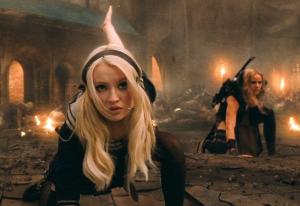
Hmmm…that’s a familiar pose.
Let’s start with a few obvious points. As even those who hate this film seem to be admitting, it’s visually stunning. The battle scenes are kinetic and exciting, the film’s over-the-top production design (a mix of German Expressionism, 50s film noir, Bob Fosse choreography and old Zack Snyder films) is always a blast to look at, and the soundtrack kicks ass. Like other films in the so-called “Girls with Guns” genre, Sucker Punch allows its actresses to be something other than just scenery or helpless damsels.
Interestingly enough, for a film that takes place mostly in the world of fantasy, there’s no attempt to really make this film’s version of “reality” come across as anything other than an elaborate fantasy as well. The film’s opening scenes are played out in slow-motion and the film’s asylum (which, like most movie asylums, appears to have been borrowed from The Cabinet of Dr. Caligari) is so gray that the film might as well be in black-and-white. Blue and Babydoll’s father hold a melodramatic conference while standing directly behind Babydoll, their three heads filling the screen like flashes of manic paranoia. As such, the film — at times — becomes a fantasy taking place in a fantasy taking place in a fantasy. It takes a while for the viewer to get used to this and, at times, it can seem like there’s really nothing to give the film any sort of grounding. However, for me, the opening sequences are not meant to be “real” as much as they serve as a reflection for the way that the real world can imprison anyone but women in particular. As women, we know what its like to look up and suddenly realize that our entire world has somehow become gray and cold without our knowledge. Throughout history, when everything else has been taken away from us, fantasy has been our escape and salvation, our imagination being the one of those precious things that our fathers, our husbands, and our bosses would never be able to deny us.
One problem I did have with the film is that, for all the talk about how Babydoll’s dancing is essential to the escape plan, we never actually see her dance. Instead, we see Browning start to sway a little, her eyes cast down and then suddenly, we’re transported into a fantasy involving zombie Nazis or giant samurai. Once this fantasy mission has been completed, we’re suddenly back in the brothel where we see Babydoll ending her dance while her audience applauds.
To a large extent, I actually agree with Snyder’s approach here because I know, for me much as with the characters in this film, dance always presented an escape from the grayness of being. When I was dancing, I was literally living a fantasy and this seems to be the case with Babydoll as well. However, from simply a cinematic point of view, the constant talk of the importance of Babydoll’s dance leads the audience to naturally expect that they’ll get to see at least a little bit of the dance in question. When you don’t, it’s hard not to feel as if you’ve been teased. (I have to admit, as well, that all this dance talk got my competitive streak going as well. As I whispered to Erin, “They should see me dance.” “It’s a movie, Lisa Marie, not a challenge.” Erin replied.) Snyder, as a director, certainly probably has a strong enough visual sense that he could have found a way to make any dance that Emily Browning came up with look impressive and other worldly.
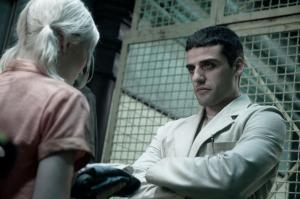
Oscar Isaac
As Arleigh has pointed out on both twitter and this site, Zack Snyder is a director who concentrates almost all of his effort on producing memorable visuals. That’s how he tells his stories and gets the whatever response he wants from his audience. Characters and dialogue are often kept simple so that they don’t get in the way of his visuals. Typically, I hate films like this and I’m hardly a fan of Snyder’s previous work. However, it didn’t bother me so much here, perhaps because I could relate to the overall theme of feeling trapped and needing an escape. (More on that later.) As with previous Snyder films, the performances here are mostly in service of the visuals. The actors don’t so much perform as much as they just pose against the stunning backdrops. As such, Emily Browning, Vanessa Hudgens, and Jamie Chung don’t really get much of a chance to make an individual impression. Playing sisters, Abbie Cornish and Jena Malone don’t have a lot to work with but they both are strong enough personalities that they manage to bring some life to their characters beyond simply serving as figures on a landscape.
(I should also mention — and Arleigh had the same reaction — that Cornish and Malone and their character’s relationship reminded me a lot of my relationship with my older sister, Erin — especially all the times that Rocket attempted to keep things fun and interesting just to be told, by Sweetpea, that she wasn’t being boring enough. I definitely related to that. Erin, for her part, says that she related to all the scenes where Sweatpea nearly got killed “because her bratty, little sister did something stupid that made absolutely no sense.”)
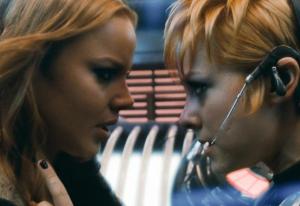
Abbie Cornish and Jena Malone (or Erin and Lisa) In Sucker Punch
I also have to mention Oscar Isaac and Carla Gugino, both of whom seem to understand just how far they can go with their characters without descending to the level of camp. Gugino — after this film, Sin City , and Watchmen — has got to be the Queen of digital filmmaking. She’s also the closest thing that American film has to an old school femme fatale right now. As well, as I told Erin as we watched the film, I can only hope that my tits look that good when I’m 60 years old. And speaking of looking good, Oscar Isaac certainly does look good here. Even when he has dark circles under his eyes and sports a glowering scowl, I would still throw Isaac on the ground and lick his face. Plus, he and Gugino contribute a great performance of Love Is The Drug which plays over the end credits.
Finally, Scott Glenn — looking a lot like the late David Carradine — plays the “Wise Old Man” who pops up as a father figure of sorts in Babydoll’s fantasies. Glenn does okay with his role though I wish his character had been a bit more clear. To be honest, simply from the point of view of empowerment, I kinda wish his character had been known as the “Wise Woman” and had been played by Cate Blanchett.
One huge issue that seems to be coming up a lot when people talk about Sucker Punch is the issue of “empowerment.” Does this film, which indulges in a massive schoolgirl fetish even while portraying girls kicking ass, empower or degrade women? Well, first off, I would suggest that the question itself is an inappropriate one because to argue that a film is either “empowering” or “degrading” and nothing else is basically the same as arguing that all women are going to have the exact same response to what they see regardless of their own life experiences or personal outlook. Quite frankly, because of some of my own personal experiences, I find the infamous, much-maligned 1970s rape/revenge film I Spit On Your Grave to be very empowering and I’m not alone in that regard. At the same time, I also know many very intelligent, very strong women who would consider that film to be anything other than empowering. It’s simply a matter of perspective.
I think the same can be said about Sucker Punch. To me, Sucker Punch was a very empowering film and, honestly, that’s the main reason that I loved it even with its flaws. First off, I think that any film in which women are allowed to do something other than stand around and panic until they’re rescued by a man, is going to be empowering because, far too often, we are taught that waiting for the right man to arrive is the only option available to us. As well, the main theme of Sucker Punch was the theme of escape, whether that escape was physical or mental. While I won’t presume to speak for all women, I can say that for many of us, escape is the usually the root of all fantasy and, at least to some extent, the ultimate goal. As I watched Sucker Punch on Friday night, it seemed to me that, for far too many of us, life is a series of prisons and asylums in which the walls are constructed out of the harsh judgments of patriarchal society. We allow ourselves to become trapped by the need to be a mother or a wife or a nurturer or a seductress or a whatever it is that society says a good woman has to be on any given day. The women in Sucker Punch are imprisoned because they’ve gone against the expectations of society and now, whether being lobotomized or sacrificing their bodies in the fantasy brothel, they are allowing their role and personality to be defined by men. Therefore, when Babydoll and her crew fight for their freedom, we can relate to them because that’s what we have to do every day of our lives.
My Dream Is Yours
But, the argument goes, how this be considered to be empowering when all the female images in the film are so hyper-sexualized? And it’s true that even when the film is supposed to be portraying reality, the camera does linger over the bodies of the actresses. In the brothel sequences, the film often looks like an outtake for some anime-inspired Victoria’s Secret fashion show. (Seriously, this film has a major lingerie fetish but you know what? So do I. Lingerie is fashion poetry and when I’m wearing something pretty, I feel like a poem.) Finally, there’s the image of Babydoll fighting her enemies and dodging explosions while flashing her underwear to the viewer. Many have argued that this is a degrading image, that it encourages male viewers to leer and to ogle.
Well, the fact of the matter is that this film was directed by a man and often times it is obvious that we’re watching the action through a male gaze. But, so what? Just as I believe that women should not be ashamed of their sexuality, I don’t see why men should be expected not to look. (Looking is not the problem. It’s the assumption that the right to look also gives one the right to judge.) And ultimately, I would argue, that being sexy is empowering because society, with its fucked up view of human sexuality in general, is so quick to tell us that the ideal woman is unaware of her sexuality or, at the very least, she should either hide it behind a facade of demure humility or else flaunt it to such an extent as to suggest that it’s all actually a sign of some deeper neurosis. What is rarely given as an option is the idea that we might want to show off a little just as a matter of pride. Men are applauded for showing off their muscles yet we are still expected to blush if we show a little cleavage. Being sexy is not degrading. What’s degrading are the conditions that society has attempted to impose on the right to be sexy. To me, it’s very empowering to see strong, independent women standing up for themselves and looking good while doing it.
Sexual Empowerment
And therefore, for me, Sucker Punch was a very empowering film. It’s entirely possible that this empowerment could be the result of a happy accident and that Snyder had no idea he was actually making a film that celebrated third wave feminism. In fact, I’m sure that’s probably the case.
Even with as much as I enjoyed Sucker Punch, I’m still not really sold on Zack Snyder as a director When his films work, they almost work despite his directorial flourishes than because of them. The slow-mo action thingee was kinda fun at first but now, everyone’s doing it and it’s hard to see why it was so exciting in the first place. Add to that, whenever I hear his name mentioned, I think about the Zach was on both seasons of Paradise Hotel and who, at one point, did this priceless drunken monologue about how he was apparently descended from lawyers. Seriously, he was such a tool. Well, why take my word for it? Here’s a clip of Zach that I found on YouTube…
But anyway, what about Zack Snyder? As I’ve mentioned earlier, there’s a lot of people right now who are gleefully hating on Sucker Punch in general and Zack Snyder in specific. What’s really odd is, to judge from twitter, a lot of these haters are people who previously loved Snyder’s more male-centric films. Which just goes to show what I’ve always said — men suck. Well, that and nothing breeds contempt quicker than success. The fact of the matter is that it was time, in the eyes many, for Snyder to take a fall. Personally, I think Zack Snyder could be a truly noteworthy director but his style — the slow-mo action and all that — is running the risk of becoming less a storytelling tool and more of a nervous tic.
In many ways, Sucker Punch is a happy accident, a film that works despite itself. I think that’s probably why so many male filmgoers are having such a negative reaction to it — in order to surrender to a happy accident, one has to surrender the illusion of control and men aren’t exactly good at that. (Of course, neither are most women but seriously, at least we’ll admit to being lost. I mean, goddamn, guys — if you don’t know where you are, you’re lost. Just deal with it.) I expect to have a lot of people disagree with me concerning my opinion of this film and I expect those same people will probably use Sucker Punch as some sort of code word for a “bad” or “disappointing” film from now until whenever David Fincher releases his Girl with The Dragon Tattoo remake. But I think, as time goes on, Sucker Punch will probably be one of the few Zack Snyder films to truly become a cult film. 300 will be forgotten but Sucker Punch will remain.
Having recently seen Michael Caine’s revenge film Harry Brown I got to thinking about other revenge-themed films I’ve watched through the years and I realized that there were quite a bit of them. There’s something just primal and Old Testament about revenge flicks. It doesn’t matter whether they’re high-brow art-house films or the cheapest grindhouse flicks in the end it all boils down to one individual raining down their own version of Divine Wrath on those who wronged them.
Who hasn’t fantasized or thought about going all medieval on someone who just screwed them over. Maybe it was an infraction that was minor that one didn’t need to get overly upset over or something so heinous that only violence at its most basest was the only response. Going through with such thoughts usually stayed there: in one’s thoughts and imaginings. Revenge films seems to be quite popular because they allow even the meekest and most pacifist to secretly live vicariously through the revenge-minded leads in the film.
The list below is not the best revenge films out there but they definitely are my favorites…
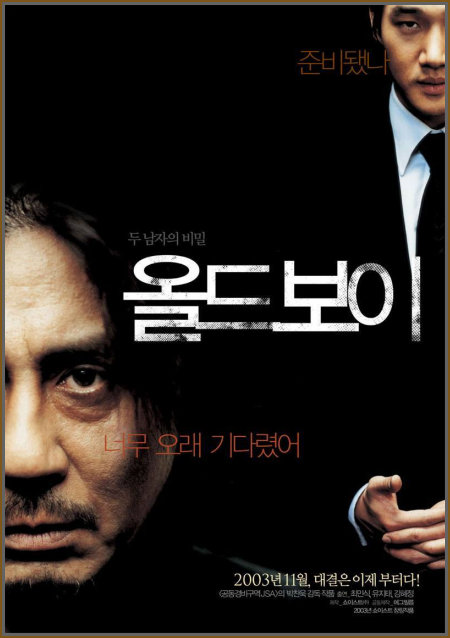
Oldboy – This revenge film by South Korean auteur Park Chan-wook wasn’t just a blast to watch but also happens to be one of the best films of the past decade. It takes a simple plot of a man imprisoned against his will for 15 years with no explanation whatsoever that he literally goes insane and back to sane during his captivity. Revenge being the one thing which keeps him going and revenge he gets to inflict on all those he discovers were responsible. The mind-twisting last act in the film takes the revenge-theme right on it’s head as we find out that the main lead wasn’t the only one on a revenge train of thought.
I Spit On Your Grave aka Day of the Woman – This grindhouse classic from Meir Zarchi is the epitome of the rape victim turned revenge valkyrie. The film is not very easy to sit through since there’s nothing subtle about how filmmaker Meir Zarchi filmed every exploitative scene. From the prolonged gang rape sequence to each subsequent revenge act by Camille Keaton’s Jennifer character. Some critics have blasted the film as pandering to the lowest common denominator while others have hailed it as a post-modern feminist film. I like to think that both sides are correct and that the film lies somewhere in the middle. It definitely will put a scare on any group of men who are having thoughts of shenanigans.
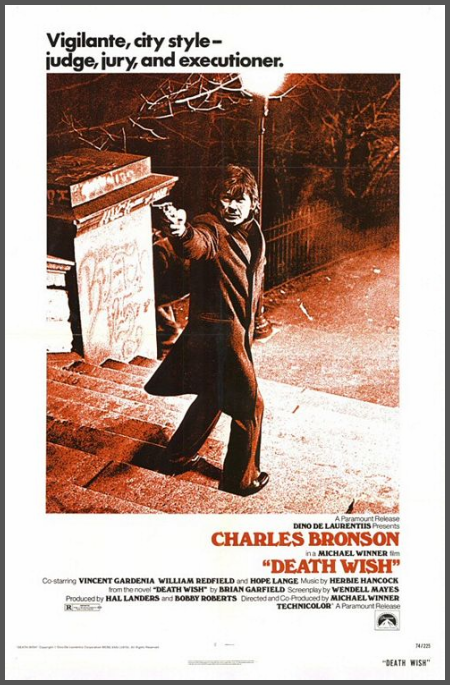
Death Wish – When people hear revenge flick they almost always say this iconic film by Charles Bronson from the 70’s. The film was adapted from Brian Garfield’s 1072 novel of the same name and directed by Michael Winner. While critics had mixed reactions to the film with some calling it irresponsible filmmaking, the nation as a whole embraced the film. Here was a film which screamed to the nation that the rising crime-rate in the U.S. during the 1970’s wasn’t going to go unanswered. While some people may have seen the film as a blank check to actually commit vigilantism in the end it just helped a country sick and tired of the crime they see day in and day out. Again here was art becoming a driving force in changing a nation’s collective malaise into something more positive. It didn’t hurt that Bronson was badass as Paul Kersey.
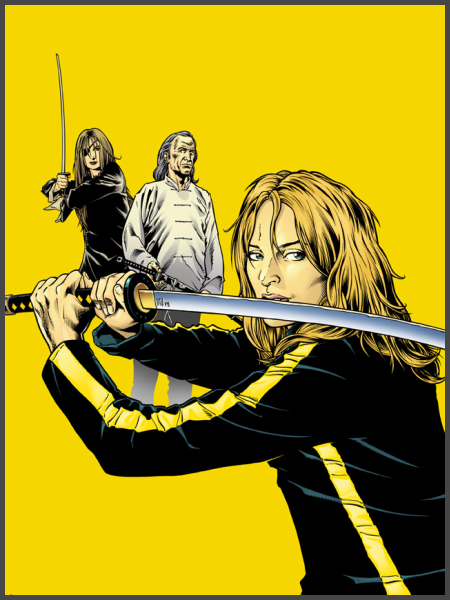
Kill Bill: Volume 1-2 – Who else but the video clerk made good would make what I would consider the greatest genre mash-up film ever made. Quentin Tarantino’s ode to kung fu, spaghetti westerns and revenge flicks became so massive that he had to split the film into two volumes. I am talking about Kill Bill. Not his greatest film ever but I definitely consider it his most geek-friendly and most entertaining. Uma Thurman as The Bride tearing a bloody and witty path of revenge on those who failed to kill her created some of the most iconic fight sequences of the generation this film came out in. Every scene almost seemed to be inspired by other films of a similar theme and genre that film geeks everywhere must’ve exploded in their pants from all the awesomeness they were witnessing. Each volume had two great action sequences that were both fantastical and brutal.
Straw Dogs – One of the most controversial films in Sam Peckinpah’s controversy-filled directing career. Released in 1971 it told the story of how even the meekest person could be pushed into dealing out extreme violent justice on those who have wrong them and those they love. Seen by critics as quite misogynistic due to the nature of the rape scene of Susan George’s Amy character the film was banned for two decades in the UK for it’s unflinching look at violence. Being a huge fan of Sam Peckinpah I had to see it and when I did it automatically became one of my favorite films ever and not just a favorite revenge film. If there was ever a modern retelling of a Biblical-level fable it is this classic from Sam Peckinpah. Every revenge-fueled act by Dustin Hoffman literally oozes Old Testament justice. Just the way I like my revenge. 🙂
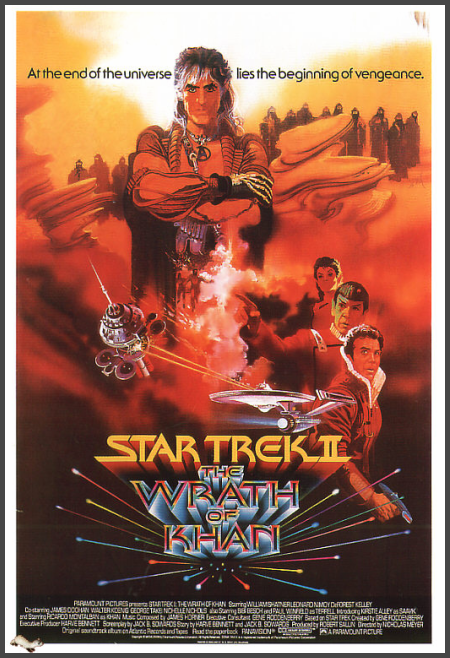
Star Trek II: The Wrath of Khan – Speaking of Biblical this first sequel in the Star Trek film franchise still considered by fans and non-fans alike as the best in the series. Hard to argue with them since it’s also an opinion I share. The sequel takes a popular episode from the original series and follows it up with all the cast of characters older and more seasoned. In the case of Ricardo Montalban’s Khan Noonian Singh quite seasoned and classy as smooth Corinthian leather. It’s a film with Shatner’s Kirk and Montalban’s Khan in an everending cycle of revenge which would culminate in what would be one of film’s most heartbreaking scenes. One could taste the revenge emanating from the two characters as age-won wisdom and genetically-engineered intellect fell by the wayside to feed the vengeance sought by Kirk and Khan. This revenge flick also has one of the most awesome death speeches by a character on film.
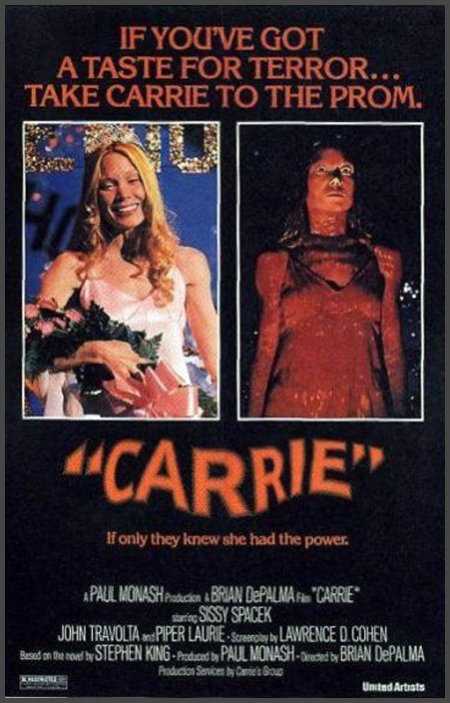
Carrie – Brian De Palma’s film adaptation of one of Stephen King’s better horror novels still seen by many as the best film adapt of a King novel. It combines the existential horror of being a girl and her body maturing in the dog-eat-dog world of high school and the horror said girl can inflict on those tormenting her. It’s high school bullying and revenge with a healthy dose of Stephen King shenanigans mixed in. Sissy Spacek was great as the titular character. One doesn’t have to be a high school girl to feel for Carrie and what she goes through. Her snapping in the last act and inflicting her psychokinetic-brand of revenge on her tormentors must’ve gotten more than a few “Hell yeah!” from some of the teens and adults who went through high school hell. It also has a classic line uttered by Carrie’s mother played by Piper Laurie: “I can see your dirty pillows. Everyone will.”
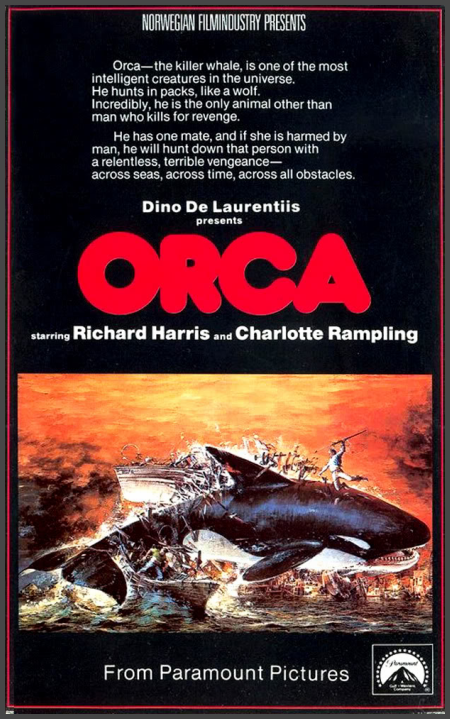
Orca – This film was to be producer Dino De Laurentiis’ attempt to capitalize on the success of Steven Spielberg’s classic man-versus-nature thriller, Jaws. Starring Richard Harris, Charlotte Rampling and Bo Derek the film wasn’t a success when it first came out. While Spielberg’s film was a modern retelling of Moby Dick this killer whale version by director Michael Anderson was Death Wish on water with Paul Kersey as the killer whale. This was one of the first films where I realized none of the people on the screen were worth rooting for to survive. I was all for the killer whale who was on a warpath to avenge his mate and unborn wee killer whale who were killed by Harris and his crew. Shamu this killer whale was not and it always brought a smile to my face whenever the killer whale outsmarted the humans and killed each and everyone in inventive ways. I’m wondering if all the killer whales in all the aquatic parks are just biding their time before they too go all Orca on their handlers and the audience. I’d pay to see that!
Treevenge – Last but not least the greatest film ever made!






 Through the Shattered Lens