Film Review: Exodus (dir by Otto Preminger)


First released in 1960 and based on a novel by Leon Uris, Otto Preminger’s Exodous is two films in one.

The first half of the film takes place in Cyprus in the days immediately following World War II.  A young war widow named Kitty (Eva Marie Saint) is sightseeing when she learns of the Karaolos Internment Camp, where the British are interning thousands of Jewish refugees who demand to be allowed to go to the land that will eventually become the State of Israel.  Kitty visits with General Sutherland (Ralph Richardson), who oversees the camp and who is rumored to secretly be Jewish because of his relatively benevolent attitude towards the internees.  Disgusted by the anti-Semitism displayed by many of the British officers (one of whom is played by Kennedy in-law Peter Lawford), Kitty volunteers at the camp and learns about the Holocaust from those who survived it.  She also meets Ari Ben Caanan (Paul Newman), a former officer in the British army.  Ari manages to get control of a cargo ship, one that is renamed Exodus.  Six hundred refugees stage a hunger strike, vowing that they will willingly starve to death rather than be returned to Europe.

The second part of Exodus takes place in what will become the modern State of Israel.  It follows Ari, Kitty, and several of the passengers of the Exodus as they adjust to life and continue to fight for a land of their own, despite the opposition of the British and much of the rest of the world.  Karen (Jill Haworth) is a young woman who searches for her father, a brilliant man who has been driven into a nearly catatonic state by the horrors of the Holocaust.  Dov Landau (Sal Mineo) is an explosives expert who survived Auschwitz as a Sonderkommando and who was repeatedly raped by the guards at the camp.  Dov joins the Irgun, a paramilitary organization that the British consider to be terrorists.  Leading the Irgun is Ari’s uncle, Akiva (David Opatoshu), and Dov soon finds himself being targeted by both the British and the Arabs who, despite the moderating efforts of men like Taha (John Derek, who would later direct Ghosts Can’t Do It), want to violently force the Jews out of the land.

Legend has it that, after a private screening on Exodus, comedian Mort Sahl turned to director Otto Preminger and said, “Otto, let my people go.”  And it’s true that Exodus is a very long film.  Preminger, who started out making film noirs like Laura, spent the latter part of his career making “important” epics and, like many Golden Age directors struggling to compete with television and the 60s counterculture, he tended to make long, star-studded films that dealt with current events and which pushed the envelope just enough to be controversial without actually being radical.  However, I would argue that the three-hour running time of Exodus is justified.  To understand why Ari, Dov, Karen, and the other passengers of the Exodus would rather risk their lives by staying in what will become the State of Israel, one has to understand both what they went through to get there and also the anti-Semitism that they faced even in post-World War II Europe.  If Exodus were made today, it would be a mini-series.  Since it was made in 1960, it was instead a 3-hour film with an intermission.

Exodus holds up relatively well, with the sprawling action anchored by the presence of a cast of familiar faces.  Paul Newman and Eva Marie Saint bring a good deal of movie star glamour to scenes that would have otherwise just been dry exposition.  The film’s heart truly belongs to Jill Haworth and Sal Mineo, both of whom bring two life characters who have very differing views of the world.  Karen remains an optimist, one who is convinced that people can live together.  Dov, fueled by his own guilt and anger, has no room for negotiations and compromises.  Mineo received his second and last Oscar nomination for his performance in Exodus, though he lost to Peter Ustinov’s showy turn in Spartacus.  Exodus itself was clearly made with a hope for Oscar glory.  While Exodus did pick up a handful of nominations, it was left out of the five movie Best Picture slate.  The Academy only had room for one historical epic and they went for John Wayne’s The Alamo.  The eventual winner was The Apartment, the best of the nominated films.  (Indeed, even if Exodus had taken the Alamo’s spot, The Apartment would still be the best of the nominees.)  The Oscars aside, Exodus remains a good example of the type of epic filmmaking that once defined the Hollywood studios.

14 Days of Paranoia #3: The Passover Plot (dir by Michael Campus)


First released in 1976 and based on a book that had come out ten years previously, The Passover Plot is a film that asks, “What if Jesus was a political revolutionary who faked his own death?”

Even when the film was first released, that wasn’t a particularly novel or new theory.  Ever since the Crucifixion, there have been conspiracy theorists who have claimed that the entire thing was staged.  Indeed, the early days of the Church were defined by conflicts between different sects debating the true nature of Jesus, with those who believed that he was the son of God and that he had risen from the dead eventually winning out over sects who claimed that Jesus was not divine or that he had actually escaped from the Romans and was instead hiding out in Egypt or even on the island that would eventually become known as Britain.  (The fact that so many Gnostics and other heretics were executed by the Church and their texts suppressed only served to lend them credibility with future theorists.)  Still, every few decades, some new book or film will claim that Jesus faked his death or married Mary Magdalene and gullible people will act as if this is somehow a new argument.  It’s been over 20 years since all of that Da Vinci Code nonsense convinced bored suburbanites across America that they could be experts on both boxed wine and historical conspiracy theories.  We’re about due for a new version of the old story.

As for The Passover Plot, it features Zalman King as Yeshua of Nazareth, an angry young man who dreams of the day when Judea will be free of the Romans.  Having a knowledge of the prophecies of a messiah and also knowing that he is descended from King David, Yeshua specifically patterns his life after the prophecies and presents himself as being not just another revolutionary but instead as being sent by God.  However, he is also aware that it will be necessary for him to “die” and “rise from the dead,” so he goes out of his way to force the hand of Pontius Pilate (Donald Pleasence).  Having seen plenty of crucifixions when younger, Yeshua arranges for the local revolutionaries to drug him so that he’ll appear to be dead.  When he later wakes up, everyone will believe that he has returned from the dead.  The film ends with several title cards, all arguing that the Gospels were written long after Yeshua’s death (“Mark lived in Italy!” one title card proclaims with almost comical indignation) and were subsequently rewritten by “unknown” hands.

The Passover Plot is a weird combination of biblical epic and conspiracy thriller.  Scenes of Yeshua preaching feel as if they could have come from any traditional Biblical epic but they are awkwardly placed with scenes of Yeshua having secret, melodramatic meetings with various conspirators.  It would make for an interesting contrast if not for the fact that the film itself is so slowly paced and boring.  Zalman King, who is best-known for his subsequent career as a softcore filmmaker, spends a lot of time yelling and smoldering intensely but he still doesn’t have the charisma or screen presence necessary to be convincing in the role.  In the scene were he’s meant to be passionate, he shrieks with such abandon that he makes Ted Neeley’s performance in Jesus Christ Superstar feel restrained.  This film asks us to believe that people would not only abandon their previous lives to follow Yeshua but that they would also take part in an elaborate conspiracy that could have gone wrong at any time.  For that to be believable, Yeshua needs to be played by someone who doesn’t come across like the drama student that everyone dreads having to do a scene with.  Far more impressive is Donald Pleasence, whose portrayal of a ruthless and unfeeling Pilate is a marked contrast to some of the more sympathetic interpretations of the character that tend turn up in the movies.

On the plus side, the film does look good.  It was shot on location in Israel and there is a certain authenticity to the film’s recreation of the ancient world.  Along with Pleasence, character actors like Scott Wilson (as Judas!) and Dan Hedaya get a chance to shine.  But otherwise, The Passover Plot is too slowly paced and kooky for its own good.  Conspiracy theorists never seem to understand that the more elaborate a conspiracy theory becomes, the less convincing it is to anyone who isn’t already a true believer.  In the end, how one feels about the film’s conclusions will probably be connected to how one already views Jesus and the Church.  The Passover Plot is not a film that’s going to convince anyone who wasn’t already convinced.

14 Days of Paranoia:

  1. Fast Money (1996)
  2. Deep Throat II (1974)

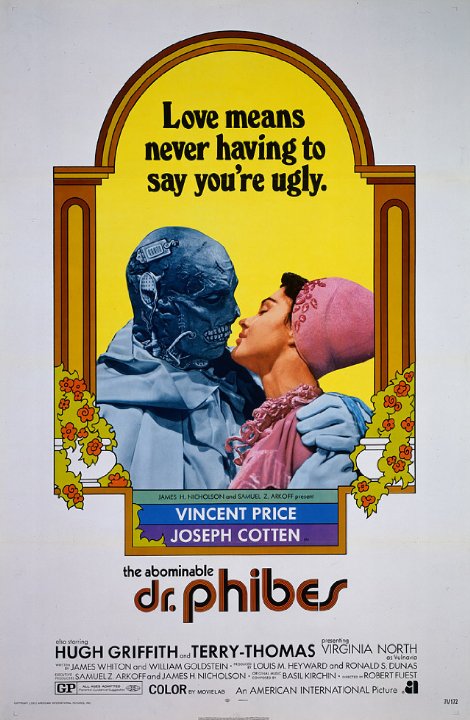
Horror On The Len: The Abominable Dr. Phibes (dir by Robert Fuest)


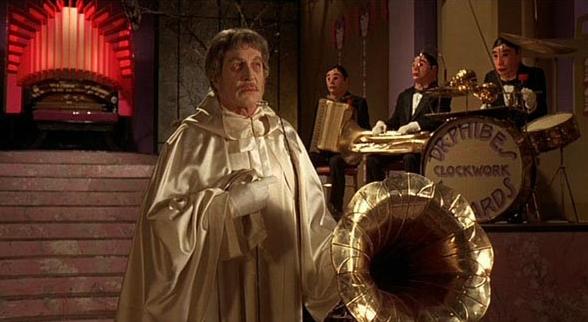
For today’s horror on the lens, we have one of Vincent Price’s most popular films, 1971’s The Abominable Dr. Phibes!

This is Price at his considerable best.  Be sure to read Gary’ review.

And watch the film below!

Enjoy!


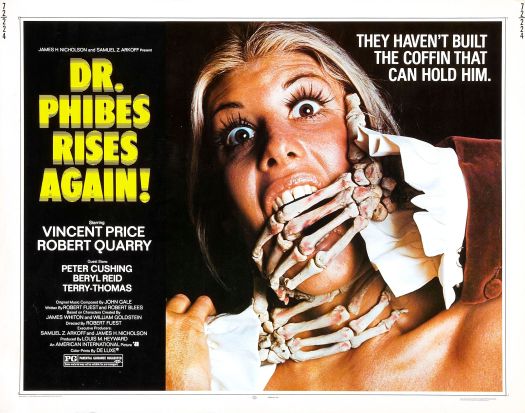
Horror on the Lens: Dr. Phibes Rises Again (dir by Robert Fuest)


Since yesterday’s horror on the lens was The Abominable Dr. Phibes, it only seems logical that today’s should be the sequel to that film, 1972’s Dr. Phibes Rises Again.  Would you believe that, before I actually found the film on YouTube, I thought this film was called Dr. Phibes Rides Again?  Personally, I think Rides Again sounds better than Rises Again but what do I know?

All that matters is that Vincent Price is back!  Be sure to check out Gary’s review of Dr. Phibes Rises Again when you get the chance.

And watch the movie below!

Enjoy!

Horror On The Len: The Abominable Dr. Phibes (dir by Robert Fuest)


It’s really not October until you’ve watched at least one Vincent Price film and, for today’s horror on the lens, we have one of his most popular films, 1971’s The Abominable Dr. Phibes!

This is Price at his considerable best.  Be sure to read Gary’ review.

And watch the film below!

Enjoy!


Vincent Price Goes to Camp in DR. PHIBES RISES AGAIN (AIP 1972)


gary loggins's avatarcracked rear viewer

Since 1971’s THE ABOMINABLE DR. PHIBES  was such a big hit, American-International Pictures immediately readied a sequel for their #1 horror star, Vincent Price. But like most sequels, DR. PHIBES RISES AGAIN isn’t nearly as good as the unique original, despite the highly stylized Art Deco sets and the presence of Robert Quarry, who the studio had begun grooming as Price’s successor beginning with COUNT YORGA, VAMPIRE. The murders (for the most part) just aren’t as monstrous, and too much comedy in director Robert Feust’s script (co-written with Robert Blees) turn things high camp rather than scary.

Price is good, as always, bringing the demented Dr. Anton Phibes back from the grave. LAUGH-IN announcer Gary Owens recaps the first film via clips, letting us know Phibes escaped both death and the police by putting himself in suspended animation. Returning with loyal servant Vulnavia (who’s now played by Valli Kemp, replacing a then-pregnant Virginia North), Phibes…

View original post 369 more words

Love Means Never Having To Say You’re Ugly: THE ABOMINABLE DR. PHIBES (AIP 1971)


gary loggins's avatarcracked rear viewer

abom1

For a 13-year-old monster-crazed kid in 1971, attending the latest Vincent Price movie at the local theater on Saturday afternoon was a major event. Price was THE horror star of the time, having assumed the mantle when King Karloff passed away a few years before. Not to take anything away from Mr. Cushing and Mr. Lee, but “Vincent Price Movies” had become, like “John Wayne Movies “, a sort of genre unto themselves. AIP had squeezed about every nickel they could  out of the Edgar Allan Poe name so, with the release of THE ABOMINABLE DR. PHIBES, a new character was created for the horror star, the avenging evil genius Dr. Anton Phibes.

abom2

Phibes is a concert organist, theologian, scientist, and master of acoustics who uses his knowledge and vast wealth to gain revenge on the nine surgeons who (to his mind) botched an operation that killed his wife. We first see…

View original post 874 more words

Cleaning Out The DVR #20: Tom Jones (dir by Tony Richardson)


(For those following at home, Lisa is attempting to clean out her DVR by watching and reviewing 38 films by this Friday.  Will she make it?  Keep following the site to find out!)

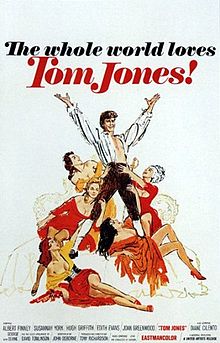
220px-Poster_-_Tom_Jones_01

Oh, how I wanted to love Tom Jones!

http://www.youtube.com/watch?v=NjEE_1U0-8s

No!  Not that Tom Jones.

I’m talking about Tom Jones, the British film from 1963.  Based on a novel by Henry Fielding, Tom Jones was a huge box office success and it was one of the few comedies to ever win the Oscar for best picture.  Whenever you watch a documentary about the British invasion of the early 60s, chances are that you’ll see at least a clip or two from Tom Jones.  The film (or perhaps I should say the film’s box office success) is a part of 60s pop history, right up there with The Beatles on The Ed Sullivan Show and Sean Connery shooting that guy in cold blood in Dr. No.

Up until last night, I had heard about Tom Jones but I had never seen it.

And I really wanted to love it.

The film takes place in 18th century England and it tells the story of young Tom Jones (Albert Finney).  It starts with a lengthy sequence that plays out like a silent film, complete with title cards.  Upright Squire Allworthy (George Devine) comes home and discovers that a baby has been left in his bed.  He assumes that the child was born to two of his servants and declares that he will raise Tom Jones to be a good and worthy man.

Two decades later, Tom Jones has grown up and now he’s being played by Albert Finney (who, it must be said, was quite a handsome man when he was young).  Because Tom is good-looking and kind-hearted, every woman in England lusts after him.  But Tom is in love with innocent Sophie Western (Susannah York).  However, Sophie is a member of the upper class and Tom is a “bastard,” at a time when that actually means something.

Indeed, Sophie’s aunt and uncle (played by Edith Evans and Hugh Griffith) demand that Sophie have nothing to do with Tom Jones.  They decide that she will marry Blifil (David Warner, young but already typecast as a villain).  Through clever lies and manipulations, Blifil convinces Squire Allworthy that Tom has turned bad and must therefore be exiled from his home.  Does Blifil want to get rid of Tom just so he can marry Sophie or is it possible that there’s more to Blifil’s scheming?

Before we get the answer to that question, we spend a while following the exiled Tom as he wanders around England and attempts to prove himself worthy of Sophie.  Along the way, Tom serves briefly in the army, gets into numerous fights, and has several affairs.  One of those affairs is with Mrs. Walters (Joyce Redman), who he briefly thinks might be his mother.  Eventually, Tom ends up as the lover to the decadent Lady Bellaston (Joan Greenwood).  Through Blifil’s scheming, he also ends up framed for attempted murder and facing the gallows…

And, as melodramatic as that may all sound, Tom Jones is definitely a comedy.  It doesn’t take itself seriously and there’s hardly a single scene that isn’t played for laughs.  Director Tony Richardson goes out of his way to make sure that you never forget that you’re watching a movie.  There are freeze frames.  There’s plenty of characters around to supply sarcastic commentary.  There’s even a few cases of fourth wall breaking.

As I watched Tom Jones, it was hard for me not to compare it to Stanley Kubrick’s Barry Lyndon.  After all, both films take place during the same period of time and both deal with a young man making his way through European society.  I would even argue that, in its way, Barry Lyndon is far more satirical than Tom Jones.  The main difference between the two films is that Barry Lyndon is all about subtext whereas everything that happens in Tom Jones happens right on the surface.

As I said, I really wanted to like Tom Jones but, seen today, the entire film seems to be trying a little bit too hard.  Tony Richardson’s direction is so manic that it gets a bit exhausting after a while.  That said, I can understand why the film was such a success when it was first released.  I’m sure in 1963 — after having to deal with decades of pompous costume dramas — viewers probably found Tom Jones to be a breath of fresh air.  Not only was it a British film released at a time when all things British were in style but it was also a film that, by the standards of 1963, dealt frankly with sex.  In short, Tom Jones is definitely a film of its time.  If it doesn’t hold up as well today, that’s because it wasn’t made for 2016.  It was made for 1963.

And obviously, if the judgment of the Academy is to be trusted, Tom Jones was the perfect film for 1963.  That said, I would have given best picture to another British film, From Russia With Love.

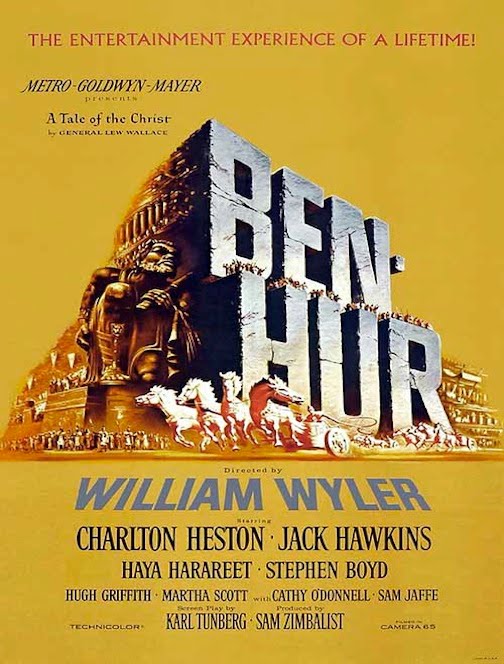
Lisa Watches An Oscar Winner: Ben-Hur (dir by William Wyler)


Ben-Hur

I’m actually kind of upset with myself because, at one point, I was planning on spending all of February watching TCM’s 31 Days of Oscars and reviewing all of the best picture nominees that showed up on the channel.  Unfortunately, I ended up getting busy with other things (like Shattered Politics, for instance) and it was only tonight that I finally got a chance to sit down and watch TCM.  Oh well, maybe next year! But for now, I’m just going to watch and review as much as I can before the month ends.

With that in mind, I just spent four hours watching the 1959 best picture winner Ben-Hur.

In many ways, Ben-Hur feels like a prototypical best picture winner.  It’s a big epic film that obviously cost a lot to produce and which features a larger-than-life star surrounded by a bunch of a memorable character actors.  It features two spectacular set pieces and some human drama that’s effective without being particularly challenging.  It’s a film that deals with big themes but does so in a rather safe way.  Perhaps not surprisingly, it’s a film that, today, is often dismissed as being old-fashioned and simplistic and yet it’s still a lot of fun to watch.

Opening with no less of an event than the birth of Jesus, Ben-Hur tells the story of Judah Ben-Hur (Charlton Heston), a wealthy Jewish aristocrat who, as a young man, was best friends with a Roman named Messala (Stephen Boyd).  When Messala is named as the new commander of the local Roman garrison, he is upset to discover that Ben-Hur is more loyal to his religion than to the Roman Empire.  Feeling personally rejected by his best friend (and perhaps more, as there are a lot of theories about the subtext of their relationship), Massala frames Ben-Hur for the attempted assassination of Judea’s governor.

Over the next 220 minutes, we watch as Ben-Hur goes from being a prisoner to a galley slave to the adopted son of a Roman general (Jack Hawkins) and finally one of the best chariot racers in ancient Rome.  Throughout it all, he remembers a mysterious man who once attempted to give him a sip of water.  Meanwhile, Ben-Hur’s family has been imprisoned and afflicted with leprosy.  Appropriately, for a film that opened with the Nativity, it ends with the Crucifixion, during which Ben-Hur’s struggle to save his family also comes to a climax.

Ben-Hur is undoubtedly flawed film.  (Among the film that were nominated for best picture of 1959, my favorite remains Anatomy of Murder.)  The film runs about an hour too long, some of the supporting actors give performances that are a bit too over-the-top, and the entire film is so reverential that in can be difficult for modern audiences, especially in this age of nonstop irony, to take it seriously.  In the lead role, Charlton Heston is always watchable and has a strong physical presence but you never quite believe that he’s the thinker that the script insists that he is.  There’s nothing subtle about Heston’s performance but, then again, there’s nothing subtle about the film itself.

And yet, if the film struggles to connect on a human level, Ben-Hur still works as a spectacle.  The gigantic sets and the ornate costumes are still impressive to look at.  The film’s two big action sequences — a shipwreck and the chariot race — are still exciting and thrilling to watch.  Ben-Hur may be dated but you can still watch it and understand why it was so popular with audiences in 1959 and, though I may not agree with a lot of the decisions, I can see why the Academy honored Ben-Hur with a record 11 Oscars.  It’s the type of spectacle that, in 1959, could only have been found on the big screen.  By honoring Ben-Hur, the Academy was honoring the relevance of the Hollywood establishment.

In the end, Ben-Hur may not hold up as well as some best picture winners but it’s still worth watching.

http://www.youtube.com/watch?v=enfWkWJZZ5U