
by Earl Norem
This cover is from 1975. This is what happens when someone has an objection and decides not to forever hold their peace.
by Earl Norem
This cover is from 1975. This is what happens when someone has an objection and decides not to forever hold their peace.
When a song has a title like Prison Sex, you can be sure that it won’t be a happy one. Tool’s Prison Sex is a song (and a video) that was judged to be so disturbing and depressing that MTV actually removed it from its playlist after viewers complained that it was freaking them out. Despite removing the video, MTV still nominated for a Video Music Award for Best Visual Effects and the video was later riffed on by Beavis and Butt-Head.
The video was directed by Adam Jones, who is also Tool’s guitarist. Along with his musical interests, Jones also worked in stop motion animation and was even a part of the team that brought the dinosaurs to life in the original Jurassic Park. This video makes good and macabre use of his talents.
Enjoy!
Welcome to Late Night Retro Television Reviews, a feature where we review some of our favorite and least favorite shows of the past! On Wednesdays, I will be reviewing Monsters, which aired in syndication from 1988 to 1991. The entire show is streaming on Youtube.

This week, Monsters features a vampire! Yay! I usually love a good vampire story.
Episode 1.4 “The Vampire Hunter”
(Dir by Michael Gornick, originally aired on November 12th, 1988)
The fourth episode of Monsters opens in New England, towards the end of the 19th century. Ernest Chariot (Robert Lansing) is a veteran vampire hunter who is planning on hanging up his crucifix and his stake so he can concentrate on flirting with the women who come to him searching for answers about the paranormal. He even tells his young assistant, Jack (Jack Koening), that is planning on heading over to Austria so he can meet with Sigmund Freud and talk about dream interpretation with him. Interestingly enough, it appears that Ernest doesn’t really believe in anything paranormal, outside of vampires. Myself, I think if I ever saw proof that vampires existed, I would probably accept that anything could exist. I mean, it’d be strange for it just be vampires.
Before he can retire, Ernest does have one last job to complete. Ms. Warren (Page Hannah) claims that her brother has been acting strangely, as if he’s been bitten by a vampire. Ernest is skeptical of Ms. Warren’s claims and decides to take a trip to Ms. Warren’s hometown so that he can investigate her background before he agrees to help her. The far more naïve Jack, however, goes with Ms. Warren back to her home.
It turns out that Ernest was right to be suspicious because Ms. Warren is the reluctant servant of Charles Poole (John Bolger), a vampire who wears a blue mask because of a facial injury that was inflicted upon him by Ernest in the past. Jack holds Ernest off with a crucifix but, after he loses that, he soon discovers that it’s not as easy to stake a vampire as he thought.
Ernest returns to his office from investigating Ms. Warren’s background, saying that it required him to work in cotton mill. His housekeeper tells him that Jack left with Ms. Warren. A panicked Ernest goes to Ms. Warren’s home where he finds Jack in a coffin and Charles Poole eager for a final battle….
And that’s pretty much it. This was a really weird episode, largely because there wasn’t even an attempt at a clever twist at the end or anything like that. Instead, it was just a straight-forward story of an old vampire hunter coming face-to-face with a vampire. In the end, Ms. Warren chooses to help Ernest instead of Charles. The good guys win and the final credits role. It’s all very earnest and, again, straight-forward. At the same time, it’s also not that interesting. It feels like a scene from a bigger story and, when viewed outside of the context of that bigger story, it lacks the type of emotional depth necessary to really hold the viewer’s attention.
It’s a shame. I usually love a good vampire story! Unfortunately, this isn’t one. Oh well.
With Halloween approaching, how about an AMV to celebrate?
Song: Horror Movies by Neoni
Anime: Mieruko-chan
Creator: ilyalniy
Past AMVs of the Day
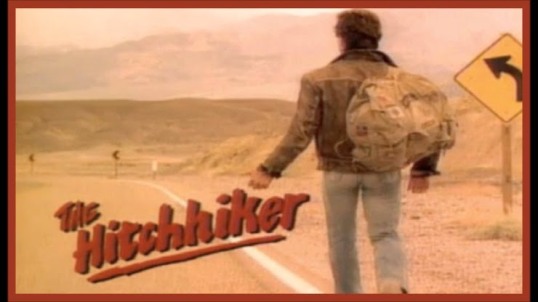
On tonight’s episode of The Hitchhiker, a woman who is having an affair with her sister’s husband (uh-oh, don’t do that) starts having surreal and increasingly frightening nightmares about a white horse. Is she being warned of her impending death?
This episode originally aired on October 5th, 1990.
A holiday slasher, 2001’s Valentine tells the story of five girls and the nosebleed-prone incel who has never forgiven them for not dancing with him in high school….
Well, no, actually, it’s a bit more serious than that. In high school, dorky Jeremy Melton asked four popular girls to dance with him at the Valentine’s Day dance. Shelley, Lilly, and Paige rejected him and were rather rude about it. Kate was polite and promised that maybe she would dance with him later. Only Dorothy agreed to dance with him but when Dorothy and Jeremy were subsequently discovered making out underneath the bleachers, Dorothy falsely claimed that Jeremy forced himself on her. School jock Joe beat up Jeremy and humiliated him in front of the entire school. Jeremy ended up in a reform school and was eventually sent to a mental institution.
Years later, everyone has grown up. Shelley (Katherine Heigl) is a medical student. Lily (Jessica Caufiel) is dating an artist named Max (Johnny Whitworth) and having to deal with Max’s angry ex, Ruthie (Heddy Burress). Dorothy (Jessica Capshaw) is insecure and dating the caddish Campbell (Daniel Cosgrove). Paige (Denise Richards) is still living her life as if she’s everyone’s favorite mean girl. And Kate (Marley Shelton) is in an on-and-off again relationship with Adam (David Boreanaz), a recovering alcoholic and writer. No one is really sure what has happened to Jeremy but when someone starts picking off the members of their group and they start to get morbid Valentines in the mail, everyone starts to wonder if maybe Jeremy has returned.
Of course, this group isn’t going to let the fact that a murderer is stalking them keep them from throwing a big Valentine’s party as Dorothy’s house. These are extremely stupid people, as you may have guessed. It’s a bit of an awkward party, largely because everyone is having relationship issues and Ruthie Walker shows up and yells at everyone. Things get even more awkward when the a killer wearing a cupid’s mask shows up and starts killing everyone at the party.
I always remember Valentine as being a really big deal when it was first released but, when I was doing a little research for this review, I discovered that Valentine was actually considered to be a flop at the box office. Maybe I just got in into my head that it was some sort of huge success because Valentine was one of those films that used to show up on Showtime constantly. I think I’ve seen the film’s ending over a hundred times, just while waiting for the next movie to start.
As far as slasher films go, it’s adequate without being particularly memorable. The killer is creepy but the victims are all so shallow that it’s difficult to have much sympathy for them. Probably the most interesting thing about this film is that all of the supporting characters are so strange and perverse that it almost feels as if they’ve wondered over from an old giallo film. This the type of film where everyone’s either an ex-addict or a notorious con artist or an underwear thief. Undoubtedly, the best supporting character is Ruthie Walker, if just because she’s the only character in the film who is willing to call out everyone on their shallowness. Unfortunately, Ruthie doesn’t come to a good end but she does get the best death scene in the film and, when it comes to something like Valentine, that has to be considered a triumph.
Anyway, Valentine ends with the set up for a sequel but it never happened. Valentine’s Day remains an awesome holiday! Don’t let any killer cupids ruin it for you.
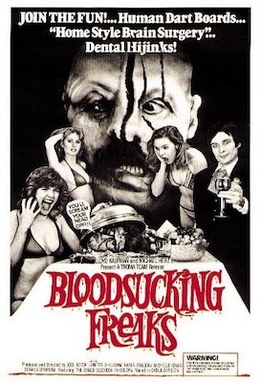
Well, with a title like Blood Sucking Freaks, it has to be good!
Right?
First released in 1976, Blood Sucking Freaks is one of those not particularly good films that every horror fan has to sit through at least once. Historically, it’s important as an example of a film that generated a thoroughly unnecessary moral panic, largely amongst people who had never actually seen the stupid thing. It tells the story of Master Sardu (Seamus O’Brien), who runs a Grand Guignol-style theater in SoHo. Wealthy New Yorkers flock to the theater on a nightly basis, to watch as Sardu and his dwarf assistant, Ralphus (Luis de Jesus), torture women on stage. The crowd thinks that it’s all fake but what they don’t know is that Sardu and Ralphus are abducting real women and forced them to live in a cage underneath the theater, where they are occasionally brought out to be abused by high-paying patrons. All of the torture and death that takes place on stage is real.
Most members of the audience enjoy the show and consider Sardu to be a master of transgressive art. However, critic Creasy Silo (Alan Dellay) doesn’t think much of Sardu or his show and he writes a review in which he refers to whole thing as being pretentious. Sardu apparently considers “pretentious” to be the worst insult that can be uttered against his production of pain and murder so he orders his followers to abduct Silo. Held prisoner in the theater, Silo is told the truth about the show and then brainwashed to become a part of the show himself.
Meanwhile, Sardu’s followers have also kidnapped a ballerina named Natasha (Viju Krem). Sardu feels that, if Natasha can be brainwashed to perform in the show, it’ll lead to greater things. The show might move to Broadway and then someone might make a movie about Master Sardu! Natasha’s lunkhead boyfriend, Tom (Niles McMaster), is not happy about Natasha being kidnapped. He teams up with a sleazy cop (Dan Fauci) and they head down to the theater.
Much as with Snuff, Blood-Sucking Freaks generated a lot of controversy when it was first released, with some speculating that the murders in Blood-Sucking Freaks may have actually been real murders. It was originally released in grindhouse theaters with an R-rating. That R-rating might take some people by surprise when you consider how graphic the film supposedly was but it must be understood that the R-rating was self-imposed. The filmmakers refused to submit the film to the MPAA and just rated it themselves. When Troma acquired the film and submitted an edited version of the film to the MPAA, the organization refused to even watch the film. That’s how controversial Blood-Sucking Freaks is! The MPAA won’t even watch it long enough to tell other not to!
Also, much like Snuff, Blood-Sucking Freaks is actually a pretty boring movie. Blood-Sucking Friends does deserve some credit for satirizing the pretentions of the underground arts scene but, for the most part, it’s a slow-moving and terribly acted film and the gore, while plentiful, is not particularly convincing. Seamus O’Brien, who was murdered in an unrelated incident shortly after the film’s release, gives an absolutely lousy performance as Sardu. Controversy aside, it’s a dumb movie and the only thing that really redeems it is that it knows it’s a dumb movie and doesn’t pretend otherwise.
The main lesson of Blood-Sucking Freaks is that it’s the type of movie that probably would have vanished into obscurity if not for the controversy that it has generated over the years. Outrage sells.
First broadcast in 1981, The Wave stars Bruce Davison as Ben Ross, a high school social studies teacher who conducts a social experiment.
Frustrated by the fact that he can’t answer his students questions of how the German people could have allowed the Holocaust to occur, Ben decides to teach his students a lesson. He starts by introducing a bunch of seemingly arbitrary rules to his classroom, concerning the proper way for students to sit at their desks and to address the teacher. Ben is somewhat surprised to see how quickly his students adapt to the new rules, even taking pleasure in showing how quickly and efficiently they can follow orders. The next day, Ben tells his students that they are now members of The Wave, a national youth organization with membership cards and a secret salute.
And that is when all Hell breaks loose. Ben only meant to show his students what it’s like to be a member of a mass movement but the students take The Wave far more seriously than Ben was expecting. Soon, other students are joining The Wave. When the popular football players announce that they are a part of The Wave, others are quick to flock to the organization. The formerly likable David turns into a fanatic about bringing people into the organization. Robert, a formerly unpopular student, revels in his new job of reporting anyone who deviates from the rules of The Wave. When a student reporter writes an article that is critical of the organization, she and the school paper are targeted. Has Ben’s social experiment spiraled out of control?
42 years after it was originally produced, The Wave remains a powerful and sobering look at how people can be manipulated into doing things as a mob that they would never do as an individual. If anything, the film feels more relevant today than it probably did in 1981. The character of Robert, in particular, is a familiar one. He’s someone with no self-esteem who latches onto a movement and finds his identity by taking down others and accusing them of failing to follow the rules. One can find people like Robert all over social media, searching through old posts for any example of wrongthink that they can broadcast all through their social world. It’s tempting to smirk at how quickly the members of The Wave sacrificed their freedom and their ability to think for themselves but it’s no different from what we see happening in the real world every day. (Indeed, if the film had been made just two or three years ago, The Wave would probably be the people policing whether or not the rest of us were observing quarantine and wearing our facemasks correctly.) People like to feel that they belong to something, even if that means sacrificing their humanity in the process.
Featuring a good performance from Bruce Davison as the well-meaning teacher who is both fascinated and terrified by the experiment that he’s set in motion, The Wave can be viewed below:
 On Halloween night, two couples leave a Halloween party and, while walking down the street, discover a deserted building. One of them recognizes the building as being a former sex shop and he insists that he and his friends break in. Unfortunately, for them, the sex shop is not actually deserted. Bunni (Cat Geary), a woman who was raped 18 years previously and got a gruesome revenge on her attacker, is also in the building and she’s looking for more victims.
Bunni is full of gore, much of it shown in closeup. Things that other films would cut away from, Bunni zooms in on. If you want to see a man get his dick chopped off and then have the severed member stuffed down his throat in close-up, this is your movie. If you want to see guts literally pour out of a body, this is your movie. If the main reason you’re watching this movie is for the gore and the sense of transgression, more power to you. You will like this film. But me, I would have traded the gore for a compelling plot or at least one interesting character or maybe just one scene that, visually, reached above the level of a youtube video. Some people will find what they’re looking for with this movie. I did not.

Today’s horror star is the great Vincent Price.
Born in Missouri and blessed with both an aristocratic profile and a resonant voice, Vincent Price started his career as a romantic leading man before eventually before finding more success a character actor. Starting in the late 40s and continuing until his death in 1993, Price was a beloved horror icon, bringing his witty presence to several different horror films.
Price always cites Roger Corman’s Edgar Allan Poe adaptations as being amongst his favorite of the horror films in which he appeared. In this scene from 1964’s The Masque of the Red Death, Vincent Price delivers a monologue on the meaning of terror as only he could.
 Through the Shattered Lens