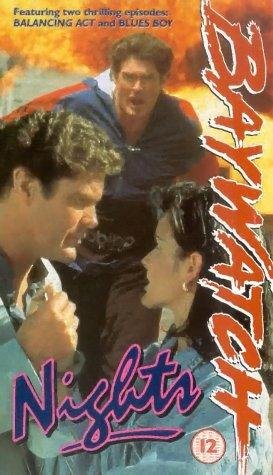
On tonight’s episode of horror on TV, we have an episode of Baywatch Nights that originally aired on February 9th, 1997. In this one, two 900 year-old Vikings are causing chaos in Los Angeles! Who can stop them?
David Hasselhoff, of course!
On tonight’s episode of horror on TV, we have an episode of Baywatch Nights that originally aired on February 9th, 1997. In this one, two 900 year-old Vikings are causing chaos in Los Angeles! Who can stop them?
David Hasselhoff, of course!
 After being a baby during the first Witchcraft and a horny high school student during the second Witchcraft, William Spanner becomes a public defender in the third Witchcraft movie.
William (Charles Solomon) is still trying to hide from his heritage as a warlock. He refuses to discuss his family with his girlfriend, Charlotte (Lisa Toothman) and instead tries to concentrate on helping underprivileged people who have run afoul of the legal system. His latest client, a teenager named Rubin Carter (Ahmad Reese), claims that he didn’t commit the murder that he’s been accused of. William is determined to make sure that Rubin gets a fair trial, despite the machinations of the ruthless DA, Vivian Hill (Nicole Lauren). William has found a way to be useful to society without having to use his magical powers.
However, events are conspiring to force William to embrace his warlock heritage. Louis (Dominic Luciana) is hitting the bar scene and picking up women so he can give them the “kiss of death” and transfer their lifeforce to his girlfriend, Roxy (Lena Hall). After Louis arranges to befriend William, he focuses his attentions on Charlotte. In order to save his girlfriend, William is going to have use the same powers that he’s spent years trying to deny.
Particularly when compared to some of the films that would come after it, Witchcraft III isn’t bad. William’s motivations for hiding from his past actually make sense and Louis is an enjoyably cheesy villain. The film features William getting advice from a witch doctor, which introduces the idea that there’s all sorts of different magic in the world. It’s an intriguing idea, or at least it is when compared with what usually passes for a deep thought in a Witchcraft movie. That’s the whole key to enjoying Witchcraft III. Don’t compare it to a real movie. Compare it to the other Witchcraft films.
I like the idea of a warlock lawyer. It seems like it could have been a good TV show. Instead, it would just be a part of horror’s longest-running franchise. Witchcraft III was enough of a direct-to-video success that Witchcraft IV soon followed.

This TWINE game is an entrant in the 2020 Interactive Fiction Competition. Because it’s October, I’m currently concentrating on only playing the horror and fantasy-based entries but I hope to have played and reviewed all of the entries by November 29th.
In this game, you are Lightbearer, Garden City’s greatest hero. And you are also Promethium, Garden City’s most nefarious villain. You play both roles in this unusual text adventure. When Lightbearer finally defeats Promethium, it might mean that she’ll have to leave Garden City and, for a lot of reasons, she’s not ready to uproot her family and make that move. So, Lightbearer and Promethium make a deal. Lightbearer will let Promethium go free on the condition that they continue to have regular “staged” battles. Lightbearer and Promethium meet regularly at a coffeeshop to choreograph their fights ahead of time. Depending on the choices that the player makes, the hero and the villain can bond over their unexpected similarities or, as the title suggests, trying to trust your enemy can be a complete disaster.
I enjoyed this game. It took me by surprise and both Lightbearer and Promethium were interesting and well-written characters. This game explored why a hero needs a villain and vice versa and the story led to some very unexpected places. It’s not a short game but it is a rewarding one. It’s well worth the time required to play it.

In honor of Canadian Thanksgiving, today’s horror scene that I love comes from one of the greatest of the Canadian slasher films, 1980’s Prom Night!
Remember everyone …. Prom Night! Everything is alright!
4 Shots From 4 Films is just what it says it is, 4 shots from 4 of our favorite films. As opposed to the reviews and recaps that we usually post, 4 Shots From 4 Films lets the visuals do the talking!
This October, we’ve been using 4 Shots From 4 Films to pay tribute to some of our favorite horror directors! Today, in honor of Canadian Thanksgiving, we recognize the talents of the one and only David Cronenberg!
4 Shots From 4 Films

Scanners (1981, dir by David Cronenberg)

The Dead Zone (1983, dir. by David Cronenberg)

The Fly (1986, dir. by David Cronenberg)

Naked Lunch (1991, dir by David Cronenberg)
The Cabinet of Dr. Caligari is a film that I’ve shared four times previously on the Shattered Lens. The first time was in 2011 and then I shared it again in 2014, 2015, 2016, 2017, 2018, and 2019! Well, you know what? I’m sharing it again because it’s a classic, it’s Halloween, and everyone should see it! (And let’s face it — it’s entirely possible that some of the people reading this post right now didn’t even know this site existed in any of those previous years. Why should they be deprived of Caligari just because they only now arrived?)
Released in 1920, the German film The Cabinet of Dr. Caligari is one of those films that we’ve all heard about but far too few of us have actually seen. Like most silent films, it requires some patience and a willingess to adapt to the narrative convictions of an earlier time. However, for those of us who love horror cinema, The Cabinet of Dr. Caligari remains required viewing. Not only did it introduce the concept of the twist ending (M. Night Shyamalan owes his career to this film) but it also helped to introduce German expressionism to the cinematic world.
My initial reaction to The Cabinet of Dr. Caligari was that it simply wasn’t that scary. It was certainly interesting to watch and I was happy that I was finally experiencing this film that I had previously only read about. However, the film itself was obviously primitive and it was difficult for my mind (which takes CGI for granted) to adjust to watching a silent film. I didn’t regret watching the film but I’d be lying (much like a first-year film student) if I said that I truly appreciated it after my first viewing.
But you know what? Despite my dismissive initial reaction, the film stayed with me. Whereas most modern films fade from the memory about 30 minutes after the end credits,The Cabinet of Dr. Caligari has stuck with me and the night after I watched it, I even had a nightmare in which Dr. Caligari was trying to break into my apartment. Yes, Dr. Caligari looked a little bit silly staring through my bedroom window but it still caused me to wake up with my heart about to explode out of my chest.
In short, The Cabinet of Dr. Caligari passes the most important test that a horror film can pass. It sticks with you even after it’s over.
For the curious with an open mind to watch with, here is Robert Wiene’s The Cabinet of Dr. Caligari!
Enjoy!
Whatever it takes
I know I can make it through….
Oh wait a minute, this isn’t the Degrassi theme song. Sad to say but there has never been an official music video released for the Degrassi theme song. If there had been, I would definitely be sharing it today for Canadian Thanksgiving.
Still, this Imagine Dragons song isn’t bad and the video features a lot of fire and destruction, which fits in with our horror theme this month. So, I’ll take it.
Enjoy!
Tonight’s episode of Baywatch Nights deals with something that every lifeguard eventually has to deal with: demonic possession.
Well, actually, it’s not so much demonic possession as its dead serial killer possession but it’s still definitely not a good thing. That’s especially true when it’s a friend and/or co-worker getting possessed. I mean, it’s never fun to end a relationship but having to end it because someone managed to get possessed …. I just don’t see how you live that down.
This episode originally aired on February 2nd, 1997.
Enjoy!

Man on the Prowl is a surprisingly intense film from 1957.
Doug Gerhardt (played by James Best) is an overly friendly young man with a pompadour and a quick smile. Doug works as a deliveryman for a car dealership and he seems like a nice enough person. He’s maybe a little bit goofy and, if you talked to him, you might think that he’s a little bit slow. Still, it’s hard not to get caught up in his endless enthusiasm. Doug is a very friendly man and he certainly does seem eager to help everyone that he meets.
Of course, Doug is also a sociopathic murderer. He’s just been released from a mental hospital and, as we see when he strangles his date during the first few minutes of the movie, he’s still got some issues. However, no one ever seems to really notice, just because he is so friendly and kind of dorky. Even though his own mother (Vivi Janiss) tries to warn people that Doug is not well, most people just think that he’s a little bit eccentric.
When Doug nearly runs over Marian Wood (Mala Powers) and her son, Marian is not very happy with him. Doug apologizes for driving too fast and he even insists on helping Marian carry in her groceries. Marian goes from hating Doug to being somewhat forgiving of his reckless driving. That’s the power of Doug’s charm. He can go from nearly killing someone to making a new friend in just a matter of minutes.
Marian is married to Woody (Jerry Paris), though it’s not a particularly happy marriage. Woody is always traveling on business, leaving Marian to take care of the house on her own. Seeing an opening, Doug starts to casually drop by so that he can do things like help Marian fix the washing machine. Of course, it’s hinted that Doug might be the one who broke the washing machine in the first place. Doug is determined to replace Woody in Marian’s life. When it turns out that Marian isn’t ready for husband to be replaced by a delivery boy (even if that delivery boy can fix a washing machine) …. well, Doug doesn’t take it well.
Man on the Prowl really took me by surprise. For a film made in 1957, the story didn’t feel particularly dated, beyond a few things that couldn’t be helped. (Doug’s pompadour comes to mind.) If anything the film feels refreshingly honest in its willingness to admit that not all marriages are happy and not all wives are content with the idea of just sitting at home and waiting for their husband to return. However, the thing that really took me by surprise was how Doug was portrayed. Considering that the term “serial killer” wouldn’t be coined until 23 years after this film was originally released, Man on the Prowl is a surprisingly realistic portrayal of a serial killer. Doug is someone who is empty on the inside but who keeps the world from noticing by deploying a charming smile and a friendly manner. He’s Ted Bundy, decades before Bundy became a household symbol of evil. As played by James Best, Doug is a very realistic and very frightening modern monster.
In many ways, Man on the Prowl is a prophetic film. In 1957, someone like Doug was probably seen as being an aberration, a once-in-a-lifetime example of the natural order of things getting screwed up. Now, however, we know that the world is full of Doug Gerhardts. And we all feel a little less safe as a result.

Electric word, “life” is an entrant in this year’s Interactive Fiction Competition. Right now, because it’s October, I’m just playing the horror and Halloween-themed entries but all sorts of different games have been entered in this year’s competition and I look forward to playing all of them in November.
Electric word, “life” takes place at a Halloween party in 1999 but it’s not really a horror game. There are elements of the supernatural in the game but the game is more about memories and grieving than it is about the paranormal. Your roommate is throwing a Halloween party and, realizing that your flat is full of strangers, you’re looking for a way to either escape or at least find some peace and quiet. Then, suddenly, your friend Andy shows up but there’s something different about him.
Like most games designed with Twine, Electric word, “life” is more a short story than a traditional game. You point and click to move the story along and to get extra details. There are a few choices you can make but they all appear to eventually lead to the same conclusion. Luckily, it’s a very well-written and emotionally-effective story. I especially liked the amount of detail that Lance Nathan went into when it came to recreating Halloween, 1999. Everything from the Matrix costumes to the music playing at the party felt spot-on. Playing the game, you feel like you really are at that party, listening to strangers chat each other up and wondering how you’re going to clean up the mess afterwards. When Andy arrives, you’re as relieved as the narrator to see a friend and when Andy reveals his secret, it’s an emotional moment for both the player and the narrator.
Electric word, “life” is a simple but rewarding work of Interactive Fiction. It can be played by clicking here.
 Through the Shattered Lens