4 Shots From 4 Films is just what it says it is, 4 shots from 4 of our favorite films. As opposed to the reviews and recaps that we usually post, 4 Shots From 4 Films is all about letting the visuals do the talking.
Today’s director: Sam Raimi!
4 Shots From 4 Sam Raimi Films
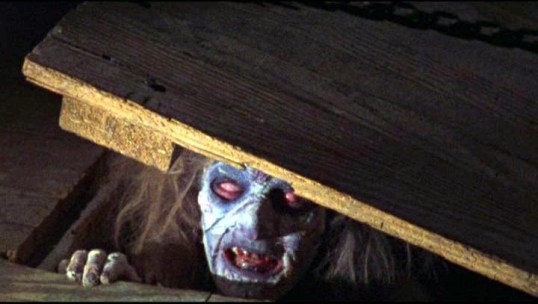
The Evil Dead (1981, dir by Sam Raimi, DP: Tim Philo)
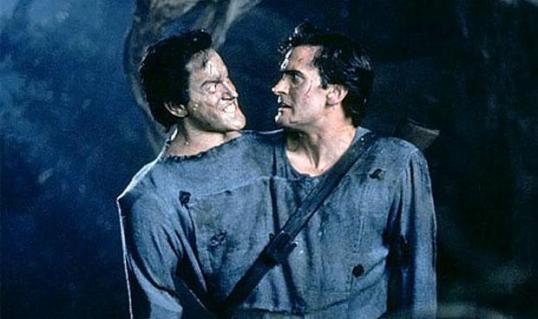
Evil Dead II (1987, dir by Sam Raimi, DP: Peter Deming)
Army of Darkness (1992, dir by Sam Raimi, DP: Bill Pope)
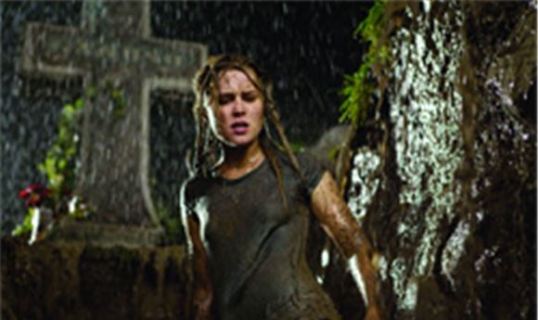
Drag Me To Hell (2009, dir by Sam Raimi, DP: Peter Deming)
That’s something that I’ve been saying for years. Of course, as is usually the case with such pronouncements, I was only being half-serious when I originally said it. The first time I said it, it was to an older relative who had just forced me to sit through a 20 minute performance of I’ll Fly Away. The second time I said it, it was to a friend who was really into Woody Guthrie, Pete Seeger, and all those commies After that, I found many excuses to say it because I was going to college that was renowned for its music program. It was one of those colleges where you couldn’t turn a corner without potentially running into someone who was taking a class in folk music. They were always a bit annoying. For folkies, it wasn’t enough to tell you that their music was better than your music. They also had to tell you why listening to the Weavers on scratchy vinyl made them better human beings than you.
That said, I was never totally serious about folk music being the music of evil people. That seemed like a far more appropriate thing to say about prog rock. But, having watched All You Need Is Death, I’m now not so sure. Folk music may very well be evil.
All You Need Is Death tells the story of Anna (Simone Collins) and Aleks (Charlie Maher), a couple who live in Dublin. Anna is a gifted singer and, when we first see the two of them, Anna and Aleks appear to be deeply in love. They work for an academic named Agnes (Catherine Siggins), whose goal is to find the oldest known versions of various folk songs. Their work brings them to an apparently demented old woman named Rita (Olwen Fouere), who is rumored to know a song that is in a language the predates the Irish language. Rita reveals that she does indeed know the song, which was apparently inspired by a romantic betrayal and a brutal death. She explains that the song has been passed down from one woman to another over the centuries. It can never be recorded and men are not allowed to hear the song. After Aleks excuses himself, Rita sings the song to Anna. As they drive back home, Anna tries to sing the song from memory but struggles, which isn’t surprising considering that the song isn’t even in a living language. However, they’re stopped by Agnes who reveals that she secretly recorded Rita singing. Meanwhile, Rita is herself gruesomely murdered by a mysterious force.
Things get progressively stranger from there, as Anna finds herself being targeted by Rita’s unhinged son (Nigel O’Neill) and Anna and Alek’s previously blessed relationship suddenly seems to be cursed. There’s even a touch of Cronenbergian body horror as the film plays out. The film’s plot is not always easy to follow and that’s not a bad thing. This is one of those horror films that works because the audience never feels quite secure in their understanding of what they’re seeing. The story plays out at its own pace, putting an emphasis on atmosphere over easy shocks and jump scares. It’s about as close to a filmed dream as the viewer is likely to find. It’s a horror film that sticks with you after the end credits role. You’ll never listen to another folk song.
That’s the question I asked myself as I watched 1964’s The Tomb of Ligeia. Loosely based on a short story by Edgar Allan Poe, The Tomb of Ligeia tells the story of Verden Fell (Vincent Price). Fell’s wife, Ligeia, has recently died but Fell worries that her spirit is still haunting and watching him. One gets the feeling that Fell hated his late wife but, at the same time, was obsessed with her. Fell has an eye condition which causes him to wear dark glasses on the rare occassions that he leaves his manor. He’s definitely a creepy guy but that doesn’t stop Rowena (Elizabeth Shepherd) from falling in love with him and leaving her fiancé, Christopher Gough (John Westbrook), to marry him. Unfortunately, Rowena is soon feeling the spirt of Ligeia as well, in the form of a black cat who keeps attacking Rowena.
Now, in all honesty, I doubt that Roger Corman specifically had an issue with cats. It’s possible the Edgar Allan Poe had an issue with cats, as he lived at a time when cats were rarely kept as pets and were instead just used to catch and kill mice and rats. (And, in fairness to the 19th century, that was a very important job in those days of bad hygiene and outhouses.) There’s no cats to be found in Poe’s short story about Ligeia but there was one very prominently featured in The Black Cat. As Ligeia was not exactly one of Poe’s most detailed stories, it’s probable that Corman and screenwriter Robert Towne just included the evil black cat because that story was one of Poe’s best-known.
That said, for me, it was difficult to watch an entire movie about people hating and attempting to destroy a cat. It’s certainly not the cat’s fault that it’s been possessed by the spirit of Ligeia. As I watched the film, it occurred to me that cats may not have been as popular in the 1960s as they are today. I mean, there was no internet when this film was made and, as a result, people weren’t constantly being bombarded by cute cat pictures. Instead, people probably just knew cats for their habit of hissing at people and scratching their owners. Today, we find that behavior to be cute. Perhaps back in 1964, people felt differently.
If I seem to be rambling on about the cat, that’s because there’s not really a lot to be said about The Tomb of Ligeia. It was the last of Corman’s Poe films and neither Corman nor Price seem to be particularly invested in the material. Price is actually rather miscast as Verden Fell. Fell is meant to be a mysterious aristocrat, in the spirit of Maxim de Winter from Rebecca. But Vincent Price is …. well, he’s Vincent Price. Vincent Price was a wonderful actor and personality but he wasn’t particularly enigmatic. From the first minute we see Price, we know that he’s being haunted by his dead wife because he’s Vincent Price and the same thing happened to him in several other films.
The Tomb of Ligeia is full of the ornate sets and beautiful costumes that were featured in all of Corman’s Poe films. And even a miscast Vincent Price is still fun to watch. But, when compared to the other films in the Poe Cycle, this one falls flat.
First published in 1926, Amazing Stories was the first magazine to be devoted to science fiction and it’s still going, nearly 100 years later! There have been many amazing covers over the course of this magazine’s history. Here are just a few of them.
This film was produced as a direct result of the box office success of I Was A Teenage Werewolf. Just as in Teenage Werewolf, Whit Bissell plays a mad scientist who makes the mistake of trying to play God. (He also makes the mistake of keeping an alligator in his lab but that’s another story.) The end result …. Teenage Frankenstein!
The makeup on the Teenage Frankenstein is probably the best thing about this film. If nothing else, this film features a monster who actually looks like he was stitched together in a lab.
1957’s I Was A Teenage Werewolf combines two genres that were very popular in the late 50s.
On the one hand, it’s a film about a teenage rebel. Tony Rivers (Michael Landon) is a teenager that means well but he keeps losing his temper. If he can’t learn to control his anger, he could very well be looking at a life behind bars.
On the other hand, it’s also a horror film. When Tony visits a hypnotist (Whit Bissell), the end result is Tony turning into a werewolf and going on a rampage, all while still wearing his letterman jacket.
Today’s song comes the hypnotic soundtrack of Paul Schrader’s Cat People. This song was so good that it later showed up and was used to equally strong effect in Quentin Tarantino’s Inglourious Basterds.
Or maybe you don’t. Sometimes, I forget that not everyone can read my mind. Anyway, I used to do a weekly post of my favorite grindhouse trailers. Eventually, it went from being a weekly thing to being an occasional thing, largely due to the fact that there’s only so many trailers available on YouTube. Now, Lisa Marie’s Favorite Grindhouse and Exploitation Film Trailers is something that I usually only bring out on a holiday.
Like today!
So, here are 6 trailers for the last week of October!
Last House On The Left (1972)
“Two girls from the suburbs. Going to the city to have …. good time….” Wow, thanks for explaining that, Mr. Creepy Narrator Dude. That classic tag line about how to avoid fainting would be imitated time and again for …. well, actually, it’s still being imitated. This was Wes Craven’s 1st film and also one of the most influential horror films of all time.
2. The Texas Chainsaw Massacre (1974)
Speaking of influential horror movies, the trailer for The Texas Chainsaw Massacre is almost scarier than the film itself!
3. Lisa Lisa (1977)
I love this trailer! Can you guess why?
4. Ruby (1977)
Ruby, starring Piper Laurie! I’m going to assume this was after Piper Laurie played Margaret White in Carrie. Don’t take your love to town, Ruby.
5. Jennifer (1978)
Jennifer was another film that pretty obviously inspired by Carrie. In this one, Jennifer has psychic control over snakes. So, don’t mess with Jennifer.
6. The Visitor (1979)
Finally, this Italian Omen rip-off features Franco Nero as Jesus, so it’s automatically the greatest film ever made.



 Through the Shattered Lens