Andrea (Virginia Madsen) is a small town teenager who has just received a scholarship to attend the Ettinger Academy, a formelyr all-male boarding school. Andrea is excited because some of the most powerful and wealthy people in the country have graduated from Ettinger. Her boyfriend (James Wilder) is less excited because he worries that Ettinger is going to change Andrea. He might be right because all of the students at Ettinger are emotionless robots who read the Wall Street Journal and listen to classic music. Even Andrea’s new friends, who all seem normal, soon change into mindless preppies who wear sweaters over their shoulders.
A high school version of The Stepford Wives, Zombie High features no zombies and is more of a comedy than a straight up horror film. The movie’s original title was the far cooler The School That Ate My Brain. Zombie High is nothing special but it does feature Sherilyn Fenn in a small role, as one of the students who goes from being vampy to preppy in just one day. Virginia Madsen and Sherilyn Fenn in the same movie? What 80s or 90s kid could resist that? Also, Zombie High wins points by proving that heavy metal music is the key to reversing brainwashing.
Today’s horror scene that I love comes from the 1939 film, The Walking Dead.
In this film, Boris Karloff plays a pianist who, after being framed for a murder he didn’t commit, is executed and then brought back to life by a scientist played by Edmund Gwenn. The re-animated Karloff sets out for revenge.
In this scene, Karloff plays the piano while some of the men who framed him sit out in the audience. Just check out the power of that Karloff glare!
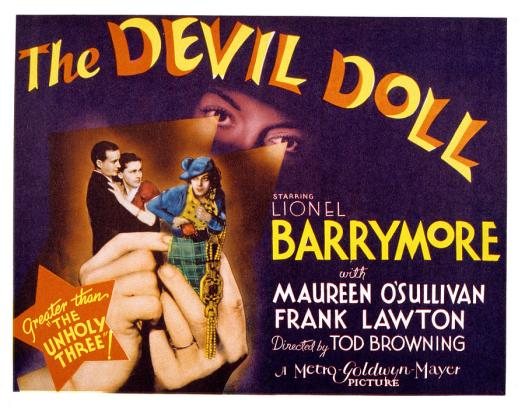
Producer/director Tod Browning’s THE DEVIL DOLL is a film reminiscent of his silent efforts with the great Lon Chaney Sr. This bizarre little movie doesn’t get the attention of Browning’s DRACULA or FREAKS , and the ending’s a bit on the sappy side, but on the plus side it features Lionel Barrymore dressed in drag for most of the time, some neat early special effects work, and a weird premise based on a novel by science fiction writer A. Merritt, adapted for the screen by Guy Endore, Garrett Ford, and Erich von Stroheim (!!).
Barrymore stars as Devil’s Island escapee Paul Lavond, and he pretty much carries the picture. Lavond and fellow con Marcel (Henry B. Walthall ) make it to Marcel’s home, where wife Melita (a pop-eyed Rafaela Ottiano) has been keeping the faith on her hubby’s experimental work… turning animals miniature, to solve the coming food shortage…
In Bucket of Blood, Dick Miller plays, for the first time, a character named Walter Paisley. Walter is an artist who discovers that the dead make the best models!
2. Little Shop of Horrors (1960)
Dick Miller returned to play a supporting role in Little Shop of Horrors, where his co-stars included a young Jack Nicholson.
3. The Terror (1963)
Both Jack Nicholson and Dick Miller returned for The Terror and they were joined by Boris Karloff.
4. The Raven (1963)
At around the same time, Karloff and Nicholson were co-starring with Vincent Price and Peter Lorre in The Raven.
5. The Masque of the Red Death (1964)
Price would return for The Masque of the Red Death.
6. The Tomb of Ligeia (1964)
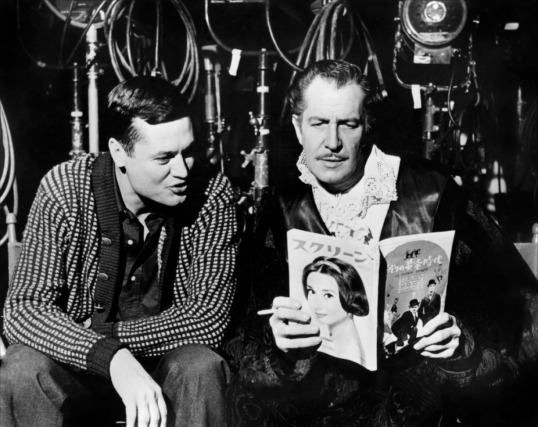
To my knowledge, this film was the final time Corman directed Vincent Price, though he produced a few more films that featured him.
What do you think about all the trailers, random director with a tommy gun?
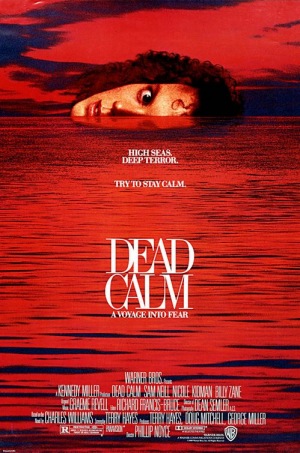
As I was watching the 1989 thriller-horror hybrid Dead Calm, I found myself wondering what I would do if I found myself in the same situation as Rae (Nicole Kidman)?
You’re stuck on a yacht that’s floating out in the middle of the ocean, trying to mentally recover from the death of your child in a horrific car accident. Your only company on the boat is your husband, an experienced sailor named John (Sam Neill), and a dog who always barks at the worst possible time. One night, you see another boat in the distance. The boat is obviously just drifting and appears as if it might be sinking. Suddenly, a frantic man in a row boat approaches your yachet. He says his name is Hughie (Billy Zane) and that he’s just escaped from the other boat. He says he’s a photographer. He says that everyone on the other boat is dead and he suggests that it was due to botulism. (In real life, I had to look that up to figure out what Hughie and John were talking about. However, in this scenario, you are Rae and you understand immediately.)
John has his doubts about Hughie’s story. John says that he is going to go over to the boat on his own and check things out. You nod and then watch as John rows away. Of course, Hughie was supposed to remain locked up below deck but that doesn’t last long. Soon, Hughie is free, he’s taken control of the yacht, and you are sailing away from both the other boat and John.
“Oh my God,” I thought as I watched, “what would I do if that happened to me!? I have no idea!”
However, I then thought about it some more and I realized that would never happen to me. I mean, let’s ignore the obvious fact that I’m terrified of drowning and would never be out in the middle of the ocean in the first place. I would like to think that my husband would be smart enough to say, “There’s no way I’m leaving my wife, who is still emotionally recovering from the death of our son, alone on a boat with a total stranger who might be totally insane!” And, if for some reason, my husband wasn’t that smart, I’d like to think that I would say, “Are you fucking kidding me? You’re not leaving me alone on a boat with a total stranger who might be totally insane!”
In the past, I’ve always defended horror movies where people do stupid things by arguing that people do stupid things in real life all the time. But Dead Calm really takes it a bit too far. Maybe I could buy it if John and Rae were the type of teenagers who inevitably end up working as a camp counselor at Camp Crystal Lake. But John is an officer in the Australian navy! And Rae is Nicole Kidman!
That said, if you can accept the stupidity of the film’s premise, Dead Calm is an effective and often scary thriller. There’s really only three characters in the entire film but Kidman, Neill, and Zane all give excellent performances, though their work is often undercut by the stupid things that the movie requires them to do. Once Rae is trapped on that boat with the Hughie, Rae has to both play up to Hughie’s delusions while also looking for a way to get him out of the way so she can turn the yacht around and go back to rescue John and most of these scenes only work because of Kidman’s fierce performance (though, again, that same fierceness makes it hard to believe that Rae would ever have acquiesced to John’s decision to leave the yacht in the first place). As for Zane, he is a bundle of nonstop, psychotic energy. When he loses control, he is genuinely frightening. This is probably the best Billy Zane performance that I’ve ever seen. Certainly, he’s far better here than he was in Titanic.
Still, you have to wonder why Rae didn’t just shoot Hughie with a harpoon or a flare gun whenever he turned her back to him. There’s even an extended sequence where Hughie dances on the deck, with no idea that Rae is watching him. Considering that, by this point, there was no doubt that Hughie was a crazy murderer, it seems like Rae could have just giving him a little push overboard. It seems like that could have saved everyone a lot of trouble…
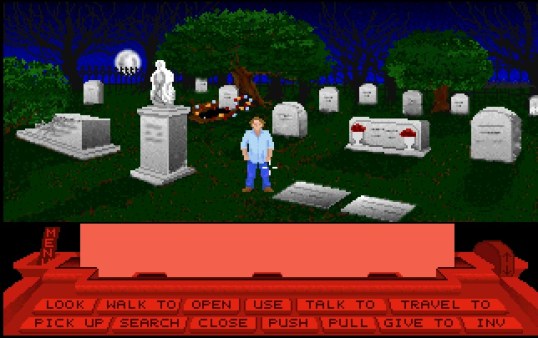
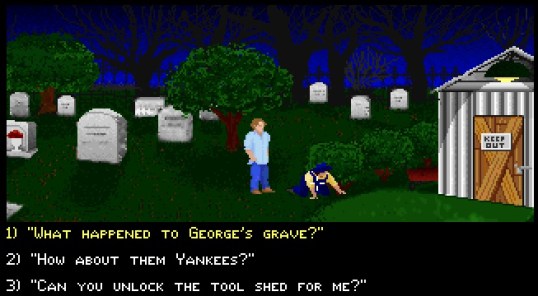
The Dark Half was released as a tie-in with the movie version of Stephen King’s novel of the same name. I have read that some people consider The Dark Half to be one of the worst games of all time. If I can ever figure out how to get out of the cemetery, I will tell you if they are right.
You play writer Thad Beaumont, who used to write under the pen name of George Stark. As a publicity stunt, Thad and his wife hold a mock funeral for George Stark in the local cemetery. When the game starts, Thad has just discovered that someone has dug up George’s grave.
The game uses a standard point-and-click interface, the type that was once very popular but which seems clunky by today’s standards. By clicking on right side of the screen, you can walk over the groundskeeper and have a conversation with him.
The groundskeeper does not have much to say about “them Yankees” but he will unlock the shed for you. Going into the shed, you can get tools that I think will help you later in the game. The problem is that they do not help you get out of the cemetery which is where I’m running into trouble.
As soon as you leave the shed, this happens:
At first, I thought that was George Stark killing Thad but, according to a walk-through that I found, that is actually George killing the reporter who was sent to cover his “burial.”
This scene is followed by this:
That is a blank screen. Creepy music plays in the background while you get to stare at the blank screen and it just keeps on playing. I have literally counted the minutes that I have spent staring at the screen and listening to the music before getting annoyed and ending the game. The longest that I’ve gone is 8 minutes. There is no text nor pictures, just the most droning and repetitive music imaginable. Is this a glitch that only effects the Archive version of the game or did The Dark Half really come with an 8 minute-plus musical interlude? I’m hoping that someone reading this post can tell me. I would like to play the game but there’s only so much time that I can devote to staring at a blank screen.
4 Shots From 4 Films is just what it says it is, 4 shots from 4 of our favorite films. As opposed to the reviews and recaps that we usually post, 4 Shots From 4 Films is all about letting the visuals do the talking.
This October, I am going to be using our 4 Shots From 4 Films feature to pay tribute to some of my favorite horror directors, in alphabetical order! That’s right, we’re going from Argento to Zombie in one month!
Today’s director is one of the most influential figures in American film history, the one and only Roger Corman!
4 Shots From 4 Films
It Conquered The World (1956, dir by Roger Corman)
Since yesterday’s horror on the lens was The Abominable Dr. Phibes, it only seems logical that today’s should be the sequel to that film,1972’s Dr. Phibes Rises Again. Would you believe that, before I actually found the film on YouTube, I thought this film was called Dr. Phibes Rides Again? Personally, I think Rides Again sounds better than Rises Again but what do I know?
The Twilight Zone wasn’t the only televised horror anthology show to air in the late 50s and early 60s! There was also a show called One Step Beyond, which ran for three seasons. It was hosted by a man named John Newland and each episode was supposedly based on an event that may have actually occurred … an event that defied rational explanation!
The episode features one of the icons of horror cinema, the one and only Christopher Lee! Lee plays a German soldier who, during World War I, enlists a local psychic to discover whether or not his lover is being faithful to him. When he discovers that she isn’t, he uses the psychic’s powers to get revenge. Afterward, when he wants to confess to his crime, he runs into a problem. No one believes him because he was over 800 miles away when the crime occurred.
To be honest, the main reason to watch this episode is to see Christopher Lee but isn’t that reason enough? Lee was one of the great gentlemen of horror and his performance in this episode helps to show why.
 Andrea (Virginia Madsen) is a small town teenager who has just received a scholarship to attend the Ettinger Academy, a formelyr all-male boarding school. Andrea is excited because some of the most powerful and wealthy people in the country have graduated from Ettinger. Her boyfriend (James Wilder) is less excited because he worries that Ettinger is going to change Andrea. He might be right because all of the students at Ettinger are emotionless robots who read the Wall Street Journal and listen to classic music. Even Andrea’s new friends, who all seem normal, soon change into mindless preppies who wear sweaters over their shoulders.






 Through the Shattered Lens