4 Shots From 4 Films is just what it says it is, 4 shots from 4 of our favorite films. As opposed to the reviews and recaps that we usually post, 4 Shots From 4 Films lets the visuals do the talking.
Since we yesterday paid our respects to the great Bela Lugosi, it only seems right that today, we should honor Boris Karloff. By all account, Boris Karloff was a remarkably gentle and friendly man. Perhaps that’s why he could find the soul in almost any character, even the ones who didn’t have one.
It’s time for….
4 Shots From 4 Boris Karloff Films
Frankenstein (1931, dir by James Whale, DP: Arthur Edeson)
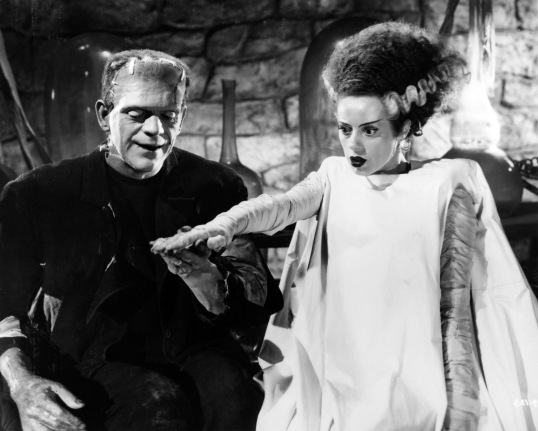
Bride of Frankenstein (1935, dir James Whale, DP: John J. Mescall)
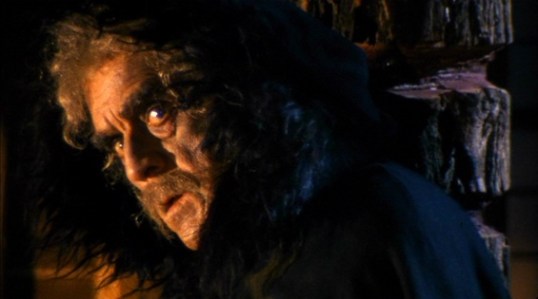
Black Sabbath (1963, dir by Mario Bava, DP:Ubaldo Terzano and Mario Bava)
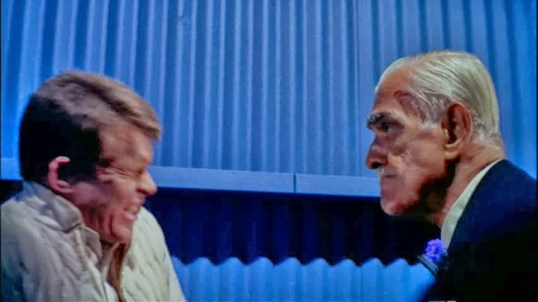
Targets (1968, dir by Peter Bogdanovich, DP: Laszlo Kovacs)
1957’s I Was A Teenage Werewolf combines two genres that were very popular in the late 50s.
On the one hand, it’s a film about a teenage rebel. Tony Rivers (Michael Landon) is a teenager that means well but he keeps losing his temper. If he can’t learn to control his anger, he could very well be looking at a life behind bars.
On the other hand, it’s also a horror film. When Tony visits a hypnotist (Whit Bissell), the end result is Tony turning into a werewolf and going on a rampage, all while still wearing his letterman jacket.
Tonight, for our horror on the lens, we have the fourth episode of the 2nd season of Friday the 13th: The Series!
Colin Fox plays a Satanist who plans to use a magic coin to summon the dead and take over the world! Can Micki and Ryan stop him and his cult?
This episode originally aired on October 21st, 1988! It was apparently as close as the 2nd season of Friday the 13th got to doing a Halloween show as the next episode wouldn’t air until November 4th.
Wow, there certainly are a lot of vampires in New Mexico!
Well, I guess I can understand the logic behind it. My family used to visit New Mexico frequently. We even lived there for a few months when I was a kid. If you’re looking for a place to hide out, New Mexico is a good place to do it. You can drive for hours without seeing another car or another person. Add to that, New Mexico is state where people respect your privacy. No one’s going to show up at your house demanding to know why you only come out at night.
Of course, if I was a vampire, I might avoid New Mexico because of the bright sunlight. Seriously, if you’re trying to escape being touched by the sun, the New Mexico desert might not be the ideal place to hide out. I don’t know, though. I’ve never been a vampire.
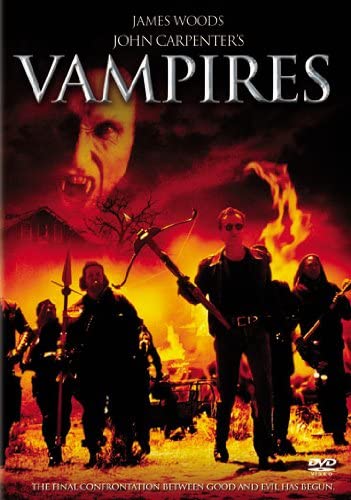
In John Carpenter’s 1998 film, Vampires (actually, John Carpenter’s Vampires because everyone know the power that the Carpenter name holds for horror fans), Jan Valek (Thomas Ian Griffith) is the world’s oldest vampire and he’s looking to perform a ceremony that will take care of that whole sunlight issue. If he can perform the ceremony, he’ll be the most powerful creature in the world.
Fortunately, the Vatican has put together a team of ruthless vampire exterminators. Led by Jack Crow (James Woods), these guys have no problem tracking down vampires and riddling their undead bodies with bullets that have probably been dipped in holy water. Unfortunately, with the exception of Jack and his second-in-command, Tony (Daniel Baldwin), the vampires hunters aren’t too smart because Valek gets the drop on them while they’re partying at a hotel with a bunch of prostitutes. The only survivors are Tony, Jack, and Katrina (Sheryl Lee), a prostitute who was previously bitten by Valek.
After teaming up with an enthusiastic but inexperienced priest named Father Guiteau (Tim Guinee), Jack tries to find a way to stop Valek. Meanwhile, Tony finds himself falling for Katrina despite the fact that Katrina will soon be transforming into a vampire and he and Jack have pledged to destroy every vampire that they come across. It leads to several chases, several bloody shootouts, and a lot of panoramic shots of the New Mexico desert.
The first time I ever watched Vampires, I thought it had its moments of demented fun and I thought that James Woods gave a wonderfully frantic performance as Jack Crow but overall, I got a little bit bored with the film’s constant violence. There’s only so many times that you can watch people die in slow motion before you get tired of it. The second time I watched the movie, I was able to better appreciate the film’s self-awareness. As directed by John Carpenter, it’s intentionally over-the-top in just about every regard and it’s definitely not meat to be taken seriously. It’s a mix of a western and a vampire film and Carpenter is basically saying, “If we’re going to do this, let’s go crazy with it.” The film still has its flaws, of course. Daniel Baldwin seems lost in the role of Tony and the film is oddly paced, It ends awkwardly, with the promise of a direct sequel that was never made. (There were sequels, don’t get me wrong. But Jon Bon Jovi is no substitute for James Woods at his most nervy.) But the important thing is that, on a second viewing, those flaws were overshadowed by John Carpenter’s kinetic direction and the performances of James Woods, Sheryl Lee, and Thomas Ian Griffith.
The first time I watched the film, I thought it was just another movie about modern-day vampires killing people while being hunted by unconventional extrerminators. However, the second time that I watched it, I found myself considering that Vampires is actually a movie about Catholics kicking ass! Yay! The lesson here is to always do a second viewing. Flaws and all, Vampires was far better than I remembered.
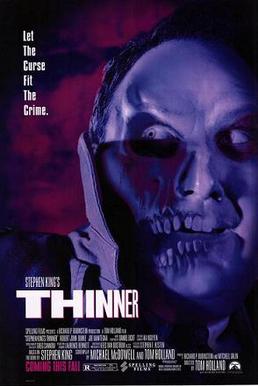
Billy Halleck (Robert John Burke, in a fat suit) is a morbidly obese attorney who might be destined to die of a heart attack but who definitely will not be serving jail time despite running over an old gypsy woman. After a corrupt judge and crooked cop, both of whom are friends of Billy’s, conspire to get Halleck acquitted, all three of them are cursed by the woman’s husband (Michael Constnatine). The judge turns into a lizard while the cop is covered in sores. Halleck, however, finally starts to lose weight! At first, he’s happy. He’s finally getting thin and all he had to do was run over an old woman! But then, he realizes that he’s never going to stop getting thinner and he’s going to just waste away.
Thinner is based on a novel by Richard Bachman, who was actually Stephen King. Like most of the Bachman books, Thinner is nastier than most of the King books. Billy is a terrible character and he deserves exactly what’s coming to him. The book is not usually listed as being one of King’s better efforts and the movie doesn’t get much love either. I’ve always liked Thinner, though. It’s like a really good episode of Tales From The Crypt, with Billy paying the price for his sins. Billy actually gets several chances to redeem himself but, because he’s such a terrible character, he keeps messing them up. Instead of begging for forgiveness, Billy hires a gangster (Joe Mantegna) to try to take out the gypsies. Even when the dead woman’s husband gives Billy a chance to escape his fate with some shred of dignity, Billy would rather go after his perceived enemies. Many bad things happen to Billy but he brings them all on himself. Even when it becomes obvious that he’s under a curse, he still thinks he can plea bargain his way out of it. He’s a lawyer, through and through.
Thinner is frequently cartoonish and broad but that works for the story that it’s telling. Robert John Burke’s performance may not have many shadings to it but again, it’s right for the story that’s being told. My favorite performance in the film was Joe Mantegna’s turn as the gangster and fans of Late Night Cinemax will feel a rush of nostalgia when Kari Wuhrer makes an appearance as the beautiful daughter of the woman that Billy ran over. Thinner is a middle-tier King adaptation, neither as bad nor as good as some others. I dug it.
The 1995 YA thriller, Final Girl, tells the story of Lily. Lily is about to graduate high school and she is determined that she is going to beat out Graham for valedictorian. After all, Graham is just a rich boy who owns a green Porsche while Lily is working two jobs to help support her mother, who has had a stroke. Plus, both of Lily’s older sisters were valedictorians so of course Lily is going to continue the family tradition!
(At this point, let me just say that I’m glad that the only family-related high school pressure that I had came from people who wanted me to become a cheerleader like my sister. If I had people pressuring me to also do well in school, I don’t think I could have handled it. Don’t get me wrong, I did pretty well in school. But there was never any risk of me becoming valedictorian, not as long as I was required to take Algebra classes. I was very happy with academically being in the upper half but not at the top of my class.)
Anyway, Lily is determined to give the big speech at graduation but one of her teachers, Mr. Reiner, has given her a B on what Lily clearly feels was an A paper. When Reiner refuses to reconsider the grade, Lily says that she could kill him. Shortly afterwards, Mr. Reiner dies in a freak accident! AGCK!
Even with Mr. Reiner out of the way, it still seems like Graham might beat her to the top. But then Graham turns up dead, push head first into a — I’m being totally a serious here — printing press! Mr. Reiner’s death may have been a tragic accident but Graham was definitely murdered! And guess who everyone suspects!
Can Lily prove her innocence while maintaining her grade point average? And who is responsible for the latest deaths on Fear Street?
You’ll have to read the book to find out. If I told you any more details about the plot, you’d probably guess who the murderer is. It’s really not a shock at all. But still, Stine has some fun with the way this killer reacts to the truth beingd discovered. This is one Stine book where the killer is even more creepy than usual. Lily’s a bit difficult to sympathize with (because, seriously, it’s not like being the 2nd best student at the school is going to force her to settle for a fast food job or something) but the supporting cast is likable and the the whole printing press death is just strange enough to make the book a bit more memorable than the average Stine thriller.
I guess my grad for Final Grade would be a much deserved B+. There’s nothing wrong with a good, strong B.
In this twine game, a friend invites you to visit his home. He says that you can come over and you can ever sleep over but that it’s important that you follow the rules. What are the rules? He gives you four pages of notes, detailing all the rules for the different times of day.
Some of the rules make sense. When you arrive at the front door, knock twice. If you enter the kitchen and his mother is making something to eat, do not make eye contact with her. Do not bother his father if the old man is watching television.
Other rules make less sense. If you find yourself standing in front of a portrait of a woman, do not move until the portrait blinks at you. If you hear a scream in the middle of the night, pull your covers over your head and do not get out of bed. If you’re taking a shower and hear a sound, do not leave the shower. If you see your friend at certain times of the day, do not approach him because he won’t actually be your friend.
These rules would be enough to make most people stay home but you go anyways. Can you follow the rules and survive the house? It’s not as easy as it sounds because there are a lot rules to remember and there are also a lot of ghosts looking for a reason to kill you. Only knocking once before entering the house is as good a reason to take you out as any. Don’t worry, though. Each time you die, new ghosts and new quests are unlocked and you find yourself standing in front of the house again.
It’s fun for Halloween and a good horror game, with none of the clunkiness that you sometimes find in other big Twine games. The house is great location and very well-described. You can survive by following the rules but it’s more fun to intentionally break the rules and discover all the different ways that you can die. There’s a lot of them!
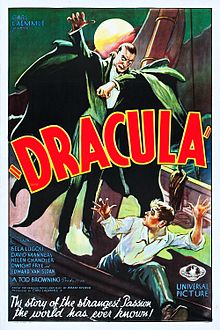
Seeing as how today is Bela Lugosi’ birthday, it only seems appropriate that today’s scene that I love should honor him. This is one Bela’s best scenes from 1931’s Dracula. Because his performance has been so widely imitated (and Bela himself appeared in a few films that poked fun at it), it’s often forgotten just how could Lugosi was in the role.
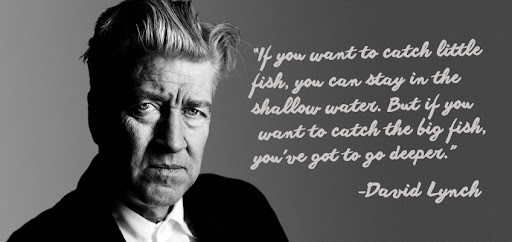
First published in 2007, Catching The Big Fish is a 177-book full of very short chapters in which David Lynch writes things that feel very David Lynchian.
The back of the book describes Catching The Big Fish as being the story of where David Lynch gets his ideas from. And it is true that, in a few chapters, Lynch does describe how a certain sight or sound inspired some of the scenes in his films. (For instance, he describes how he came to cast Frank Silva as KILLER BOB in Twin Peaks. It’s a story that you’ve probably heard before but, as with most things, it’s more charming when you read it in Lynch’s words.) Lynch describes capturing an idea as being like catching a big fish. It’s not easy and it requires you to heard for what Lynch calls the “deeper water” but you feel proud of yourself when you do it. (Or, at least, I assume that’s the case. I don’t actually fish myself.) Along with discussing his ideas, Lynch mentions the pain of Dune’s failure, his love of the French, his fascination with textures and Bob’s Big Boy, and the importance of not doing anything that could possibly compromise one’s creativity, whether it be therapy or drugs.
That said, the majority of the book is Lynch discussing meditation. Lynch is a notably apolitical filmmaker but he’s always been outspoken in his support of meditation to find peace and inspiration so it’s not surprising that a book about where he gets his ideas would center on meditation. Most of Lynch’s big ideas seem to come from catching details that others are too busy to spot and Lynch credits meditation with giving him the peace of mind and the insight necessary to do that.
So, it would seem that Lynch’s main lesson here would be that it’s a good idea to pay attention to what’s going on around you and to always take a closer look at things than the people around you. To be honest, it’s kind of an obvious lesson but again, the book is written by Lynch and the most obvious of things are more charming when Lynch points them out. As you might expect, Lynch comes across as being in his own world but he also seems like he genuinely hopes that you get something worthwhile out of the book. In the final chapter, he wishes you “peace” and you have no doubt that he means it.
To be honest, I’m not really into meditation. It works for some but it usually just makes me more anxious. But I do really like David Lynch and, if you’re a Lynch fan, you’ll find this book interesting. It’s enigmatic but earnest, much like Lynch’s best films.




 Through the Shattered Lens