Tomorrow, we will be sharing the classic film Carnival of Souls. That means that today, it’s for us to show our last Herk Harvey short film of the 2021 Horrorthon. And appropriately enough, it’s all about Halloween!
This short film was made in 1977, long after the release of Carnival of Souls. In it, safety tips are offered up to make sure that all the kids have a safe Halloween. Make sure you can see clearly, even if you’re wearing a mask. Don’t wear dark clothing. Grab a flashlight. Don’t trick or treat alone! Hey, it’s all good advice. And Herk Harvey seems like someone who knew a little something about having a good Halloween!
From 1977, here’s some lessons on Halloween Safety!
4 Or More Shots From 4 Or More Films is just what it says it is, 4 shots from 4 of our favorite films. As opposed to the reviews and recaps that we usually post, 4 Shots From 4 Films lets the visuals do the talking!
Today, we pay tribute to the legendary director and producer, Roger Corman! It’s time for….
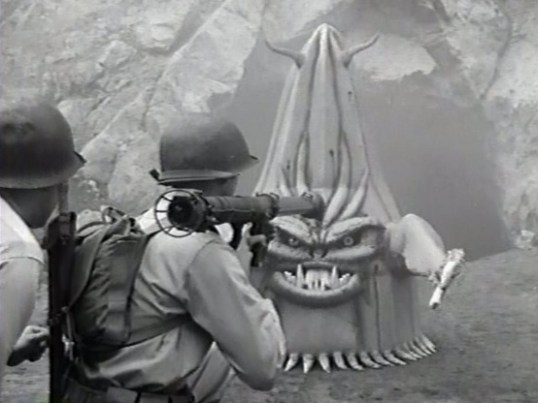
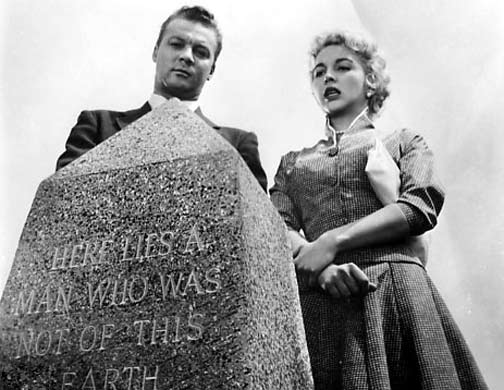
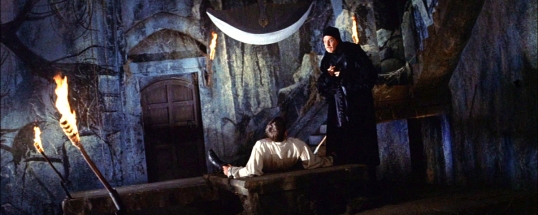
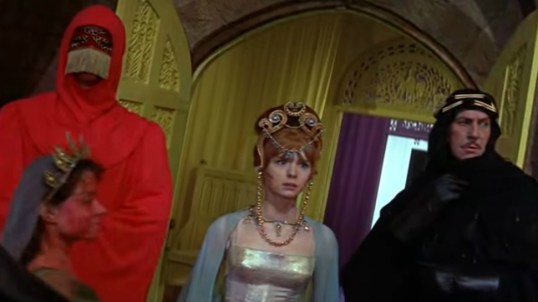
4 Shots From 4 Roger Corman Films
It Conquered The World (1956, dir by Roger Corman, DP: Fred E. West)
Not Of This Earth (1957, dir by Roger Corman, DP: John J. Mescall)
Pit and the Pendulum (1961, dir by Roger Corman, DP: Floyd Crosby)
The Masque of the Red Death (1964, dir by Roger Corman, DP: Nicolas Roeg)
Since the start of the pulp era, cults have been a popular subject. Usually dressed in red and concealing their faces behind hoods, cult members have menaced, tortured, and frightened. Luckily, there’s often a strong-jawed hero right around the corner to take them out and save the day.
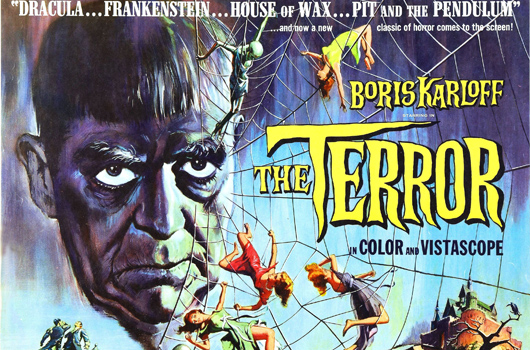
Can you follow the plot of the 1963 horror film, The Terror?
If so, congratulations! You’ve accomplished something that even the people who made the film have admitted to being unable to do.
The film opens in 19th century Europe. Andre Duvalier is an earnest French soldier who has somehow gotten lost in Germany. Andre is played by a youngish, pre-stardom Jack Nicholson. Nicholson, that most contemporary, sarcastic, and American of actors, is thoroughly unconvincing as an idealistic Frenchman from 1806. Obviously unsure of what do with the character, Nicholson delivers his lines stiffly and does what he can to downplay the naturally sardonic sound of his voice. This is probably the only film where Jack Nicholson is a “nice young man.”
Andre meets a mysterious woman named Helene (played by Sandra Knight, who was Nicholson’s wife at the time). Helene appears to live in a castle with the Baron (Boris Karloff) and his servant, Stefan (Dick Miller, who makes no effort to come across as being, in anyway, European). However, Helene bears a distinct resemblance to the Baron’s long-dead wife, Ilse, who the Baron killed after discovering her with another man. However, a witch in the village claims that Ilse’s lover was her son so she put a curse on the Baron and the presence of Helene is a part of that curse. However, Stefan claims that the Baron isn’t actually the Baron and and that Ilse’s husband isn’t actually dead. However….
Yes, there’s a ton of plot twists in this movie, which is probably the result of the fact that the film was shot without a completed script. In fact, the only reason the movie was made was because Roger Corman had access to Boris Karloff and a castle set that he used for The Raven. When he discovered that he could use the set for two extra days, he shot some random footage with Boris Karloff and then he tried to build a movie around it. As a result, the cast and the directors largely made up the story as the filmed.
Yes, I said directors. While Corman shot the Karloff scenes, he no longer had enough money to use a union crew to shoot the rest of the film. Because Corman was a member of the DGA, he couldn’t direct a nonunion film. So, he assigned the rest of the film to one his assistants, an aspiring filmmaker named Francis Ford Coppola. Coppola shot the beach scenes and, in a sign of things to come, he went overbudget and got behind schedule. Coppola was meant to shoot for three days but instead went for eleven.
Though Coppola shot the majority of the film, he got a better job offer before he could do any reshoots. Coppola suggested that a friend of his from film school, Dennis Jakob, take over. Jakob shot for three days and reportedly used most of the time to shoot footage for his thesis movie.
Still feeling that the movie needed a few extra scenes to try to make sense of the plot, Corman then gave the film to Monte Hellman and, after Hellman got hired for another job, Jack Hill. Hellman would later go on to direct films like The Shooting and Two-Lane Blacktop. Jack Hill would later direct Spider Baby and several other exploitation films in the 70s. Reportedly, on the final day of shooting, even Jack Nicholson took some time behind the camera. It was Nicholson’s first directing job. (Nicholson, for his part, has often said that his original ambition in Hollywood was to become a director and not an actor.)
So, yes, the film’s a bit disjointed. The plot doesn’t make any sense. Nicholson shows little of his trademark charisma. But Dick Miller has a lot of fun as the duplicitous Stefan and Boris Karloff brings his weary dignity to the role of the Baron. Oddly, even though the Baron’s scene were shot before the script had even been written, they’re the ones that make the most sense. It’s a messy film but it plays out with a certain hallucinatory style. It’s a piece of Hollywood history and a testament to Roger Corman’s refusal to waste even two days of shooting. If you’ve got a star and a set for two days, you’ve got enough for a movie!
(It’s tradition here at the Lens that, every October, we watch the original Little Shop of Horrors. And always, I start things off by telling this story…)
Enter singing.
Little Shop…Little Shop of Horrors…Little Shop…Little Shop of Terrors…
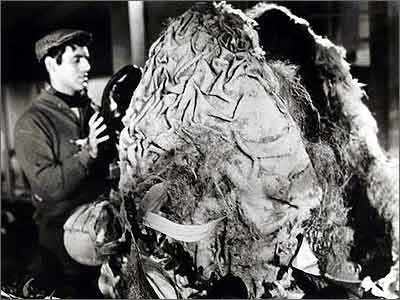
Hi! Good morning and Happy October 29th! For today’s plunge into the world of public domain horror films, I’d like to present you with a true classic. From 1960, it’s the original Little Shop of Horrors!
When I was 19 years old, I was in a community theater production of the musical Little Shop of Horrors. Though I think I would have made the perfect Audrey, everybody always snickered whenever I sang so I ended up as a part of “the ensemble.” Being in the ensemble basically meant that I spent a lot of time dancing and showing off lots of cleavage. And you know what? The girl who did play Audrey was screechy, off-key, and annoying and after every show, all the old people in the audience always came back stage and ignored her and went straight over to me. So there.
Anyway, during rehearsals, our director thought it would be so funny if we all watched the original film. Now, I’m sorry to say, much like just about everyone else in the cast, this was my first exposure to the original and I even had to be told that the masochistic dentist patient was being played by Jack Nicholson. However, I’m also very proud to say that — out of that entire cast — I’m the only one who understood that the zero-budget film I was watching was actually better than the big spectacle we were attempting to perform on stage. Certainly, I understood the film better than that screechy little thing that was playing Audrey.
The first Little Shop of Horrors certainly isn’t scary and there’s nobody singing about somewhere that’s green (I always tear up when I hear that song, by the way). However, it is a very, very funny film with the just the right amount of a dark streak to make it perfect Halloween viewing.
So, if you have 72 minutes to kill, check out the original and the best Little Shop of Horrors…
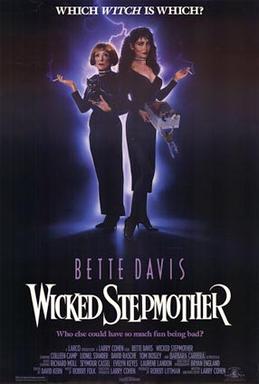
The 1989 film, Wicked Stepmother, was Bette Davis’s final film. She was cast as Miranda, an enigmatic woman who meets and marries a man named Sam (Lionel Stander). Sam’s daughter, Jenny (Colleen Camp) and her husband, Steve (David Rasche), are stunned to come home from a vacation just to discover Miranda living in their house. Miranda chain-smokes, despite Jenny and Steve asking her not to. Miranda cooks and eats meat, despite Jenny being a vegetarian. Miranda brags about her sex life which freaks Jenny out even though I suppose really old people do occasionally have sex. When it becomes apparent that Miranda is a witch who seduces and shrinks her victims, Jenny decides that something must be done.
Wicked Stepmother was not only Bette Davis’s last starring role but it was also the last production that she ever walked out on. Early on in filming, she announced that she didn’t like the script, she didn’t like the way she was being filmed, and that she didn’t like the director, venerable B-move maestro Larry Cohen. For his part, Cohen said that Davis left the movie because she was in bad health but she didn’t want to announce that to the world. In Cohen’s defense, Davis does appear to be rather frail in the movie and often seems to be having trouble speaking. (Davis has a stroke a few years before appearing in Wicked Stepmother.) Davis died just a few months after Wicker Stepmother was released so I tend to assume that Cohen was correct when he said that the main reason Davis left the film was because of her health. That doesn’t mean the script wasn’t bad, of course. But, in the latter part of her career, Davis appeared in a lot of badly written movies. She did Burnt Offerings, afterall.
Regardless of why she left, Davis’s absence did require that Wicked Stepmother work around her character. But how do you do that when Bette Davis was literally the title character? This film’s solution was to bring in Barbara Carrerra as Priscilla, Miranda’s daughter. It turns out that Miranda and Priscilla both inhabit the body of a cat but only one of them can use the body at a time. So, when Priscilla is in the cat, Miranda is among the humans. When Miranda is in the cat, Priscilla is …. well, you get the idea. In the film, Priscilla leaves the body of the cat and then refuses to reeneter it because “I’m having too much fun.” So, whenever we see the cat glaring in the background, we’re meant to assume that we’re actually seeing Miranda in the background.
Got it?
Now, believe it or not, the whole thing with the cat is probably the least confusing thing about Wicked Stepmother. Jenny can’t convince Steve that Miranda and Priscilla are actually witches. Steve actually has sex with Pricilla and is shocked when Priscilla starts to turn into a cat but the whole incident is never mentioned again and Steve quickly goes from being an adulterous jerk to a loyal husband. Sam goes on a game show and, with Priscilla’s help, wins a lot of money even though the questions that he answered were so simple that he shouldn’t have needed the help of a witch’s spell. (“Who won the election of 1876?” is one question. The correct answer, by the way, is Rutherford B. Hayes. Screw you, Samuel Tilden.) Jenny gets some help from a cop, a private detective, and a priestess of some sort. The whole thing ends with a big magical battle that involves Barbara Carrera mouthing pre-recorded Bette Davis dialogue.
None of it makes any sense. The special effects are incredibly cut-rate. It’s hard not to regret that Bette Davis didn’t go out on a better film. And yet, when taken on its own terms, Wicked Stepmother itself is oddly likable. Colleen Camp is sympathetic as Jenny, which is saying something when you consider that Jenny is written to be a humorless vegetarian. Lionel Stander appears to be having fun as Sam. Larry Cohen was a good-enough director that, even though he couldn’t save the film from its own bad script and miniscule budget, the movie itself is never boring. It’s cheap and stupid but its watchable in the same way that Michael Scott’s Threat Level Midnight was watchable. It may not be particularly good but you just can’t look away.
I was in Arkansas, looking for a certain grave, when I discovered that I was not alone. The deer stayed long enough for me to get a picture and then ran along. This picture is a reminder that there is beauty even among sadness.
Tonight, for our horror on the lens, we have the twentieth episode of the 2nd season of Friday the 13th: The Series!
In tonight’s episode, an obsessive weirdo named Howard (well-played by Martin Neufeld) uses a curse antique to try to get close to a rock star named Angelica (played by real-life rock star, Vanity).
This episode originally aired on May 1st, 1989. Happy May Day, I guess.
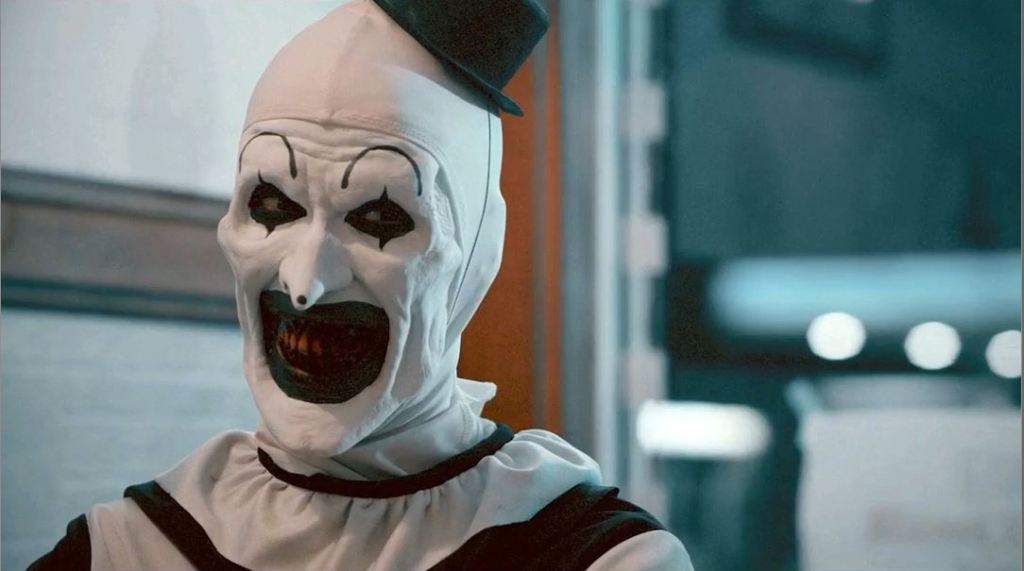
I’ve never really had much of a problem with clowns, beyond the fact that some of them really do need to learn how apply lipstick without getting it all over their face. That said, two years ago, I watched the 2016 horror film, Terrifier, on Netflix and I now totally understand why some of my friends are totally terrified of the grinning men in the white makeup. I mean, I will send a Pennywise GIF to my clownphobic friends without even worrying about what damage I may or may not be doing to their mental well-being but I can guarantee you right now that I will never send any of them a picture of Art the Clown.
Art the Clown
Art (who is played by David Howard Thornton) is the clown at the center of Terrifier and, as you can tell from looking at the picture above, he’s not exactly a clown that you want to meet in the middle of the night. Unfortunately, over the course of the film, several innocent people do just that. There’s the homeless woman who meets him in an abandoned building. There’s the two drunk girls who, after leaving a Halloween party, make the mistake of laughing at Art. There’s the owner of the pizzeria who makes the mistake of kicking Art out of his establishment. Art, it turns out, doesn’t deal well with rejection. It also turns out that Art can turn just about anything into a deadly weapon. (We also later learn that Art just happens to have a chainsaw. Agck!)
Art doesn’t speak. We never learn where Art came from and why he insists on killing everyone that he meets. This lack of motivation makes Art a very scary clown indeed. We can only assume that he kills because he’s evil and, being a creature of pure evil, there’s really no way to reason with him or to rationalize his actions. Art is pure chaos released into the world and, as a result, he’s terrifying. If nothing else, Terrifier is a film that lives up to its name.
Director Damien Leone made Terrifier with a budget of a $100,000 and he uses that low budget to his advantage. The deserted building where Art stalks the majority of his victims is a genuinely atmospheric location and, even if they were done cheaply, the gore effects are disturbingly nightmarish. Fortunately, Leone gets some good performances from his cast, which makes the film all the more frightening. David Howard Thornton has enough presence to make Art the Clown intimidating, even when he’s just standing still and staring at nothing. As the film’s “final girl,” Samantha Scaffidi gives a likable and relatable performance. Wisely, the film neither turns her into a super warrior nor a simpering fool. Instead, she’s just a normal person trying to survive the night, much like those of us watching the film in what we hope is the safety of our own home.
Terrifier is an effectively scary little slasher film. It’s not for everyone, of course. It’s a film for horror fans and it has little interest in reaching out to people who don’t normally enjoy the genre. The violence is brutal and the film doesn’t shy away from gore. Those of you who easily fall prey to nightmares may want to stay away. As for those of you who are scared of clowns …. well, Terrifier will prove the correctness of your phobia. Seriously, if clowns scare you, don’t watch this movie. It’ll be safer for you just to watch It again….







 Through the Shattered Lens